This article is about agricultural pricing, including problem introduction, mathematical model establishment, problem solving and application demonstration.

1. Problem description
The government of a country wants to determine the price of dairy products such as milk, butter, and cheese. These products originate directly or indirectly from the country's raw milk production. Raw milk can be effectively divided into two components: fat and dry matter. After deducting fat and dry matter destined for export or on-farm consumption, the total annual raw material available for the production of milk, butter and two types of cheese for domestic consumption is: 600 kilotonnes of fat and 750 kilotonnes of dry matter. The ingredient percentages of these products are shown in Table 1. The domestic consumption and prices of these products during the previous year are shown in Table 2.
Table 1 Ingredient percentage of dairy products in a certain country
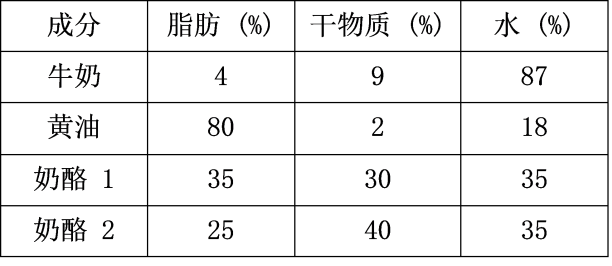
Table 2 Consumption and price of dairy products in a country
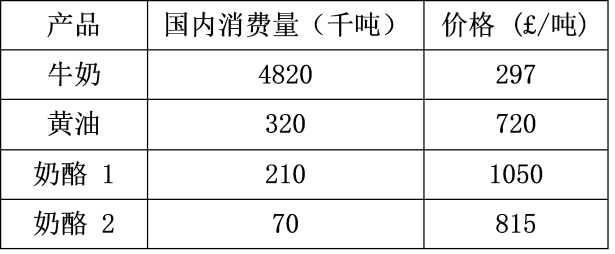
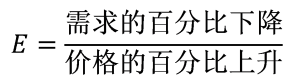
Based on past statistics, the price elasticity of demand for consumer demand has been calculated in relation to the price of each product. The price elasticity E of the product is defined as:
For two cheeses, when prices change relative to each other, there will be a certain degree of substitution between consumer demand. This substitution relationship is measured by the cross elasticity of demand. Cross elasticity E of product A with respect to product BABDefined as:
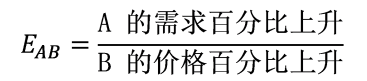
Table 3 lists elasticity and cross-elasticity data for each product.
Table 3 Elasticities and cross-elasticities of each product

The goal is to determine the price and resulting demand so that total revenue is maximized.
However, it is politically unacceptable to allow a certain price index to rise. Because of the way the index is calculated, this restriction simply requires that new prices must ensure that the total cost of last year's consumption did not increase. A particularly important additional requirement is to quantify the economic costs of this political restriction.
The following issues need to be addressed:
-
How to price dairy products to maximize total revenue?
-
It is politically unacceptable to limit the rise of the price index. How to quantify the economic costs of this political restriction?
-
If the upper limit of total fat and dry matter resources is adjusted, how will the optimal pricing plan change?
2. Establishment of mathematical model
To solve this problem, a nonlinear programming problem is established. Define the following decision variables:
-
x i : Consumption of product i (unit: kilotons), i=1,2,3,4;
-
p i : Price of product i (unit: £1,000/ton);
Additionally, define the following parameters:
-
a ij : The proportion of the jth raw material component of product i, j=1,2;
-
b j : The maximum supply of the jth raw material;
-
d i : Consumption volume of product i last year (unit: kilotons);
-
e i : Last year’s price of product i (unit: £1,000/ton);
-
P c : Price index, related to last year’s price and consumption, P c =∑ i d i e i /1000=1.939;
-
E i : Price elasticity of product i;
-
E AB : Cross elasticity of product A to product B;
Constraints:
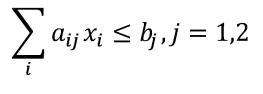
1. Limited supply constraints of fat and dry matter: the total consumption of each raw material cannot exceed its maximum supply
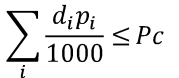
2. Constraints on the price index: the new price must ensure that the total cost of consumption last year will not increase
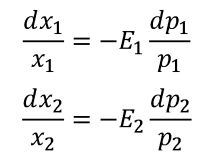
3. Elastic constraints on milk and butter products: the relationship between product consumption and price
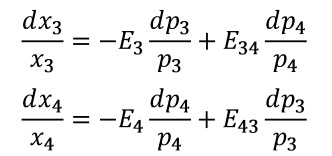
4. Cross-elasticity constraints of two types of cheese products: the relationship between product consumption, price, and substitutes
Objective function:
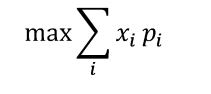
The objective function is to maximize total revenue, that is, to maximize the sum of the products of consumption and price of each product. The specific form is:
3. Problem Solving and Application Demonstration
The following is the web version of the solver we developed, which can adjust parameters and solve with one click:
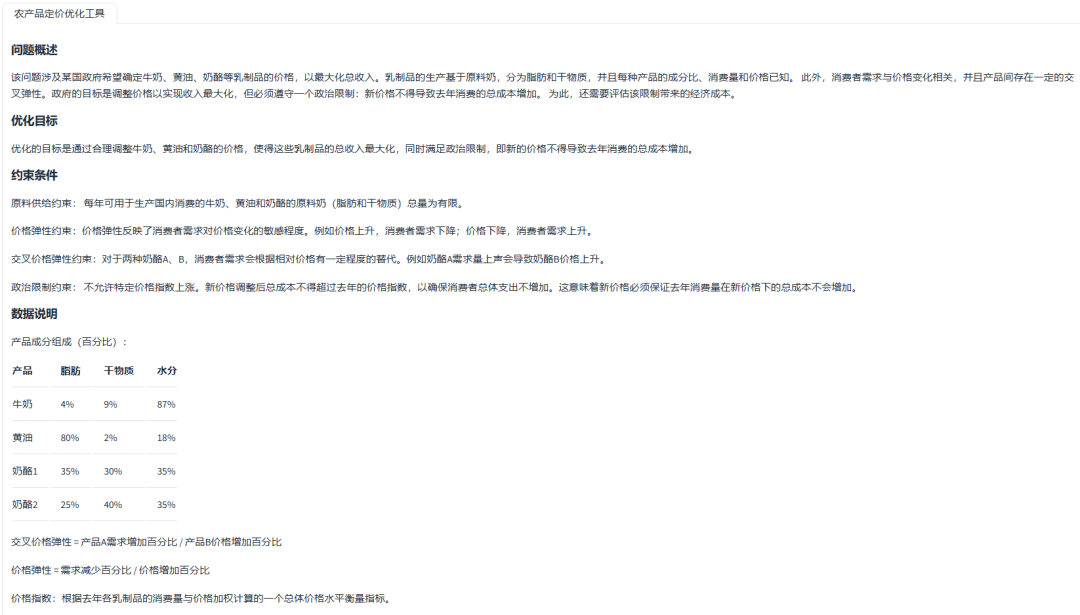

As shown in the figure below, click Optimize Pricing, and the solver quickly gives the optimal result: the optimal total revenue is 19,915,86,000 pounds, the fat usage is 600,000 tons, the dry matter usage is 535,000 tons, and the increased revenue over the previous year is 52,096 thousand pounds. The economic cost of political restrictions is £370,414,000.

Agricultural pricing-Agricultural pricing-demo video

Machine-translated from the Chinese original 农产品定价问题 Agricultural Pricing (published 2024-12-26). WeChat original ↗