【Abstract】This article explores the latest progress of artificial intelligence (AI) in the field of combinatorial optimization. First, the ORLM optimization modeling tool is introduced, which is a solution based on open source large language models (LLMs) that can automatically understand and generate mathematical models to solve complex operations research problems. Secondly, the HypOp framework is discussed, which is an AI-driven framework for high-order constrained combinatorial optimization problems that provides efficient solution solutions through technologies such as hypergraph modeling and distributed parallel training. Finally, the cuPDLP-C linear programming solver is mentioned, which uses the GPU to accelerate first-order linear programming solving, significantly improving the efficiency of solving large-scale problems. The article also compares these three technologies and looks forward to their possible future development directions. At the end, a demonstration video of using ORLM to solve product production quantities is given to deepen readers' understanding.
1. ORLM optimization modeling tool
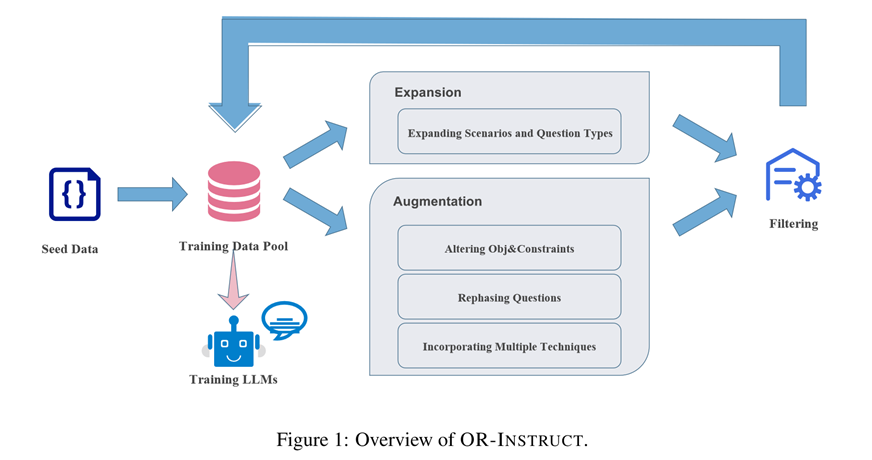
2. HypOp framework

3. cuPDLP-C linear programming solver
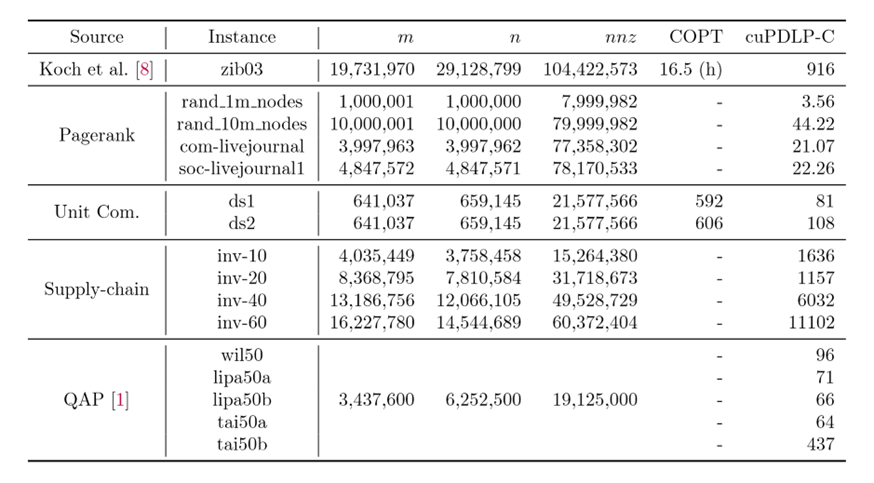
4. Comparison of AI-empowered combinatorial optimization technologies
The comparison of the characteristics, key technologies, and advantages of the above three AI-enabled combination optimization technologies is shown in the table below.
|
|
ORLM optimization modeling tool |
HypOp framework |
cuPDLP-C linear programming solver |
|
Features |
Automatically understand and generate mathematical models |
Solve high-order combinatorial optimization problems |
Accelerate large-scale problem solving |
|
Key technology |
OR-INSTRUCT semi-automated process |
HyperGNN, distributed parallel training |
First-order algorithm, GPU parallel computing |
|
Advantages |
Powerful natural language understanding capabilities |
Handle complex higher-order relationships |
Significantly improve computing speed |
|
Application examples |
Operations Research Problem Modeling |
Classic graph theory problems, such as MaxCut, MIS |
linear programming problem |
|
interaction |
Data analysis, model building |
Speed up model solution |
Speed up model solution |
|
Test results |
Excellent performance on IndustryOR benchmarks |
Excellent performance on multiple benchmarks |
Outperforms commercial solvers on LP benchmarks |
|
future direction |
Expand IndustryOR to train more agents |
Enhance transfer learning strategies to accelerate the solution process of new problems |
Extension to nonlinear programming solver |
5. Trial demo
The following is an example of using the orlm large operations model to solve the product production quantity. Describe the problem through text language: Calculate the production quantity of multiple products under the limited available time of the workshop to maximize the company's total profit, and give relevant data. After text and other information is submitted, orlm can establish a mathematical model in a short period of time, including identifying it as a linear programming type, confirming decision variables, objective functions and constraints, and then calling the coptpy library to write a python script to obtain the solution results.
[Summary] This article outlines three innovative tools of artificial intelligence in the field of combinatorial optimization: the ORLM optimization modeling tool uses open source large-scale language models to automatically generate mathematical models to solve operations research modeling problems; the HypOp framework uses hypergraph modeling and distributed parallel training to effectively solve combinatorial optimization problems with high-order constraints; the cuPDLP-C linear programming solver significantly improves the efficiency of solving large-scale problems through GPU acceleration. These three technologies all performed well in their respective benchmark tests, not only demonstrating the potential of AI in solving optimization problems, but also providing new directions for the development of future technologies, indicating that AI will play a key role in more fields and promote continued innovation and development in science and industry.
【Reference】
Machine-translated from the Chinese original AI赋能组合优化 (published 2024-07-16). WeChat original ↗