Introduction

Imagine this scenario:
You are the investment manager of an industry fund. I arrived at the office at nine o'clock on Monday morning. In the email were 6 business plans copied from last weekend. In addition, FA in the group forwarded 2 more business plans, and the to-be-read list suddenly increased to 8. Each PDF has an average of 30 pages. It takes at least 1 hour to read each PDF carefully. The partners will give preliminary opinions on "which three companies to follow first" at the regular partners' meeting at 3 p.m.
You'll most likely do the following: take a quick glance at the summary page, pick two that "look reliable" to read closely, and stuff the rest into your "to-do" folder—and then add eight new ones to the pile next Monday.
There are three obvious problems with this way of working.
First, most BPs are not read carefully. Usually I reach the top after reading 3-5 copies in a week, and the rest depends on the first impression filter on the summary page.
Second, cross-industry projects cannot be objectively sorted. A certain smart agriculture project has a rating of 81.9 points, and a certain semiconductor upstream project has a rating of 83.7 points. They seem to be similar, but the popularity of the track is much different. Who should follow first? No ruler.
Third, fund matching relies on experience. If the project is promoted to the counterpart fund, LP referrals can be obtained. If the project is recommended incorrectly, it will not only result in no results but also damage the IR relationship - but the judgment of matching is entirely in the IM individual's mind, and he will take it with him when he leaves.
This system called Virtual Investment Analyst is built for these three things.

1. What is a virtual investment analyst?
A virtual investment analyst who automatically completes the work link of "entering a BP document → a structured analysis report + three-dimensional score + recommended funds + track popularity".
The input can be a BP in PDF format, a PPTX roadshow draft, a text description, a link to the company's official website, or an industry article. The output is a 6-dimensional structured report (corporate fundamentals/market analysis/operating data/investment logic/valuation/risk) + three-dimensional quantitative score (fundamentals 40% + fund matching 30% + market industry 30%) + 1-3 recommended funds + first-level track classification and popularity scores, delivered in 10 to 15 minutes.
It won’t make investment decisions for you—decisions are still made by humans—but it can reduce the task of “quickly going over it + giving a preliminary judgment + sorting” from one hour to ten minutes.

2. What has been done about the three most frequently reported pain points?
01 · BP can’t see it, and the report written by AI may not be trustworthy
This is the glimmer of pain in all IM. The core ability of the virtual investment analyst is to turn PDF/PPTX into a structured report within 10-15 minutes, with all six fixed dimensions filled in and aligned to a unified schema.
But just doing this step is not enough - many AI report generation tools on the market can do it. The problem isThe bottom line of quality is not guaranteed. Early versions also occasionally had flaws like this:
A BP report on a certain hard technology target appeared in the report written by AI, which stated that “a total of more than 140 patent applications have been filed and 29 authorized invention patents have been granted” – but the original text of BP only mentioned the number of patents held by core technical experts (such as 5 inventions + several defense patents by a doctor), and never disclosed the company’s overall number of patents.
In the same report, the "product throughput rate >60%" clearly disclosed by BP on page 6 was replaced by "current throughput rate >70%", and the number increased by 10 percentage points out of thin air.
This kind of "confidently making up a specific number" is the most difficult illusion to eradicate in large models, and it is also the most unacceptable thing for IM in the deal flow table.
The solution for virtual investment analysts is to wrap the report generation Agent with a layer ofheterogeneous review——After the draft comes out, another manufacturer’s model (to avoid blind spots in homologous self-evaluation) will be checked one by one according to the 5-dimensional rubric (data authenticity/completeness/logical consistency/fund relevance/format). If problems are found, feedback will be sent back for rewriting, up to 3 rounds.
A real example of running down: BP of a new material/intelligent hardware target had two flaws in the first round of the report: (1) it wrote "the research and development cycle was shortened by more than 50%", but BP's original text only said "the research and development cycle was shortened" without disclosing the specific proportion; (2) it wrote "a certain wearable product and detector and other products are already on the market", but BP's original text clearly marked "sample display". After the second round was rewritten based on feedback, both parts were revised - the former was changed to "the research and development cycle has been significantly shortened (BP did not disclose the specific proportion)", and the latter was changed to "prototype development and demonstration has been completed and is in the registration application or clinical verification stage".
In the reports that are actually delivered to IM, every specific number can be found in the original text, rather than compiled by AI based on impressions.
02 · Cross-industry project ranking, single Rating is not enough
This is a partner/boss pain. There are dozens of projects in Deal flow, spanning more than a dozen tracks such as smart agriculture, semiconductors, medical equipment, new materials, clean energy, etc., and they will be prioritized at next week’s regular meeting. Just looking at the "fundamentals + market + matching" weighted rating of each project is not enough - a clean energy project with a score of 80 and a semiconductor project with a score of 80 are not the same thing at all, and the track popularity is much different.
The solution given by the virtual investment analyst is the composite score:
Composite = 0.7 × Rating + 0.3 × Heat
Heat is the track heat score, which comes from a manually maintained "industry heat table" - 15 first-level tracks + an "other/not yet defined" bottom line. Each track is given a benchmark score of 0-100. The caliber of the table is 30% capital + 25% policy + 25% industry consensus + 20% exit activity, updated quarterly. AI is only responsible for classifying projects into specific tracks, and the scores are checked from the authoritative table by the Python side to ensure comparability across standards.
The weight 0.7/0.3 is not fixed, you can change one line of configuration and it will take effect. If the fund owner feels that the industry outlet is more important, he can adjust it to 0.5/0.5, and if he feels that the company itself is more important, he can adjust it to 0.85/0.15.
The following is the actual sorting of the current deal flow table (9 targets, company name masked):
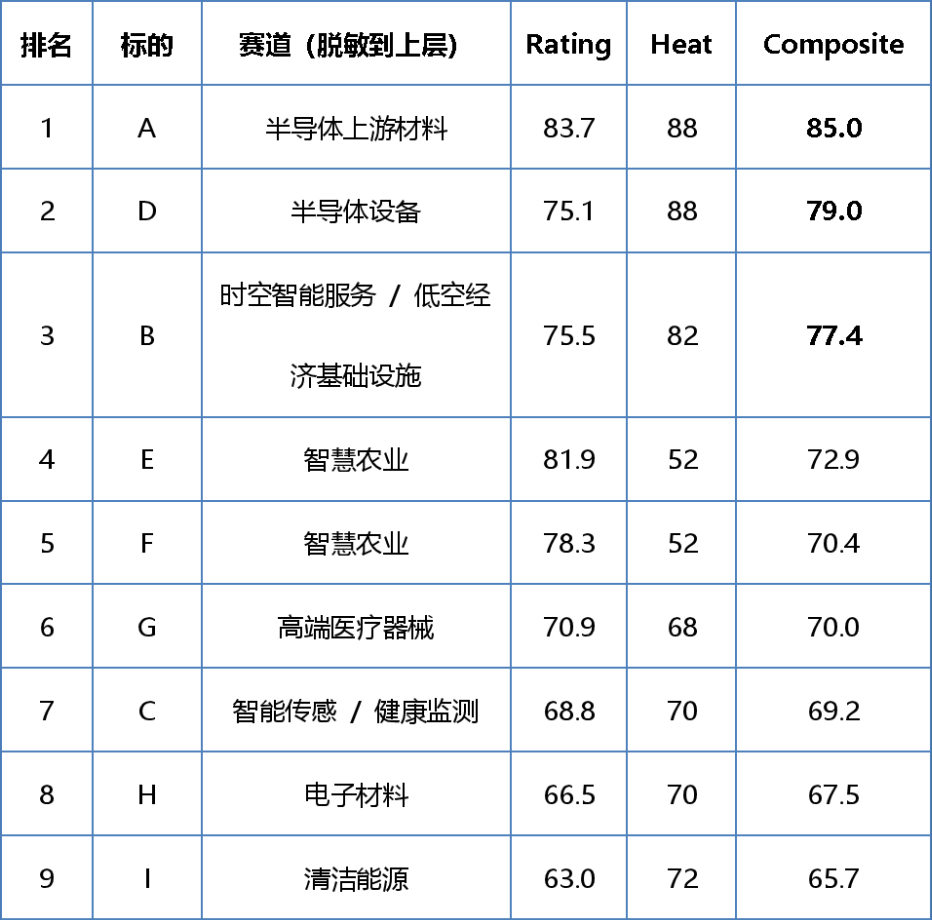
Pay attention to E (Smart Agriculture) and F (Smart Agriculture) - they are 1st and 3rd respectively in terms of Rating, but they have dropped to 4th and 5th in the Composite ranking, because the current popularity of the smart agriculture track is only 52. In turn, the D (semiconductor equipment) rating is only 75.1 (5th), but Composite overtakes it to 2nd because the semiconductor equipment is hot at 88.
This is exactly the problem that Composite wants to solve. Rating measures “how is the company itself?” and Heat measures “whether this track is worth investing in right now.” After weighting the two, it is close to the true judgment of "should the fund IM put it at the forefront of deal flow?"
03 · Fund matching cannot go wrong
This is a double pain in the IM ego and IR relationship. If you recommend the project to a counterpart fund, you can get a recommendation opportunity. If you recommend it incorrectly - such as recommending an angel round project to a fund that only invests in Series B or later, or recommending a fund name that is not in the fund library at all (AI will occasionally spell it wrong or make it up based on impressions) - the result will be an embarrassment to the IR side, and the institution will discount your "professionalism".
The virtual investment analyst has made the most stringent "fact-checking agent" in the fund matching process. The weight design puts "the real existence of the fund" in the highest 40% of all dimensions:
-
Each recommended fund name mustcharacter by characterAppears in the fund portrait file you maintain. If it is not correct, it will be directly judged as an error and rewritten.
-
Each recommendation reason mustQuote by nameThe preferences actually written in the fund profile (such as "a fund profile states that it prefers semiconductor upstream materials, and this project belongs to this track") cannot be generally said to be "a high degree of matching."
-
The stage of the recommended fund must be compatible with the project round
-
Each project is recommended to promote 1-3 funds, no more than 0 or more than 3 funds.
To give a real example: Target B (spatial-temporal intelligence/low-altitude economic infrastructure) passed the matching review once, with a score of 98 (out of 100). The system gave two recommended funds (both desensitized "a state-owned venture capital X" and "an industry fund Y"). Each reason accurately cited the specific preferences written in the fund portrait (such as "Fund X" The portrait states that he prefers infrastructure projects and high-precision location service scenarios, and this project belongs to this track").
Target C (intelligent sensing/health monitoring) is a typical counter-example: after the system gave two candidate funds, the match_score was only 58 and 42 respectively, and it was directly pointed out in the overall_reasoning that "most of the existing 7 funds do not match, and only 1 has a weak correlation in the general direction of AI/sensors but does not match the subdivisions."
The system will not force push. It will honestly tell IM: "This project is not well matched with your fund pool, so be cautious in recommending it."This is more valuable than a "forced push of 3 reports for the sake of delivery" report.

3. How does it work?
The working chain of the entire system is as follows:
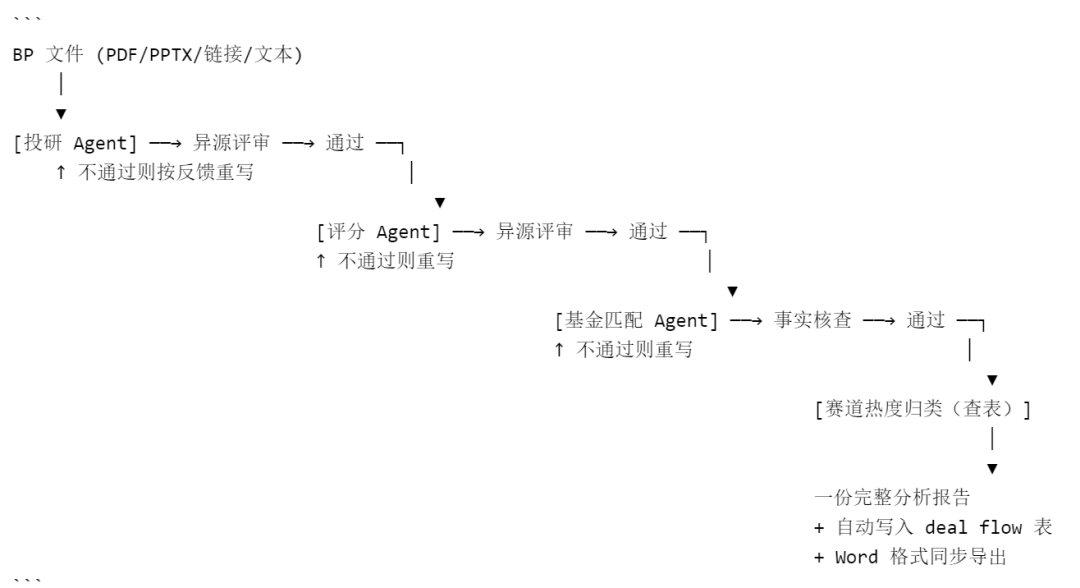
The "review agent" in each section uses a model from a different manufacturer to avoid blind spots in the same self-review. Each review not only gives points, but also records the flaws found in a cumulative "failure case library" - the next time you run a new BP, the system will automatically insert the recent failure cases into the prompt as a "lesson", so that it will know "Don't step on this pit again this time."
The entire process is transparent to users:Type `analyze --bp BP.pdf` on the command line and wait 10-15 minutes to get the result. Multiple copies of BP can be run serially with one line of `batch` command. If it is completely unattended, you can enable `watch` mode, allowing the system to scan the input directory every 60 seconds, and new files will automatically run - throw 10 copies of BP in on the weekend, and the results will be laid out on Monday morning.

4. Real use effect
Here are the key numbers after desensitization:
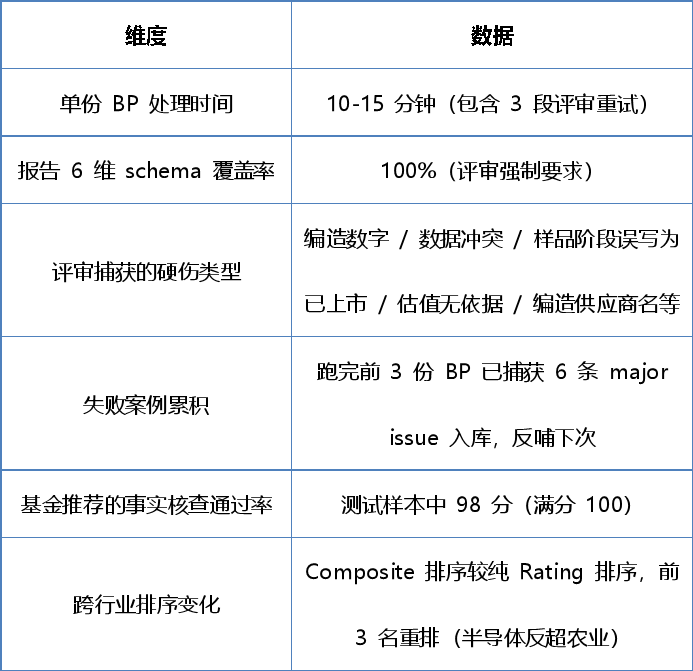
A specific comparison: for the same BP of a certain hard technology target, the old version of the system came out with a Rating of 79.4 / Composite 82.0; after adding a review mechanism and re-running, the score itself was Rated 83.7 / Composite 85.0 - the score itself is more accurate, because the review process mandates that the reasoning of "fund matching" must name specific funds and cannot generally say "high matching", so the new version can identify strong matches missed by the old version.

5. Who is it suitable for?
According to the capability boundaries of this product, the most suitable types of users are:
-
Fund Investment Manager/Analyst:First-line BPs have a large amount of reading, so they need to speed up the "quickly read it + give a preliminary judgment" by 5-6 times
-
Fund Partner/GP:deal flow cross-industry sorting, decision-making assistance, reporting standardization
-
Individual Angel Investors/Small LPs:There is no team to help look after BP, and a "co-pilot" is needed.
-
FA/Financial Advisor:Find a matching agency for the project and issue teaser reports in batches
-
Corporate Strategic Investment Department/Listed Company Investment Manager:Write decision-making reports, industry research, and cross-project comparisons for bosses
If you are an entrepreneur, you can also use it in reverse: feed it your BP and see how it scores, what types of funds it recommends, and what risk points it lists - essentially a preview of "the reaction of the counterpart fund IM when it first sees your BP."
Scenarios that are not suitable for: pure transaction structure design work such as mergers and acquisitions/reorganizations/PIPE (this system does not do valuation modeling and transaction structure deduction), and only making investment decisions in the secondary market (this system is designed for early-growth stage projects in the primary market).
write at the end
The virtual investment analyst is not trying to replace the judgment of fund IM. Its positioning is very clear:Reduce the "must-do but most time-consuming" part of the IM workflow (reading BP, writing the first draft, preliminary screening, matching candidate funds) from one hour to ten minutes, and let IM put the saved time back into judgment, negotiation, and relationship building, which cannot be replaced by AI.
It's not a perfect system either. Occasionally during the three-stage review, the review agent itself hangs up (output truncation, model protocol compatibility issues), these are fault-tolerant paths within the design - if the review fails, it will not block the main process, and will retain the current results and continue. Every failure and success experience will be accumulated in the failure case library to feed back the next time.The intelligence of the system does not come from the individual ability of any agent, but from its mechanism of "willingness to admit that it will make mistakes and write them down."


Machine-translated from the Chinese original Alpha投决引擎:身边的虚拟投资助手 (published 2025-06-30). WeChat original ↗