
The flexible flow shop scheduling problem with random arrivals (FFSROA) is a complex dynamic optimization problem. First, due to the coupling of two discrete sub-problems, job selection and machine allocation, the search for feasible solutions and optimal scheduling solution spaces becomes complicated. These two sub-problems are inseparable and intertwined. Secondly, since there are a large number of scheduling schemes, that is, multi-modal scheduling schemes, local optimality can be achieved. The non-convex nature of the problem results in no explicit optimization gradient, making the optimization process more complex. Finally, since jobs arrive randomly, scheduling needs to be optimized dynamically in real time. The algorithm needs to be able to re-evaluate and optimize operations without interruption, which poses a higher challenge to time efficiency. In addition, in actual scheduling scenarios, the number of randomly arriving orders often reaches thousands, so the large-scale characteristics exacerbate the complexity of the FFSROA dynamic scheduling problem. Therefore, it is crucial to consider both time efficiency and search efficiency when solving these problems, which will bridge the gap between complex real-world optimization challenges and advanced optimization algorithms.
The dynamic scheduling problem of FFSROA is a challenging optimization problem that is widely encountered in practical scenarios, in which evolutionary algorithms have great potential in solving the FFSROA scheduling problem.This is SFFSROA’s first competition at a CEC conference in recent years and will promote the application of evolutionary computing methods in real-world problems.
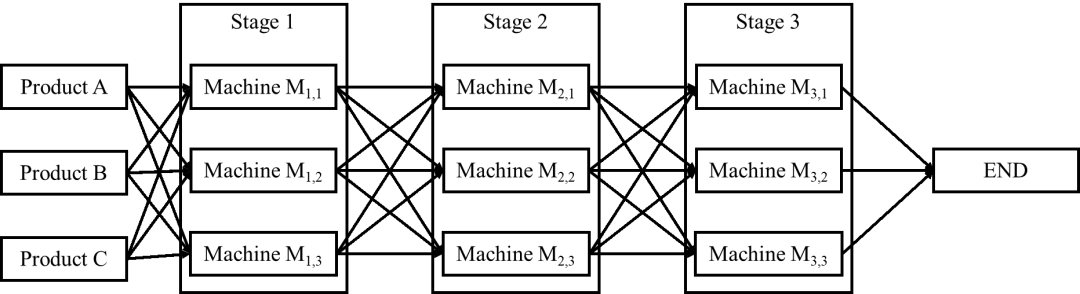
Figure 1 The flexible flow shop scenario.
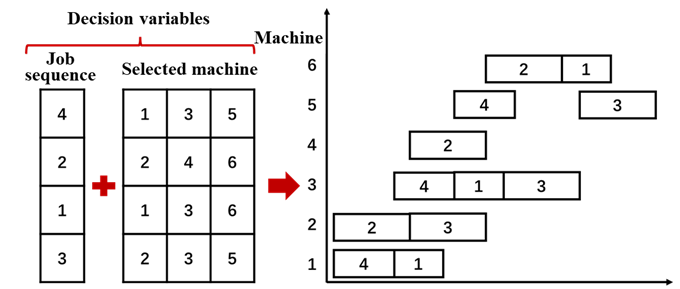
Figure 2 The diagram of decision variables.
In this competition, we carefully selected three representative flexible flow shop solutions.As shown in Figure 1, each scenario is built from different products, processing stages, and multiple parallel machines in each processing stage. Usually, the decision variables include the processing order of jobs and the selection of parallel machines at each stage, with the goal of on-time delivery rate of jobs, as shown in Figure 2. Expired orders will be stopped from being processed. This competition will present the dynamic scheduling problem of a flexible flow shop with random job arrivals at three scales: 1000 orders, 5000 orders and 10000 orders (detailed specifications will be provided on the competition website). As an extension of the dynamic scheduling problem of flexible flow workshops, this competition aims to promote the research on production scheduling, propose optimization algorithms, and explore potential research directions for dynamic optimization.
Participants need to develop an algorithm to efficiently solve this complex scheduling problem.Participants are required to submit complete source code. In addition, code documentation should be provided that briefly introduces the structure, functionality, and variables of the code so that organizers can quickly understand it. The evaluation will be conducted under the same computing resources, including computing power and time, on all problem instances in three flexible flow shop scenarios. The optimal scheduling solutions output by the participant algorithms before the computation time expires are compared. The participant with the most optimal solutions across all instances will be crowned the champion. Subject to the same performance, further metrics such as the number of suboptimal solutions and average computation time are taken into account.
Participants should submit their source code and documentation via the designated email ([email protected]) and are allowed multiple submissions before the deadline.Organizers will begin evaluating submissions after the deadline and announce the results once the evaluation is complete. Participants can seek support and feedback through the contact information provided. We estimate that approximately 20 people will participate in this competition.
For competition topics, please see:https://github.com/SIA-aps/CEC2025-DFFSP-competition
CEC2025 official website:https://www.cec2025.org/
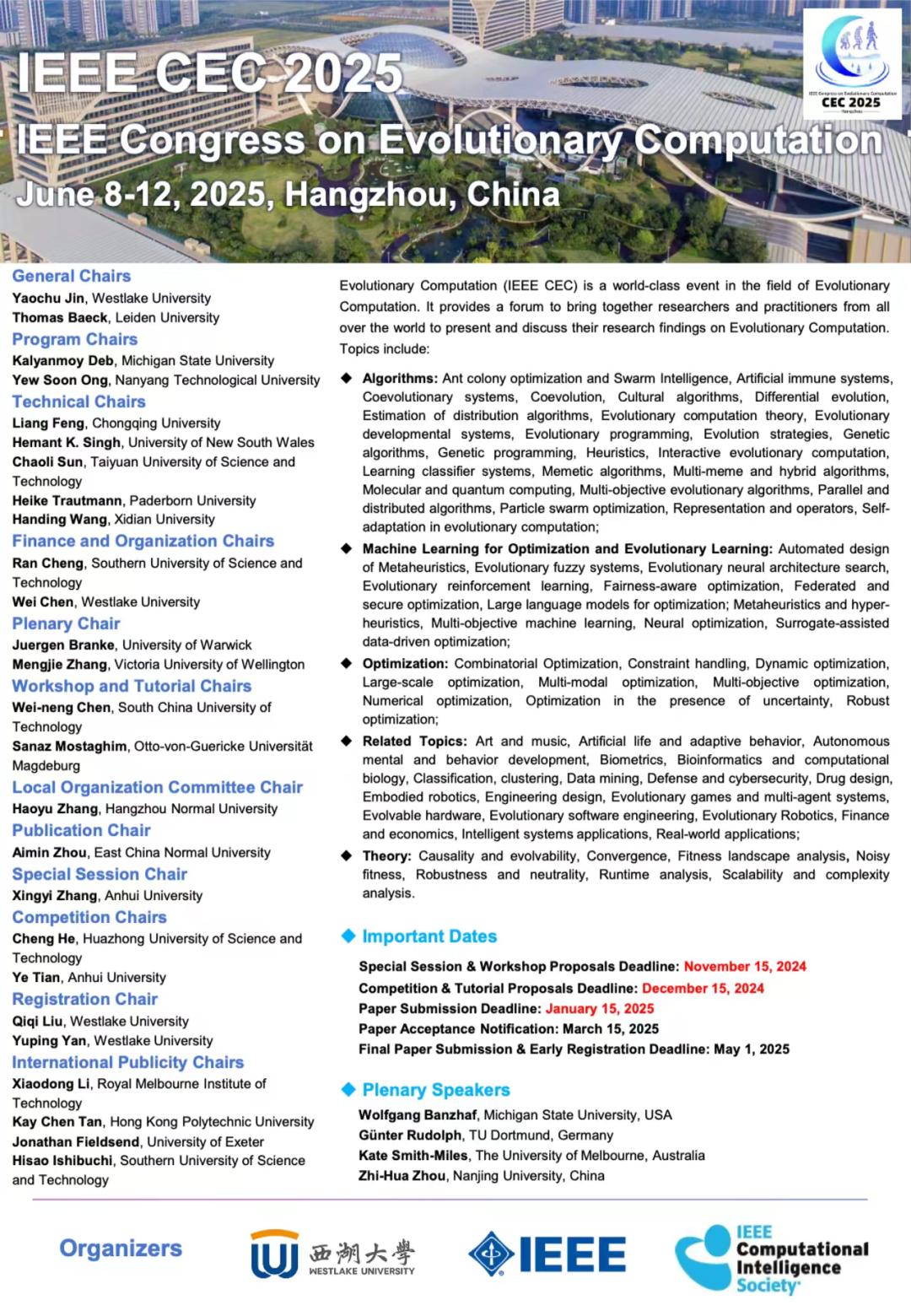
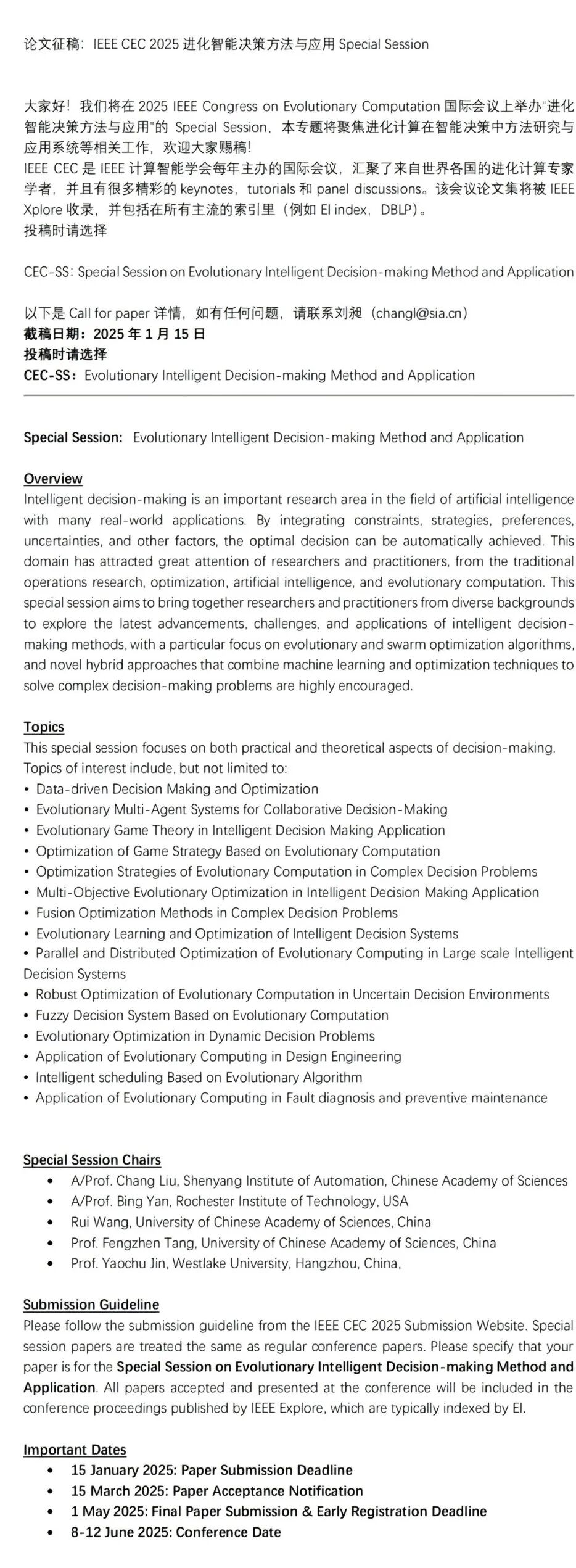
CEC
organizer
Liu Chang
Affiliation: Shenyang Institute of Automation, Chinese Academy of Sciences, Shenyang, China
Email: [email protected]
He has long been engaged in theoretical and applied research on complex manufacturing process modeling, production scheduling and intelligent optimization. She has undertaken a number of national science and technology projects, including the 863 Program, major national science and technology projects and the Natural Science Foundation. Her team has accumulated rich theoretical and applied research experience in production scheduling and intelligent optimization of complex manufacturing systems, as well as closed-loop optimization of production scheduling driven by both data and knowledge, and has formed a comprehensive and in-depth method system. He has published more than 50 academic papers, more than 20 patents and software copyrights, and won the first prize of provincial and ministerial level scientific and technological progress awards, invention patent awards, and 5 scientific research achievements. The "Zhongke Yunyi Intelligent Production Scheduling System" developed under her leadership has been put into practical use in discrete and semi-process industries.
Wang Rui
Affiliation: Shenyang Institute of Automation, Chinese Academy of Sciences, Shenyang, China
Email: [email protected]
Introduction: Obtained a master's degree from the School of Software, Northeastern University in 2020. Currently, he is an engineer at the Shenyang Institute of Automation, Chinese Academy of Sciences. His research areas include multi-objective evolutionary optimization, pipeline scheduling, and evolutionary deep reinforcement learning.
Shi Changwei
Affiliation: Shenyang Institute of Automation, Chinese Academy of Sciences, Shenyang, China
Email: [email protected]
Introduction: Obtained a master's degree from the School of Power and Energy Engineering, Harbin Engineering University in 2023. He is currently an assistant engineer at the Shenyang Institute of Automation, Chinese Academy of Sciences. His research interests include shop floor scheduling optimization and applications of evolutionary algorithms.
Zhang Xinjie
Subsidiary: Shanghai Jiuzhang Intelligent Technology Co., Ltd., Shanghai 200437, China
Email: [email protected]
Introduction: Zhang Xinjie graduated from Fudan University and has more than 20 years of experience in IT services in the IT industry: including operation and optimization applications, project development, management and consulting experience.
Jin Yaochu
Affiliation: College of Engineering, West Lake University, Hangzhou 310030, China
Email: [email protected]
Introduction: Professor Jin received his bachelor's degree, master's degree and doctorate degree from Zhejiang University in Hangzhou, China in 1988, 1991 and 1996 respectively, and his doctorate degree from Ruhr-Universität Bochum in Germany in 2001. He is a professor at the School of Engineering, West Lake University, China. He is the Alexander von Humboldt Professor of Artificial Intelligence and Chair of Nature-Inspired Computing and Engineering at the Technical Institute of the University of Bielefeld in Germany. He is also Professor and Distinguished Chair of Computational Intelligence in the Department of Computer Science at the University of Surrey, UK. He was once the "Finnish Distinguished Professor" at Jyvaskyla University in Finland, the "Yangtze River Distinguished Visiting Professor" at Northeastern University in China, and the "Distinguished Visiting Scholar" at the University of Technology, Sydney, Australia. His main research interests include evolutionary optimization, evolutionary learning, trustworthy machine learning, and evolutionary development systems. Professor Jin is currently the editor-in-chief of "Complex and Intelligent Systems". He was Editor-in-Chief of IEEE Transactions on Cognitive and Developmental Systems from 2016-2021, IEEE Distinguished Lecturer from 2013-2015 and 2017-2019, and Vice President of Technical Activities of the IEEE Computational Intelligence Society (2015-2016). He is the recipient of the 2018 and 2021 IEEE Transactions on Evolutionary Computation Outstanding Paper Award and the 2015, 2017 and 2020 IEEE Computational Intelligence Magazine Outstanding Paper Award. From 2019 to 2021, he was continuously rated as a "Highly Cited Researcher" by "Science Network". He is a Fellow of the European Academy.

Machine-translated from the Chinese original CEC 2025 随机作业到达的柔性流水车间动态调度竞赛 (published 2024-12-24). WeChat original ↗