This article is about warehouse positioning, expansion, and closure issues, including problem description, mathematical model establishment, problem solving, and application demonstration.

1. Problem description
In modern logistics distribution networks, warehouse location selection, capacity planning and closure decisions are crucial to reducing operating costs. In order to help enterprises optimize warehouse layout and resource allocation, this article takes specific scenarios as an example to discuss how to minimize total costs through reasonable warehouse location decisions.
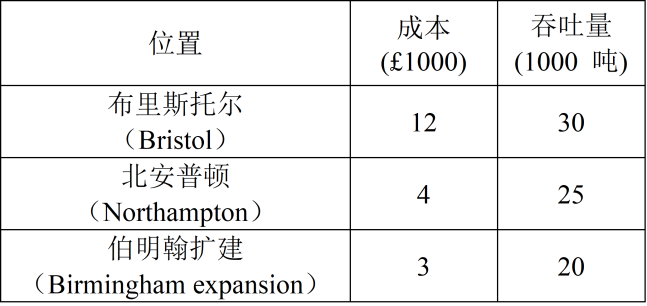
hypothetical caseDistribution 1Enterprises in due to business expansion (Distribution 1Review link: WeChat public platform), considering building new warehouses in Bristol and Northampton, while potentially expanding the existing Birmingham warehouse. There is also an option to close existing Newcastle and Exeter warehouses. The monthly operating costs and corresponding cargo throughput of different warehouses are shown in Table 1.
Table 1 Warehouse operating costs and throughput
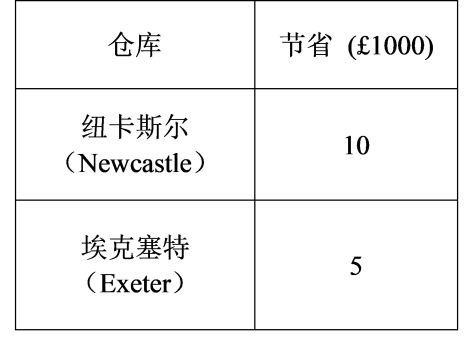
Closing the existing Newcastle and Exeter warehouses will result in corresponding cost savings as follows:
Table 2 Savings from closing warehouses
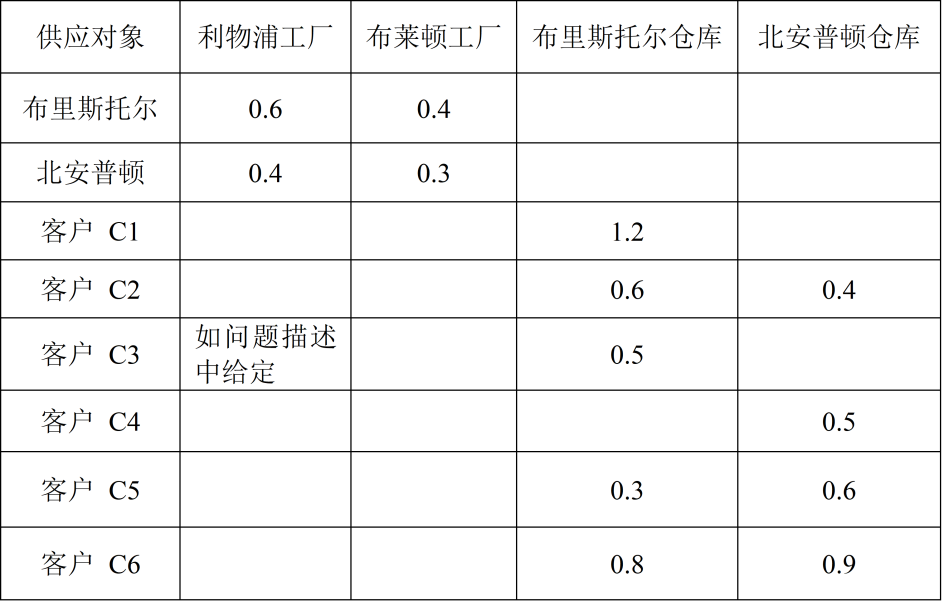
In addition, the distribution costs (distribution charges per ton of goods) for different warehouses are as follows:
Table 3 Distribution costs
Question: To achieve the lowest delivery cost:
-
Where should companies build new warehouses?
-
Should a Birmingham warehouse be expanded?
-
Will the Newcastle or Exeter warehouses need to close?
2. Establishment of mathematical model
inDistribution 1Based on a linear programming problem, this distribution problem can be extended to a mixed integer model to solve the additional decision of whether to build or close a warehouse. inDistribution 1Based on this, an additional 0-1 integer variable δ is introducedj, and defined according to the following explanation:
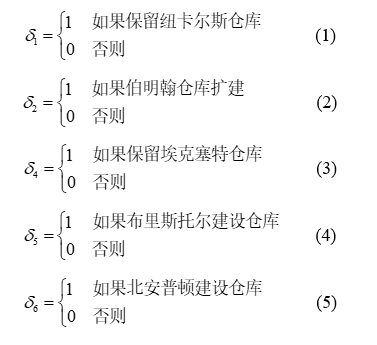
Also, to reviewDistribution 1Decision variables and parameters defined in:
decision variables
-
x ij : Continuous variable, the amount of goods shipped from factory i to warehouse j;
-
y ik : Continuous variable, the amount of goods shipped from factory i to customer k;
-
z jk : Continuous variable, the amount of goods shipped from warehouse j to customer k;
parameters
-
C i : Production capacity of factory i, i=1,2;
-
P j : Throughput of warehouse j, j=1,2,3,4;
-
R k : Demand of customer k, k=1,2,...,6;
-
c ij : The unit distribution cost from factory i to warehouse j;
-
d ik : unit distribution cost from factory i to customer k;
-
e jk : The unit distribution cost from warehouse j to customer k;
Constraints on Distribution 1
1. Factory capacity constraints:The total quantity of goods produced by each factory cannot exceed its maximum monthly production capacity.

2. Warehouse capacity constraints:Each warehouse's throughput cannot exceed its monthly maximum capacity.

3. Flow conservation constraints:The sum of the quantity of goods flowing out of the warehouse must be equal to the sum of the quantity of goods flowing into the warehouse.

4. Customer demand constraints:Every customer's needs must be met.

to solveDistribution 2problem, introducing an additional continuous variable xi5,xi6,z5kand z6kto represent the volume of goods dispatched and received from the new warehouses Bristol and Northampton. And forDistribution 1The model additionally adds the following constraints:

The original Birmingham throughput is 50,000 tons. The volume of cargo sent from Birmingham after the expansion must be within its capacity limits:
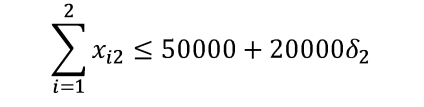
The number of warehouses is limited to no more than four (including Birmingham and London):

objective function
new variable xijand zijis assigned a corresponding cost factor, which is added toDistribution 1In the objective function, the new objective function is:
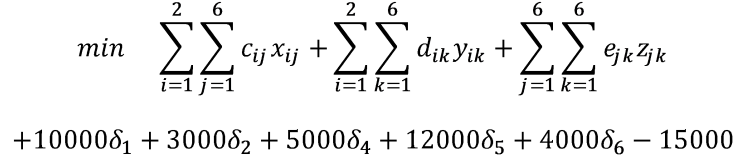
Note that since the number of warehouses has changed, the corresponding coefficient of the summation term has also changed (the coefficient of j has increased by two warehouses).
3. Problem Solving and Application Demonstration
The following is the web version of the solver we developed, which can import other data for one-click solving:
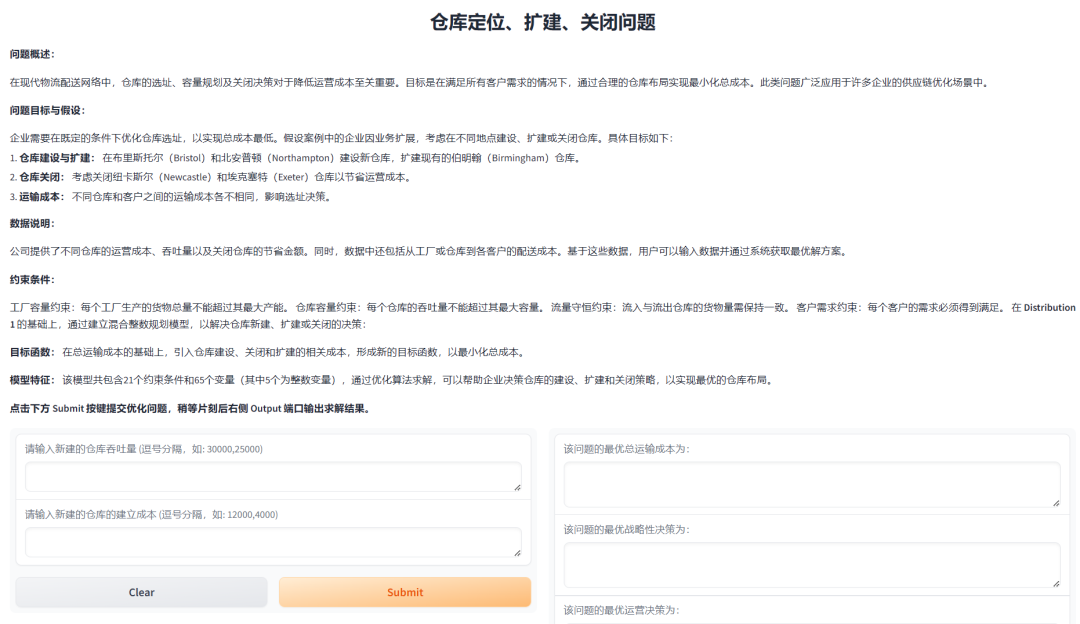
As shown in the figure below, the solver quickly gave the optimal result: the optimal total transportation cost is 175,000, and the decision is to retain the Exeter warehouse and build the Northampton warehouse.
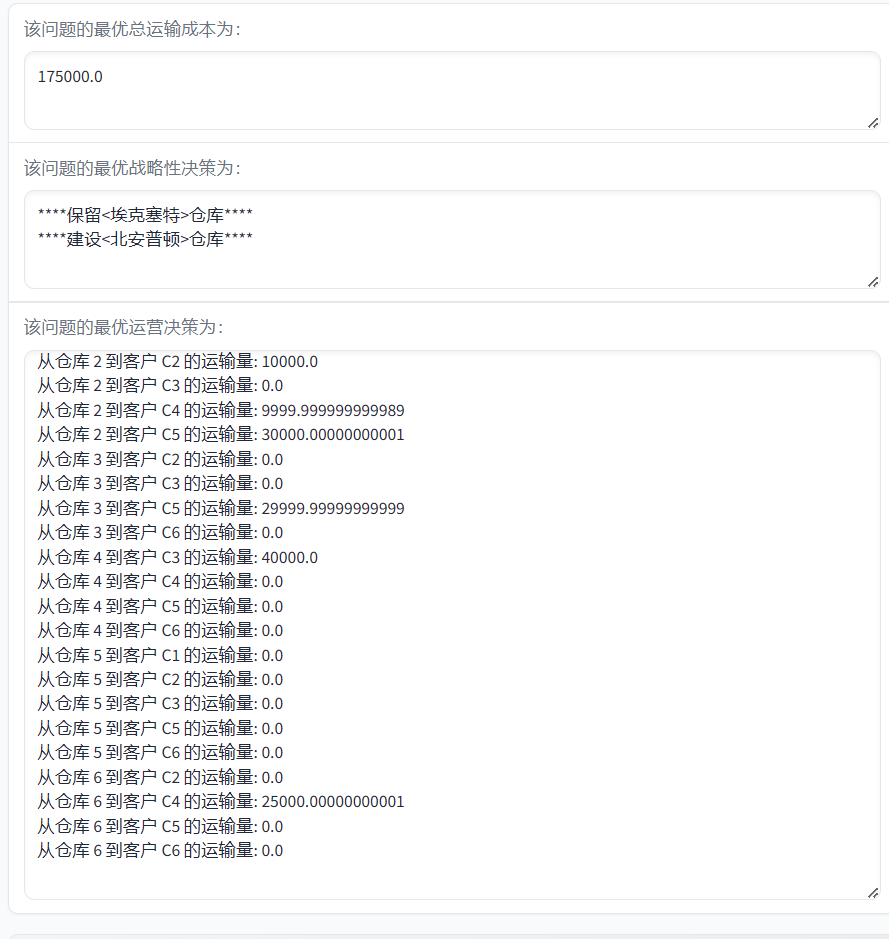
Warehouse positioning, expansion and closure issues

Machine-translated from the Chinese original 仓库定位、扩建、关闭问题 Depot Location (Distribution 2) (published 2024-11-11). WeChat original ↗