Discrete optimization problems widely exist in many fields such as logistics scheduling, network design, and resource allocation. Depending on the size and complexity of the problem, choosing the right solution is critical. This article divides the solutions to discrete optimization problems into four parts according to problem size: exact algorithms for small-scale optimization problems, metaheuristic algorithms for medium-scale optimization problems, heuristic algorithms for large-scale optimization problems, and deep reinforcement learning algorithms for dynamic optimization problems. Each part will introduce its definition, reasons for use, specific methods and classic applications in detail.
1. Small-scale optimization problems and exact algorithms
- What is a small-scale problem?
Small-scale problems refer to discrete optimization problems that have a relatively small number of decision variables and constraints and can be solved through systematic methods within a reasonable computational time. Usually, the solution space of this type of problem is small and it is suitable to use exact algorithms to find the optimal solution.
- Why use exact algorithm
Exact algorithms aim to find the global optimal solution to a problem. For small-scale problems, due to the limited solution space, exact algorithms can exhaust all possibilities within an acceptable time or quickly locate the optimal solution through effective pruning strategies. Therefore, using accurate algorithms can ensure the quality of solutions and is suitable for scenarios that require high accuracy of solutions.
3. What are the exact algorithms?
Branch and Bound: Reduce the number of branches that need to be considered by systematically enumerating all possible solution spaces and using upper and lower bound pruning.
Dynamic Programming: Decompose the problem into sub-problems, save the solutions to the sub-problems to avoid repeated calculations, and gradually build the optimal solution to the original problem.
Integer Programming: In mathematical programming, variables are limited to integers and the optimal solution is found through the expansion method of linear programming.
4. Classic application
Traveling Salesman Problem (TSP): In small-scale situations, the branch-and-bound method can effectively find the shortest path.
Knapsack problem: Dynamic programming methods can accurately calculate the maximum value combination.
Resource allocation: Integer programming is used to determine the optimal resource allocation plan to ensure that constraints are met.
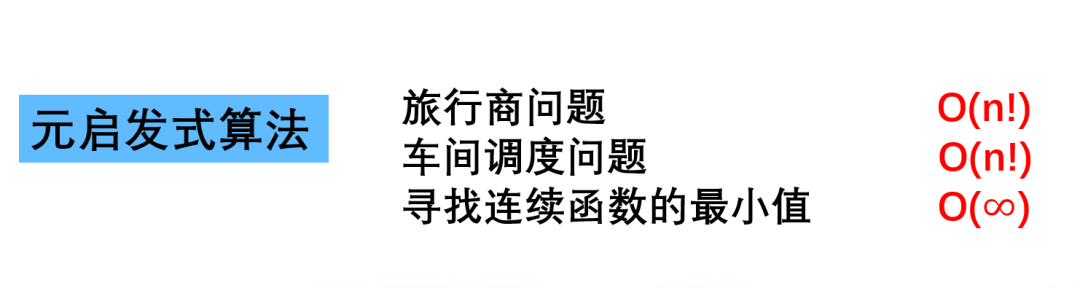
2. Medium-scale optimization problems and metaheuristic algorithms
- What is a mid-scale problem?
Medium-scale problems involve many decision variables and constraints, and the solution space is large, making it difficult to solve them within a reasonable time through simple and accurate algorithms. Such problems often require more advanced search strategies to find high-quality approximate solutions.
- Why use metaheuristics
Metaheuristic algorithms combine a variety of heuristic strategies, have strong global search capabilities and flexibility, and can effectively explore complex solution spaces to avoid falling into local optima. For medium-scale problems, metaheuristic algorithms can find near-optimal solutions within a reasonable time, taking into account solution efficiency and solution quality.
3. What are metaheuristic algorithms?
Genetic Algorithms: simulates natural selection and genetic mechanisms, and evolves better solutions through selection, crossover, mutation and other operations.
Tabu Search: Based on local search, a tabu table is introduced to record recent search history to avoid repeated visits and falling into local optimality.
Ant Colony Optimization: simulates the feeding behavior of ants and guides the search direction through the accumulation and volatilization of pheromones.
Simulated Annealing: simulates the physical annealing process and gradually reduces the "temperature" by controlling it, allowing the acceptance of inferior solutions to jump out of the local optimum.
4. Classic application
Scheduling problems: Genetic algorithms and tabu search are often used in production scheduling and task allocation to optimize resource utilization and construction schedules.
Path planning: Ant colony optimization performs well in traffic route optimization and logistics distribution, and can find efficient path solutions.
Graph coloring problems: Simulated annealing is used to solve graph coloring problems, reduce color conflicts, and improve coloring efficiency.
Vehicle Routing Problem (VRP): Metaheuristic algorithm can effectively handle the path optimization of multiple vehicles and reduce transportation costs.
3. Large-scale optimization problems and heuristic algorithms
- What is a large-scale problem?
Large-scale problems involve a large number of decision variables and complex constraints, and the solution space is extremely large. It is difficult for traditional exact algorithms and meta-heuristic algorithms to find satisfactory solutions within a reasonable time. Such problems often require the rapid generation of feasible solutions that, although they may not be optimal, are sufficient to meet practical needs.
- Why use heuristics
Heuristic algorithms are efficient and scalable and can quickly generate feasible solutions to large-scale problems. Although there is no guarantee that the optimal solution will be found, in practical applications heuristic algorithms can often provide good enough solutions to meet time and resource constraints.
3. What are the heuristic algorithms?
Greedy Algorithms: Select the current optimal local option at each step, hoping to achieve the global optimal through a series of local optimal choices.
Local Search: starting from an initial solution and gradually improving it by searching for better solutions in its neighborhood.
Heuristic Rules: Design heuristic rules based on the specific structure of the problem to guide the search process.
Greedy Random Adaptive Search Algorithm (GRASP): Combines greedy selection and randomization to generate and improve solutions through multiple iterations to find high-quality approximate solutions.
4. Classic application
Minimum spanning tree: Greedy algorithms such as Kruskal and Prim's algorithm can efficiently generate minimum spanning trees.
Activity Selection Problem: A greedy algorithm is used to select the maximum number of non-overlapping activities.
Large-scale scheduling: Local search and heuristic rules are used to quickly generate feasible scheduling solutions that meet time and resource constraints.
Vehicle route planning: GRASP can efficiently generate and optimize multi-vehicle delivery routes in vehicle route planning.
4. Dynamic Optimization Problems and Deep Reinforcement Learning Algorithms
- What is a dynamic optimization problem?
Dynamic optimization problems refer to situations where the environment or constraints change during the problem solving process, and the strategy needs to be adjusted in real time to adapt to the new situation. Such problems often involve a continuous decision-making process that requires algorithms to learn and adapt.
- Why use deep reinforcement learning algorithms?
Deep Reinforcement Learning (DRL) combines the advantages of deep learning and reinforcement learning and can learn optimal strategies in complex and dynamic environments through interaction with the environment. DRL has strong generalization ability and independent learning ability, and is suitable for optimization problems that require real-time decision-making and dynamic adjustment.
3. What are the deep reinforcement learning algorithms?
Deep Q-Network (DQN): Combining Q learning and deep neural networks, it can handle high-dimensional state spaces and achieve efficient policy learning.
Policy Gradient Methods: Directly optimize the policy function and update the policy parameters through gradient ascent, which is suitable for continuous decision-making problems.
Actor-Critic method: combines the policy gradient (Actor) and the value function (Critic) to improve learning efficiency and stability.
Transfer learning and multi-task learning: Use the knowledge learned in one task to improve learning efficiency and performance on related tasks, and accelerate the speed of adapting to new environments.
4. Classic application
Real-time traffic management: DRL is used to dynamically adjust the timing of traffic lights to optimize traffic flow and reduce congestion.
Dynamic resource allocation: In cloud computing and network environments, DRL can allocate resources in real time to optimize system performance and response speed.
Adaptive supply chain management: Based on market demand and supply chain changes, the DRL algorithm can dynamically adjust supply chain strategies to improve efficiency and responsiveness.
Dynamic task scheduling: In the manufacturing and service industries, DRL is used to adjust task scheduling in real time to adapt to emergencies and demand changes.
Machine-translated from the Chinese original 离散优化问题的常用算法 (published 2025-06-26). WeChat original ↗