This article is about economic planning problems, including introduction to economic planning problems, construction of mathematical models, solution results and trial demonstrations.
Total text: 1809 words
Estimated reading time: 5-7 minutes

01·Problem introduction
The input-output model is a widely used economic planning model that reflects the economic interrelationships between different industries or business sectors of the government or enterprises. Input-output model is usually considered as a special type of LP model.
For example, an economy consists of three industries: coal, steel, and transportation. The output of each industry is generally used for two purposes:
(1) Direct consumption, such as selling coal to domestic consumers; (exogenous demand)
(2) As inputs to other industries or sectors of the economy, such as coal to power the steel industry. (endogenous demand)
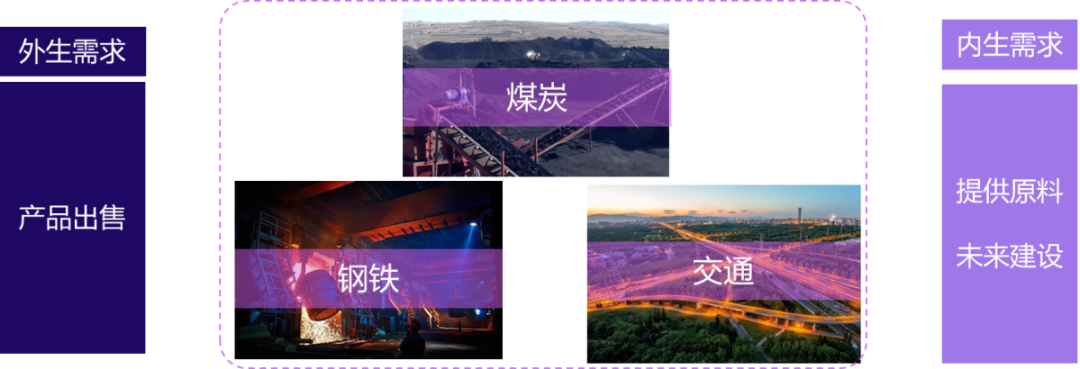
How to plan input and output quantities to achieve different economic goals? We show a simple case.
The production of coal, steel and transportation requires inputs from itself and other industries. For example, blast furnaces that produce steel require coal, and machines that mine coal require steel. It is assumed that input and output are directly proportional and the ratio between input amounts is fixed. Due to the time lag in the economy, output in year t+1 requires input in year t. Table 1 gives the input and manpower requirements required per unit (worth £1) of output.
Table 1 Input and manpower requirements required for the output of each industrial unit
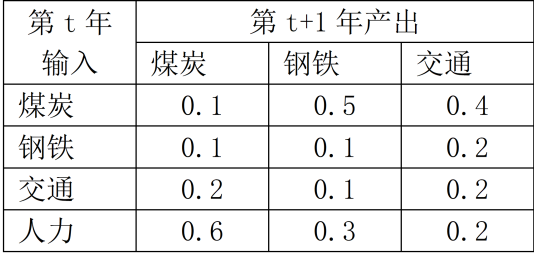
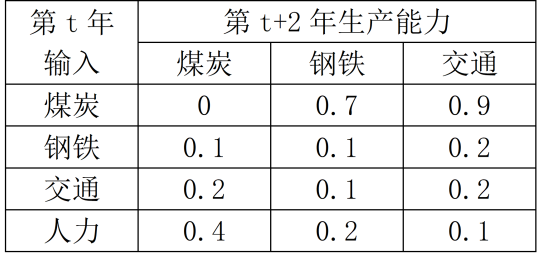
The output of each industry can also be used to expand production capacity for itself or other industries in the coming years. Investment in an industry in year t results in a permanent increase in production capacity in year t+2. Table 2 gives the inputs required to increase one unit (worth £1) of production capacity.
Table 2 Inputs required to increase unit production capacity
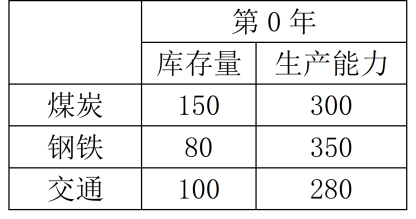
Inventories of goods can be held from year to year. Table 3 lists the current (year 0) inventory and production capacity (per year) (in millions of pounds). Annual human capacity is limited at £470 million.
Table 3 Current (year 0) inventory and production capacity
It is hoped that different growth patterns for the economy over the next five years will be investigated. In particular, it is desirable to understand the growth patterns that will result from pursuing the following goals:
(1) Maximize total production capacity at the end of five years while meeting exogenous consumption requirements of £60 million of coal, £60 million of steel and £30 million of transport per year (except in year 0).
(2) Maximize total output (rather than production capacity) in years four and five, but ignore exogenous demand in each year.
(3) Maximize the total manpower demand (ignoring manpower capacity constraints) while satisfying the annual exogenous demand of (1).
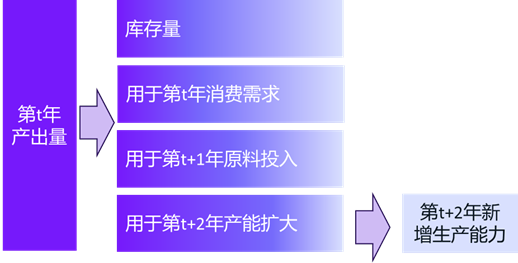
Under different optimization goals, we need to make the following decisions:
Direct decision:
• Annual output of each industry
• New production capacity in various industries every year
Indirect decision-making:
• Annual opening inventory levels
• The output of each industry for industrial input in year t+1
• The output of each industry used for capacity expansion in year t+2
02 · Constructing mathematical models 1 · Decision variables
-
x it = Total output of the i-th industry in year t (i =C (coal), S (steel), T (transportation), t =1, 2,...,5)
-
s it = Inventory level of the i-th industry at the beginning of t (t =2, 3,…,6)
-
y it =The additional production capacity of the i-th industry effective in year t (t =3, 4,…,7)
Other symbols:
-
e i represents the consumption demand of the i-th industry,
-
c ij Indicates that unit output of industry j in year t+1 requires input from industry i in year t,
-
d ij Indicates the input of industry i in year t required by unit output of industry j in year t+2
2 · Model constraints
(1) Balance between demand and output

(2) Human capacity limitations

(3) Production capacity restrictions
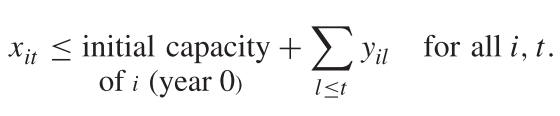
In order to establish a realistic model, it is necessary to consider the situation after the end of the five-year period. Ignoring exogenous demand in the sixth and subsequent years will result in no investment in the fifth year. Therefore, we assume that exogenous demand remains constant before and after year 5, that inventory levels remain constant, and that production capacity does not increase after year 5.
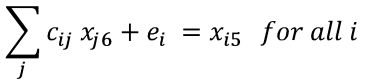
xi5is the (static) output of industry i in year 5 and beyond. This set of three equations gives the lower bound of the variable,
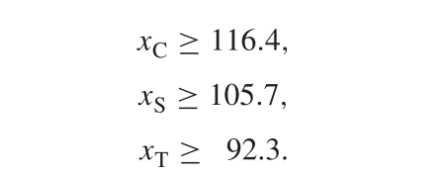
In the total output constraint above, for t=5, xi5will be set to be greater than or equal to these values. For t≥6, yitwill be set to 0, sit=si5
3·Objective function
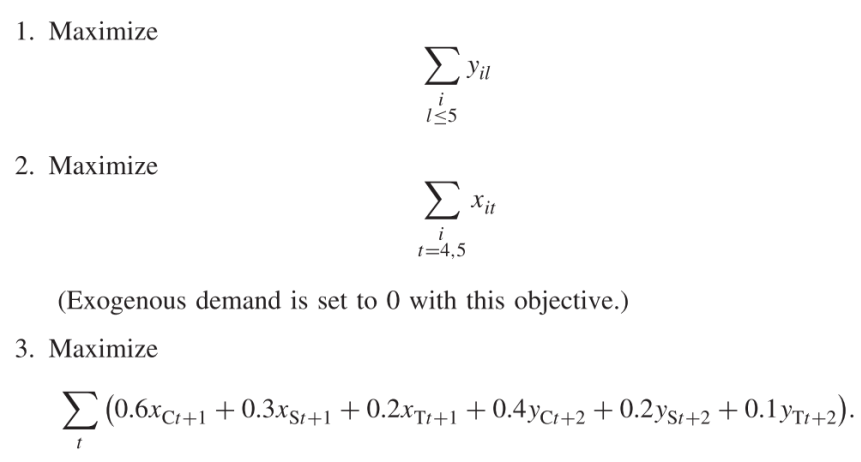
Under this objective, manpower constraints are ignored. The model has 45 variables and 42 constraints.
03·Solution results
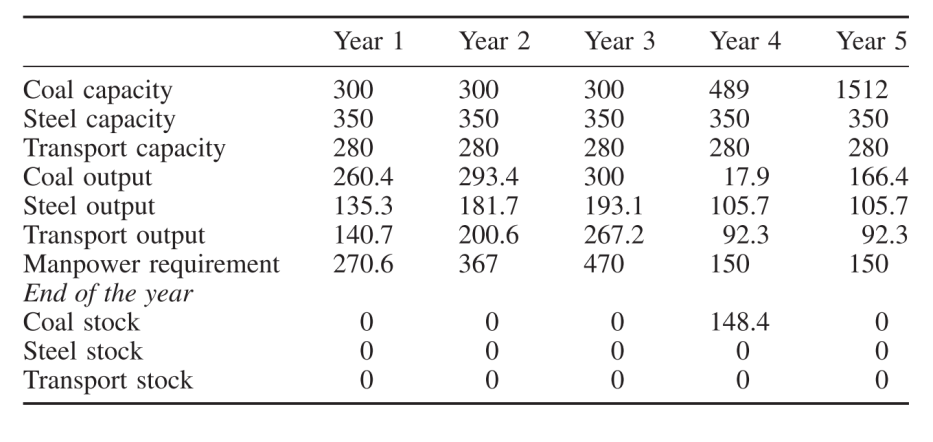
According to the first goal (maximizing the total production capacity in the fifth year), the growth model shown in Table 4 brings the total production capacity in the fifth year to 2.142 billion pounds. Quantities are in millions of pounds.
Table 4 Economic growth model under Goal 1
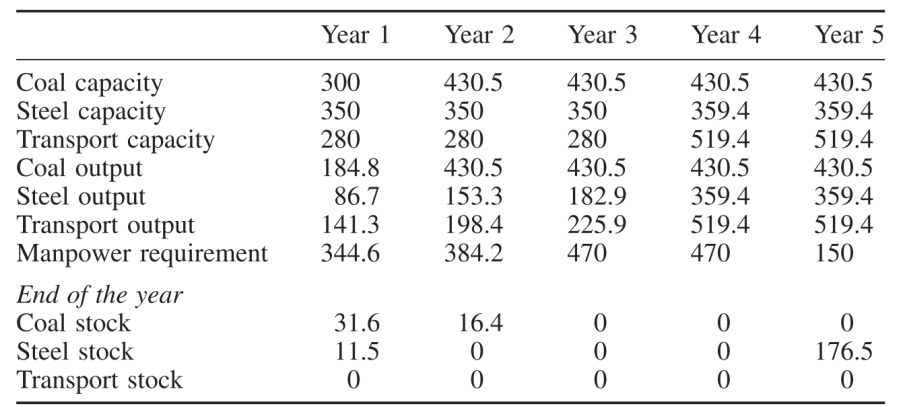
Following the second objective (maximizing total production in years four and five), the growth pattern shown in Table 5 results in a total production of £2.619 billion for these two years.
Table 5 Growth model under goal 2
In line with the third objective (maximizing manpower requirements), the growth pattern shown in Table 6 results in a total manpower usage of £2.45 billion.
Table 6 Growth model under Goal 3
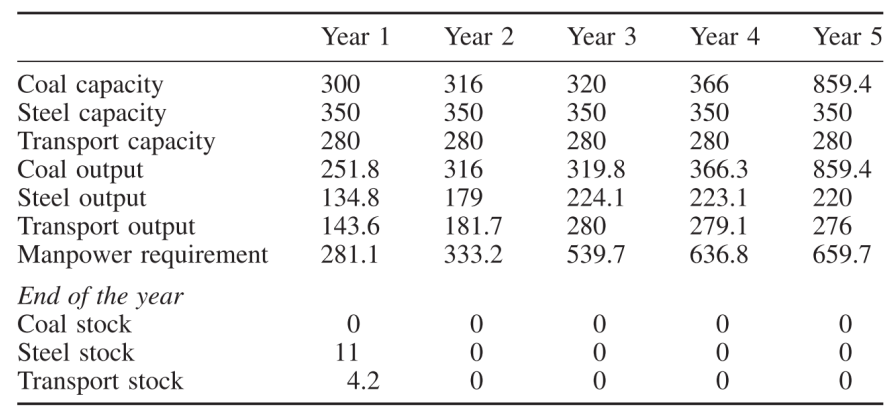
The first objective clearly resulted in concentrated efforts to build capacity in the coal industry, since the production of additional coal capacity used relatively little of the output of other industries. The second goal is to spend more time on transportation, in part because transportation uses less labor than other industries. The coal industry prospers again under the third goal because the coal industry requires a large amount of manpower.
04 · Trial display references
[1] Williams, H. P. (2013). Model Building in Mathematical Programming (5th ed.). Wiley.

Machine-translated from the Chinese original 经济计划问题 Economic Planning (published 2025-01-05). WeChat original ↗