Traditional operations research and optimization solutions usually adopt the approach of “customized modeling + specialized solving”. Engineers need to build a mathematical programming model based on the problem background and expert knowledge, and perform optimization calculations through solvers. If customers have high requirements for solving efficiency, they also need to specially develop customized accelerated precise algorithms or heuristic algorithms.
This process involves multiple links such as demand research, problem analysis, mathematical modeling, model optimization, algorithm development, programming implementation and debugging. It is cumbersome and error-prone, and usually requires a lot of time and energy. Therefore, researchers not only need a strong operations research background, but also an understanding of business logic, proficiency in mathematical modeling, and programming and debugging skills.
It can be seen that a major obstacle to the widespread application of operations research in domestic enterprises is its high development threshold. Looking back at the development process of operations research optimization solutions, we can find that if only "solving the problem" is the minimum goal, without considering the solution effect and speed, the most challenging part of the current process is how to extract key information from the demand descriptions of non-professionals and transform it into a mathematical planning model. This process involves a large amount of expert knowledge, and much of the information is semantically based and difficult to quantify. As Shanshu mentioned: "In the past eight years, all projects of Shanshu have to accurately convert business text descriptions into mathematical language.[1]!”。
However, with the rapid development of large language model technology, there is hope to solve the above problems. The core advantage of large models is that for the first time, machines can "hear" and understand human language, and then generate natural language-based responses. This enables humans to interact directly with machines in natural language. Because large models rely on massive training data (covering almost all human knowledge), their strong generalization capabilities, rich knowledge reserves, and excellent logical reasoning capabilities enable them to surpass the knowledge boundaries of a single human expert in many fields. Therefore, considering that real business scenarios often contain a large amount of text- and semantic-based information, can we use large models to help us "understand" this information and establish corresponding planning models? Some research that combines large models with operations research is based on this concept, trying to use the semantic understanding capabilities of large models to achieve automatic generation from customer requirements to mathematical model codes, thereby bypassing the traditional customized modeling process of algorithm engineers. We call this research framework "Language Format Requirement-Based Assisted Modeling of Large Models."

01 · Assisted modeling of large models based on language requirements
This framework mainly uses the powerful language understanding and generation capabilities of large language models to achieve"Language format requirement description" to "Complete operations optimization model and code generation", and then to"Solve with Optimization Solver"the whole process. However, since the essence of large model output results is to learn language patterns and logical relationships through massive data and make predictions based on probability, although the results may seem reasonable, there may be "pseudo-accuracy" in them. In the construction process of the operations research optimization model, the introduction and setting of every variable and every constraint need to be strictly considered. Especially when dealing with nonlinear problems that are difficult to solve, it is usually necessary to convert them into an equivalent linear format. Only through rigorous mathematical derivation can the correctness and interpretability of the final model be ensured.
When a large model handles this process, it is impossible to ensure the correctness of every step of derivation and transformation. Especially when dealing with extremely long texts or large information tasks, the probability of "illusion" will be greatly increased. In operations research, even if the sufficiency and necessity of minor equivalence conditions are not fully considered during the derivation process, or an inconspicuous sign error, the optimality of the final result may not be guaranteed.
Although the development of large models has spawned many methods to enhance reasoning capabilities, such as Chain-of-Thoughts and its variants (such as Tree of Thoughts, Graph of Thoughts), Progressive-Hint Prompting, Large Model Agent Technology (ReAct), Reflection Mechanism (Reflexion), etc., these methods have made significant progress in the fields of mathematical application problems, 24-point games, novel writing, etc.However, current language-based large model-assisted modeling can still only deal with classic and simple optimization problems. When dealing with large-scale and high-complexity tasks, there is still a big gap between practical applications.
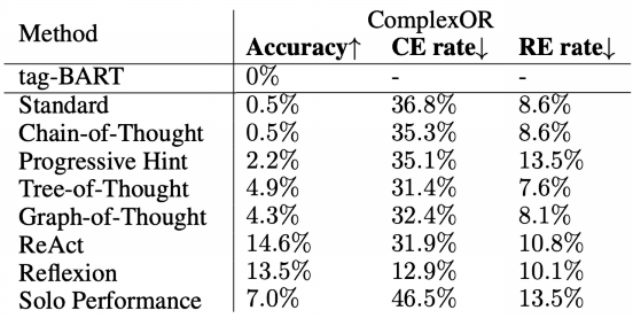
Figure 1 Performance of algorithms based on large models in modeling operations optimization problems[2]
In Figure 1, Method on the left represents different algorithms based on large models, and the right side shows their performance on complex operational research optimization problem data sets. It can be seen from the accuracy rate that the current large model-based methods are almost completely wiped out in complex operations optimization problems. The highest accuracy rate does not exceed 15%, that is, on average, only 1 problem can be solved correctly for every 7 problems, and the performance is quite unsatisfactory. The main reason is that the solution of operations optimization requires deep professional background knowledge and extremely long logical reasoning links. However, existing methods are mainly aimed at simpler reasoning tasks, so they are difficult to apply to this field.
In addition, the test is based on a general large model and has not been professionally fine-tuned for operations optimization problems, which limits the capabilities of the large model to a certain extent. However,The current core bottleneck that hinders the fine-tuning of large models for operational optimization problems is the scarcity of training data.Currently, open source public data sets are mostly single and simple scenarios, while high-quality industrial cases often involve private data, which is difficult to obtain.
The latest practice to solve the above problems is Shanshu’s ORLM (Operations Research Language Model) large operational research model.[3]. Its core contribution lies in the adoption of a semi-automated method - OR-INSTRUCT, which is used to create, expand and synthesize data that meets specific requirements, so as to train the optimization and solving capabilities of large benchmark source models in a targeted manner. In addition, Shanshu built IndustryOR, the first industrial benchmark for evaluating the quality of large language models in solving real-world operations research optimization problems.
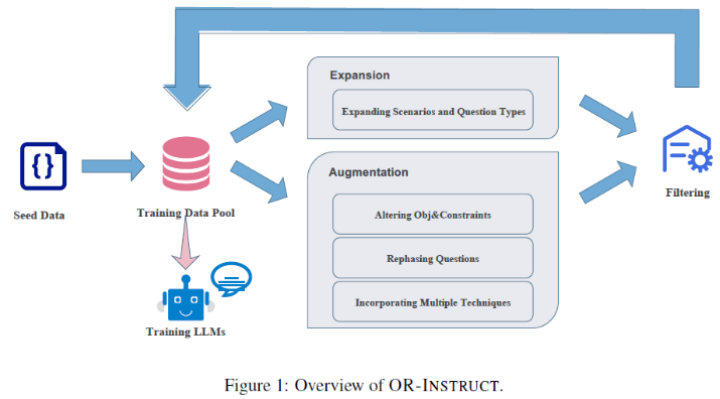
Figure 2 OR-INSTRUCT method framework
OR-INSTRUCT extracts scenarios and problem types from 686 real industry cases as seed data through GPT-4, and generates 30K training samples through expansion and enhancement operations. Among them, the expansion operation focuses on expanding application scenarios rather than a single task, thereby increasing the coverage of data; the enhancement operation aims to enrich the diversity of problem solutions, covering changes in problem descriptions, objective functions, constraints, and the combination of different modeling technologies to improve the generalization ability of the model.
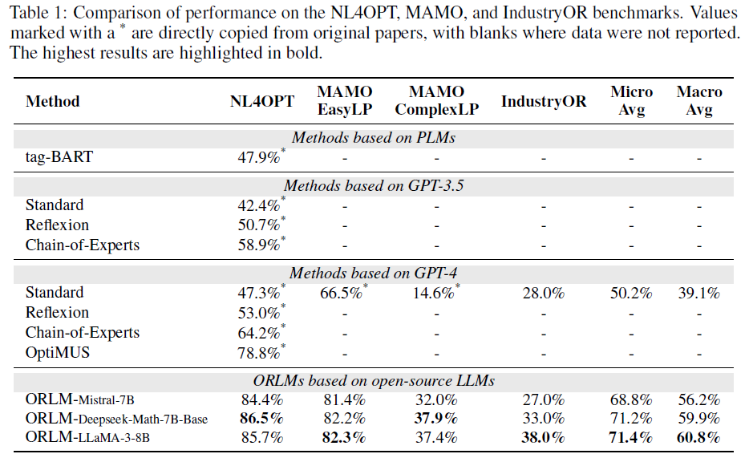
Figure 3 Comparison of test results of different models
In the specific training process, Shanshu used OR-INSTRUCT data to train multiple open source large models of approximately 7B in size, including Mistral-7B, Deepseek-Math-7B-Base Shao and LLaMA-3-8B, and the trained models are collectively called ORLM. Test results show that compared with open source large models that have not been specially trained, ORLM has achieved significant improvements in optimization modeling capabilities. For example, ORLM-LLaMA-3-8B achieves state-of-the-art performance on the NL4OPT and MAMO (covering simple and complex linear programming) test sets, as well as the IndustryOR benchmark. Compared with the standard Standard-GPT-4, its micro average improvement is 42.2% and the macro average improvement is 55.4%. In terms of solving complex problems, ORLM-LLaMA-3-8B outperforms Standard-GPT-4 in linear programming, integer programming, and mixed integer programming. However, the performance of both models still needs to be improved on nonlinear programming and other rare problem types.
Generally speaking, in the application of auxiliary modeling of large models based on language requirements, data is the core and most critical factor. And although the modeling capability of the targeted fine-tuned large model has been significantly improved compared to the general large model, and it has lowered the threshold of use to a certain extent and has strong versatility, there are still great difficulties when facing complex industrial-level operations optimization problems, and there is still a long way to go before practical application.
02 · Use large models to directly make end-to-end decisions
If the large model's auxiliary modeling based on language requirements mainly relies on the language understanding and generation capabilities of the large model, then using the large model for end-to-end decision-making directly utilizes the predictive ability of the Transformer model. Solving traditional optimization problems usually requiresDemand data → Mathematical modeling → Optimization solution → SolutionThis complete process. Although the final solution can theoretically guarantee optimality, the entire process is complex and time-consuming, and lacks generalization ability between different problems. If we already have demand data and the goal is to directly obtain feasible solutions, is there a way to directly establish a "mapping function" from demand data to feasible solutions? Through this method, we can skip the tedious modeling process and only need to substitute the demand data into the mapping function to quickly obtain a feasible solution. The decision-making process of obtaining feasible solutions based on this "mapping function" is called end-to-end decision-making.
End-to-end decision-making does not directly model the problem, but learns decision rules that map from covariates x to decisions z, looking for a rule function that can directly map covariates to decisions. The advantage of this framework is that once the decision rule function is obtained, for possible future scenarios, just by substituting the corresponding covariates into the rule function, the decision can be quickly obtained without resolving the optimization problem. This feature makes end-to-end decision-making particularly suitable for scenarios that require fast decision-making.
There are many ways to construct a mapping function from independent variables to dependent variables, ranging from the simplest multiple linear regression to complex machine learning and deep learning methods. However, since the optimal solution space of optimization problems in reality is usually high-dimensional and nonlinear, it is difficult to obtain an ideal mapping function using traditional linear regression methods. Therefore, many studies choose to adopt machine learning\deep learning methods to solve this problem. For example, JD.com’s end-to-end inventory management model[4]It is a typical practical research. This study trains a deep learning model through historical observational data and is able to output recommended replenishment quantities directly from the input features without any intermediate modeling steps.
Compared with traditional deep learning models, large models exhibit stronger learning capabilities when performing end-to-end decision-making tasks. This is because large models can not only handle structured data, but also unstructured data and information (such as direct language descriptions), and are significantly better than ordinary deep learning models in terms of context length and knowledge breadth.
For example, the optimization method proposed by the Google DeepMind team - Optimization by PROmpting (OPRO) [5], focusing on using large models as optimizers to directly generate solutions and prompt words to problems. Taking the solution of optimization problems as an example, the core process of OPRO is shown in Figure 4. First, OPRO uses Meta-Prompt as the input of the large model, generates feasible solutions to the problem, and calculates the objective function value of the solution as a score. Then, the newly generated solution and score composition "Solution-Score pair" are added to Meta-Prompt for the next round of optimization.
Obviously, the design of Meta-Prompt is crucial to whether a large model is capable of optimization tasks.Meta-Prompt mainly consists of two parts:
-
Relevant description of the optimization problem:Taking advantage of large models to handle natural language processing (NLP) tasks, the objective function, constraints and related background of the problem are described in words. In addition, you can also add informal regularization prompt words, such as "Prompts should be concise and universal";
-
Optimized historical information:Appropriate presentation of historical context helps large models identify underlying patterns. OPRO sorts historical solutions and their scores in ascending order, helping large models discover similarities between high-scoring solutions.
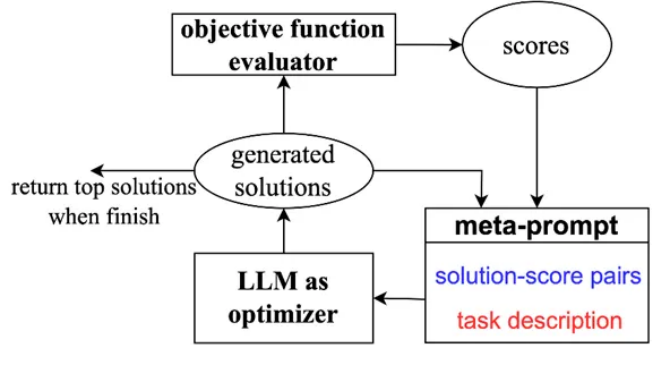
Figure 4 Schematic diagram of the OPRO optimization process of the Google team
In the solution generation stage, instability can be reduced by generating multiple solutions per round of optimization, and the sampling temperature of large models can be adaptively adjusted to achieve a balance between exploration and development. Figure 3 shows the solution results of OPRO on the TSP problem, in which NN (Nearest Neighbor) and FI (Farthest Insertion) are classic heuristic methods for solving TSP problems. When n=10 and 15, the large model can obtain a near-optimal solution with a very small gap. However, as the number of TSP nodes increases, the solution performance of LLM declines significantly.
In the solution generation stage, multiple solutions can be generated through each round of optimization to reduce instability, and the sampling temperature of large models can be adaptively adjusted to achieve a balance between exploration and development. Figure 3 shows the solution results of OPRO on the TSP problem, in which the NN (Nearest Neighbor) nearest neighbor method and the FI (Farthest Insertion) method are classic heuristic methods for solving TSP problems. When n=10 and 15, the large model can obtain near-optimal solutions with a very small gap. However, as the number of TSP nodes increases, the solution performance of the large model declines significantly.
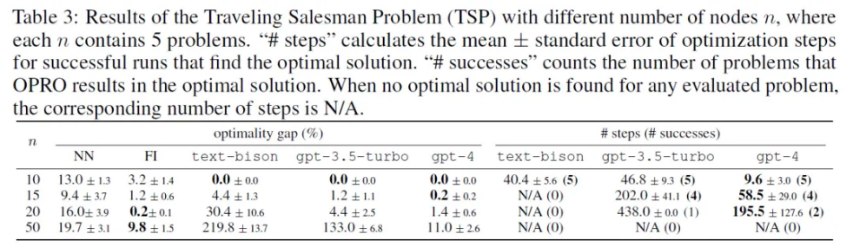
Figure 5 Performance of OPRO method under TSP problem
In addition, "City-LEO: Using large language models and end-to-end optimization to achieve transparent urban management" by the Tsinghua team [6]An innovative large language model embedded agent - City-LEO (LLM with End-to-End Optimization) is proposed for the first time. This agent combines the advantages of large language models in logical reasoning with prior knowledge, combines an end-to-end modeling framework with pre-trained random forests, and effectively narrows the scope of predefined large-scale optimization problems to address urban management challenges in uncertain operating environments.
The City-LEO agent task framework designed in this study integrates a code protection mechanism and can follow the rules of the Gurobi optimization language for iterative verification. Figure 6 shows the framework structure of the agent, including key components such as question matcher, question-related goal generator, question tailoring tool, end-to-end model and response prompter.
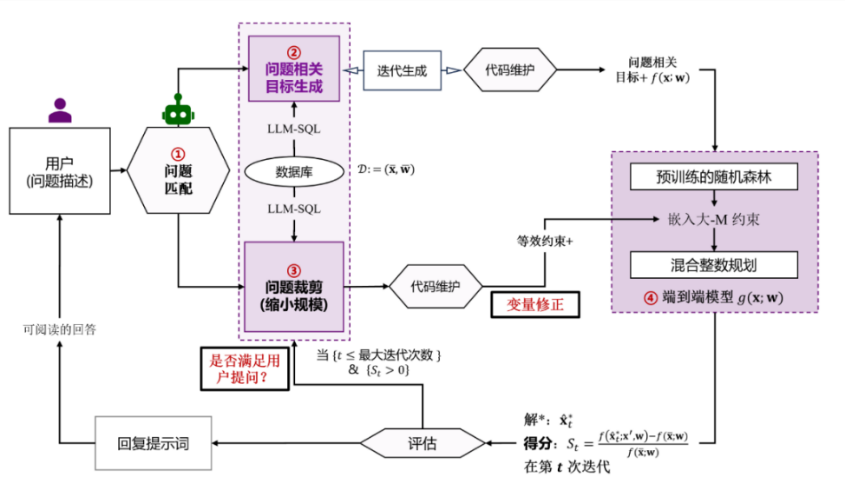
Figure 6 City-LEO agent structure
The specific steps of this method are as follows:
-
question matcherMatch user questions Q with domain-specific agents.
-
Problem related goal generatorGenerate an objective function f (x; w) based on user questions as an auxiliary objective for the end-to-end optimization problem.
-
Question cropping toolReducing the feasible region X of the decision variable x is mainly achieved by searching and parameterizing the decision variable x'∈X that is weakly related to the user's question.
-
end-to-end modelContains two objective functions: random forest-related objectives and user question-related objectives. The ontology consists of different pretrained random forest models.
-
Maintenance mechanismUse self-iteration to ensure the reliability of large language model outputs.
This study applied City-LEO to urban E-Bike Sharing (EBS) operation and management scenarios and conducted numerical experiments. In the end-to-end model, the random forest model is trained based on the actual operating data of the shared motorcycle system and the corresponding weather data. The tree structure is able to capture the inherent uncertainty in user requirements because it relies on historical meteorological information and operational records for learning. The final numerical experiment results show that City-LEO can better match the questions asked by users and integrate relevant goals into the end-to-end optimization model; under different problem narrowing settings and when there is a certain compromise in accuracy, City-LEO shows superior computing efficiency; the shared motorcycle operation strategy provided by City-LEO better meets user needs than the complete model.
In general, compared with the end-to-end framework based on traditional deep learning, directly using large models for end-to-end decision-making can significantly improve learning capabilities and decision-making quality; compared with traditional operations optimization methods, after obtaining a better mapping function, feasible solutions can be obtained quickly, and the response speed is greatly improved; and compared with general-purpose large models, it can handle more complex and industrialized optimization problems. However, the project complexity, development difficulty, and required professional knowledge investment for the development and training of an end-to-end decision-making framework for large models are no less than those of traditional operations research and optimization models. In addition, the training of end-to-end models requires a large amount of high-quality, highly vertical historical data as input. Therefore, this framework is more suitable for specific optimization problem scenarios that rely on the platform economy of large enterprises, have rich private historical data (support model training and algorithm implementation effect causality testing) and require rapid response, but are less suitable for general operations optimization problems.
03 · Use large models to assist in improving existing intelligent optimization algorithms
Other research mainly uses large models to assist in improving existing intelligent optimization (heuristic) algorithms. Heuristic algorithms usually use some heuristic rules to jump out of the local optimal solution and find the global optimal solution. The design of these rules is mostly based on empirical summary and does not rely on strict mathematical reasoning, so it is very suitable for large models to guide the design of rules - they have certain regularities, but do not require strict reasoning proof (similar to finding effective protein molecular structures through large models in biology). In some cases, the phenomenon of "emergence" in large models may generate unexpected operators that significantly improve the solution efficiency of heuristic algorithms.
Relevant studies include Liu et al. (2024)[7]This work proposes a large model-driven evolutionary algorithm (LLM-driven EAs, LMEA), which for the first time applies large language models to evolutionary combinatorial optimizers. This method uses prompt word engineering to guide large models to perform classic evolutionary operations such as selection, crossover, and mutation on the current population, avoiding the need for complex designs of various operators and requiring no additional training of the model. At the same time, LMEA is equipped with an adaptive mechanism to adjust the temperature of the large model to achieve a balance between exploration and utilization and avoid the search from falling into a local optimal solution.
For the LMEA method, the construction of prompt words mainly includes three parts:
-
Problem Description and Reconciliation Characteristics:Contains a description of the optimization problem and the characteristics and format of the expected solution;
-
Contextual example:Help large models understand this information by displaying solutions to optimization problems and their corresponding fitness function values, usually from the current population;
- Mission description:Provide clear task guidance for large models, including operations such as parent selection, crossover, and mutation, to generate new solutions.
It is not difficult to find that the prompt word construction of the LMEA method is similar to the OPRO method above. However, OPRO focuses more on directly letting LLM generate new solutions based on the current population; while the LMEA method starts from the idea of evolution and takes advantage of large models to drive the three classic evolution operators of selection, crossover and mutation, thereby achieving more efficient evolution.
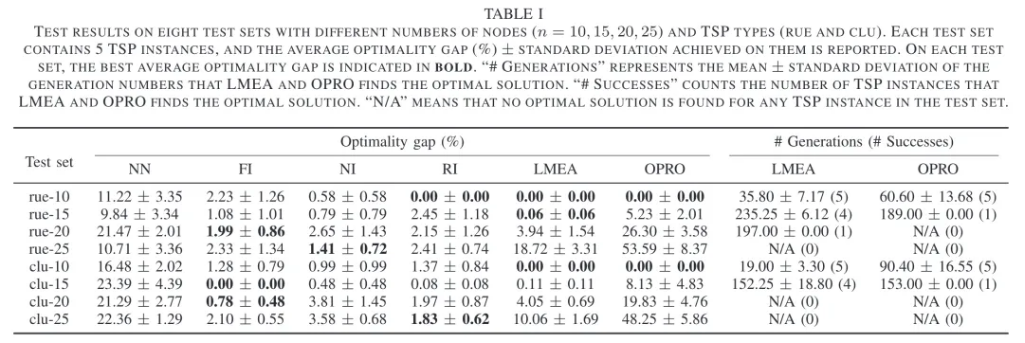
Figure 7 Solution results of LMEA method on TSP problem
Figure 7 shows the solution results of the LMEA method on the TSP problem and compares them with different heuristic methods and the OPRO method. Experimental results show that the solution obtained by the LMEA method is very close to the optimal solution in small-scale problems (n=10 and n=15), and in all test cases, LMEA performs better than the OPRO method. However, as the number of nodes increases, both LMEA and OPRO fail to handle large-scale TSP problems well, and their performance is inferior to traditional heuristics.
Although LMEA draws on the idea of evolutionary algorithms to guide large models to generate solutions, to some extent, it can still be classified as an "end-to-end" framework because, like OPRO, LMEA also directly generates solutions through large models. This direct way of generating solutions may limit the performance of large models when dealing with large-scale combinatorial optimization problems. Therefore, more and more researchers are beginning to take advantage of large models and introduce the idea of Evolutionary Computing (EC) to generate heuristic rules. This type of technology is also called Language Hyper Heuristic (LHH).
Relevant research includes research completed by the Google DeepMind team and published in Nature[8]. Unlike the solution paradigm where large models directly generate solutions, the goal of this research is to generate heuristic rules for solution. The paper introduces a method called FunSearch, which realizes the automated design of heuristic rules by searching in the function space and utilizing feedback loops. The FunSearch method is an iterative process of solving programs. In each iteration, the system will select some programs from the current program pool as prompt words, and generate new programs from the large model and automatically evaluate them. Programs that work properly will be added to the existing program pool, creating a self-improvement cycle.
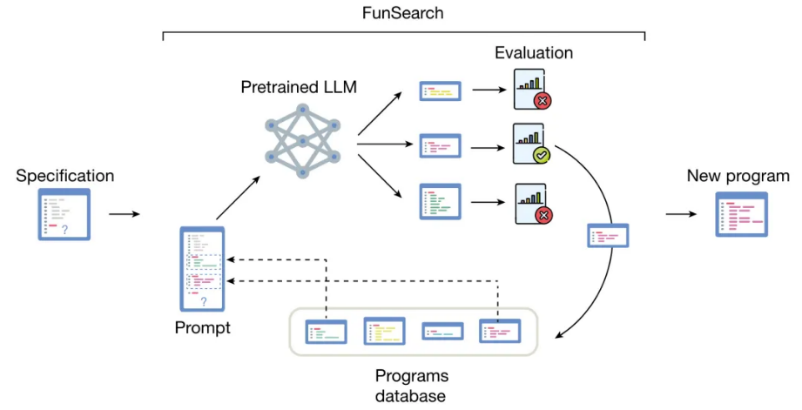
Figure 8 FunSearch method flow chart
As shown in Figure 8, the FunSearch method continuously generates and evaluates new programs, and uses an iterative loop to search the heuristic rule space to obtain a more efficient and performant solver. In order to improve the search efficiency and performance of FunSearch, the solution (code program) is represented as a skeleton (Skeleton) form, and only the key parts of the code are optimized and searched.
At the same time, the FunSearch method was experimentally verified on the Cap Set Problem and the Bin Packing Problem. Experimental results show that in some examples of hat set problems, the FunSearch method yields solutions that exceed the best solutions known to date. On the binning problem, FunSearch also showed excellent performance, surpassing the First Fit and Best Fit heuristics in different calculation examples.
Different from direct solution, the FunSearch method starts from the perspective of algorithm design and explores how to better utilize the advantages of large models in understanding and reasoning to assist in solving optimization problems. The FunSearch method innovatively proposes a large model-driven algorithm design framework, laying the foundation for subsequent research on hyper-heuristic methods.
In addition, Liu et al. (2024) [9]Based on the research, EoH (Evolution of Heuristics) was proposed to realize the automatic design of heuristic rules through large models. EoH integrates large models and prompt engineering into the evolutionary computing framework. Through iterative evolutionary thinking, the large model continuously generates heuristic ideas (High-level Thoughts) and corresponding feasible codes (Low-level Code). The performance of EoH has been verified in online bin packing problem, traveling salesman problem (TSP) and workshop scheduling problem. Taking TSP as an example, in a 200-node scale problem, EoH can obtain a gap of about 0.2%.
Similar to FunSearch, the large model in EoH also generates heuristic rules, but the number of queries is three orders of magnitude less than FunSearch. EoH designed 5 prompt strategies, focusing respectively on exploration (expanding the heuristic space) and modification (learning and optimizing from previous experiences). By applying the generated heuristic rules to a series of problems (such as a certain class of problems in TSPLib), the fitness function value is calculated and the overall performance is evaluated. It is worth noting that FunSearch only prompted code generation, while EoH generated both ideas and code. The ablation experiment verified the effectiveness of High-level Thoughts guidance.
Methods such as FunSearch and EoH incorporate large models into the evolutionary computing framework and use heuristic rule generation to solve combinatorial optimization problems, which is better than OPRO that directly generates solutions. However, in solving large-scale problems, the performance of large model optimization is still inferior to that of end-to-end neural combinatorial optimization. The researchers found that despite providing contextual demonstration information or optimization history, the strengths and weaknesses of heuristic strategies are still implicitly informed to large models. Inspired by the feedback mechanism of control systems, researchers began to try to introduce feedback ideas and let large models generate feedback prompt information to guide the generation of subsequent strategies.
Ye et al. (2024)[10]The proposed ReEvo incorporates the above feedback ideas and enhances LHH through Reflection Evolution, allowing the large model to provide verbal gradients (Verbal Gradients) for the generation of heuristic rules, thus improving its reasoning capabilities. ReEvo inherits the Genetic Programming (GP) framework, and its optimization process mainly includes five steps: selection, short-term reflections, crossover, long-term reflections, and elite mutation.
Short-term feedback refers to the reflection of the large model on the relative performance of the parent heuristic rules and provides tips for improving the design. This feedback can provide a linguistic gradient to the heuristic search space, thereby smoothing the fitness landscape of the optimization problem. Short-term feedback is incorporated into the crossover operation and serves as a prompt for the crossover operation together with information such as the problem description, parent heuristic rules and its fitness value.
Long-term feedback refers to the long-term thinking of large models during the heuristic design process. By integrating the latest short-term feedback and previous long-term feedback, summary tips are given. Based on long-term feedback, the large model will sample and generate multiple heuristic rules to optimize the existing optimal solution, that is, elite mutation.
From the perspective of a large model agent architecture, short-term feedback explains the environmental feedback in each round of interaction; long-term feedback refines accumulated experience and knowledge and integrates it into the reasoning context.
Sufficient verification experiments were conducted in the ReEvo paper. Taking five classic combinatorial optimization problems such as TSP, CVRP, and MKP as examples, ReEvo was compared with ACO and DeepACO (SOTA). On problems such as TSP50, OP50, and MKP100, ReEvo outperformed DeepACO, a type of end-to-end neural combinatorial optimization, even though the latter overfitted at the test problem size. The paper also observes that most of the heuristic rules generated by ReEvo perform consistently across different problem sizes and data distributions. Therefore, as the data distribution shift increases, the advantages of LHH over neural combinatorial optimization will become more obvious.
Generally speaking, using large models to assist in improving existing intelligent optimization algorithms is a direction that has achieved good results. Whether it is academic research or industrial applications, it is expected to replace traditional machine learning models in an end-to-end framework in terms of solution effect and interpretability.
04 · Expert system constructed based on multiple large models
In reality, modeling a real-world problem often requires the participation of a series of human experts, each of whom has different knowledge backgrounds and excellent reasoning capabilities. From this, can multiple large language models be trained to perform similarly to human experts? In this regard, Xiao et al. (2024)[11]Research presented at ICLR, a top conference in the field of AI, proposes the concept of “large model experts.” Each large model expert is responsible for solving specific sub-problems, such as interpreting professional terms, extracting variables and constraints, building mathematical models, programming, debugging and corrections, etc. Similar to a team of human experts, multiple large model experts can collaborate to solve a problem.
The collaboration process of this system is shown in Figure 9. The bottom layer of each "expert" is supported by a large model. The expert can automatically retrieve the knowledge base related to the problem, stimulate the learning ability of the large model in the context, and use the chain of thinking to perform reasoning. So, how do experts collaborate? The system introduces a special role - Conductor, which can intelligently select appropriate experts for questioning, put the experts' results into a public comment pool, and then select the next expert. When reasoning, each expert can view the reasoning results of the previous expert in the public comment pool, thereby achieving orderly collaboration among experts and forming a chain structure. This system is therefore called the "Expert Chain". In addition, the expert chain also has the ability to reflect, and the system will reflect based on the results of the final program operation. If the program fails to run successfully or the modeling is invalid, error information will be propagated from the end of the expert chain to the front end, and reflection will be carried out from back to front until the error is found and corrected, thus improving the success rate of modeling.
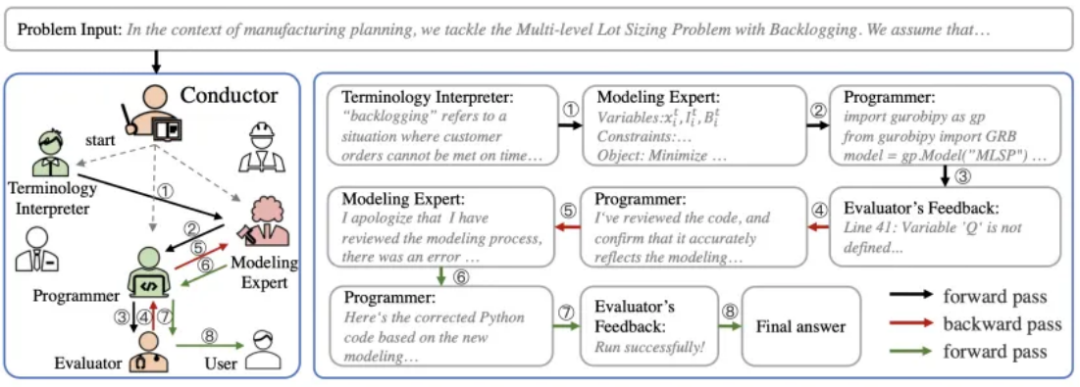
Figure 9 Overall framework of the “Expert Chain” system
Experiments have proven that the effect of the "Expert Chain" system has almost doubled (from 14.6% to 25.9%) under complex modeling data sets. This data set contains 37 difficult problems in the field of operations research and optimization, derived from academic research and actual industrial problems. Figure 10 shows the performance of the “Expert Chain” system and the comparison algorithm on various difficult problems. It is worth noting that this method is not only suitable for the ChatGPT large model, but can also be replaced with different base models according to needs, such as LLaMa2 or Claude, with good portability.
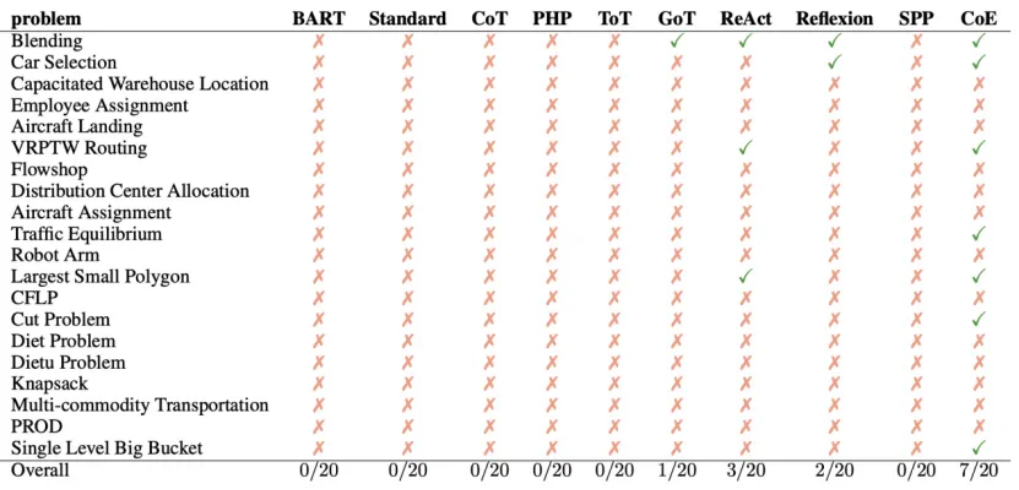
Figure 10 shows the performance of each comparison algorithm on each difficult problem.
The rightmost row is the performance of the "Expert Chain" system
Overall, the expert chain system provides a good idea for the future application and development of large models in the field of operations research and optimization. This study shows that directly using a general large model to solve optimization problems may lead to a situation where "each link is not refined, and the overall effect is even worse." In contrast, using an idea similar to the decision-making of a human expert team, by building multiple specialized small models and effectively managing them by a coordinator, the strengths of each small model can be fully utilized, thereby achieving a more efficient and accurate overall effect.
05 · Summary
This article reviews multiple exploration paths of large models in the field of operations research and optimization. Judging from current research, the application of large models is mainly concentrated in two directions: first, using the natural language understanding and knowledge expression capabilities of large language models to achieve automatic abstraction and mathematical modeling of problems; second, integrating large models with traditional optimization algorithms to promote decision-making and strategy optimization. These explorations have made significant progress in breaking through the limitations of traditional methods, improving solution efficiency, and improving model interpretability. However, mathematical rigor, data dependence, model generalization, and "black box" issues still need to be solved, reflecting the obvious gap between theory and practice. Therefore, this article puts forward some thoughts on the future development trend of combining large models with operations optimization:
1. In the future, the deep integration of large models and operations research and optimization will give rise to complex intelligent agents composed of multiple specialized small models, and even form a complete intelligent ecosystem.Practical experience and “expert chain” system exploration in recent years have shown that general large models have limitations when dealing with specific complex tasks. The future system will be split into several subsystems based on task logic, with each subsystem assuming a specific function by a specially trained small model. Similar to how existing apps complete tasks by calling multiple APIs, the future system can simultaneously mobilize multiple APIs such as precise modeling and solving, heuristic modeling and solving, etc., and the "leader" model will evaluate the performance of each module in real time, and finally output the comprehensive optimal solution. Such a system will integrate multiple functions such as precise solving, heuristic optimization, code generation and verification, and gradually evolve into a complete-function, multi-task operational research and optimization problem-solving ecosystem.
2. We should focus on cultivating the ability of large models to use existing tools to complete tasks, rather than directly letting them undertake tasks.Although large models show good capabilities in various tasks, their essence is still a language model based on probability output, which is good at understanding language information rather than mathematical derivation or solving tasks. For those single-dimensional tasks that already have professional software that can be efficiently completed, large models do not require a lot of resources to catch up. Instead, focus on training large models to effectively leverage existing specialized software to solve problems. This includes automatically organizing input data, guiding professional software to perform tasks, and automatically evaluating results to decide whether to adjust execution parameters, re-execute, or directly organize and output the results. The above may require modifying the underlying code of the professional software or adding a conversion layer to ensure that the two can share the same reasoning framework or logic rules
3. Formal verification tools such as Lean 4 can be integrated to assist in verifying the correctness of its mathematical derivation, especially in the equivalent transformation process of complex planning models.This method can directly ensure the strict accuracy of mathematical reasoning of large models. When a large language model generates a mathematical solution, its output can be passed to formal verification tools such as Lean 4 to ensure that the derivation results meet mathematical standards through automated theorem verification and derivation process checks. This automated verification step greatly improves the problem-solving accuracy of large models in operations research and optimization, ensuring the rigor and correctness of the results.
Finally, as a future operations optimization algorithm engineer, when facing the menacing potential impact of large models, although I am full of anxiety and worry, I must also objectively look at the potential contribution of large models to promoting the further implementation of operations optimization in China and its own shortcomings. At present, the ability of large models in abstract modeling is only equivalent to that of a master's student, and is far from being able to replace traditional operations research and optimization algorithm engineers. Its role in the future is most likely to be similar to today's development positions, as an auxiliary tool for efficiency improvement and a good teacher for quickly acquiring knowledge in new fields.
However, don’t jump to conclusions and become complacent and be abandoned by the times. After all, when we were still relying on LSTM models for natural language processing a few years ago, no one could have imagined the powerful ability of today's large models to unify the world. Operations research and optimization is a relatively niche field in China, and most manufacturing industries do not pay much attention to it. If the emergence of large models can lower the development threshold of operations research optimization and make more and more companies pay more attention to the matching efficiency of production factors, then this will undoubtedly broaden the demand space for operations research optimization, and society's demand for operations research optimization algorithm engineers will become increasingly strong. Therefore, what we can do is to actively embrace new knowledge, maintain a lifelong learning attitude, and strive to be a leader in the wave of impact. Only in this way can we continue to maintain competitiveness and meet new opportunities and challenges in the ever-changing market environment.
References
[1]. Research and development and commercial application of the intelligent decision-making large model ORLM, https://mp.weixin.qq.com/s/GHFgEmrBg-G49JGJU0sGXA
[2]. When large models meet operational optimization: an "expert chain" system that can automatically model in one sentence, https://mp.weixin.qq.com/s/UMFmTYCtCCfNTKsqyOTvEQ
[3]. Shanshu released the first open source operations research large model ORLM, which surpassed GPT-4, https://mp.weixin.qq.com/s/1NyjyBNtKbTxpK_VdmFydw
[4]. Qi, M., Shi, Y., Qi, Y., Ma, C., Yuan, R., Wu, D., & Shen, Z. J. (2023). A practical end-to-end inventory management model with deep learning. Management Science, 69(2), 759-773.
[5]. C. Yang, X. Wang, Y. Lu, H. Liu, Q. V. Le, D. Zhou, and. X. Chen, “Large language models as optimizers,” arXiv preprint arXiv: 2309.03409, 2023.
[6]. Jiao, Z., Sha, M., Zhang, H., Jiang, X., & Qi, W. (2024). City-LEO: Toward Transparent City Management Using LLM with End-to-End Optimization. arXiv preprint arXiv:2406.10958.
[7]. Liu S, Chen C, Qu X, Tang K, Ong YS. Large language models as evolutionary optimizers. In 2024 IEEE Congress on Evolutionary Computation (CEC) 2024 Jun 30 (pp. 1-8). IEEE.
[8]. Romera-Paredes B, Barekatain M, Novikov A, Balog M, Kumar MP, Dupont E, Ruiz FJ, Ellenberg JS, Wang P, Fawzi O, Kohli P. Mathematical discoveries from program search with large language models. Nature. 2024 Jan 18;625(7995):468-75.
[9]. Liu F, Xialiang T, Yuan M, et al. Evolution of Heuristics: Towards Efficient Automatic Algorithm Design Using Large Language Model. Forty-first International Conference on Machine Learning. 2024.
[10]. Ye H, Wang J, Cao Z, et al. Reevo: Large language models as hyper-heuristics with reflective evolution. arXiv preprint arXiv:2402.01145, 2024.
[11]. Xiao, Z., Zhang, D., Wu, Y., Xu, L., Wang, Y. J., Han, X., ... & Chen, G. (2023). Chain-of-experts: When llms meet complex operations research problems. In The twelfth international conference on learning representations.

Machine-translated from the Chinese original 大语言模型与运筹优化的融合:当前进展、挑战及未来思考 (published 2025-10-16). WeChat original ↗