[Introduction & Background of New Energy Vehicle Scheduling Issues]
The new energy vehicle route optimization problem refers to the problem of optimizing the vehicle route planning under the premise of considering the characteristics of new energy vehicles and energy utilization efficiency. With the increasing awareness of environmental protection and the development of new energy technology, the application of new energy vehicles such as electric vehicles in the transportation field is gradually increasing. However, new energy vehicles have unique characteristics, such as charging requirements, energy consumption, driving mileage, etc. that are different from traditional fuel vehicles. Therefore, path planning and optimization need to be based on these characteristics to improve the vehicle's operating efficiency and energy saving and emission reduction effects. The research on new energy path optimization problem aims to solve the problems of how to effectively utilize the energy of new energy vehicles, rationally plan the vehicle's driving route, reduce energy consumption and emissions, and improve transportation efficiency and environmental friendliness.
Electric vehicles (EVs) are growing rapidly in demand and production due to their environmental benefits. The few existing EVRP models take into account the unique characteristics of electric vehicles, such as nonlinear charging functions, nonlinear power consumption functions and dynamic range, energy losses (aerodynamics, tire friction, transmission system, auxiliary equipment and kinetic/potential energy losses).
EVRP (Electric Vehicle Routing Problem) is an optimization problem that studies electric vehicles in route planning. As the development and application of electric vehicles become more and more widespread, the research and application of EVRP are becoming more and more important. The following are the research and application frontiers of EVRP:
-
multi-objective optimization: EVRP usually involves multiple objectives, such as minimizing the total driving distance, minimizing the total cost, minimizing the total time, etc. Researchers are committed to developing multi-objective optimization algorithms to balance the trade-offs between these objectives.
-
Dynamic path planning:Route planning in EVRP usually needs to consider dynamic factors such as real-time traffic information and the status of charging stations. Researchers are studying how to apply dynamic path planning technology to EVRP to improve the efficiency and accuracy of path planning.
-
Intelligent algorithm: Intelligent algorithms such as genetic algorithm and particle swarm algorithm are widely used in EVRP. Researchers continue to improve and optimize these algorithms to solve complex optimization problems in EVRP.
-
Electric vehicle charging infrastructure planning: With the popularity of electric vehicles, the planning and layout of charging infrastructure has become increasingly important. Researchers are studying how to rationally plan the location and number of charging stations to support the implementation of EVRP.
-
Practical application: EVRP is not only a subject of academic research, but also widely used in practice. Many logistics companies, urban traffic management departments, etc. are researching and applying EVRP technology to optimize the path planning and dispatching of electric vehicles.
The research and application frontiers of EVRP mainly focus on multi-objective optimization, dynamic path planning, intelligent algorithms, charging infrastructure planning and practical applications to promote the efficient, intelligent and sustainable development of electric vehicles in route planning.
[Jiuzhang Logistics Smart Scheduling System Solution]
Jiuzhang launched the "Jiuzhang Logistics Intelligent Scheduling System" to address the EVRP problem. This system focuses on solving the problem of new energy vehicle capacity scheduling for logistics companies. By integrating advanced algorithms and optimization technologies, users only need to input waybills, transportation capacity, charging and discharging data and corresponding constraints to obtain an efficient capacity scheduling plan, rationally arrange vehicle dispatching and charging and swapping, and reduce distance and time costs. Whether it is a logistics enterprise or a distribution service provider, this tool greatly improves distribution efficiency and customer satisfaction.
Based on the known transport capacity and power exchange information, the system can optimize vehicle dispatch and power exchange plans based on the waybill demand, taking into account factors such as power swap time, power swap sites, time-of-use power prices, etc., to prevent power shortages on the way and achieve optimal dispatch of vehicles. The current system mainly includes three modules:
-
Data processing module: Including reading and checking of data.
The data processing module is mainly oriented to the input information obtained by the system and performs corresponding transformations according to system requirements, including node and path coding, path energy consumption matrix construction between nodes, and combined with order data visualization, etc.
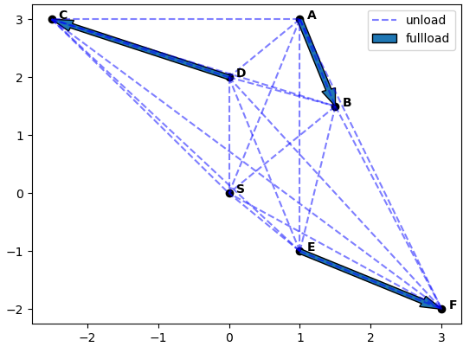
Visualization of all loaded and unloaded road sections
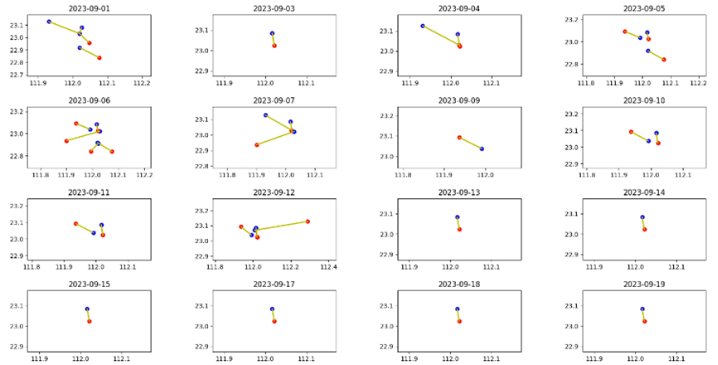
The location coordinates and routes of the shipping and receiving points of daily transportation orders. Red is the starting point and green is the end point.
-
Algorithm engine module: Includes main problem and sub-problem algorithm engine components.
The algorithm engine module integrates the optimization solution solutions of the two major scenario modules based on the column generation method. Module one isSingle garage and single battery swapping station(Can only exchange electricity in the garage) scenario, the optimization goal is to find the minimum number of freight vehicles that can transport all the goods to the end of the goods. Module 2 isMultiple garages and multiple battery swap stations(Battery can be exchanged at a battery exchange station outside the garage) scenario, the optimization goal is to minimize the energy consumption of completing all orders. The vehicle dispatching is optimized according to the scenario through two modules, and all the transportation tasks of the enterprise are completed with the minimum total cost to help customers solve actual business problems.
We used the column generation method when designing the model and algorithm, and divided the original problem into two parts: the main problem and the sub-problem: the main problem takes minimizing the number of route executions, that is, minimizing the number of trucks, as the optimization goal, and takes transportation weight restrictions, demand satisfaction, etc. as constraints; the sub-problem takes maximizing the number of selected fully loaded road sections In order to optimize the goal, electricity, flow balance, etc. are used as constraints; find the feasible solution to the main problem and the optimal solution to the sub-problem, and check whether the solution to the sub-problem can improve the solution to the main problem. If so, add the solution to the sub-problem to the main problem, and iterate until the solution to the main problem is no longer improved, and then the optimal solution to the problem is obtained. At the same time, the elimination sub-loop design is also added to the algorithm.
This setAlgorithm advantagesWhen the constraints of the scheduling problem increase, the size of the variables will explode as the constraints increase, and the efficiency of exact solving algorithms such as the simplex method will drop significantly, while the column generation algorithm willSuitable for large-scale problems, can also provide effective solutions to problems containing thousands of variables and constraints, andHigh flexibility, which can be adjusted according to the characteristics of the problem to adapt to different optimization needs and supportparallel processingand easy to implement,High computational efficiency。
-
Visualization module: Including order data visualization and dispatch route visualization, mainly providing services to clients.
At the same time, the system has multiple interfaces to connect to third-party systems:
-
Order information input interface: Connect with TMS system and platform system through this interface to read waybill data.
-
Battery swap station information input interface: Connect with the battery swap station management system through this interface to read information such as site location, battery number, and lane changing time.
-
Capacity management interface: Connect with the vehicle management system (vehicle network, capacity database, etc.) through this interface to read the vehicle’s real-time location, battery capacity, serial number, driver and other information.
-
Solution output interface: Connect with the TMS system and driver APP through this interface to generate dispatch instructions.
[Introduction to calculation examples]
Taking the scenario of a single garage and a single battery swapping station (power can only be swapped in the garage) as an example, it is known that:
(1) Starting point and quantity of cargo transportation
(2) Distance between transportation locations
(2) Vehicle maximum load capacity and power consumption
Find the minimum number of delivery vehicles that can complete the transportation task as scheduled
Using an integer programming algorithm based on column generation and calling the Google OR-tools solver, the number of freight shipments and routes of the vehicle can be quickly obtained. The figure below is a visual display of the transportation plan, in which
-
Garage location: point S, starting and ending points of two freight orders: D→C, A→B
-
The arrow indicates the direction of travel of the vehicle
-
The blue line segment is an unloaded road segment, the red line segment is a fully loaded road segment, and the number on the line segment is the number of trips on the transportation road segment.
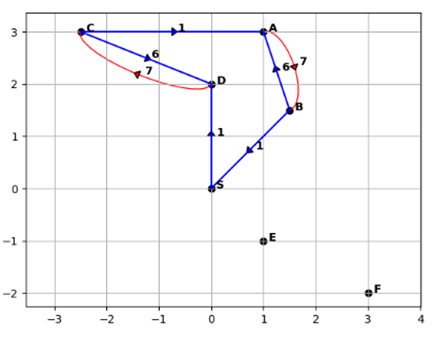
Transportation solution visualization example
In the picture above, we can see that the vehicle starts from point S (garage), arrives at the freight starting point D, and travels between C and D. After completing the order task, it goes to the next freight starting point A, and travels between A and B. After all tasks are completed, it returns to the garage.
【Summary】
Regarding the transportation capacity scheduling problem of new energy vehicles for logistics companies, users only need to input waybills, transportation capacity, charging and discharging data and corresponding constraints. With the help of our proposed algorithm, we can obtain an efficient transportation capacity scheduling plan, rationally arrange vehicle dispatching and charging and swapping, reduce distance and time costs, and improve distribution efficiency and customer satisfaction.
[Recommended reading & extended thoughts]
[Paper Recommendation] Hou Hui of Wuhan University of Technology and others: Multi-agent day-ahead bidding strategy for electric vehicle aggregators taking into account demand response potential
As a mobile electrochemical energy storage resource, electric vehicles have the potential to be used as flexible resources. If electric vehicles participate in the future business model and construction system of the power market, how should demand response and charge and discharge planning be considered in the EVRP problem? We hope readers with ideas can join our innovation group to discuss and research together!

In addition, thanks to Liu Zunzeng, Liu Zhen, and Tian Zhihua, our free tsp has been launched, and the calling method is as follows:
We will launch a more convenient calling method in the future
Help truck drivers and self-driving travelers with route planning
Extraction code 7000 (corresponds to 7000 rare diseases)
1. Enter: http://47.102.146.120:3504/
2. Enter the Json file: (see the link below for a sample):
3. Wait a few seconds to get the output Json and image. (See the link below for samples):
Link: https://pan.baidu.com/s/1UIolGjkekuM7UK4HVfn3Pg?pwd=7000
If you have new energy vehicle dispatching needs, please feel free to inquire.
Contact: Zhang Xinjie Mobile: 13311931669
Email: [email protected]
Personal WeChat

Welcome to click on the official account to follow more intelligent decision-making case sharing
[Jiuzhang Intelligent Decision-making Solution] Warehousing Integration Optimization
[Jiuzhang Intelligent Decision-making Solution] Order Wave Picking
[Jiuzhang Intelligent Decision-making Solution] Vehicle Path Planning (VRP)
[Jiuzhang Intelligent Decision-making Solution] 3D-BPP Visualization Algorithm Solution
(Cover image source: Yu Guoqiang)
Machine-translated from the Chinese original 【久章智能决策方案】之新能源车的物流智能调配系统 (published 2024-06-24). WeChat original ↗