This article is aboutRefinery Optimization ProblemScenarios, models, solution results and modeling techniques.

1. Problem description
A refinery purchases two crude oils (Crude Oil 1 and Crude Oil 2). The crude oil goes through four processes: distillation, reforming, cracking and blending to produce gasoline and fuel for sale.
1. Distillation
Distillation separates each crude oil into fractions called light naphtha, medium naphtha, heavy naphtha, light oil, heavy oil, and residual oil based on boiling point. Light, medium, and heavy naphtha have octane numbers of 90, 80, and 70 respectively. The table below gives the proportions of each component in each crude oil:
[Additional knowledge: The octane number of gasoline (Octane Rating) is an indicator of the anti-knock performance of gasoline. It indicates the ability of gasoline to resist self-ignition (i.e. knocking) when burned in an internal combustion engine. The higher the octane number, the better the anti-knock performance of the gasoline, and the less likely the engine will knock when running at a high compression ratio]

(Note: There is a small amount of waste during the distillation process.)
2. Reforming
Naphtha can be used immediately for blending into different grades of gasoline, or it can go into reforming. Reforming produces reformate gasoline, which has an octane rating of 115. The reformed gasoline yield per barrel of different types of naphtha is as follows:
1 barrel of light naphtha produces 0.6 barrels of reformed gasoline;
1 barrel of naphtha produces 0.52 barrels of reformed gasoline;
One barrel of heavy naphtha produces 0.45 barrels of reformed gasoline.
3. Cracking
These oils (light and heavy) can be blended directly into jet fuel or fuel oil, or they can be fed into the catalytic cracking process. Catalytic crackers produce cracked oil and cracked gasoline. Cracked gasoline has an octane rating of 105.
1 barrel of light oil produces 0.68 barrels of cracked oil and 0.28 barrels of cracked gasoline;
One barrel of heavy oil produces 0.75 barrels of cracked oil and 0.2 barrels of cracked gasoline.
Cracked oil is used to blend fuel oil and jet fuel; cracked gasoline is used to blend gasoline.
Residual oil can be used to produce lubricants or to blend jet fuel and fuel oil:
Each barrel of residual oil produces 0.5 barrels of lubricating oil.
4. Blending
(1) Gasoline (auto fuel)
There are two types of gasoline, regular and premium, which are a blend of naphtha, reformate gasoline, and pyrolysis gasoline. The only rule about them is that regular gasoline must have an octane rating of at least 84 and premium gasoline must have an octane rating of at least 94. Octane is assumed to mix linearly by volume.
(2) Jet fuel
The regulation for jet fuel is that its vapor pressure must not exceed 1 kilogram square centimeter. The vapor pressures of light oil, heavy oil, cracked oil and residual oil are 1.0, 0.6, 1.5 and 0.05 kg cm 2 respectively. It can again be assumed that vapor pressure mixes linearly with volume.
(3) Fuel oil
To produce fuel oil, light oil, cracked oil, heavy oil and residual oil must be mixed in a ratio of 10:4:3:1.
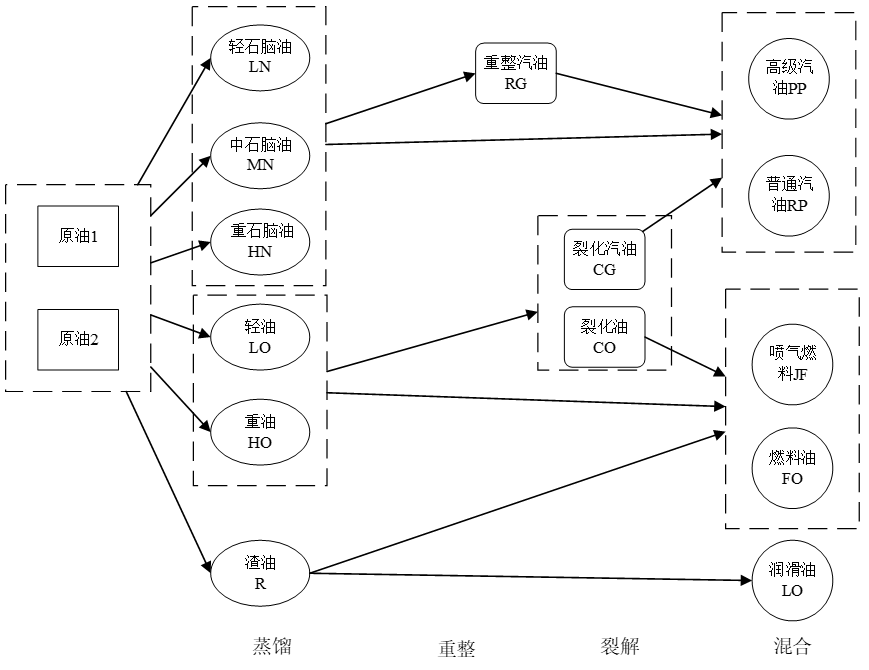
Crude oil conversion process diagram
There are availability and capacity limitations on quantities and processes used, as follows:
1. The daily supply of crude oil 1 is 20,000 barrels.
2. The daily supply of crude oil 2 is 30,000 barrels.
3. It can distill up to 45,000 barrels of crude oil per day.
4. Can reform up to 10,000 barrels of naphtha per day.
5. Can crack up to 8,000 barrels of oil per day.
6. The daily output of lubricating oil must be between 500 and 1,000 barrels.
7. Premium automotive fuel production must be at least 40% of conventional automotive fuel production.
Profit contribution from final product sales (in pence/barrel) is as follows:
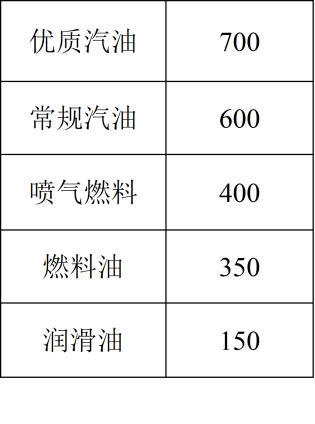
How should refinery operations be planned to maximize total profits?
2. Solving
The petroleum industry is a major user of linear programming models. This is a very small part of a typical application. Typically, the model used will consist of thousands of constraints, possibly connecting more than one refinery together.
1. Variables
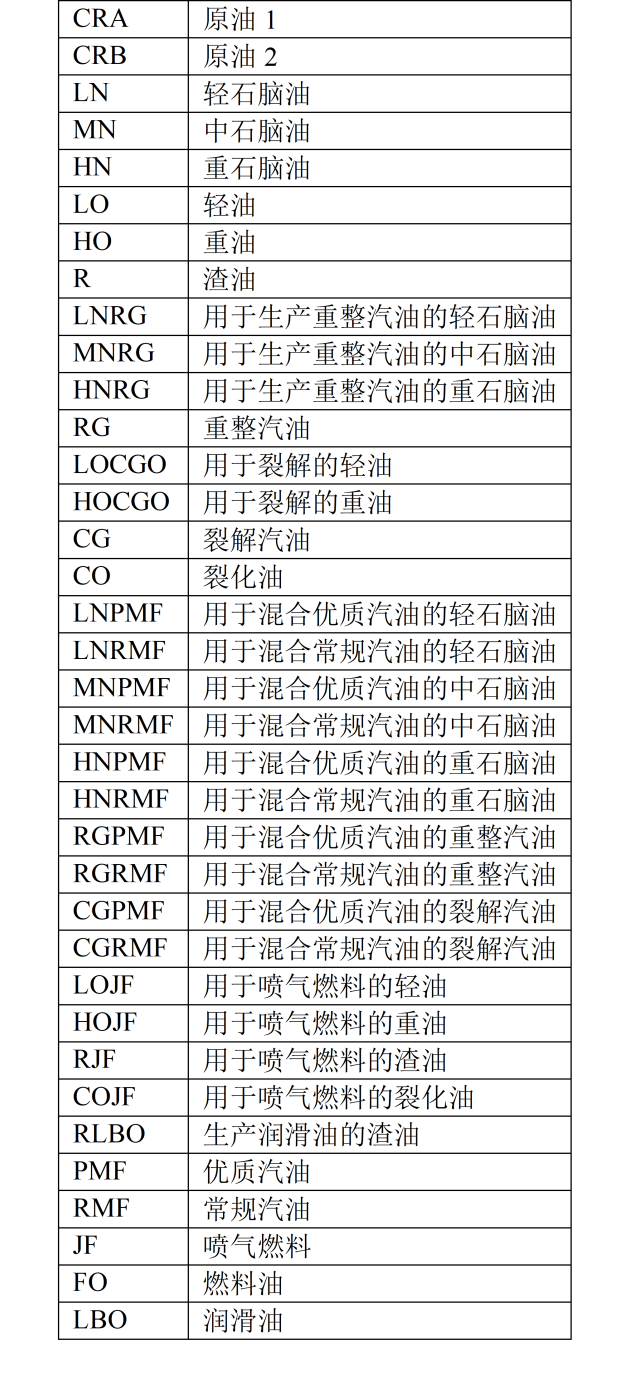
Considering that there are many different kinds of variables in such a model, it is convenient to use mnemonic names when describing formulas. The following variables are used to represent the quantity of material in barrels:
2. Constraint availability
The finite supply of crude oil provides a simple upper bound:

Capability constraints
Distillation capacity constraints:

Reorganization ability constraints:

Disintegration capacity constraints:

Regulations on lubricant production give the following lower and upper bounds:

Continuity:
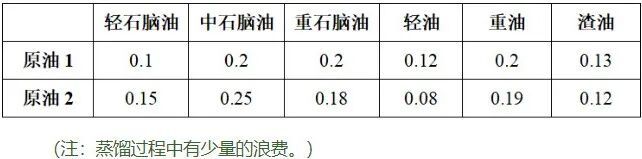
The yield of light naphtha depends on the amount of crude oil used, taking into account how each crude oil separates under distillation. This gives:

Similar constraints exist for MN, HN, LO, HO and R.
-0.2CRA-0.25CRB+MN=0
-0.2CRA-0.18CRB+HN=0
-0.12CRA-0.08CRB+LO=0
-0.2CRA-0.19CRB+HO=0
-0.13-0.12CRB+R=0
The amount of reformated gasoline produced depends on the amount of naphtha used in the reforming process. This gives the constraints:

The amount of pyrolysis oil and pyrolysis gasoline produced depends on the amount of light oil and heavy oil used. This gives the constraints:

The production (and sales) volume of lubricating oil is 0.5 times the amount of residual oil used. This gives:

The amount of light naphtha used for reforming and blending is equal to the amount available. This gives:

Similar constraints exist for MN and HN.
-MN+MNRG+MNPMF+MNRMF=0
-HN+HNRG+HNPMF+HNRMF=0
The amount of light oil used for cracking and blending is equal to the amount available.This gives:
-LO+LOCGO+LOJF+0.55FO=0
Distilled light oil is used for cracking (LOCGO), jet fuel production (LOJF) and fuel oil production.For fuel oil blending, the proportion of light oil is fixed at 10/18. Therefore, a separate variable is not introduced here, that is, the light oil used to produce fuel oil, but is directly expressed as the proportion of light oil occupying fuel oil.
Similar restrictions exist for HO, CO and R, also involving fixed ratios of FO, and CG and RG.
-HO+HOCGO+HOJF+3/18FO=0
-CO+COJF+4/18FO=0
-R+RJF+1/18FO+RLBO=0
-CG+CGRMF+CGPMF=0
-RG+RGRMF+RGPMF=0
The amount of premium motor fuel produced is equal to the total amount of its ingredients. This gives:

Similar limitations exist for RMF and JF.
-LNPMF-MNRMF-HNRMF-RGRMF-CGRMF+RMF=0
-LOJF-HOJF-COJF-RJF+JF=0
Premium motor fuel production must be at least 40% of conventional motor fuel production,

Quality
It is necessary to stipulate that the octane number of premium automotive fuels should not be lower than 94. This is accomplished by the following constraints:

(Volume can be seen as a weight coefficient. After weighted summation, it is divided by the total amount, that is, PMF<=94)
RMF has similar restrictions.
-90LNPMF-80MNRMF-70HNRMF-115RGRMF-105CGRMF+84RMF<=0
For jet fuel, we have a limit on vapor pressure.

The model has 29 constraints, as well as simple bounds on three variables.
3. Objective function
The only variable involved in profit (or cost) is the final product. This gives the target (in pounds) to maximize,

3. Solving
The profit of the optimal solution is £211,365.
The optimal values for the variables defined in part 3 are as follows:
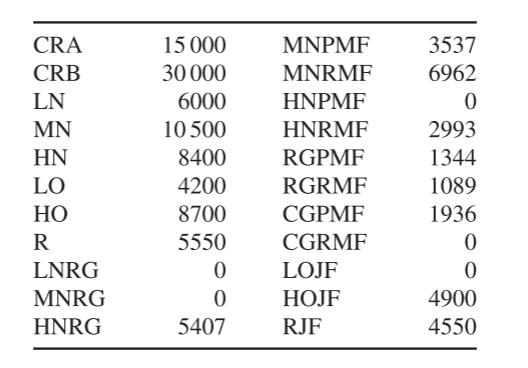
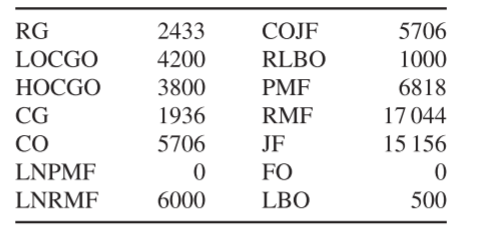
4. Display of refinery optimization problem page display
5. Modeling tips
Modal formulations are used to reduce the number of constraints
In this problem, for fuel oil blending, the components (light oil, heavy oil, cracked oil and residual oil) are mixed in fixed proportions.Here, it is best to think of the production of FO as a fixed activity. This is the modal formulations approach, where activities represent extreme modes of operation of a process.In the oil industry, it is common to think in terms of activities rather than volumes.In this case, the quantity of the activity automatically fixes the quantity of each component proportionally.
Example of modal formula:
In large LP problems, modal formulations can be used to reduce the number of constraints. If a set of constraints involves only a few variables, the feasible region of the space of these variables can be considered. For example, suppose x_A and x_B are two (non-negative) variables in the LP model, and they appear in the following constraints:
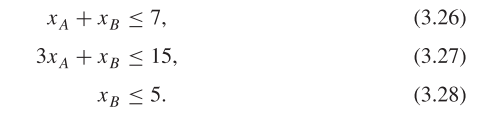
As shown in Figure 3.3, this situation can be simulated by using variables instead of x_A and x_B to represent the activities of the "extreme operating mode". If these variables are λ0, λ1, λ2, λ3, and λ4, we only need to specify a single constraint.
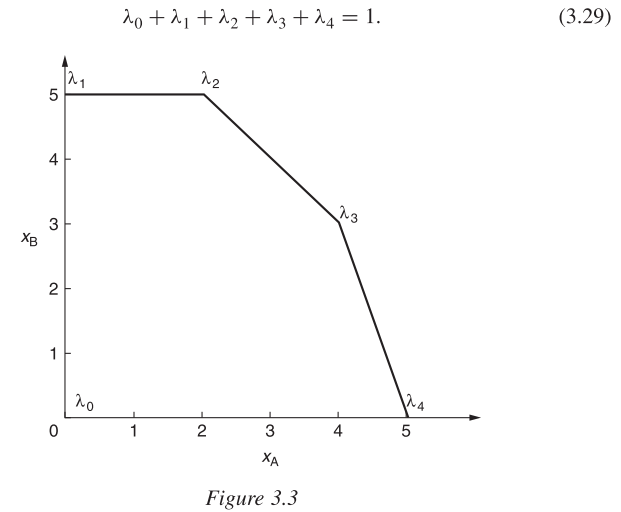
When x_A and x_B appear in other parts of the model, in addition to the constraints (3.26), (3.27) and (3.28) which are now ignored, we replace the following expressions:

For x_A, the coefficients of λ1, λ2,... are the corresponding values on the x_A axis in Figure 3.3. Similarly, for x_B, the coefficients of the replaced variables are the values corresponding to the x_B axis.
In this case, we save two constraints. Clever use of this idea can significantly save the number of constraints in the model.
References
[1] Williams, H. P. (2013). Model Building in Mathematical Programming (5th ed.). Wiley.

Machine-translated from the Chinese original 炼油厂优化 Refinery Optimization (published 2024-09-11). WeChat original ↗