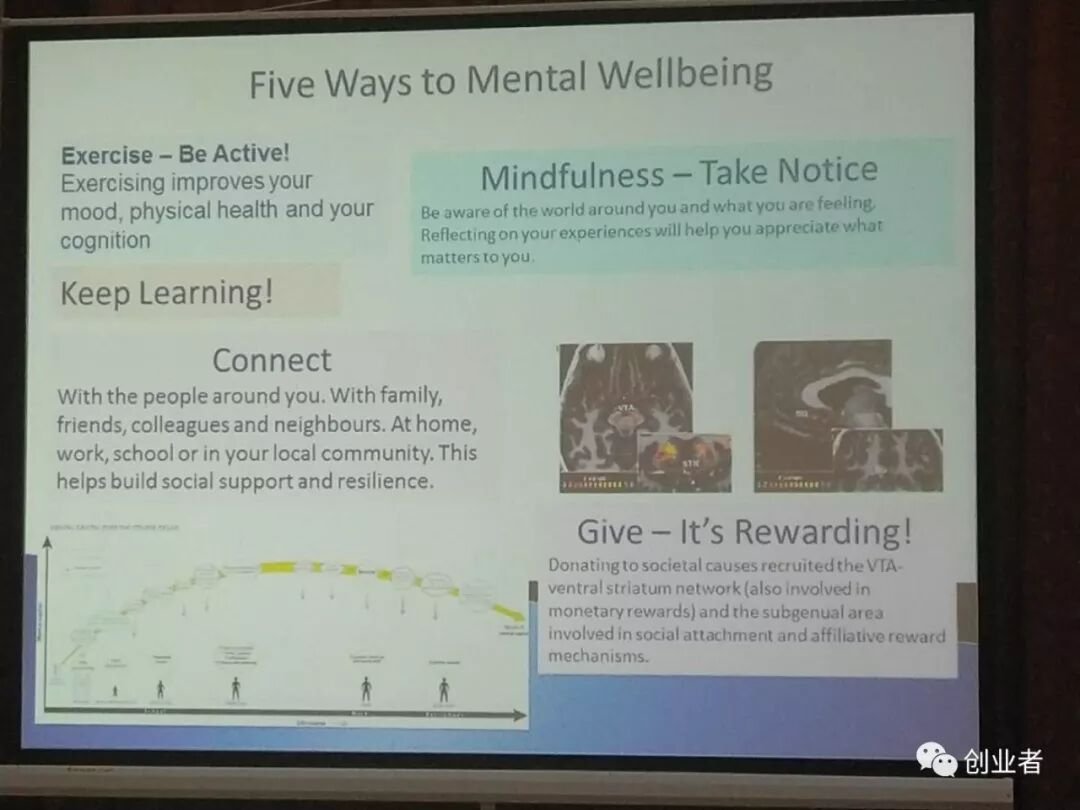
五个保持幸福的方法
-
运动
-
不断学习
-
保持联系
-
专注当下:做笔记
-
回馈社会 :以自己舒适的方式。
Five ways to mental wellbeing:
Exercise
Keep learning
Connect
Mindfulness-take notice
Give-it’s rewarding
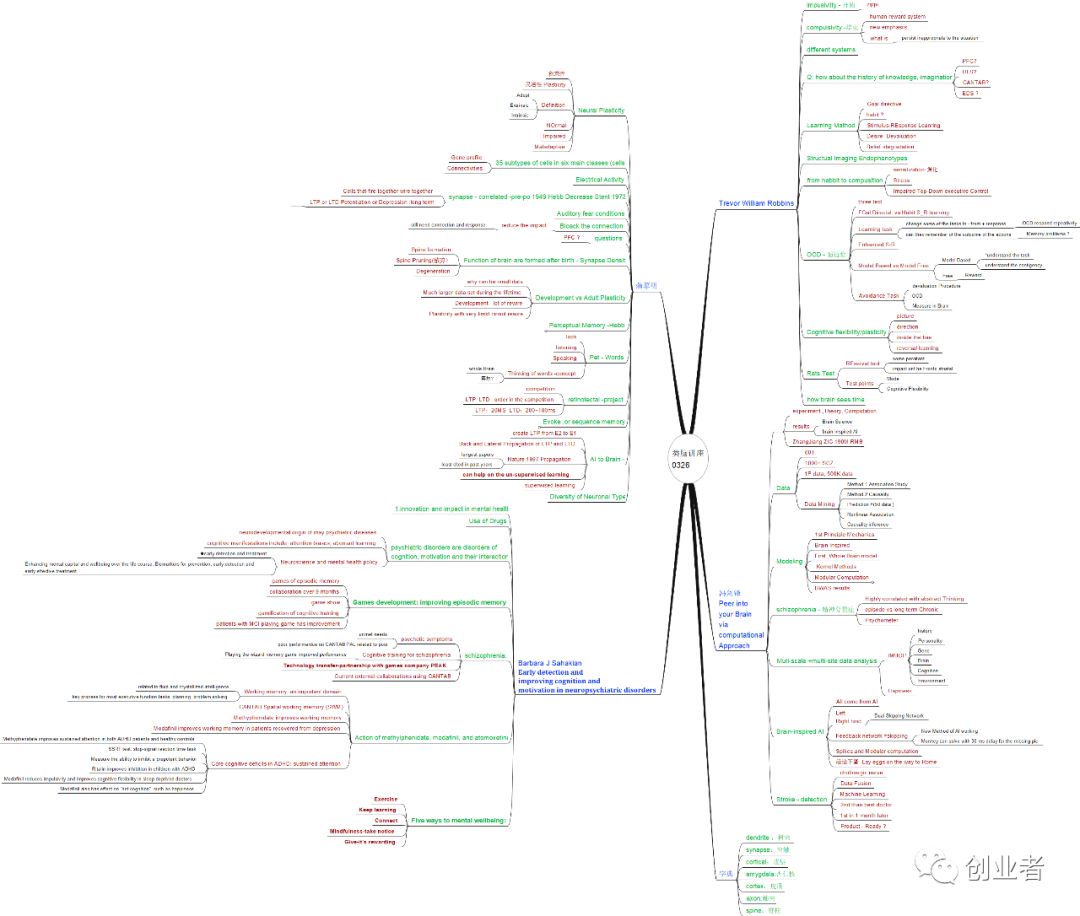
类脑讲座
0326
1 蒲幕明
1.1 Neural Plasticity
1.1.1 稳态性
1.1.2 灵活性 Plasticity
1.1.3 DefinitionAdoptExtrinsicIntrinsic
1.1.4 NOrmal
1.1.5 Impaired
1.1.6 Maladaptive
1.2 35 subtypes of cells in sixmain classes (cells)
1.2.1 Gene profile
1.2.2 Connectivities
1.3 Electrical Activity
1.4 synapse - correlated -pre-po1949 Hebb Decrease Stent 1973
1.4.1 Cells that fire together wiretogether
1.4.2 LTP or LTD Potentiation orDepression :long term
1.5 Auditory fear conditions
1.6 Bloack the connection
1.6.1 reduce the impact
still needconnection and response
1.7 questions
1.7.1 PFC ?
1.8 Function of brain are formed afterbirth - Synapse Density
1.8.1 Spine formation
1.8.2 Spine Pruning(修剪)
1.8.3 Degeneration
1.9 Development vs Adult Plasticity
1.9.1 why can be small data
1.9.2 Much larger data set during thelifetime
1.9.3 Development - lot of rewire
1.9.4 Plasiticity with very limktcirsuit rewire
1.10 Perceptual Memory -Hebb
● How Perceptual Memory
● Visual Feature
○ different Color etc
○ Assemble them
○ Remember grandmother's face
■ strengthening connection
■ activating partial assemblies
○ Face recognization
● Concept
○ Features
○ connection
○ Imvoke the whole brain
1.11 Pet - Words
1.11.1 look
1.11.2 listening
1.11.3 Speaking
1.11.4 Thinking of words -conceptwhole Brain
冥想?
1.12 retinotectal -project
1.12.1 competition
1.12.2 LTP LTD . order in thecompetition
1.12.3 LTP:20MSLTD:200~100ms
1.13 Evoke ,or sequence memory
● pre - strength
● Conditional with moving ball
● Anesthetized >awake ?
● Mass learning
● Spaced Learning - 5 min pick time Optimal intervals
● Back Prop Algorithm . - NO As there is no working method for thenatural network
1.14 AI to Brain -
1.14.1 create LTP from E2 to E1
1.14.2 Back and Lateral Propagation ofLTP and LTD
1.14.3 Nature 1997 Propagation --
longest papers
least cited inpast years
1.14.4 can help on the un-superwisedlearning
1.14.5 superwised learning
1.15 Diversity of Neuronal Type
2 Barbara J Sahakian Earlydetection and improving cognition and motivation in neuropsychiatric disorders
2.1 1. innovation and impact in mentalhealth
2.2 Use of Drugs
2.3 psychiatric disorders aredisorders of cognition, motivation and their interaction
2.3.1 neurodevelopmental origin ofmay psychiatric diseases
2.3.2 cognitive manifestationsinclude: attention biases, aberrant learning
2.3.3 Neuroscience and mental healthpolicy
earlydetection and treatment
Enhancingmental capital and wellbeing over the life course. Biomarkers for prevention,early detection and early effective treatment
2.4 Games development: improvingepisodic memory
2.4.1 games of episodic memory
2.4.2 collaboration over 9 months
2.4.3 game show
2.4.4 gamification of cognitivetraining
2.4.5 patients with MCI playing gamehas improvement
2.5 schizophrenia
2.5.1 psychotic symptomsunmet needs
poorperformentce on CANTAB PAL related to poor
2.5.2 Cognitive training forschizophrenia
Playing thewizard memory game improved performance
2.5.3 Technology transfer-partnershipwith games company PEAK
2.5.4 Current external collaborationsusing CANTAB
2.6 Action of methylphenidate,modafinil, and atomoxetine
2.6.1 Working memory: an importantdomain
related tofluid and crystallized intelligence
key process formost executive function tasks, planning, problem solving
2.6.2 CANTAB Spatial working memory(SWM)
2.6.3 Methyphenidate improves workingmemory
2.6.4 Modafinil improves workingmemory in patients recovered from depression
2.6.5 Core cognitive deficits inADHD: sustained attention
Methyphenidateimproves sustained attention in both ADHD patients and healthy controls
SSRT test:stop-signal reaction time task
Measure theability to inhibit a prepotent behavior
Ritalinimproves inhibition in children with ADHD
Modafinilreduces impulsivity and improves cognitive flexibility in sleep depriveddoctors
Modafinil alsohas effect on “hot cognition”, such as happiness
2.7 Five ways to mental wellbeing:
2.7.1 Exercise
2.7.2 Keep learning
2.7.3 Connect
2.7.4 Mindfulness-take notice
2.7.5 Give-it’s rewarding
3 Trevor William Robbins
3.1 impusiviity - 开始
3.1.1 zippi
3.2 compulsivity -结束
3.2.1 human reward system
3.2.2 new emphasiis
3.2.3 what is
persistinappropriate to the situation
3.3 different systems
3.4 Q: how about the history ofknowledge, imagination
3.4.1 PFC?
3.4.2 DLS?
3.4.3 CANTAB?
3.4.4 EDS ?
3.5 Learning Mathod
3.5.1 Goal directive
3.5.2 habit ?
3.5.3 Stimulus-REsponse Leanring
3.5.4 Desire -Devaluation
3.5.5 Belief -degradation
3.6 Structual ImagingEndophenotypes
3.7 from habbit to compusition
3.7.1 sensitization-强化
3.7.2 Stress
3.7.3 Impaired Top-Down executiveControl
3.8 OCD - 强迫症
3.8.1 three test
3.8.2 FOal Directal vs Habit S_Rlearning
3.8.3 Learning task
change some ofthe tasks to - from + response
OCD respondrepeatively
can theyremember of the outcome of the actions
Memory problems?
3.8.4 Enhanced S-R
3.8.5 Model Based vs Model FreeModel Based
*understand thetask
understand thecontigency
Free
Reward
3.8.6 Avoidance Task
devaluationProcedure
OCD
Measure inBrain
3.9 Cognitiveflexibility/plasticity
3.9.1 picture
3.9.2 direction
3.9.3 inside the line
3.9.4 reversal leanring
3.10 Rats Test
3.10.1 REserval test
some persitant
impact ont he Frontostriatal
3.10.2 Test pointsMode
CognitiveFlexibility
3.11 how brain sees time
4 冯剑锋 Peer into your Brain via computational Approach
4.1
4.1.1 experiment ,Theory, Computation
4.1.2 results
Brain Science
brain-inspiredAI
4.1.3 ZhangJiang ZIC 190M RMB
4.2 Data
4.2.1 60T
4.2.2 1000+ SCZ
4.2.3 1P data, 500K data
4.2.4 Data Mining
Method 1Association Study
Method 2Causality
Prediction F(50data )
NonlinearAssociation
Causalityinference
4.3 Modeling
4.3.1 1st Principle Mechanics
4.3.2 Brain Inspired
4.3.3 First Whole Brain model
4.3.4 Kernel Methods
4.3.5 Modular Computation
● Own feature, works together to achieve a holistic goal
● Searching the root
● Depression
4.3.6 BWAS results
4.4 schizophrenia - 精神分裂症
4.4.1 Highly correlated with abstractThinking
4.4.2 episode vs long term Chronic
4.4.3 Psychometer
4.5 Muti-scale +multi-site dataanalysis
4.5.1 IMUDPhistoryPersonalityGeneBrainCognition
Environment
4.5.2 Hapiness
4.6 Brain-inspired AI
4.6.1 All come from AI
4.6.2 Left Right hind
Dual SkippingNetwork
4.6.3 Feedback network =skipping
New Method ofAI working
Monkey cansolve with 30 ms delay for the missing pic
4.6.4 Spikes and Modular computation
4.6.5 沿途下蛋 -Lay eggs on the way to Rome
4.7 Stroke - detection
4.7.1 cholinergic nerve
4.7.2 Data Fusion
4.7.3 Machine Learning
4.7.4 2nd than best doctor
4.7.5 1st in 1 month later
4.7.6 Product - Ready ?5 字典
5.1 dendrite :树突
5.2 synapse:突触
5.3 cortical:皮层
5.4 amygdala:杏仁核
5.5 cortex:皮质
5.6 axon:轴突
5.7 spine:脊柱
本文转载自久章智能微信公众号(原文发布于 2018-03-28),内容保持原貌。扫码关注公众号「久章智能」,第一时间获取系列文章。阅读原文 ↗