Faculty
When the departments were reorganized in 1952, the Department of Mathematics of Fudan University was formed by merging the mathematics group of the Department of Mathematics and Physics of Fudan University and the mathematics departments of four universities, including Zhejiang University, Tongji University, Jiaotong University and Datong University. Article "The Directory of Personnel Changes in Fudan University Adjusted by Departments in 1952"[1], which lists in detail the faculty, staff and students who were transferred from various universities to the Department of Mathematics at Fudan University between September and October 1952. The faculty members are now transcribed as follows:
“Yang Wuzhi (professor) and Wang Guangshu (assistant teacher) were transferred from Tongji University.
Professors Lu Qingjun, Su Buqing, Chen Jiangong, Zhang Sucheng, lecturers Zhu Liangbi, Jin Fulin, teaching assistant Xia Daoxing, and co-worker Ma Bingxin were transferred from Zhejiang University.
Assistant teacher Hu Ke was transferred from Beijing Institute of Mechanized Agriculture.
Teaching assistants Lai Zenggui and Qiu Huanzhang were transferred from Guangxi University.
Teaching assistants Mai Xuexian and Huang Shufang, and technician Gu Caigen were transferred from Shanghai Industrial College.
Teacher Li Fumian was transferred from Shixi Middle School.
Assistant professor Xie Lanan was transferred from Soochow University (Suzhou).
Professor Cui Mingqi was transferred from the Statistics Department of our school. "
A list of the Mathematics Department faculty and staff at the end of 1952 is shown in Appendix 1. The faculty of the Department of Mathematics at Fudan University is unprecedentedly strong. There are seven professors who have served as deans of the University’s Department of Mathematics (or Department of Mathematical Sciences)—Chen Jiangong, Su Buqing, Lu Qingjun, Yang Wuzhi, Chen Chuanzhang, Zhou Huaiheng, and Zhou Muxi. After the adjustment of departments, Su Buqing served as the dean of the school, and Professor Chen Chuanzhang served as the head of the Department of Mathematics. Professors Chen Jiangong and Su Buqing have long been famous at home and abroad. Chen Chuanzhang and Zhou Muxi have been described in the article "Department of Mathematics and Science from 1941 to 1952". Here we only give a brief introduction to Yang Wuzhi, Zhou Huaiheng and Lu Qingjun.
Yang Wuzhi, born in 1896, received a master's degree from Stanford University in the United States in 1924 and a doctorate from the University of Chicago in 1928. After returning to China, he served as a professor at Xiamen University, Peking University, and Tsinghua University, and served as the director of the Department of Mathematics at Tsinghua University and the director of the Department of Mathematics at Southwest Associated University. Specializes in number theory and algebra. The famous mathematicians Chen Shengshen and Hua Luogeng both took Mr. Yang's "Group Theory" class at Tsinghua University. Hua Luogeng said in a letter to Mr. Yang, "The ancients said that my parents gave birth to me, Uncle Bao knew me, and my Uncle Bao is Yang's teacher." Chen Shengshen said in the article "My Destiny with Two Generations of the Yang Family" that "Mr. Yang Wuzhi is my most reliable friend in school, and it was he who facilitated my marriage to Shi Ning."
Zhou Huaiheng, born in 1905, was given the courtesy name Boping. He graduated from the Department of Mathematics of Southeast University in 1929 and went to Cambridge University in England in 1945 for further study. After returning to China in 1947, he worked as a professor at Nanchang National Chung Cheng University and Wuxi Jiangnan University. In 1948, he was appointed as the director of the Department of Mathematics and Physics of Jiangnan University. In 1949, he was appointed as a professor of the Department of Mathematics and Physics of Fudan University. Specializes in series theory and mathematics education.
Lu Qingjun, born in 1913, graduated from the Department of Mathematics of Zhejiang University in 1936 and stayed at the school as a teaching assistant, lecturer and associate professor. He went to the University of Chicago to study in the United States in 1946, received his doctorate in 1948, and remained as a researcher. In 1949, he returned to Zhejiang University as professor, director of the Department of Mathematics and director of the Institute of Mathematics. Specializes in function theory, probability theory, mathematical statistics and their applications.
In addition to greatly strengthening the teaching staff, a large number of books and materials have also been transferred from various schools. For example, 27 large boxes of thousands of books and more than 50 important foreign language journals have been transferred from Zhejiang University.
Whether it is the Department of Mathematical Sciences or the Department of Mathematics, photos of all faculty and staff have not yet been discovered. One of the two photos below was taken in September 1952 when the department was adjusting and sending off teachers who were transferred to other schools. The other is a group photo taken in 1955 to see off Zhou Muxi and three other teachers as they went to support Lanzhou University.
During the restructuring of departments, a group of teachers from the Department of Mathematics and Science of Fudan University were deployed to other universities. Article "The list of personnel changes in Fudan University adjusted by departments in 1952"[1]There is no list of mathematics teachers that we can call out from another article[2]Saw a related photo.
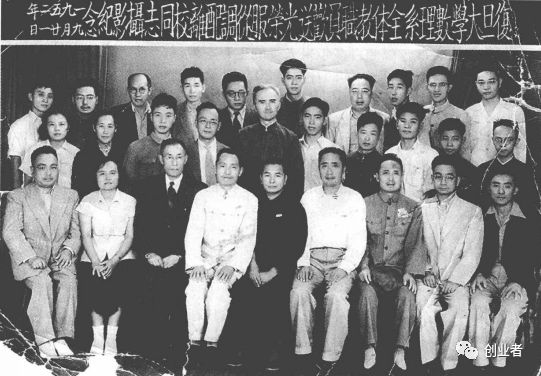
The article[2]The author is the daughter of Mr. Fan Jiping, associate professor of the Department of Mathematics. Based on the photo, he contacted the list of the Department of Mathematics and Physics. Now we know that the mathematics teachers transferred at that time were: Cheng Jitai, Li Ruifu, Fan Jiping and Tan Tongkun. Cheng Jitai graduated from the Department of Mathematics and Astronomy of Sun Yat-sen University in 1949, and in 1951 he worked as a teaching assistant in the Department of Mathematics and Physics of Fudan University. He was transferred to the mathematics teaching and research group of Jiaotong University and later became a professor of applied mathematics. From 1976 to 1995, he made important contributions to the reconstruction and development of the Department of Mathematics (Department of Applied Mathematics) of Jiaotong University.[3]. Li Ruifu (formerly known as Li Fan) graduated from Central University in 1929 and served as a professor at Chongqing University and other universities. In 1952, he was transferred from Fudan University to Vice Provost and Professor of Mathematics Department of East China Normal University. Expertise in complex functions[4]. Associate Professor Fan Jiping first taught at East China Normal University and was transferred to Shanghai Normal College in 1953. He was a member of the preparatory committee of Shanghai Normal University and later served as deputy director of the mathematics department of Shanghai Normal University. Only Associate Professor Tan Tongkun's situation is unknown. It is reported on the Internet that he taught at Yangzhou Normal College, which later developed into Yangzhou Normal University.
In 1955, Fudan University sent 7 people to support Lanzhou University, 4 of whom were from the Department of Mathematics. They were Zhou Muxi, Li Fumian, Xie Lanan, three teachers, and graduate Chen Xiangling. Zhou Muxi serves as professor and director of the Department of Mathematics at Lanzhou University. The photos below record the farewell scene for them. The photo was provided by Xu Danyun and Xu Liang, the children of Professor Xu Zisheng.
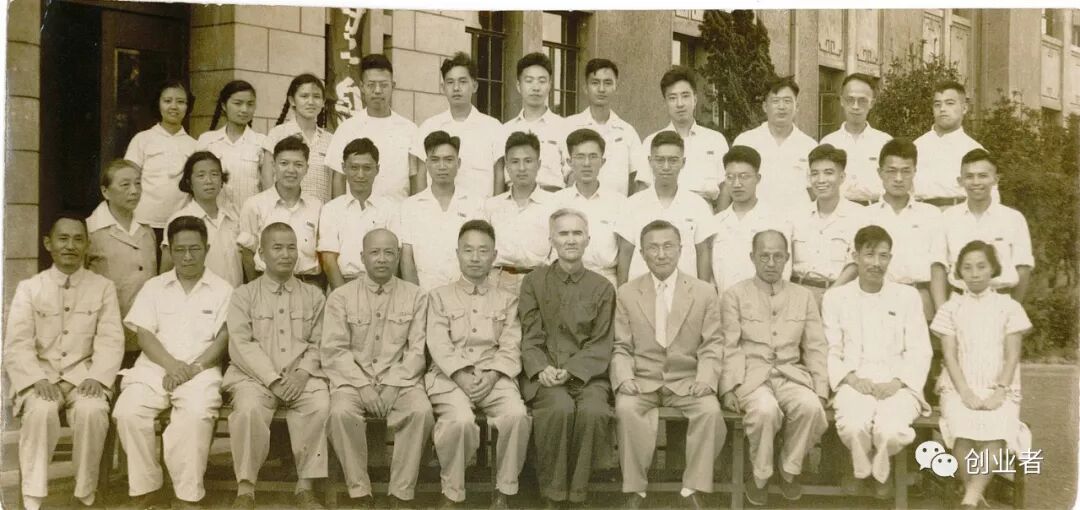
Front row from left: Sun Zhenxian, Chen Chuanzhang, Huang Yuanfang, Su Buqing, Li Fumian, Zhou Muxi, Chen Jiangong, Zhou Huaiheng, Cui Mingqi, Zhu Liangbi
Zhong Sheng Zuxin Wang Guangshu Gu Chaohao Hu Jiagan Qiu Huanzhang Mai Xuexian Jiang Furu Xia Daoxing Zheng Shaolian Xu Yisheng Ye Jingtang Jin Fulin
Hou Hu Hesheng Kai Ming Zong Yuexian Sun Baotai Xie Lan'an Xu Zisheng Wang Guozhen Shan Boxi Huang Yuren Huang Liede Lu Nianyi
It has been two years since we got the photo above. Although we have written out the names of the people in the photo with the help of many teachers, there is still one vacancy. Except for Professor Yang Wuzhi who was sick at home and did not attend the farewell, all professors and associate professors sat in the front row, and many teachers in the middle row and back row became the backbone of the school or college leaders. After the adjustment of departments, the teaching team of Fudan’s Department of Mathematics will mainly be supplemented by its own graduates. When there is a need for new subjects, young teachers are sent to Peking University or the Academy of Sciences for further studies. Due to the national conditions at that time, there were almost no introduction of various types of personnel from outside. Only in 1954, when the academic system was changed from a three-year system to a four-year system, four graduates were transferred from Northeastern Renmin University as postgraduate students. However, the following teachers were transferred from the Department of Mathematics of Fudan University: At the end of 1952, Professor Zhang Sucheng went to the Institute of Mathematics, Chinese Academy of Sciences, to take charge of the geometric topology group. In early 1953, Professor Lu Qingjun was transferred to the newly established Military Engineering College of the Chinese People's Liberation Army (Harbin Military Engineering College for short) and served as the director of the Advanced Mathematics Professors Association. In addition to transfers, of course, there were also transferred and new teachers after 1952. For example, Mr. Gu Chaohao was transferred to Fudan in 1953, and then made important contributions to Fudan and mathematics. In 1955, graduates Xu Yonghua and Bao Xuesong were sent to study in Germany to reserve teaching talents for Fudan University.
The history of the Department of Mathematics should not only record the teachers who have worked in the department for a long time, but also remember the teachers who once worked in the Department of Mathematics at Fudan and later left Fudan to shoulder the task of supporting national construction. They overcame various difficulties to complete the tasks assigned by the country. They not only made outstanding contributions in their own jobs, but also directly or indirectly expanded the influence of the Fudan Mathematics Department and improved the status of the Fudan Mathematics Department.
Curriculum
The urgent and primary job of the mathematics department is teaching. While the teaching team is strong, the student team has also grown: 32 students transferred from the Department of Mathematics of Zhejiang University, 29 from Tongji University, 27 from Jiaotong University, 3 from Datong University, plus original students majoring in mathematics from the Department of Mathematics and Physics of Fudan University, a total of about 100 people.
At that time, the office of the Department of Mathematics was located at No. 800 (now it has been demolished due to the construction of Metro Line 18). There were no electric bells to ring before and after class. A small copper bell was hung on the tree, and Master Ma would ring the bell to announce the beginning and end of get out of class. Technician Master Gu managed teaching models and other teaching supplies, and later also managed hand-cranked computers. He is responsible for the maintenance and repair of these supplies. Among the teaching models, the most impressive ones are the single-leaf hyperboloid and the saddle surface, both of which are composed of two clusters of straight lines.
The Department of Mathematics advocates teaching basic courses, and two masters, Chen and Su, developed the seminar method that Zhejiang University has implemented for many years in Fudan. They also proposed the concept of "chickens hatching ducks" and continued to innovate in scientific research and talent training. For details, please refer to the article[5]. Find the curriculum for the 1952 academic year from the archives[6]It can be seen in the article that the first grade is divided into two classes, A and B, and the second and third grade classes are divided into one class each. All professors and lecturers are responsible for basic courses. Analytical geometry was taught by Zhou Muxi, Sun Zhenxian and Xu Zisheng, calculus was taught by Chen Chuanzhang, Jin Fulin and Lu Qingjun, algebra was taught by Huang Yuanfang and Yang Wuzhi, differential equations was taught by Xia Daoxing, differential geometry was taught by Zhang Sucheng, real variable function theory was taught by Chen Jiangong, complex variable function theory was taught by Lu Qingjun, and advanced geometry was taught by Zhou Muxi. Zhu Liangbi and Zhou Huaiheng are the lecturers of advanced mathematics in the Department of Physics, and Cui Mingqi, Huang Yuanfang, and Jin Fulin are the lecturers of advanced mathematics in the Department of Chemistry. The third grade students are divided into five groups, and the seminars are directed by professors Su Buqing, Chen Jiangong, Lu Qingjun, Yang Wuzhi, and Zhou Huaiheng respectively.
Compared with the curriculum of the Department of Mathematics and Physics in 1951, major changes were made to the curriculum of the Department of Mathematics after the restructuring of departments in 1952. In 1952, the first-year curriculum added two courses, analytic geometry and algebra, based on calculus in 1951; the third-year curriculum added the theory of functions of real variables and special discussion courses on the basis of the theory of functions of complex variables and differential geometry. The theory of functions of real variables was a fourth-grade course in 1951, and in 1952 After the system was changed to a three-year system in 1952, the fourth-grade courses were set as third-grade courses. Therefore, the number of courses for both first-year and third-year students increased in 1952. Only the second-year courses included differential equations, advanced calculus, advanced algebra, advanced geometry, and advanced applied mathematics, minus the advanced applied mathematics course. Other courses remained unchanged.
1953 was the first year after the restructuring of departments. Professors' names appear on course schedules. Chen Chuanzhang, Mathematical Analysis (for second-year students in the Department of Mathematics, the same below); Yang Wuzhi, Advanced Algebra of Number 1; Number Theory of Number 3; Zhou Muxi, Analytical Geometry of Number 1, Differential Geometry of Number 3; Huang Yuanfang, Advanced Algebra of Number 1, Number 2 Advanced algebra; Zhou Huaiheng, mathematical analysis of numbers two, second-year advanced mathematics in the Department of Physics; Chen Jiangong, theory of real functions of numbers three, theory of functions of complex variables; Su Buqing, special discussion; Cui Mingqi, first-year and second-year advanced mathematics in the Department of Chemistry[7]. Compared with 1952, the first-year curriculum of the Department of Mathematics did not make any changes in 1953, while some changes were made to the second- and third-year courses. In 1953, all professors came to the front line of teaching. Except for two professors, Su Buqing and Chen Chuanzhang, who had heavy administrative work and only taught one course, the other professors taught two courses. They hope to use their lectures to arouse students' interest in mathematics and develop students' ability to think independently. At that time, the country was in urgent need of construction talents, and third-year students in many colleges and universities across the country were graduating early to join the workforce. Ye Jingtang, Zong Yuexian, Kai Ming, Zheng Shaolian and other graduates stayed in the department to work.
The 1954 curriculum included four-year arrangements, and it was not until 1955 that there were four-year graduates. In the past two years, the curriculum has also undergone some changes compared with the previous one, but the first-grade courses have basically remained unchanged since 1952. Some changes have basically occurred in senior grades above the first grade. In 1954, three new courses, mathematical physics equations, integral equations, and basic geometry, were added to the fourth-grade curriculum that had never appeared before. However, since the top-grade seminar class was established in 1952, it was almost never interrupted from 1952 to 1955.
Therefore, by comparing the curriculum of the Department of Mathematics after adjustments by departments, we can roughly summarize the following points: 1. Starting from 1952, the highest grade has offered a special discussion course, and this course has been offered almost every year since then. In the analysis of scientific research results below, we can see the advantages of this course The establishment of the Mathematics Department greatly promoted the academic research of the Department of Mathematics; 2. From 1952 to 1955, except for the first-year curriculum of mathematical analysis, analytic geometry, and advanced algebra, which basically never changed, the courses of the first-year and above grades basically had some changes, but the changes were not significant. The author's analysis is mainly due to the following two reasons: first, the change of the academic system from a three-year system to a four-year system has caused the curriculum of each grade to be balanced and some adjustments have occurred; second, after the adjustment of departments, the teaching has continued to explore and mature, so adjustments and attempts need to be made in the curriculum. Therefore, every change in the curriculum of the curriculum reflects the changes and attempts made by the Department of Mathematics after the adjustment of departments. It is these small changes that make the curriculum of the Department of Mathematics continue to mature.
Scientific research results
Under the leadership of two internationally renowned mathematicians, Chen Jiangong and Su Buqing, the Department of Mathematics, which has been restructured, has vigorously developed scientific research and achieved numerous scientific research results. Not only have teachers published a large number of academic papers, but students' scientific research abilities have also been cultivated. The academic atmosphere is very active and the research spirit is very hard. On the basis of the original two teaching and research groups - Function Theory Teaching and Research Group and Geometric Algebra Teaching and Research Group, the Department of Mathematics has established a differential equations teaching and research group (see Appendix 2). In 1956, the Institute of Mathematics at Fudan University was established, with Professor Su Buqing as its director. These provide organizational guarantees for a better march towards science.
The journal "Journal of Mathematics" sponsored by the Chinese Mathematical Society had a total of 4 issues in 1955 and published 39 papers, including 7 articles written by teachers from the Department of Mathematics of Fudan University (2 articles by Gu Chaohao, 1 article by Zhou Huaiheng, 1 article by Hu Hesheng, 2 articles by Xia Daoxing, and 1 article by Su Buqing). There were 4 issues in 1956, and 50 papers were published, including 17 papers written by teachers from the Department of Mathematics of Fudan University (1 article by Su Buqing, 5 articles by Gu Chaohao, 1 article by Zhou Huaiheng, 3 articles by Hu Hesheng, 3 articles by Xia Daoxing, 1 article by Xu Xiaobo, 1 article by Chen Jiangong, 1 article by Wu Zhuoren, and 1 article by Hu Jiagan). Let's look at the "Journal of Fudan University" (Natural Science Edition). When it was first published in 1955, there were 17 papers, of which 9 were mathematics papers. The first issue in 1956 contained 22 papers, of which 15 were mathematics papers. From the two sets of data we listed, we can see that during this period, the mathematics department was very active in scientific research activities at home or on campus. The academic results are also very gratifying. In the four years from 1952 to 1956, the two masters and the rapidly growing young backbone published more than 10 papers.
Professor Su Buqing's monograph "Introduction to Projective Curves" and Professor Chen Jiangong's monograph "Sum of Orthogonal Function Series" were published by the Chinese Academy of Sciences in 1954. They were both elected members of the Department of Mathematics, Physics and Chemistry of the Chinese Academy of Sciences in 1955. Together, they participated in the meeting to formulate the "1956-1967 Science and Technology Development Plan" convened by Premier Zhou Enlai and Vice Premier Chen Yi from the end of February to the end of March 1956. In addition, they also translated many Russian mathematical works. Professor Su Buqing translated 4 books including "Analytical Geometry", "Fundamentals of Geometry", "Cardan Foreign Formal Method" and "Geometry", and Professor Chen Jiangong translated 2 books "Some Problems in Single Leaf Functions" and "Geometric Theory of Complex Variable Functions". On June 25, 1956, Chen Jiangong, together with Hua Luogeng, Qian Xuesen, Wu Wenjun and other scientists, participated in the All-Soviet Mathematics Conference held at Moscow University. He gave a report entitled "Cesaro Convergence of Faber Polynomial Approximation" at the meeting. In the same year, two mathematicians, Su Buqing and Wu Wenjun, went to Sofia to attend the annual meeting of the Bulgarian Mathematical Society. Su Buqing gave a 45-minute report at the meeting, titled "Geometry of Area Space". Professor Su Buqing's project "K-expansion space and general metric space geometry and projective space curve theory" won the second prize of the National Natural Science Award in 1956.
Under the guidance of Professor Su Buqing, Lecturer Gu Chaohao studied the overall installation problem of affine contact space and Finsla space, and then studied the group invariant structure of geometric object fields. His scientific research achievements were outstanding. In 1956, he was elected as an advanced worker in Shanghai and the country, and attended the National Advanced Workers Congress. On May 27, 1956, the Fudan campus newspaper reported the news that he had returned from attending the Advanced Producers Conference. In the same year, he was promoted to associate professor.
Assistant Professor Xia Daoxing, who graduated from graduate school in 1952, under the guidance of Professor Chen Jiangong, studied the theory of single-leaf functions and solved the conjecture of Soviet mathematician Gorusin. On April 21, 1956, a reporter from Fudan News reported on him with the title "Young Mathematician Xia Daoxing". Xia Daoxing was promoted to lecturer in 1954 and associate professor in 1956.
Special mention should be made of two assistant researchers at the Institute of Mathematics, Chinese Academy of Sciences. They came to Fudan University from Zhejiang University in 1952 with Professors Chen and Su. They continued to study and research under the guidance of Chen and Su, and achieved fruitful results. When publishing a paper, write Institute of Mathematics, Chinese Academy of Sciences, Fudan University, or Fudan University, Institute of Mathematics, Chinese Academy of Sciences in the author's affiliation column, which adds honor to the mathematics department. Teacher Hu Hesheng studied differential geometry under the guidance of Professor Su Buqing. Due to her outstanding research work, she was named an advanced worker of the Institute of Mathematics, Chinese Academy of Sciences in 1956. In the same year, she became an assistant researcher at the Institute of Mathematics, Fudan University. Under the guidance of Professor Chen Jiangong, Teacher Gong Sheng studied the single-leaf function theory and made outstanding achievements. He was rated as an activist for socialist construction by the Central Committee of the Communist Youth League. He left Fudan University in 1954 and returned to the Institute of Mathematics, Chinese Academy of Sciences.
After the adjustment of departments, in addition to the teachers' own scientific research results, students also wrote many academic papers due to the addition of special discussion courses. After the special discussion course lasted for one semester, each student wrote a reading report, describing the parts of particular interest to him and his own opinions. Based on these reports, the instructor proposed research questions and introduced some references to guide the students to start research. The Department of Mathematics organizes seminars, and students can come and participate in the discussions. Such special seminars and seminars have produced many academic achievements. For example, at a seminar, a teacher reported on Gorusin's work and pointed out that Gorusin only solved half of a certain problem. After the report, a teacher thought that if the integral in Gorusin's article was regarded as the center of a certain mass distribution, it would be possible to solve the other half of the problem. This idea was adopted by fourth-grade classmate Xu Xiaobo, who conducted detailed analysis and finally solved the other half of the problem.[8], his article was published in the 2nd issue of "Acta Mathematica" in 1956. At that time, students' graduation thesis were all produced from special discussions, which also shows the importance of the special discussion courses after the adjustment of the department. The 1956 Science Report was held exclusively for students and was the first student paper report in the history of the Department of Mathematics. A total of 23 articles were reported at the meeting, mainly by graduate students and undergraduate graduating students. However, the first report was made by Li Daqian, a third-year undergraduate student. The title was "About n-type oval lines". After careful revision by teacher Gu Chaohao, the paper was published in the 1957 issue 3 of "Progress in Mathematics".
In short, judging from the graduation thesis of the classmates that year, we also gained a lot of experience in teaching: students can show a certain degree of creativity as long as they are properly guided. The correct leadership of the supervisor and the collective efforts of teachers and classmates are important conditions for ensuring the quality of the graduation thesis. Therefore, teachers and students are in scientific seminars, scientific reports, and experience summaries.[9]Continuously improve and obtain more and more scientific research results.
Acknowledgments: Dr. Chen Qiming of the Archives provided a lot of valuable information, for which we would like to express our gratitude.
References
[1] Compiled by Zheng Baoheng, Yu Zidao, and Qian Yimin. List of personnel changes in Fudan University in 1952 due to departmental adjustments. Edited by Jiang Yihua and Liang Yuansheng. Research on biographies and database construction of Chinese figures in the 20th century [M]. Shanghai: Shanghai Bookstore Press, 2014: 247.
[2] Fan Jin. Group photo of faculty and staff of the Department of Mathematics and Physics of Fudan University, Series 67 of "Old Photos" [M]. Shandong: Shandong Pictorial Publishing House, 2009: 135-136.
[3] Editor, Department of Mathematics, Shanghai Jiao Tong University. Eighty Years of Mathematics [M]. Shanghai: Shanghai Jiao Tong University Press, 2013: 291-292.
[4] Zhang Dianzhou. The founding period of East China Normal University (1951-1960) [J]. Advanced Mathematics Research, 2012, 15(1).
[5] Hua Xuanji, Li Daoting. Stories in Zibin’s Courtyard. Editors-in-chief, Qiu Chengtong and others. One Hundred Years of Mathematics [M]. Beijing: Higher Education Press, 2014: 101-114.
[6] Curriculum of the Academic Affairs Office (1952-1953 academic year).
[7] Fudan University Archives, Academic Affairs Office 1953:25.
[8] Xia Daoxing. Graduation thesis on function theory for fourth-year students in the Department of Mathematics [N]. Fudan University, 1955-6-15(3).
[9] Mathematics Department Draft. Teaching experience of special discussions in the Mathematics Department [N]. Fudan, 1953-5-14(3).
Appendix 1 List of Faculty and Staff of the Department of Mathematics in the Fall of 1952
Name Gender Place of Origin Age Occupation
Zhou Muxi, male, 48 professor in Hanyang, Hubei.
Su Buqing Male Pingyang, Zhejiang 50 Professor
Zhang Sucheng Male Xiaoshan Zhejiang 36 Professor
Sun Zhenxian Male Xuancheng Anhui 49 Associate Professor
Xu Zisheng Male Jiangyin Jiangsu 27 Lecturer
Yang Wuzhi Male Hefei, Anhui 56 Professor
Huang Yuanfang Male Fuzhou, Fujian 49 Professor
Wang Guangshu Female Beijing 31 Teaching Assistant
Mai Xuexian Male Dongguan, Guangdong 28 Teaching Assistant
Zhou Huaiheng Male, Yixing, Jiangsu Province 48 Professor
Zhu Liangbi Female, Jinshan, Jiangsu 39 Lecturer
Huang Yuren Male Wujin, Jiangsu 30 Lecturer
Cui Mingqi Male Guangdong Dianbai 45 Professor
Li Fumian Male Zhuji Zhejiang 46 Teacher
Huang Liede Male Quanzhou, Fujian 28 Teaching Assistant
Chen Chuanzhang Male Anhui Huaiyu 49 Professor
Chen Jiangong Male Shaoxing Zhejiang 59 Professor
Lu Qingjun Male Zhenjiang, Jiangsu 39 Professor
Jin Fulin Male Huainan, Jiangsu 30 Lecturer
Hu Jiagan Male Huangmei Hubei 27 Lecturer
Xia Daoxing Male, Taizhou, Jiangsu Province 22 Assistant Teacher
Hu Ke Male, Jiangxi Fengxin 28 Assistant Teacher
Jiang Furu Male Danyang, Jiangsu 25 Assistant Teacher
Lai Zenggui Male Guixian County Guangxi 23 Teaching Assistant
Xie Lanan, male assistant coach
Qiu Huanzhang Male Baise, Guangxi 24 Assistant Coach
Gu Caigen, male technician
Ma Bingxin male worker friend
Appendix 2 Teacher roster of the Department of Mathematics for the academic year 1955-1956 Function Theory Teaching and Research Group:
Chen Chuanzhang Chen Jiangong (Director) Cui Mingqi (Deputy Director) Xia Daoxing (Secretary) Jin Fulin Hu Jiagan Xu Yisheng Shan Boshi Hu Ke Kaiming Ming Qiu Huan Zhang Zong Yuexian Xu Xiaobo Xuan Wenming Zheng Shaolian
Geometric Algebra Teaching and Research Group:
Huang Yuanfang (Director) Su Buqing Yang Wuzhi Sun Zhenxian Gu Chaohao (Deputy Director) Xu Zijiang
Mai Xuexian Ye Jingtang Wang Guangshu
Differential Equations Teaching and Research Group:
Chen Chuanzhang, Zhou Huaiheng (director), Zhu Liangbi, Jiang Furu, Huang Yuren (secretary), Huang Liede, Zhu Jiajun, Qiu Xiaolian, Shen Qionghua, Guo Yufan
Machine-translated from the Chinese original 院系调整时成立的数学系 (published 2019-06-17). WeChat original ↗