
Having been in the enterprise services market for many years, the author has been fortunate enough to witness the booming rise of China's enterprise application software industry, as well as the hardships and decline of local enterprises under the impact of international giants such as SAP and Oracle. In 2011, Marc Andreessen, the founder of Internet pioneer Netscape and a famous Silicon Valley investor, proposed the famous concept of "software eats the world." The issuance of 4G licenses in 2013 brought China into the era of cloud, big data analysis, mobile, and social networking. The brilliant achievements of Silicon Valley upstarts such as Salesforce once again ignited the entrepreneurial desire of domestic industry players. In recent years, capital support and the entry of giants have brought more hope to the industry, especially the recent sudden outbreak of the epidemic, which has made the industry feel that the spring of SaaS is close at hand.
Not long ago, Tencent Cloud and Smart Industry Business Group launched the "Tencent SaaS Accelerator Watch Plan" for the first phase of Tencent SaaS Accelerator member companies in response to the epidemic, aiming to help these outstanding SaaS startups alleviate short-term financial resource pressures and operational challenges. The author was fortunate to participate in it and provided one-on-one mini-strategic consultation to 12 CEOs among the first members of the accelerator. The core topic we discussed was "How can SaaS companies have the opportunity to embrace the warmth of spring?" Based on observations and research over a period of time, this article will share some insights with SaaS industry players and experts from the perspective of business models.
The article will be divided into two parts: the first part and the second part. The first part mainly discusses the development trend of business models from the perspective of the history of software industry development. The second part will analyze some cases and hope to inspire us all to think about the possibility of China's SaaS development model. Friends who are familiar with the development history of software can skip the previous part and go directly to the next part.

Previous article: A brief history of enterprise software 1·The origin of the software industry
The word Software was first proposed around 1959. The early development of the software industry was promoted by some large-scale projects in the United States. In 1954, IBM was invited to customize and develop an aircraft reservation system for American Airlines, which was the first software project in the world that was paid for by an enterprise. Throughout the 1960s, the mainstream view still held that software had to be customized and developed for each customer or distributed with computer manufacturers, and it could not independently become a profit model.
Informatics created a new model of software licenses. At that time, they were troubled by what cost factors should be considered to price software services. Because of IBM's policy of including a large number of customer services in the selling price of its computers, Informatics could only cooperate with IBM to provide customers with free product maintenance and upgrades. Around 1971, Informatics gradually figured out the true cost of these services and began to try to mark the prices. This change gradually developed the license model that everyone later knew and affected the entire software industry. In order to prevent unauthorized copies of Autoflow, the first real software product in software history developed by ADR, it applied for a patent for the product. Autoflow became the first software patented product in history. The intellectual property protection and profit model of software products are gradually becoming clearer.
Due to the pressure of increasing software development and maintenance costs, on June 23, 1969, IBM made a statement that affected the development of the entire industry: it stopped sending random free software and began to price hardware and software separately. This day is known as the "Birthday of the Software Industry". From then on, software took the pace of industrial development.
The license model for software products is one of the best business models in the industrial era, because in addition to obtaining software license income from one-time sales, software product companies can also obtain considerable maintenance fee income every year within the period stipulated in the sales contract (according to current market regulations, this annual income is equivalent to more than 20% of software license income), and the cost of the latter is relatively small. With the widespread promotion of microcomputers in the 1980s, the development of the software industry has since entered a fast lane, creating a number of giants such as Microsoft and Oracle, and bringing strong growth momentum to the U.S. economy. According to data from the U.S. Department of Commerce, the software industry directly contributed US$564.4 billion to the U.S. economy in 2016, creating more than 10 million direct and indirect jobs in the United States. Computer software service exports accounted for nearly 30% of the total U.S. intellectual property royalties exports.
2 · Business model of enterprise application software
During World War II, the Allies hired experts in mathematics, statistics and other fields to form research teams to help solve logistical supply problems. For example, British mathematicians established a resource optimization allocation model to study how to use limited air force resources to resist the powerful German Air Force. Similar initiatives have achieved great results. After World War II, these scientists applied similar ideas to business management. This is the origin of "quantitative management thinking", the core of which is to use mathematics, statistics and computer science to study and solve complex business management problems. In this context, MIS (Management Information System) emerged as the times require, MRP (Manufacturing Resource Planning), ERP (Enterprise Resource Planning), CRM (Customer Relationship Management) and other concepts and software products were launched one after another. A new branch in the software industry - enterprise application software began to slowly emerge, and increasingly profoundly affected the operation and management of enterprises.
The master of this market is none other than SAP. SAP was founded in Germany in 1972 by five former IBM employees and established its position in the world with the success of the SAP R/3 product. In terms of profit model, SAP follows the license model created by Informatics, but packaged enterprise application software like SAP cannot be used out of the box like tool software like Windows. For example, SAP ERP is like a complete set of well-made parts prepared for a luxury car. Enterprises that purchase SAP must deploy and implement it based on their own actual conditions. Because its product functions and the technology behind it are very complex, it requires a lot of manpower, material resources, and even internal changes before it can be implemented. For this work, it is unimaginable to rely solely on SAP's own strength to meet global expansion and services.SAP has explored a brand-new model: SAP focuses more on product research and development and innovation, and leaves the sales and implementation delivery of software to certified partners. At the same time, problems and suggestions encountered by partners during implementation are fed back to SAP and reflected in the optimization and innovation of SAP products. After 20 to 30 years of development, this move by SAP has created a $100 billion SAP implementation consulting service market., top SAP partners such as IBM and Accenture each earn up to tens of billions of dollars in revenue from this market each year, and the Chinese market has also created listed companies such as Hande and Saiyi that focus on ERP implementation services.
For example, if a company wants to use ERP, it will need to pay the following explicit costs (including but not limited to):
1. Software licensing fees, pay a certain amount of software license fees (recorded as LF) based on the number of users to the ERP vendor;
2. Software maintenance costs, pay the ERP vendor a software maintenance fee equivalent to 20%+ of the LF amount every year within the future usage period (ERP vendor services are limited to telephone, email or online consultation, and standard software upgrades within the scope of the software license agreement, etc.);
3. Software implementation costs, select an ERP implementation service provider that suits you to help you make the software run according to your business logic and expectations, and pay implementation consulting service fees ranging from a few million yuan to tens of millions or hundreds of millions (excluding the company's own human investment);
4. Hardware costs, in order to use ERP, enterprises need to purchase hardware facilities such as network, information security and servers that meet the requirements;
5. Operation and maintenance costsMoreover, due to the complexity of ERP itself, after the system is put into operation, the enterprise itself needs to configure a sizable ERP management team (or outsource it to a professional third party) to support daily operations and continuous optimization, and prepare a large amount of special budget for it every year.
Although the cost is high, enterprise application software has become the standard for enterprise management in the industrial era. Therefore, both global giants and high-growth domestic enterprises in China have purchased ERP, CRM, etc. that are suitable for them to help enterprises develop. As of now, SAP serves approximately 440,000 companies in 180 countries around the world, 80% of which are small and medium-sized enterprises. These services are provided by SAP's more than 20,000 partners around the world.
The "software license + cooperation ecosystem" business model pioneered by SAP was quickly copied by global enterprise application software manufacturers and became the industry's standard model, promoting the prosperity of the enterprise application market in the past thirty years.After the storm, SAP and Oracle became the first echelon, followed by Microsoft, Infor, etc.
Since the late 1980s, a number of manufacturers have gradually emerged in China, represented by Kingdee in the south and UF in the north. But unfortunately,Due to various reasons such as weak corporate intellectual property awareness, poor management foundation, and harsh competitive environment in the domestic software industry, Kingdee UF has been struggling in the quagmire of a software project model of "half product, half customization" and has been unable to enjoy the dividends of the software license model. This is the key pain point that restricts domestic software manufacturers from being able to compete with international giants.

3·The rise of SaaS in developed markets
The enterprise application software mentioned above is deployed on the IT infrastructure controlled by the enterprise itself, that is, the On premise (OP for short, the same below) model, which is managed by the enterprise completely independently or partially/fully with the help of a third party. ButAs competition intensifies, enterprises are facing increasing cost pressures, and calls for cutting operating expenses and improving cash flow are getting louder. The turbulent, uncertain, complex, and ambiguous business environment also urgently requires enterprise applications to respond more agilely to business changes. The market is calling for an enterprise application model with a more flexible architecture, faster deployment, and lower management costs. From host hosting (to a third-party computer room) to application service hosting (outsourcing application management services to a third party), it has gradually evolved into a brand new market like SaaS today.
The first benchmark in the field of enterprise application SaaS is Salesforce from Silicon Valley. For "a historical position" and "looking for spiritual enlightenment," Oracle executive Mark Binioff resigned in 1999 to found Salesforce. Salesforce has been committed to creating a new model from the first day, which is the SaaS model we are familiar with today. It sells software as a service and runs it directly on the Internet. Users no longer need to spend huge sums of money to purchase software or hardware, nor do they need to pay large deployment and maintenance fees. They only need to pay subscription fees on demand. Compared with previous IT application purchases that often cost millions or even tens of millions of dollars, Salesforce is undoubtedly very attractive.
Salesforce entered the small business market and achieved success. Subsequently, the economic downturn caused by the bursting of the Internet bubble caused some large enterprises to reduce their investment in information technology. They turned their attention to SaaS. Giants such as Cisco, AMD, Dell, and HP have all become Salesforce users.Salesforce now has more than 150,000 customers around the world, and its market value easily surpasses giants such as IBM. As a number of outstanding SaaS startups such as Workday, ServiceNow, Atlassian, Shopify, Zoom, Slack, Hubspot, Zendesk, and Intercom have begun to emerge, more and more large-scale mergers and acquisitions in the SaaS field have occurred, such as SAP acquiring SuccessFactors and Concur, Microsoft acquiring LinkedIn, Salesforce acquiring Tableau, etc., and the SaaS era has arrived.
Next article: SaaS business model innovation path
I don’t know if you have discovered anything from the previous article,SaaS is actually a more challenging business model than the license model. Because customers' software usage costs are lower, this also means that compared to the OP era, customer switching costs are lower and the risk of customer churn has increased significantly. In China, if SaaS only puts the deployment method in the cloud without any breakthrough in other aspects, and it still has high marketing costs like the traditional to B industry, or heavy project delivery, then there is no doubt that we will repeat the mistakes of our predecessors in the OP era, and such an entrepreneurial venture is unlikely to have any long-term value. How to acquire and convert customers more economically and efficiently, how to obtain more customer value, and how to ensure long-term customer retention are all crucial questions facing SaaS entrepreneurs.
The following will be combined with some cases to try to explore the solution to this question from four aspects: business scope, value proposition, marketing model and growth strategy.
1. The business scope of SaaS, in addition to software services,
What else could there be?
We judge that it may take a long time to cultivate the habit of continuously paying subscription fees for SaaS in China. In the short term, it may be a very difficult challenge for most SaaS products in the Chinese market to survive if they rely on a pure subscription fee model. Due to many factors such as customer awareness and competitive environment, on the one hand, the unit price per customer is low, on the other hand, the customer acquisition cost (CAC, the same below) is high, and customer growth and retention are difficult. So, is there still demand around customers that can be tapped? Let’s take a look at what outstanding foreign colleagues do.
Screenshot of Intuit official website
Case 1
Intuit builds an ecological closed loop and creates value beyond software services
Intuit was founded in 1983. It started as a personal financial management service provider and has gradually grown into a leading manufacturer focusing on providing comprehensive financial and tax solutions for small and medium-sized enterprises, individuals and accounting professionals. On the B-side, based on the Quickbooks system, it cuts into the finance of small and medium-sized enterprises, forming full coverage of the financial, taxation, and credit needs of small and medium-sized enterprises through corporate financial bills, employee salary payments, etc., and builds a complete closed loop of small business financial and taxation ecology with the "self-build + mergers and acquisitions + open API" model, establishing strong industry barriers. For the C-side, Intuit entered personal tax filing through the acquisition of Turbotax and occupied more than 70% of the market share. In 2009, it acquired the personal finance website Mint.com, allowing users to manage almost all financial accounts in the United States in real time. In 2018, it launched new products focusing on individual users’ credit scores, debt-to-income ratios, etc. At this point, Intuit can obtain a relatively complete view of users' finances and begin to cooperate with financial institutions to provide credit services to users. Moreover, a good bilateral network effect has been formed between B-side and C-side businesses. In fiscal year 2019, Intuit had 50 million online users of all its products, revenue of US$6.8 billion, and a market value of US$68 billion.
Screenshot of Zenefits official website
Case 2
Zenefits, the wool comes from the pig
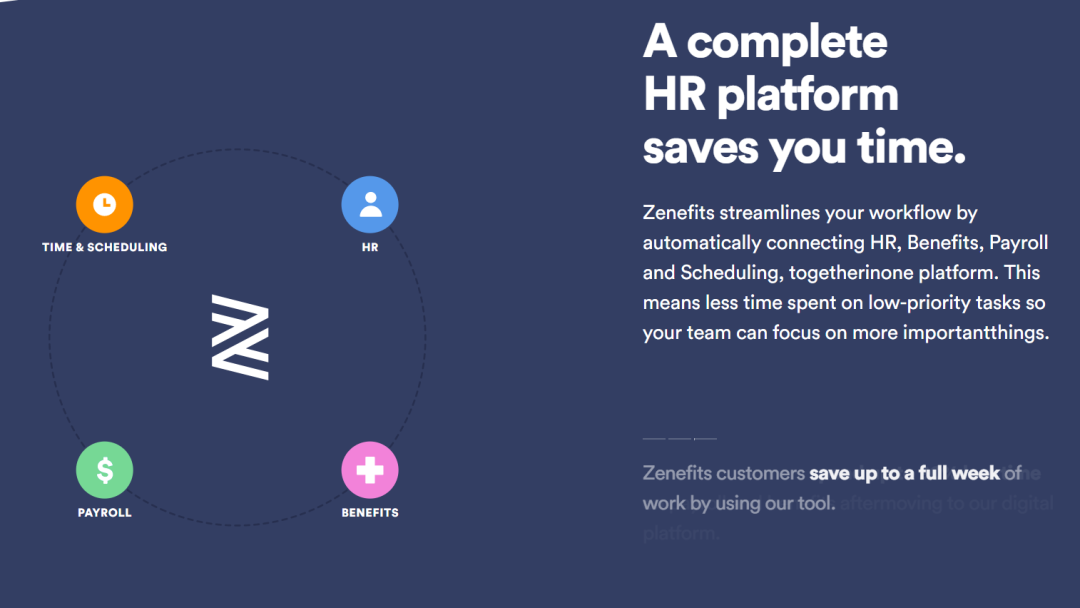
This company was founded by the famous Peter Thiel. Its business model is very simple. It provides HR software to small, medium and micro enterprises. For example, a company with about 100 people may usually hire two full-time employees to provide HR services. Zenefits helps enterprises save the cost of these two full-time employees by providing free SaaS-based HR software services. The profit model is that these companies that use the HR software provided by Zenefits for free will purchase medical insurance for their employees through Zenefits, and Zenefits will receive commissions from the insurance companies. Zenefits creatively played in the SaaS industry and the Internet industry talked about "the wool comes from the pig". In 2015, the valuation of this two-year-old company reached an astonishing US$4.5 billion. Later, Zenefits plummeted due to cheating on industry regulations, but its creativity in business models is quite commendable.
In recent years, a new concept has been mentioned and paid more and more attention to, that is, business as a service (BaaS), which not only provides software application services for some aspects of customers' business operations, but also creates some additional value in these aspects, such as traffic introduction, agency operation, procurement sourcing, logistics and distribution, payment, investment and financing, etc. In these aspects, Intuit and Zenefits have set good examples, creating new value for customers in addition to SaaS software services. On the one hand, it creates new revenue sources, on the other hand, it improves customer stickiness and retention.
Some member companies of the first phase of Tencent SaaS Accelerator have also begun to try in this area: Siwei Technology, in addition to providing online real estate marketing SaaS solutions to real estate customers, also provides customers with marketing operation services. They cooperated with a real estate developer to plan a marketing campaign of "8.8 yuan worth 30,000 home purchase price", embedding social fission gameplay to help customers recruit more than 200,000 potential home buyers, and moved marketing from the sales office to online; Salary is too soft. On the one hand, it provides a very flexible salary payment plan for labor-intensive enterprises. On the other hand, it also explores the value of the C-side. Employees who are paid on the platform can check in on some designated apps or mini-programs to get a certain amount of compensation, thereby realizing the realization of traffic monetization. Decibei Tong not only provides expense control + corporate payment solutions for medium-sized enterprises in terms of travel, taxis, meals, etc., but also earns commissions by attracting traffic for Ctrip, Meituan, and Didi.
There are two very important points for the success of the BaaS business model:
1. CEOs of SaaS companies must constantly consolidate the cornerstone of their business, just like search is to Google and social relationship chains are to WeChat. This is the prerequisite for creating extended value;
2. BaaS must rely on a large platform. In the cloud world, the winner-take-all phenomenon will become more and more intense, because the platform has network effects and gathers sufficient supply and demand resources. Only by standing on the platform can startups achieve rapid scale and maximize value. Therefore, CEOs should use ecosystem thinking to outline and explore their business models as early as possible.
2· SaaS value proposition,
Why do international peers value customer success over sales?
First, let’s take a look at the typical life cycle of a SaaS customer:

As analyzed above, enterprises in the OP era place great emphasis on marketing, because the focus of enterprise software suppliers is how to win a customer. The customer spends a lot of money and the switching cost is too high, so the software manufacturer's service basically ends in the above steps 2 or 3. Enterprises spend much less on SaaS, which also means that customer switching costs may be relatively low and customer churn is prone to occur. Therefore, the core of the SaaS business model is not only the revenue scale brought by the first customer acquisition, but more importantly, it must have very good long-term customer retention and renewal (new dollar retention). SaaS companies need to extend their services to the 4th step of customers, ensure that customers gain growth, and help customers complete the 5th step to achieve continuous payment.
How can we solve this problem well? Salesforce realized this and created the practice of customer success, which was later followed by many Silicon Valley companies. Some domestic companies have also begun to establish their own customer success teams, but it sounds like many are still at the stage of putting on a new vest for their customer service functions. What is the difference between the two? I try to use Table 1 below to explain the difference between the two.
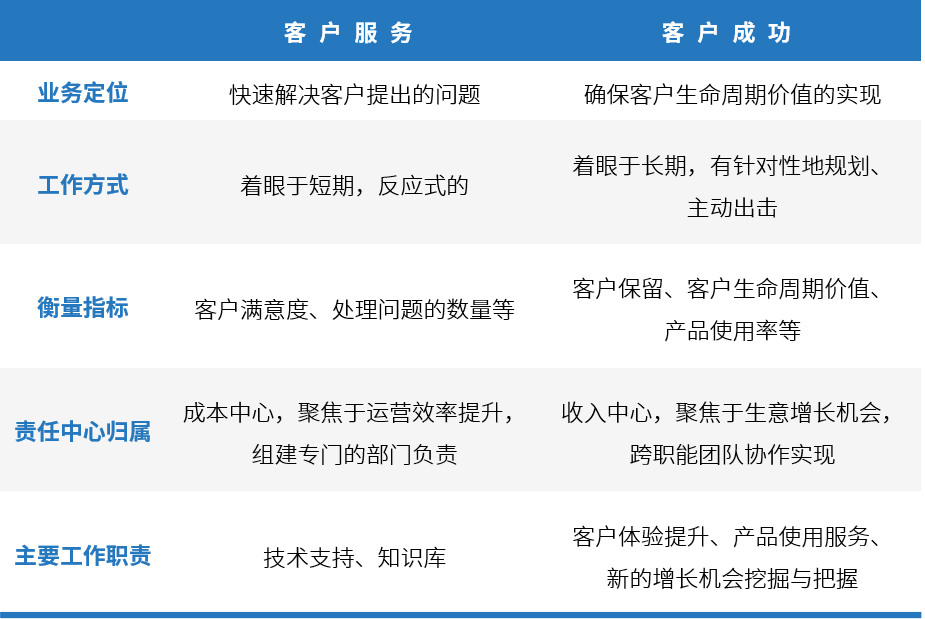
Table 1: Key differences between customer success and customer service functions
The industry usually uses the ratio of LTV/CAC (LTV refers to customer lifetime value, CAC refers to customer acquisition cost) to measure the value of a SaaS company. After all, the customer orders of the SaaS business are far lower than the software licenses in the OP era. If it cannot be operated from the perspective of long-term customer value, then the sustainability of this business will be out of the question. Salesforce mobilizes professionals from all aspects of product, technology, sales, and industry to focus on improving customer experience and business value based on LTV (customer lifetime value), and ultimately helping customers succeed. So,Customer success is by no means a new customer service vest or a newly created position, but a new value proposition and business model based on long-termism. CEOs should elevate customer success to the height of long-term strategy, only then can they reap the dividends of this new model.
3 · SaaS marketing model, to B or not to B
When it comes to marketing in the To B industry, what often comes to mind is reaching customers through the Air Force (advertising in the media, outgoing phone calls, etc.) and the Army (opinion leaders participating in industry forums, sales teams or channel partners participating in industry exhibitions, door-to-door visits, etc.). In the past OP era, such a heavy model was feasible because the high profits and high customer orders under the license model were enough to support it. Judging from the data provided by an executive of a well-known international software manufacturer, the ratio of SaaS customer orders to OP customer orders is about 1/5 to 1/3 of the latter. In this case, if we just stick to the past to B approach to acquire customers, our CAC will still remain at the previous level, and our customer orders or customer scale cannot be increased quickly.If there is no continuous capital support, the short-term survival pressure of enterprises will be huge. So we must think about a question, is it possible to create a completely different marketing model that is both economical and efficient?
Screenshot of Atlassian official website
Case 3
Atlassian, whose revenue has reached US$1.2 billion, has no sales team
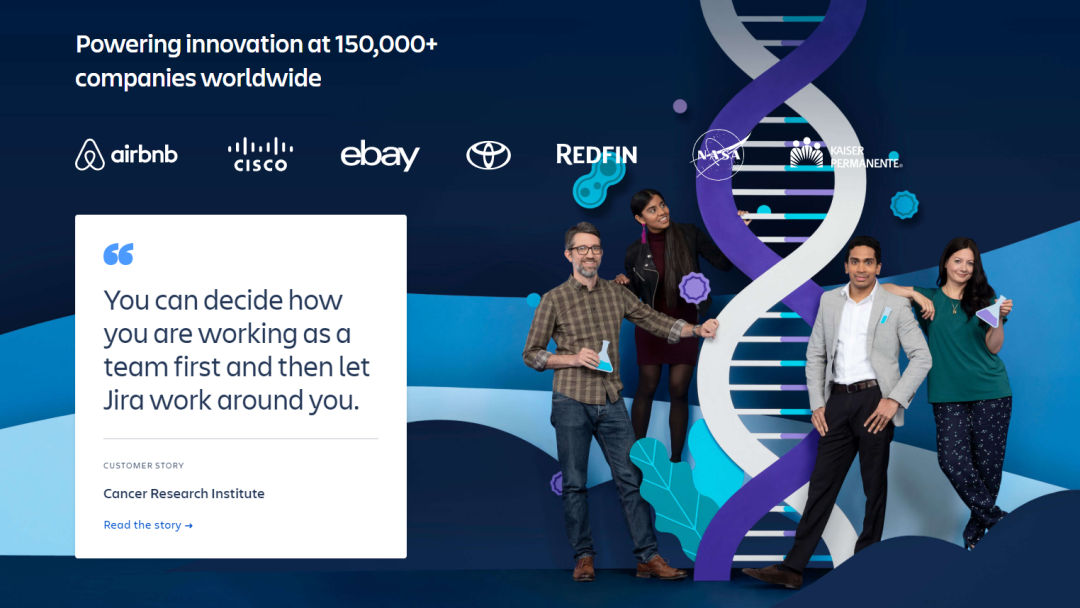
Currently, 80% of the world's Fortune 500 companies are using Atlassian's software, with more than 150,000 customers, revenue in fiscal year 2019 reaching US$1.2 billion, and a market value of more than US$30 billion. However, such a company still does not have a real sales team.
Atlassian comes from Australia. The two co-founders are university alumni and are both coders. They and many of their peers deeply felt the need for specific tools to track development issues and promote collaboration within projects, so they decided to develop such a product themselves and launched their subsequent flagship products Jira and Confluence. However, since the two founders lacked marketing experience and had no money for marketing and hiring a sales team, they put the software on the website, which anyone can use for free for 30 days. It also included payment methods that can unlock full functions and a transparent and advantageous price system. Users can purchase the product by themselves throughout the process. Unexpectedly, with the help of word-of-mouth marketing, they attracted more and more users, and many individual users volunteered to support their products. Atlassian’s growth logic is:
1. Continuously expand the user base and improve user stickiness with the help of a rich and excellent product portfolio.After they started making profits in 2005, they launched the buy-buy-buy model and continued to enrich their product portfolio to meet more user needs and expand their user base. After going public in 2015, they invested 40% of their profits in research and development, driving sales to maintain an annual growth rate of 30%. At the same time, Atlassian has also opened up its cooperation ecosystem, and the GMV of the cooperation ecosystem in fiscal 2019 exceeded US$300 million.
2. Use the free + value-added model and rely on word-of-mouth marketing + low prices to acquire customers.I once studied the 20 most outstanding SaaS companies in the US stock market in 2016 and found that the median customer acquisition efficiency (ARR/CAC, the ratio of annual operating income to customer acquisition costs) was 0.7, while Atlassian was 1.6, which is far better than its peers. Due to its excellent sales efficiency and low customer acquisition cost, Atlassian has always regarded low price as an important competitive weight.
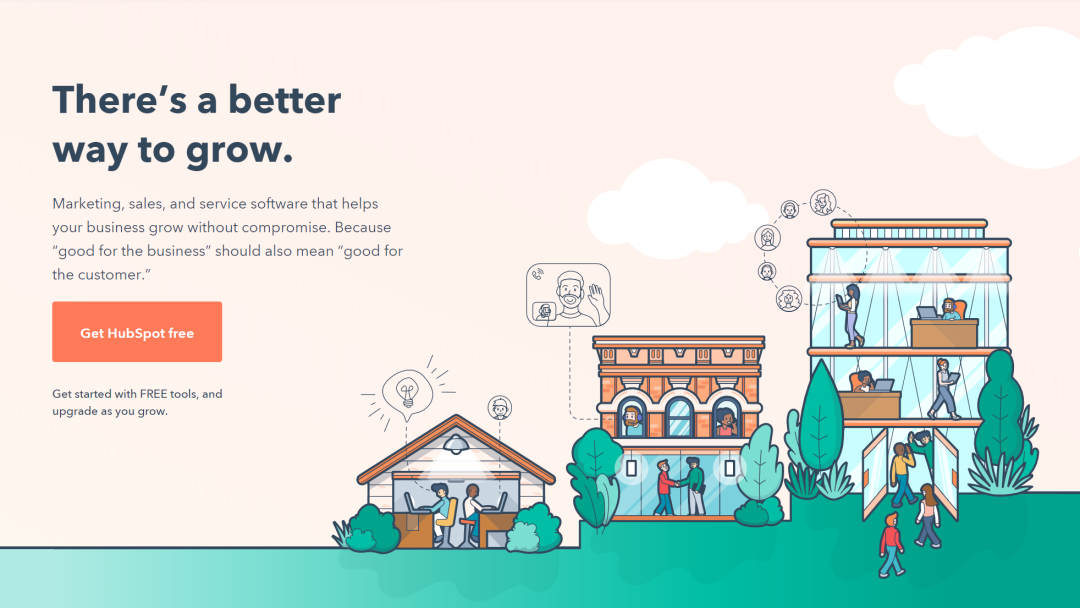
Screenshot of HubSpot official website
Case 4
HubSpot, play with private domain traffic
HubSpot is a Silicon Valley company founded in 2005 that mainly provides CRM SaaS solutions for small and medium-sized enterprises. It serves more than 70,000 customers worldwide. The two founders of HubSpot were both masters in the field of digital marketing before starting HubSpot. They repeated their old tricks during the development of HubSpot and mastered inbound marketing.
The so-called inbound marketing is actually similar to the concept of "private traffic" that is hotly discussed in the Internet circles today, that is, the idea is to attract users to your own traffic pool to achieve conversion and retention.HubSpot is very good at harvesting large-traffic platforms. They produce high-quality content and put it on these platforms, gaining incredible traffic. Currently, they have 2 million fans on Facebook, 410,000 on LinkedIn, and 90,000 on YouTube. These users have provided HubSpot with a very considerable number of valuable sales leads.
Everyone agrees that low-cost traffic comes from high-quality content, so how to produce high-quality content? The second most popular article on the HubSpot blog is actually "How to use excel"! Why does HubSpot teach everyone how to use Excel in a blog article? Because HubSpot team research found that more than 27,000 people search for this topic on search engines every month. Adopting a similar approach, HubSpot regularly researches hot search terms, and then selects some topics to write in-depth blog posts one by one. In order to improve content quality and attention, HubSpot also invites well-known serial entrepreneurs and industry figures from Silicon Valley as guest blog writers. Add a CTA (click to action) button to each blog post, and each CTA is used to trigger traffic acquisition.
Atlassian and HubSpot have opened another door for this industry. To B does not have to follow the path taken by the predecessors in the OP era, and you can still reap gratifying growth. What are the signs in China that may trigger changes in marketing and growth models? You might as well take a look at the changes in the consumer market over the years.
4 · Will B2C2B become an option for SaaS’s future growth?
Since the Ministry of Industry and Information Technology issued 4G licenses in 2003, China's consumer market has undergone earth-shaking changes in the past 6 or 7 years. The offline sales of veteran consumer goods giants Procter & Gamble and Unilever have experienced a significant decline. Why? Because the younger generation is more pursuing products and services that meet their own personality and scene needs, their purchasing decisions rely more on their circle of friends rather than media advertising. The development of mobile communication technology, data analysis technology, and social technology has helped this generation realize the sense of participation and relevance that humans have long suppressed. They use their smartphones to express their voices on social media to influence product creativity, marketing, delivery, and consumption decisions. Some of the new consumer brands (business formats) that have emerged in recent years, such as Heytea and Perfect Diary, are almost all due to their efforts in RED (Relevance focuses on relevance with consumer groups, Engagement encourages active participation of users, and Digital, referred to as RED). As a result, they have won the favor of the younger generation and gained growth that their predecessors could only dream of.
年轻一代不仅仅在消费市场成为了买单的主力,在职场也逐步成为了企业服务的主力用户和决策者,RED的影响大概率会从to C蔓延到to B领域。我们有理由相信单纯依靠传统的自上而下去攻克to B客户的模式到了需要改变的时候了,对于未来相当长时间SaaS应用的主力战场---中小企业市场来说尤其如此。我们应该大胆地设想,有没有可能借助数字化技术在目标用户群体的相关性、参与感上下足功夫,让B2C2B(先触达用户,再成就B端生意)成为SaaS行业新的增长选项呢?
Of course, it may be difficult to simply copy existing to C gameplay to to B, but over the years the to C industry has accumulated profound user insights (data) and strong user genes (thinking). SaaS companies may be able to cooperate with some excellent to C companies or introduce to C talents to explore the future together.
A concluding sentence that is not the end
There is a saying in Silicon Valley that reaching US$100 million in annual recurring revenue (ARR for short) for a SaaS company is equivalent to running a mile in under four minutes (in 1954, Roger Bannister became the first person in the world to run a mile in four minutes). By studying the US stock market, we can find that there are very few SaaS companies that can reach US$200 million in ARR seven years after their establishment, and only Salesforce and Workday have reached US$1 billion within ten years. Research on domestic software listed companies will lead to similar findings. It took the leading company UFIDA more than ten years to reach US$100 million, and it took more than a second decade to go from US$100 million to US$1 billion. It can be seen that the growth of the enterprise application market is very slow. On the one hand, it requires entrepreneurs and the capital market to have enough patience. On the other hand, it also requires CEOs to be able to get rid of the constraints of traditional to B thinking and find their own way. Only then can they hope to find their own growth path before exhausting the patience of customers, teams, and capital.
On this road, there is no ready-made answer waiting for us, and the limitations of space and the author's thinking cannot cover all possibilities. This article is like a brick thrown from here, hoping to attract jade from all directions to start thinking and exploring this market together, and to welcome the spring season together!

Wen Yongsheng George | Tencent Consulting Expert Consultant






Tencent Consulting is for companies invested by Tencent.Tencent’s post-investment service team focuses on CEO and organizational growth. We help Tencent's strategic partners develop rapidly and healthily and achieve ecological win-win through solutions and products such as CEO sharing sessions, executive recruitment, executive coaching, leadership development, organizational capability diagnosis, ESOP, cultural values, and strategic decoding.

Machine-translated from the Chinese original SaaS深度 | 创新模式才有春暖花开 (published 2020-04-01). WeChat original ↗