
This picture and the picture at the end of the article are the works of the WeChat account "@十国MR."
The purpose of this article is to help business managers with non-technical backgrounds understand the concept of cloud computing, the value of moving to the cloud, and how to move to the cloud.
The "digital transformation" of an enterprise has the following four key elements. Cloud computing is the foundation of the other three. Without cloud computing, digital transformation is impossible to talk about:
-
Cloud computing: Cloud computing means that users access, use and manage various computing resources, including hardware, software and services, through the Internet. The "users" mentioned here include, first, those who use information systems, who use application software (such as cloud ERP, or enterprise WeChat), query data, and use services (such as cloud storage) through the Internet; second, those who develop software, who use technical components of software development on the Internet platform to develop, test, and deploy programs; third, the enterprise's technical architecture managers and hardware operation and maintenance personnel, who configure and manage various software and hardware resources on the Internet; fourth, the automatic integration of external systems or automated machines
-
Big data: centralized management of data from various sources to drive business intelligence
-
Artificial Intelligence: Develop algorithms based on big data, and then use machine learning to form cognitions and insights into complex things.
-
Internet of Things: Everything has the ability to sense and everything is connected
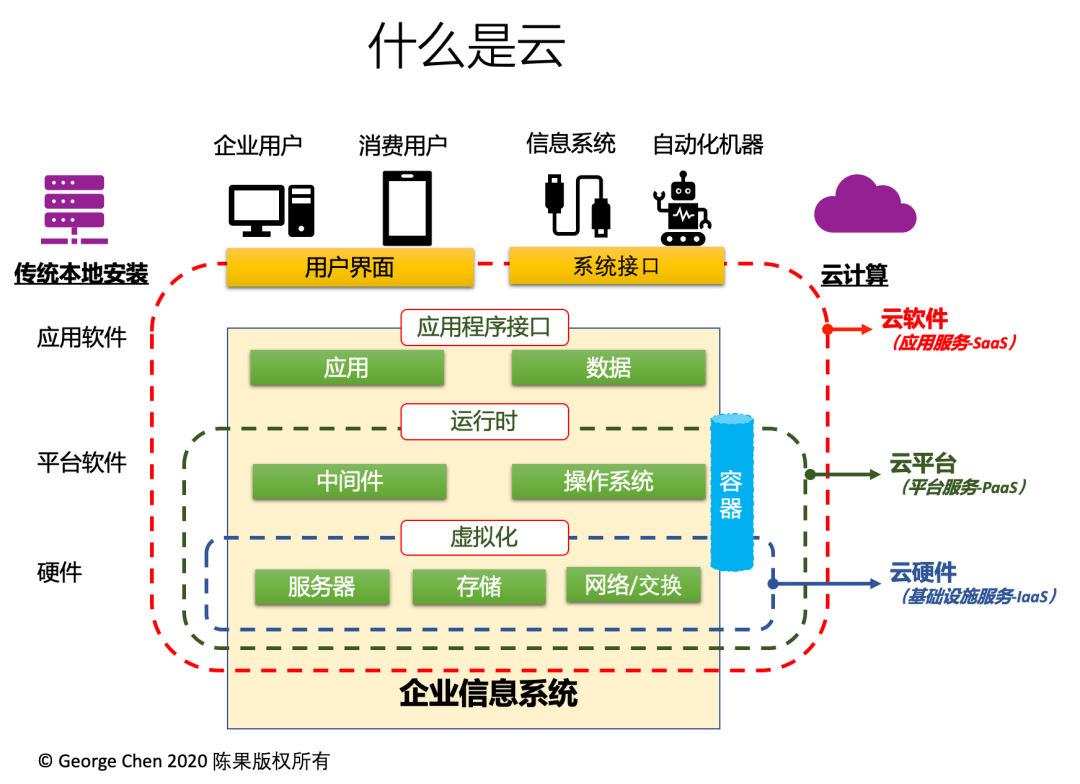
Cloud computing is a change in the way computing resources are delivered to users, that is, from owning and managing them to the owner/manager delivering them to users through the Internet, and users obtaining them from the Internet. In order to facilitate users to obtain services, complex computing resources need to be abstracted. The traditional enterprise information system consists of three levels: hardware, platform software and application software. Correspondingly, the abstract model of cloud computing's computing resources at these three levels is shown in the figure below:
-
SaaS: facing end users, or providing external interfaces
-
PaaS: For engineers and programmers engaged in internal or external software development
-
IaaS: for internal development, deployment, operation and maintenance technical personnel
If these resources are all built by the enterprise itself, they are called "private cloud"; Provided by a third party, used on demand and paid according to usage, it is called "public cloud”。
The cloud computing environment we face today has been developed for more than ten years and is still evolving; some areas are relatively mature from technology to business models, while in other areas, applications are not yet mature and new concepts are emerging. Enterprises that do not want to be "guinea pigs" for new technology experiments need to further observe and wait and see.
Public cloud SaaSIt is the most mature level of cloud computing. At the beginning of the 21st century when the Internet was just emerging, some enterprise application software entrepreneurs realized that in the future, enterprise software would no longer be purchased by enterprises with software licenses and servers and installed in their own environments, but should be used by users on the Internet. In the main enterprise application fields, Salesforce for CRM, NetSuite for ERP, Workday, and SuccessFactors for HR software all developed from this period. Today, almost all traditional packaged software, including industry-leading vendors such as SAP, Oracle, Infor, Microsoft, Siemens, and Dassault, are fully transforming into SaaS plus cloud platforms. Due to the rapid changes in the IT industry ecology, traditional locally installed, license-based application software may disappear in the foreseeable future. See 👉
Challenges in building a platform ecosystem for SaaS software
A brief history of global human resources management software (3) - Cloud and Workday
Hardware resources such as servers, storage, and network switching are provided as Internet services.IaaS, although hardware companies such as Sun/Oracle, EMC, IBM, HP, and Cisco all foresaw this trend during the rise of the Internet and thus created the virtualization of internal hardware resources within the enterprise, that is, the "private cloud" model of infrastructure. However, on the Internet, it was the virtual server (called elastic computing EC2) and virtual storage (called simple storage service S3) launched by AWS in 2007 that launched reliable commercial services and formed a business model using the public cloud method. Later, Internet companies and software vendors such as Google, Microsoft, and Alibaba entered the IaaS public cloud market. Telecommunications manufacturers with communication and computing resources are also natural players of IaaS.
Hardware manufacturers starting from private cloud have tried to move to the IaaS public cloud market, but with little success. In recent years, IBM has bet on the hybrid cloud market, switching from cloud services to cloud management platforms.
In short, after 2015, the market structure of IaaS has basically been determined, technical solutions have become mature, and various models such as private cloud, public cloud, and hybrid cloud coexist.
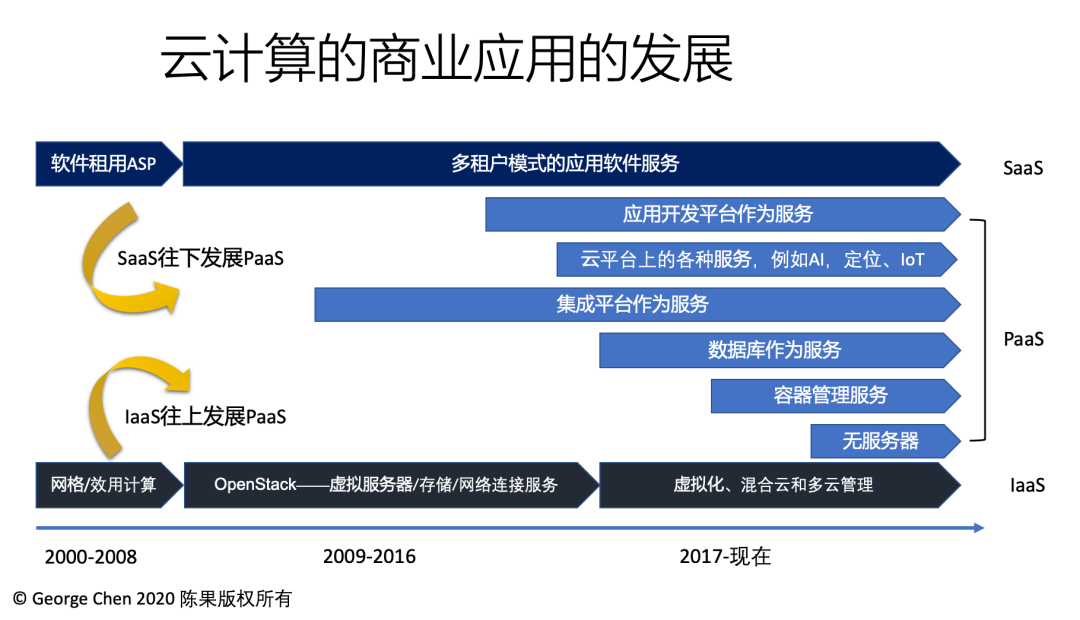
Compared with SaaS and IaaS, the definition of PaaS is relatively vague, and the technological updates are dizzying. Since PaaS is aimed at developers, it is only meaningful to companies that develop their own systems to a large extent. See 👉 IT Strategy | Enterprise software, self-developed or outsourced
The PaaS in the picture above covers application development platforms, enabling services, integration platforms, databases, container management, etc. From the perspective of origin, some PaaS technologies are generated by SaaS software vendors (such as Salesforce, SAP, Microsoft, etc.) in response to their expansion needs for customization, integration, empowerment, etc.; some are developed by large Internet companies based on open source frameworks and self-developed technologies in their data processing, software development, and system maintenance processes, such as Google (GAE, MapReduce), Yahoo! (Hadoop), LinkedIn (Kafka), NetFlix (Cassandra), and domestic Alibaba, Tencent, NetEase, etc.; some are developed by pioneering cloud computing companies such as AWS, Microsoft, Google, etc., and some are from recently emerged entrepreneurial companies. Most of these companies have certain capital ties with mainstream hardware (such as EMC, IBM) or cloud vendors.
Conceptually, PaaS and IaaS have a large overlap. Although both PaaS and IaaS have independent suppliers that only operate at this level, mainstream large cloud vendors all provide comprehensive services across PaaS and IaaS.
If Amazon is the master of IaaS, then Google is the master of PaaS. Google not only created the technical principles of distributed processing of massive data on the Internet, but also pioneered the application engineering framework and container technology.
The simulation packaging method of traditional software running on the infrastructure environment is "virtual machine" (left in the figure below), which consumes a lot of hardware resources and is time-consuming to deploy and operate. This is the mainstream technology of early IaaS/PaaS, and "containers" make the application packaging on the cloud more lightweight and easier to release and deploy:
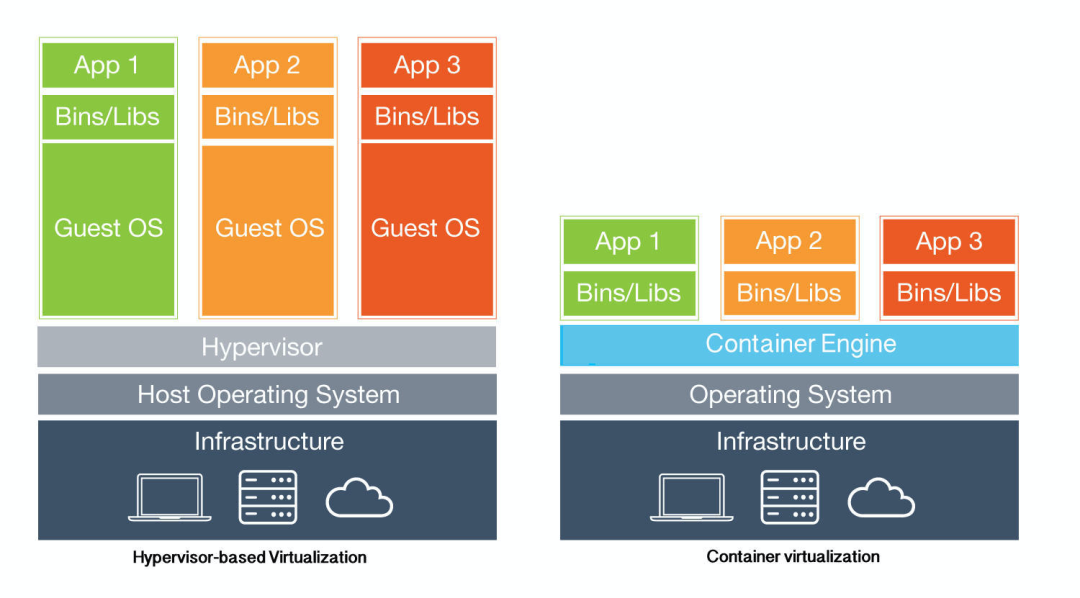
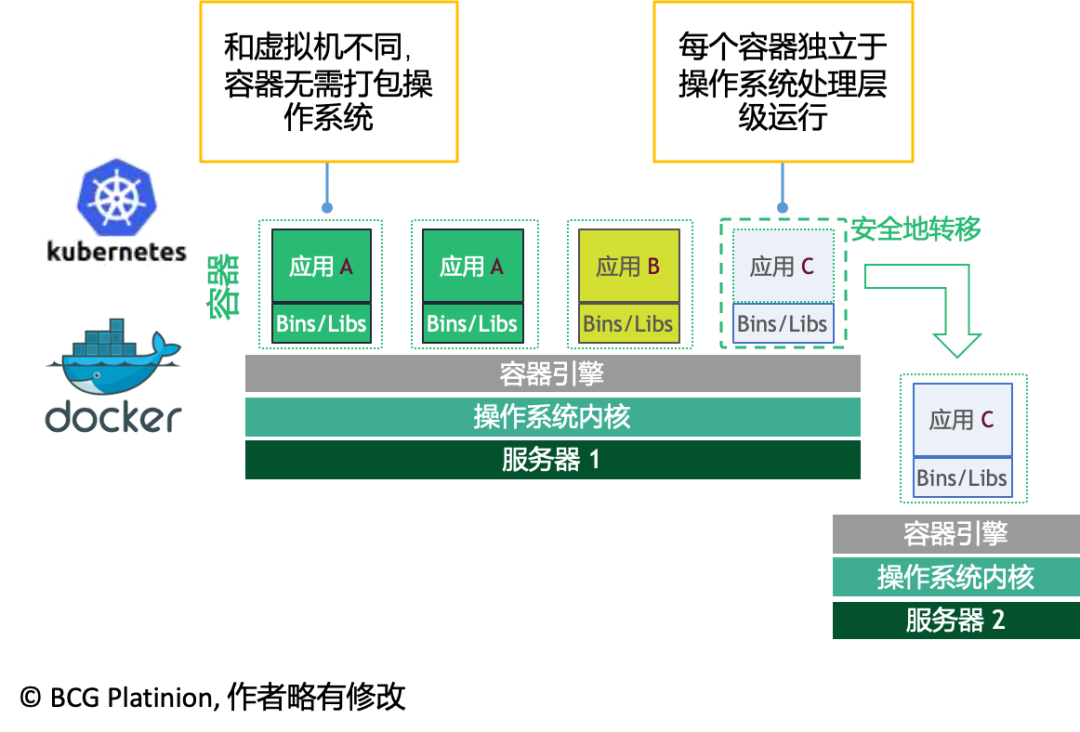
Using container technology, applications can be more easily transferred between multiple clouds, public clouds and private clouds, and are more in line with the microservice software architecture style, helping to develop the DevOps software development and operation model. Just as the microservice architecture is not a must for software development architecture, container technology is not a must for implementing PaaS. However, with the development and application of microservices and container technology, the performance and flexibility of PaaS have been greatly improved, and thus it has become a hot spot for PaaS in the past two years.
Cloud services that support users to upload, organize, start, stop, expand, and manage containers, applications, and clusters are also called Containers as a Service (CaaS). CaaS is a new cloud service model based on PaaS and IaaS. AWS, Microsoft, Alibaba and other mainstream cloud vendors have their own container management services. Starting in 2018, Google Kubernetes (K8S for short) has become the mainstream standard for container orchestration technology. CaaS vendors based on the K8S standard span across various cloud vendors, creating a multi-cloud and hybrid cloud management environment.
What does it mean for enterprises to “go to the cloud”? If it is an Internet company, the technical architecture of its system will basically follow the technical architecture of the Internet company mentioned above. It is inherently cloud-based. We call it "cloud native”, so Internet companies are “native digital enterprises”. However, the technology stack of most traditional enterprise information systems has not yet been run in a cloud manner at all levels.
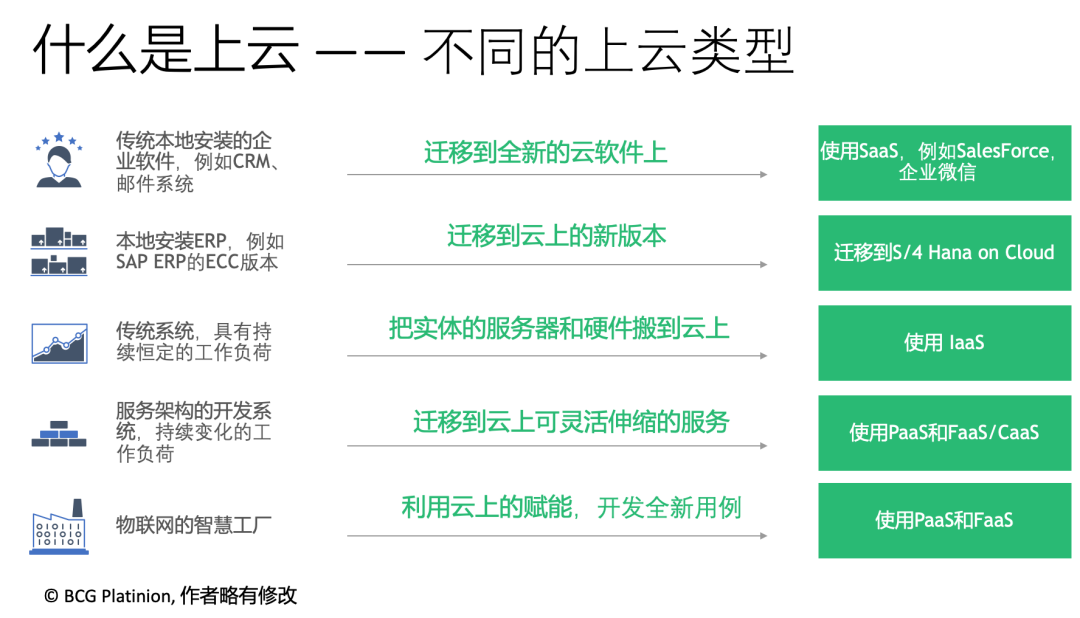
Based on the aforementioned description of cloud computing, simply speaking, “going to the cloud” means:
-
For users, in the past they used locally installed software and data was stored locally. In the future, "cloud software" (SaaS) will be used.
-
For enterprise application developers, they used to develop, integrate, and operate software in a locally installed environment. In the future, they will develop, deploy, and operate user-oriented software on the "cloud platform" (PaaS).
-
In the past, enterprise software was installed on equipment in its own computer room. In the future, virtual "cloud hardware" (IaaS) resources will be purchased on demand on the Internet.
-
Enterprise architecture managers use "cloud containers" (CaaS) to manage the migration of application software to the cloud and between clouds.
The following figure shows the common types of enterprise cloud migration:
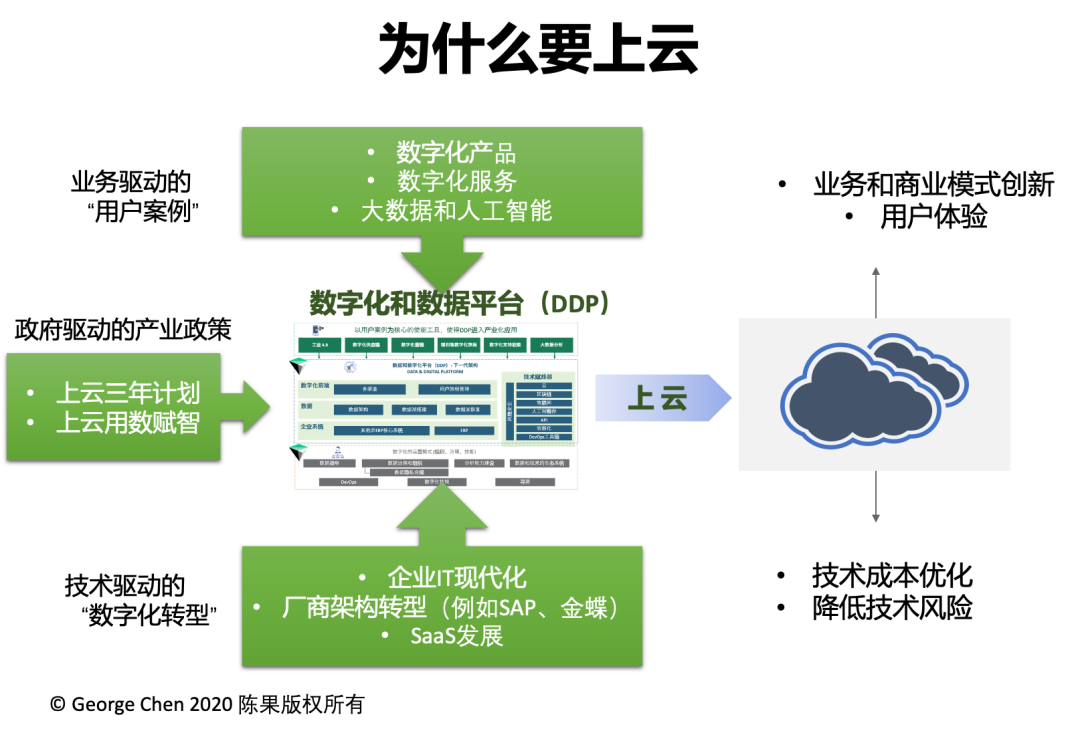
Why must enterprise information systems go to the cloud? I think there are three reasons:
1. Government-driven industrial policies:
Enterprise cloud migration has become a basic national policy in my country. In July 2018, the State Council and the Ministry of Industry and Information Technology formulated a three-year cloud migration guide for enterprises. In April 2020, the National Development and Reform Commission and the Cyberspace Administration of China once again released the action outline of "Moving to the Cloud to Empower Intelligence with Data", which is accompanied by a number of fiscal and taxation and subsidy preferential policies. The full text is attached.
2. Business-driven user cases:
The starting point for the design of traditional enterprise information systems is mostly enterprise management control or the extension of information channels. Therefore, the systems are often isolated in a silo shape, and the data and processes between systems are not connected.
Today, the front-end of information systems increasingly emphasizes user experience as the center and is driven by big data analysis and artificial intelligence. That is to say, the user digital front-end is driven by user cases (Use cases) and needs to adapt to user needs and experiences and continuously iteratively develop "digital products" rather than the user-end extension of back-end systems. This requires the digital and data platform (BCG called "DDP") architecture that supports front-end use cases and continuous innovation of digital products to become Internet-based, and the innate characteristics of DDP are carried by cloud computing.
Digital Innovation | The difference between enterprise system APP and digital products
The difference between “digital innovation” and “digital transformation”
Discussing the methods of humanized design and digital products from the case of digital procurement process
Discussing the middle platform again | DDP brings about a revolution in enterprise core systems
Entry-level exam for BCG Digital and Data Platform (DDP)
Not all information technology processing in the business process field (or "value stream") of an enterprise needs to be turned into "digital products." Those back-end systems and legacy systems of "non-digital products" can also move the hardware environment to IaaS and use containers to package it on CaaS to reduce IT operation and maintenance costs.
3. Technology-driven digital transformation:
Cloud computing is the evolution of information technology. Legacy core systems and DDP cloud migration have significantly improved data processing capabilities and real-time performance, iterative development flexibility, and flexible use of computing resources to improve system performance compared with traditional technologies.
At the same time, the IT industry ecosystem is undergoing profound changes, and traditional application software vendors are transforming into SaaS. In order to improve software performance and integrate into the industry ecosystem, traditional software vendors and emerging software vendors build their own or use mainstream PaaS to develop SaaS. Companies such as SAP and Kingdee are gradually forming a SaaS+PaaS product architecture. See 👇:
Domestic replacement of foreign enterprise software | Also talk about how the SAP cloud platform can succeed in China
The business model of cloud computing changes an enterprise's IT expenditures, including the purchase of hardware and software, from capital expenditures (CAPEX) to operating expenses (OPEX), bringing better financial flexibility to enterprises and helping them optimize IT investments.
Finally, network security risks in the digital age are getting bigger and bigger. Last year, the country issued the "Network Security Level Protection 2.0 System", which puts forward higher compliance requirements for enterprise information systems. As a shared service, cloud computing itself contains complete and compliant security prevention and control mechanisms. After enterprise systems are moved to the cloud, they can use the security mechanisms of cloud vendors to transfer their own network security risks and reduce security management expenses.
See also:
BCG-AWS joint research | Cloud strategy for enterprise digital transformation

The Ministry of Industry and Information Technology issued the "Implementation Guidelines for Promoting Enterprise Cloud Migration" (2018-2020Notice of
Ministry of Industry and Information Technology Information Software [2018] No. 135
The industrial and information technology departments of all provinces, autonomous regions, municipalities directly under the Central Government, cities under separate state planning, and Xinjiang Production and Construction Corps:
In order to implement the deployment requirements such as the "Opinions of the State Council on Promoting the Innovative Development of Cloud Computing and Cultivating New Business Formats in the Information Industry", the "Guiding Opinions of the State Council on Deepening the "Internet + Advanced Manufacturing" to Develop the Industrial Internet", and the "Three-Year Action Plan for the Development of Cloud Computing (2017-2019)" , to promote enterprises to use cloud computing to accelerate digital, networked, and intelligent transformation, and to promote the deep integration of the Internet, big data, artificial intelligence, and the real economy. The "Implementation Guide for Promoting Enterprises to Cloud (2018-2020)" is now issued to you. Please organize and implement it carefully based on the actual situation of each place.
Ministry of Industry and Information Technology
July 23, 2018
Implementation Guide for Promoting Enterprise Cloud Implementation (2018-2020)
Cloud computing is a concentrated expression of the development of information technology and service model innovation, and is a major change and inevitable trend in the development of information technology. Supporting enterprises to migrate to the cloud will help promote enterprises to accelerate digital, networked, and intelligent transformation, improve innovation capabilities, business strength, and development levels; it will help accelerate the development of the software and information technology service industry, deepen supply-side structural reform, promote the deep integration of the Internet, big data, artificial intelligence, and the real economy, and accelerate the construction of a modern economic system.
1. Overall requirements
The Ministry of Industry and Information Technology coordinates the work of enterprises on cloud migration, organizes and formulates and improves relevant standards such as the evaluation of enterprise cloud migration effects, and guides local industry and information technology authorities, third-party agencies, etc. to carry out collaborative work. Local industrial and information authorities should combine local realities, strengthen cloud computing platform services and operational capabilities as the basis, focus on accelerating the cloud migration of enterprises in key industries, and improve supporting supporting services as a guarantee, formulate work plans and promotion measures, organize publicity and training, promote cloud platform service providers and industry enterprises to strengthen supply and demand docking, and orderly promote the cloud migration process of enterprises.
By 2020, we will strive to further optimize the cloud environment for enterprises, significantly increase the awareness and enthusiasm of enterprises in the industry, significantly increase the proportion of cloud migration and the depth of application, and widely popularize the application of cloud computing in enterprise production, operation, and management. There will be 1 million new cloud enterprises across the country, more than 100 typical benchmark application cases will be formed, and a number of influential and driving cloud platforms and enterprise cloud experience centers will be formed.
(1) Enterprises moving to the cloud should start from improving their development capabilities and solving practical business problems. By combining enterprise business with information applications, information system upgrades are achieved, enterprise business innovation, process reconstruction, and management reform are promoted, enterprises are accelerated to digital, networked, and intelligent transformation, and enterprise management levels and comprehensive competitiveness are effectively improved.
(2) When enterprises carry out cloud migration, they can conduct research and analysis from aspects such as cost performance, availability, scalability, security, compliance, etc., and use theoretical analysis, simulation experiments, test verification and other methods to fully evaluate the costs, benefits, risks and acceptability of business use of cloud services. On this basis, in accordance with the principle of hierarchical classification, the cloud deployment plan of the information system is unifiedly planned.
(3) Enterprises can give priority to migrating to the cloud information systems whose business characteristics are consistent with the characteristics of cloud computing and whose value and benefits are obvious. First, the use of information systems has obvious peaks and peaks, which requires dynamic allocation of resources and elastic expansion. Second, information systems need to be iteratively launched quickly to increase the speed of business innovation. Third, information systems need to reduce operation and maintenance costs and improve emergency response, fault recovery, and information security capabilities. Fourth, information systems need to use cloud services such as big data and artificial intelligence to achieve business expansion.
(4) Carrying out cloud migration requires cloud enterprises, cloud platform service providers, cloud application service providers, system integrators, infrastructure providers and related industry organizations and third-party institutions to strengthen collaboration, clarify the responsibilities of all parties, and jointly promote implementation. Cloud platform service providers, as the main service providers, must unite with cloud application service providers, system integrators, infrastructure providers and other industry chain stakeholders to jointly provide technical support services for cloud enterprises. Enterprises that migrate to the cloud refer to the guidelines to steadily advance their own cloud migration efforts and actively utilize software applications and data services on cloud computing platforms to achieve digital transformation. Third-party organizations actively participate in publicity, training, testing and evaluation work, and strengthen tracking and research on enterprises’ cloud migration efforts.
2. Scientifically formulate deployment models
(5) Large enterprises can establish private clouds and deploy key information systems with high data security requirements; information systems connecting customers, suppliers, and employees can be deployed in public clouds and form a hybrid cloud architecture together with private clouds. For information systems that have high data security requirements and require external connections to provide services, a hybrid cloud architecture in which data is stored in a private cloud and applications are deployed in a public cloud can be considered.
(6) Small and medium-sized enterprises and entrepreneurial enterprises can rely on public cloud platforms to rent storage, computing, network and other infrastructure resources on demand, apply design, production, marketing, office, finance and other cloud services or build characteristic cloud services to improve the level and efficiency of operation and management, accelerate the formation of business capabilities, carry out business and service model innovation, realize personalized service output, and accelerate the establishment of a modern business model.
3. Reasonably choose cloud services according to needs
(7) Infrastructure cloud services. The first is computing resource services. Use various elastic computing services of the cloud platform to achieve centralized management, dynamic allocation, elastic expansion and operation and maintenance burden reduction of computing resources. The second is storage resource services. Use cloud storage services such as block storage and object storage on the cloud platform to improve the economy, security and reliability of data storage. The third is network resource services. Use cloud platform's virtual private cloud, virtual private network, load balancing and other network services to efficiently and securely utilize cloud platform network resources. The fourth is security protection services. Use cloud host security protection, network attack protection, application firewall, key/certificate management, data encryption protection and other security services to improve information security capabilities.
(8) Platform system services. One is database services. Utilize cloud database systems to achieve cross-platform and cross-business collaborative management of various data. The second is big data analysis services. Use the cloud big data platform to promote the aggregation of data resources for data collection, storage, analysis, mining and collaborative application. The third is middleware platform services. Use cloud middleware services to build a distributed system architecture to meet the needs of "Internet +" transformation. The fourth is IoT platform services. Connect massive IoT terminal devices to the cloud platform to achieve efficient and visual online management of devices. The fifth is software development platform services. Through the cloud development platform, software life cycle management is carried out to quickly build development, testing, and operating environments, standardize the development process, reduce costs, and improve efficiency. Sixth, artificial intelligence platform services. Utilize the computing resources of the cloud platform to form intelligent service capabilities such as speech recognition, image recognition, and face recognition to improve the level of business intelligence.
(9) Business application services. The first is collaborative office services. Use cloud services such as email, conferencing, and communications to form an office system with low maintenance costs and high service efficiency to improve office efficiency. The second is business management application services. Use enterprise human resources management, administrative management, financial management and other cloud services to improve the scientific nature and efficiency of enterprise operation and management. The third is operation management services. Use cloud services such as procurement management, production management, sales management, supply chain management, and customer resource management to improve enterprise operation and management levels. The fourth is R&D and design services. Use cloud services such as computer-aided design and product development to deploy development and design environments in the cloud to improve R&D efficiency and innovation levels. The fifth is production control services. By migrating MES (Manufacturing Execution System), production data and other systems to the cloud, we can optimize the production control process and improve production efficiency and level. Sixth is intelligent application services. Integrate the company's global data to create smart applications such as smart research and development, smart production, smart marketing, and smart services to improve the level of corporate intelligence.
4. Promote enterprise cloud migration in a steady and orderly manner
(10) Enterprises can migrate to the cloud according to the steps of demand analysis, feasibility assessment, selection and determination of cloud platform service providers, cloud program design, testing and deployment, verification and summary, operation and maintenance guarantee, and effect evaluation. Enterprises can choose appropriate steps based on their own actual conditions, simplify the process appropriately, and implement cloud migration in an orderly manner.
(11) Enterprises can, combined with their own business development plans and with the support of third-party organizations or cloud platform service providers, conduct a comprehensive review of information system business types, users, usage characteristics, performance indicators, database usage, inter-system relationships, etc.
(12) Enterprises can, with the support of third-party organizations or cloud platform service providers, refer to the information system analysis results, combine existing information resources and business needs, analyze the cloud basic environment requirements that meet the safe and stable operation of the system from aspects such as business needs, user experience, platform compatibility, cost, security, etc., analyze the feasibility of cloud migration of information systems, and initially determine whether various systems should be migrated to the cloud, and the priority of cloud migration. Key analysis contents include:
(1) Whether migrating to the cloud can improve enterprise development capabilities and solve practical business problems;
(2) Whether the information system is suitable for elastic expansion and requires rapid deployment; whether the cloud platform and application services are compatible with the existing information system; if not, the cost and risk of migration and transformation need to be assessed;
(3) Evaluate whether the data storage method, data security, etc. meet the requirements;
(4) Evaluate whether the cloud migration method (online/offline, etc.) meets business requirements, whether the cloud migration time is within the acceptable business interruption time range; whether the cloud migration can meet the needs of different types of user experience;
(5) Evaluate the switching plan, parallel operation plan, failure rollback plan, etc. between the existing system and the system after migrating to the cloud; evaluate possible risk points during system transformation, data migration, and application migration, and provide response suggestions.
(13) With the support of cloud platform service providers, enterprises that migrate to the cloud can formulate detailed cloud migration work content and requirements based on the conclusion of the feasibility assessment of cloud migration, and clarify the responsibilities and obligations of all parties. Fully evaluate the risk points in the process of migrating to the cloud, formulate application migration, data migration, system transformation plans, data storage methods and security protection and other technical plans, as well as supporting supervision, acceptance, and failure rollback plans, and do a good job in collaboration between cloud information systems and non-cloud information systems.
(14) Cloud-enabled enterprises can rely on cloud platform service providers or third-party organizations to clarify specific migration strategies for each information system. For the migration of complex systems to the cloud, customized migration technologies and methods need to be adopted based on actual conditions. Migration strategies include:
(1) Direct migration: Migrate and deploy the information system to the cloud platform, and use the unified operation management platform for management;
(2) Migration after transformation: Transform the database, system architecture, operating environment, interfaces, etc. to meet the technical requirements for migration to the cloud platform and then migrate;
(3) Procurement and reconstruction of cloud services: Combined with actual business conditions, purchase various cloud services that meet needs and rebuild the information system;
(4) Maintain the status quo: For systems that are not suitable for migration at the moment, continue to run in the current environment.
(15) With the support of cloud platform service providers or third-party organizations, enterprises can build a simulation environment based on the cloud migration plan and conduct cloud migration drills. After testing and verification, they can continuously optimize and improve the cloud migration plan and execute the cloud migration process.
(1) Promote development and testing environments to the cloud and build simulation environments, including migrating source and target environments;
(2) Implement simulated migration to the cloud, conduct functional testing, performance testing, backup testing, disaster recovery testing, etc., and modify and improve the cloud migration plan on this basis;
(3) Prepare resources including personnel, environment, implementation tools, etc. according to the cloud migration plan, implement the cloud migration process, carry out data migration and application migration, and implement a rollback plan in case of failure.
(16) After the cloud migration process is completed, all relevant parties can conduct data integrity and consistency verification, perform functional tests, business process tests, performance comparison tests, backup tests, disaster recovery tests, security tests, etc. after the cloud migration, and issue a cloud migration test report; formally cut the information system to the cloud platform and carry out a cloud migration summary.
(17) After successfully migrating to the cloud, enterprises that migrate to the cloud can themselves or entrust third-party organizations to supervise cloud services and urge cloud platform service providers to continuously improve their service capabilities. If the service is unavailable or fails to meet the guarantee level, the cloud platform service provider shall pay compensation in accordance with the content and method agreed in the service agreement to ensure the legitimate rights and interests of cloud-based enterprises.
(18) After migrating to the cloud, enterprises can themselves or entrust third-party organizations to evaluate the effects of migrating to the cloud in terms of resource procurement scale and utilization, business efficiency improvement, economic benefits and social benefits.
(19) Enterprises migrating to the cloud can be equipped with corresponding cloud computing talent teams, and based on the changes brought about by migrating to the cloud on business operations and organizational management, timely adjustments can be made to establish appropriate enterprise organization and management models.
5. Improve support service capabilities
(20) Cloud platform service providers should accelerate the improvement of technical level and service capabilities to ensure the efficient, safe and stable operation of the cloud platform, and work closely with cloud application service providers, system integrators, infrastructure providers, third-party institutions, and industry organizations to provide solution consulting and customized services for cloud-enabled enterprises, and expand the coverage of enterprise cloud-enabled services.
(21) Encourage cloud platform service providers to build comprehensive, industrial or regional enterprise cloud experience centers to systematically display cloud service business content, functional features, typical application cases and cloud results, and improve users' awareness and application capabilities of cloud computing. Encourage cloud platform service providers, cloud application developers, system integrators and other organizations to provide training services and strengthen the construction of professional talent teams.
(22) Encourage software and information technology service companies to accelerate their transformation to cloud computing, carry out development and testing of products, services and solutions based on cloud computing platforms in response to the differentiated needs of different industries and companies, and accelerate the enrichment of cloud computing product and service supply. Actively develop various SaaS services such as collaborative office, production management, financial management, marketing management, and human resources management to provide business support for cloud-based enterprises.
6. Strengthen policy guarantees
(23) Encourage local governments to establish multi-party cooperation promotion mechanisms such as government departments, cloud platform service providers, and cloud-based enterprises. Support local industry and information technology authorities to establish expert advisory committees for enterprise cloud migration. Increase the guidance and promotion of enterprise cloud migration, strengthen policy publicity and interpretation, popularize cloud migration knowledge, improve enterprise cloud migration awareness and practical capabilities, and continue to expand the influence of enterprise cloud migration.
(24) Support local industry and information technology authorities to establish and improve public service platforms to provide enterprises with various services such as information system planning consultation, program design, and supervision training. Carry out in-depth cloud service capability assessment and service credibility assessment to promote the improvement of cloud computing enterprise service levels and service quality. Actively explore the use of insurance models to protect cloud-based enterprises.
(25) Encourage all localities to accelerate innovation and entrepreneurship on the cloud. Support various enterprises and entrepreneurs to use new technologies such as big data, Internet of Things, artificial intelligence, and blockchain based on cloud computing platforms to actively cultivate new business forms and models such as platform economy and sharing economy.
(26) Formulate and issue evaluation standards for the effectiveness of enterprise cloud migration, and gradually build an evaluation system for the effectiveness of enterprise cloud migration. Support third-party organizations to evaluate and compile statistics on cloud migration effects such as cost savings, efficiency improvements, business upgrades, and innovation promotion based on relevant standards, and guide enterprises to migrate to the cloud in depth. Summarize and publicize typical cases and successful experiences of enterprises migrating to the cloud, increase promotion efforts, create benchmark enterprises for migrating to the cloud, give full play to the role of demonstration and leadership, and achieve large-scale advancement of enterprise migrating to the cloud.
(27) Implement the relevant requirements of the "Cybersecurity Law of the People's Republic of China", promote the establishment and improvement of cloud computing-related security management systems, and improve cloud computing network security protection standards. Guide and urge cloud platform service providers to effectively implement their main responsibilities and protect user information security and business secrets.
Issued by the National Development and Reform Commission and the Central Cyberspace Administration of China
"Notice on the Implementation Plan for Promoting the Action of "Moving to the Cloud and Empowering Intelligence with Data" to Cultivate New Economic Development"
National Development and Reform Commission [2020] No. 552
Development and Reform Commissions and Cyberspace Affairs Offices of all provinces, autonomous regions, and municipalities directly under the Central Government:
In order to thoroughly implement the spirit of General Secretary Xi Jinping's important instructions on coordinating the promotion of epidemic prevention and control and economic and social development, and in accordance with the decisions and arrangements of the Party Central Committee and the State Council, give full play to technological innovation and empowerment to combat the impact of the epidemic, do a good job in "six stability", further accelerate the digital transformation of industries, cultivate new economic development, help build a modern industrial system, and achieve high-quality economic development, the National Development and Reform Commission and the Central Cyberspace Administration of China have studied and formulated the "Implementation Plan on Promoting the "Cloud and Empowering Intelligence with Data" Action to Cultivate New Economic Development. It is hereby issued to you. Please organize and implement it carefully. Any problems encountered and good practices developed during the implementation should be reported to the National Development and Reform Commission and the Central Cyberspace Administration of China in a timely manner. The National Digital Economy Innovation and Development Pilot Zone must take active actions, boldly explore, and accelerate the implementation of various tasks.
National Development and Reform Commission
Central Cyberspace Administration of China
April 7, 2020
Implementation Plan on Promoting the Action of “Moving to the Cloud and Empowering Intelligence with Data” to cultivate new economic development
In order to further implement the digital economy strategy, accelerate digital industrialization and industrial digitization, cultivate new economic development, solidly promote the construction of the national digital economy innovation and development pilot zone, build a new pattern of economic development dominated by new drivers, help build a modern industrial system, and achieve high-quality economic development, this implementation plan is specially formulated.
1. Development Goals
On the basis of existing work, we will vigorously cultivate new digital economy formats, deeply promote the digital transformation of enterprises, create a data supply chain, use data flow to lead the flow of materials, talents, technology, and capital, form a digital ecosystem that integrates the upstream and downstream of the industrial chain and cross-industry, and build a typical paradigm of equipment digitization-production line digitization-workshop digitization-factory digitization-enterprise digitization-industrial chain digitization-digital ecology.
Build a digital enterprise.On the basis of the enterprise's "cloud migration" and other work, it will promote the digital transformation of the enterprise's R&D design, production and processing, operation management, sales services and other businesses. Support platform enterprises to help small, medium and micro enterprises tide over difficulties, provide multi-level and diversified services, reduce costs, lower thresholds, shorten cycles, improve the success rate of transformation, and enhance the vitality of enterprise development.
Build a digital industry chain.Open up data channels for upstream and downstream enterprises in the industrial chain, promote all-channel and all-link supply and demand allocation and accurate docking, use the data supply chain to lead the material chain, promote efficient collaboration in the industrial chain, and effectively support the upgrading of the industrial foundation and the modernization of the industrial chain.
Cultivate a digital ecosystem.Break the traditional business model and strive to promote agricultural and industrial service-oriented innovation and cultivate new business forms through the cross-border integration of industry and producer services such as finance, logistics, trading markets, and social networks. Relying on the digital platform, we will build a digital ecosystem of "production services + business models + financial services" to form a new digital economic entity and fully tap into new domestic demand.
2. Main direction
(1) Build the foundation and consolidate technical support for digital transformation.
Accelerate the research and development and application of common technologies and key technologies for digital transformation. Support the exploration of next-generation digital technology applications and integrated innovations such as big data, artificial intelligence, cloud computing, digital twins, 5G, Internet of Things and blockchain in qualified industry fields and enterprises. Increase support for common development platforms, open source communities, common solutions, and basic software and hardware, and encourage the open source development of relevant codes, standards, and platforms.
(2) Build a platform to build a multi-layered industrial Internet platform.
Cultivate enterprise technology centers, industrial innovation centers and innovation service complexes. Accelerate the improvement of digital infrastructure, promote the opening of enterprise-level digital infrastructure, promote the application of industrial data in the middle office, and share middle office business resources with small, medium and micro enterprises. Promote the opening of core enterprise resources. The support platform provides basic business services for free, and charges rent appropriately based on the use effect from value-added services to compensate for basic business investment. Enterprises with core technologies are encouraged to open up software source code, hardware design and application services. Guide platform companies and industry leading companies to integrate open resources, encourage regions, industries, and parks as a whole to build digital technology and solution communities, build industrial Internet platforms, and empower small, medium, and micro enterprises in their digital transformation.
(3) Promote transformation and accelerate enterprises’ “cloud migration and use of data to empower intelligence”.
Deepen digital transformation services and promote separation of light and heavy assets based on cloud services. Platform enterprises are encouraged to carry out digital transformation in core business links such as R&D and design, operation and management, production and processing, and logistics and after-sales services. Internet platform companies are encouraged to rely on their own advantages to provide end-user intelligent data analysis services to small, medium and micro enterprises. Promote the digital transformation of small, medium and micro enterprises, encourage platform companies to innovate "light applications" and "microservices", provide low-cost, low-threshold, and quick deployment services to small, medium and micro enterprises, and accelerate the cultivation of a group of gazelle companies and hidden champions in subdivided fields. Cultivate application scenarios in key industries, accelerate the development of networked manufacturing, personalized customization, and service-oriented production, promote digital villages, digital farms, smart homes, smart logistics and other applications, and create an upgraded version of "Internet +".
(4) Build an ecosystem and establish a digital ecosystem with cross-border integration.
Collaboratively promote the digitization of supply chain elements and the supply chain of data elements, support the creation of a digital industrial chain of "R&D + production + supply chain", and support industries in creating an ecosystem with a digital supply chain. Encourage traditional enterprises to carry out joint innovation with Internet platform enterprises, industry platform enterprises, financial institutions, etc., share technology, general assets, data, talents, markets, channels, facilities, middle offices and other resources, and explore and cultivate a service-oriented economy in traditional industries. Accelerate the organic integration of digital transformation with business process reshaping, organizational structure optimization, and business model changes to build a digital ecosystem with cross-border integration of "production services + business models + financial services."
(5) Develop business types and expand new space for economic development.
Vigorously develop the sharing economy, digital trade, and gig economy, support new business formats such as new retail, online consumption, contactless distribution, Internet medical care, online education, one-stop travel, shared employees, telecommuting, and the "stay-at-home economy", and clear policy obstacles and difficulties. Guide the expansion of cloud services to the manufacturing field and small, medium and micro enterprises. Encourage the development of new flexible employment models such as shared employees, and give full play to the role of the digital economy as a reservoir.
(6) Strengthen services and increase support for digital transformation.
Encourage various platforms, open source communities, and third-party organizations to provide development tools and public services required for digital transformation to small, medium and micro enterprises. Support the construction of digital transformation service consulting institutions and regional digital service carriers, and enrich the digital service functions of various parks and characteristic towns. Innovative financial products and services such as order financing, supply chain finance, and credit guarantees. Expand multi-level talent and professional skills training services for digital transformation. Platforms are encouraged to provide free or preferential services to small, medium and micro enterprises and flexible employees through government purchase of services, special subsidies, etc.
3. Recent work measures
(1) Service empowerment: Promote digital transformation partnership actions.
1. Release the Digital Transformation Partner Initiative.
Build a docking mechanism between platform enterprises (transformation service providers) and small, medium and micro enterprises (transformation service demanders), guide small, medium and micro enterprises to put forward digital transformation application needs, encourage platform enterprises to develop digital transformation tools, products, and services that are more suitable for the needs of small, medium and micro enterprises, and form market dynamics for digital transformation.
2. Carry out the construction of digital transformation promotion center.
Support the establishment of public digital transformation promotion centers in industrial clusters, parks, etc., and strengthen digital transformation public services such as platforms, service providers, experts, talents, and finance. Support enterprises to establish open digital transformation promotion centers to provide demand matching, transformation consulting, solutions and other services to upstream and downstream enterprises in the industrial chain and small, medium and micro enterprises in the industry.
3. Support the creation of open source communities for digital transformation.
Support the construction of an open source ecosystem for digital transformation, promote the open source of basic software, general software, and algorithms, strengthen the integration and encapsulation of professional knowledge and experience, digital technology products, and digital solutions, promote the formation of a public, open, and neutral open source innovation ecosystem, and enhance the ability of traditional industries to acquire new technologies and tools.
(2) Demonstration empowerment: Organize digital transformation demonstration projects.
1. Establish a number of digital transformation enterprise benchmarks and typical application scenarios.
Combined with the characteristics of the industry, establish a group of industry-representative digital transformation benchmark companies, organize platform companies and users of small, medium and micro enterprises to jointly create typical application scenarios, carry out remote office service demonstrations, guide telecom operators to provide new infrastructure services, summarize and refine transformation models and experiences, and demonstrate to drive the digital transformation of the entire industry.
2. Promote the pilot construction of industrial chain collaboration.
Support industry leading companies and Internet companies to establish sharing platforms, promote the sharing of orders, production capacity, channels, etc. among companies, and promote effective collaboration of resources. Support core enterprises with the ability to drive the industrial chain to build networked collaboration platforms, drive upstream and downstream enterprises to accelerate digital transformation, and promote the industrial chain to jump to a higher level.
3. Support the demonstration of integrated development of industrial ecology.
Support industry leading companies, Internet companies, financial services companies and other cross-industry alliances to establish transformation service platforms, cross-field technical research, industrialization cooperation, financing docking, and create a new ecosystem of service-oriented innovation in traditional industries, the combination of marketization and specialization, online and offline interaction, and the connection between incubation and innovation.
(3) Business format empowerment: Carry out actions to cultivate new business formats in the digital economy.
1. Organize pilot development policies for new digital economy formats.
Using the National Digital Economy Innovation and Development Pilot Zone as a carrier, explore and promote the Internet medical insurance first consultation system and appointment triage system in the field of health, and carry out reform pilots, practical exploration and application promotion of medical insurance settlement, payment standards, online drug sales, hierarchical diagnosis and treatment, remote consultation, multi-site practice, family doctors, and online ecosystem consultations for Internet medical care. Promote online education policy pilots in the education field, incorporate qualified video teaching services, online courses, and socialized education and training products into school curriculum systems and credit systems, and support schools in cultivating online and offline integrated learning models such as online tutoring.
2. Carry out new business growth plans.
Combined with the construction of the National Digital Economy Innovation and Development Pilot Zone and the list of key enterprises that have played an active role in epidemic prevention and control, we will explore the establishment of a list of new business growth enterprises in emerging fields such as digital economy new scenario applications and data annotation, implement dynamic management, strengthen understanding of the policy bottlenecks and policy demands faced by enterprises, and promote solutions in a timely manner.
3. Implement a flexible employment incentive plan.
Combined with the construction of the National Mass Entrepreneurship Demonstration Base and the National Digital Economy Innovation and Development Pilot Zone, we will encourage the sharing of digital production materials, lower the threshold for flexible employment, and stimulate diversity dividends. Support Internet companies and sharing economy platforms in establishing various value-added application development platforms, shared employment platforms, and flexible employment security platforms. Support enterprises to provide intra-enterprise opportunities for small, medium and micro business owners and makers through open and shared resources. Extensively open up opportunities for non-wage income, encourage reasonable sharing of creative labor, promote fair primary distribution, and further activate domestic demand. For various types of flexible employment such as freelance designers, online ride-hailing drivers, freelance housekeepers, food delivery riders, online matchmakers, online fitness coaches, freelance photographers, content creators, etc., we provide diversified employment services such as vocational training, supply and demand matching, and multi-level labor protection such as social security services and commercial insurance.
(4) Innovation empowerment: Breakthrough in key core technologies for digital transformation.
1. Organize key technologies to be revealed and take charge.
Focus on key technologies and product support for digital transformation, formulate unveiling tasks, attack cycles, and expected goals, and recruit and select units or enterprises with strong technical foundations and innovation capabilities to focus on key issues.
2. Solicit outstanding solutions.
Give full play to the important role of the market in resource allocation, integrate industry experts, investment institutions, application companies and other forces, conduct multi-party evaluations from the perspectives of technology, demand, industrial development, etc., break through a number of common digital transformation solutions with outstanding innovation capabilities, good application effects, and broad market prospects, and consolidate the technical foundation of digital transformation.
3. Carry out a digital twin innovation plan.
Research institutions and industry alliances are encouraged to organize various forms of innovation activities, focusing on solving the problems of digital infrastructure, general software and application scenarios faced by enterprises in digital transformation, focusing on the difficulties and pain points in the professional division of labor of digital twins, and guiding all parties to participate in proposing digital twin solutions.
(5) Mechanism empowerment: Strengthen financial supply for digital transformation.
1. Promote inclusive "cloud and use data to empower intelligence" services.
In conjunction with the construction of the National Digital Economy Innovation and Development Pilot Zone, explore the establishment of a government-financial institution-platform-small, medium and micro enterprise linkage mechanism, and use special funds and financial support to encourage platforms to provide cloud computing, big data, artificial intelligence and other technologies, as well as virtual digital production materials and other services to small, medium and micro enterprises, strengthen the sharing of digital production data, and reduce the operating costs of small, medium and micro enterprises through one-time fixed asset investment on the platform and multiple reuse by small, medium and micro enterprises. For pilot platforms, service agencies, demonstration projects, etc. that receive national policy support, in principle, they should provide at least one year of fee-reduced services to small, medium and micro enterprises. For those that receive local policy support, service reduction measures should be proposed accordingly.
2. Explore the "Yunliangdai" service.
In conjunction with the construction of the National Digital Economy Innovation and Development Pilot Zone, the pilot zone is encouraged to cooperate with financial institutions to explore the use of cloud services, investment in intelligent equipment and digital transformation, identify them as mortgageable assets and R&D investment, provide low-interest or subsidized loans to small, medium and micro enterprises with stable operations and good reputation, and encourage the exploration of tax exemption and refund measures.
3. Encourage the development of supply chain finance.
Combined with the construction of the digital economy innovation and development pilot zone, explore and improve the working mechanism for industry-finance information docking, enrich the financing information docking directory of key enterprises and projects, encourage leading enterprises in the industry chain to join forces with financial institutions to build industry-finance cooperation platforms, innovate financial services such as credit loans, financial leases, pledge guarantees, and "cloud" insurance for upstream and downstream enterprises, and promote coordinated development of industry and finance, mutual benefit and win-win results.
Local development and reform and cybersecurity departments must attach great importance to it. The National Digital Economy Innovation and Development Pilot Zone must take active actions, boldly explore, combine the promotion of epidemic prevention and control with economic and social development, and come up with hard, practical, and new measures to actively promote the digital transformation of traditional industries, cultivate new economic development represented by the digital economy, and timely summarize and promote a batch of good experiences and practices. In the future, the National Development and Reform Commission will further consult with relevant departments to coordinate and organize the implementation of pilot demonstrations, special projects and other work.
Machine-translated from the Chinese original 云之旅| 企业数字化转型为什么必须上云(上) (published 2020-09-27). WeChat original ↗