Maybe not many people in China can understand the information being sent out now. But I hope the number of people interested in learning more will gradually increase. Many engineering technology refinement problems require the development and breakthroughs of these basic sciences.
Data source:
https://cmsa.fas.harvard.edu/literature-lecture-series/
William Casselman (University of British Columbia)
Title: The origins of Langlands’ conjectures
Abstract: Langlands has made many contributions to number theory, but the principal one is probably his discovery in 1966–67, followed by work in subsequent years, of the role of the dual group in the theories of automorphic forms and L-functions. In order to try to understand what this amounted to, I will trace the origins of this development through work of Ramanujan, Hecke, Siegel, Maass, Selberg, and other mathematicians of the twentieth century.
Yujiro Kawamata (University of Tokyo)
Title: Kunihiko Kodaira and complex manifolds.
Abstract: Kodaira’s motivation was to generalize the theory of Riemann surfaces in Weyl’s book to higher dimensions. After quickly recalling the chronology of Kodaira, I will review some of Kodaira’s works in three sections on topics of harmonic analysis, deformation theory and compact complex surfaces. Each topic corresponds to a volume of Kodaira’s collected works in three volumes, of which I will cover only tiny parts.
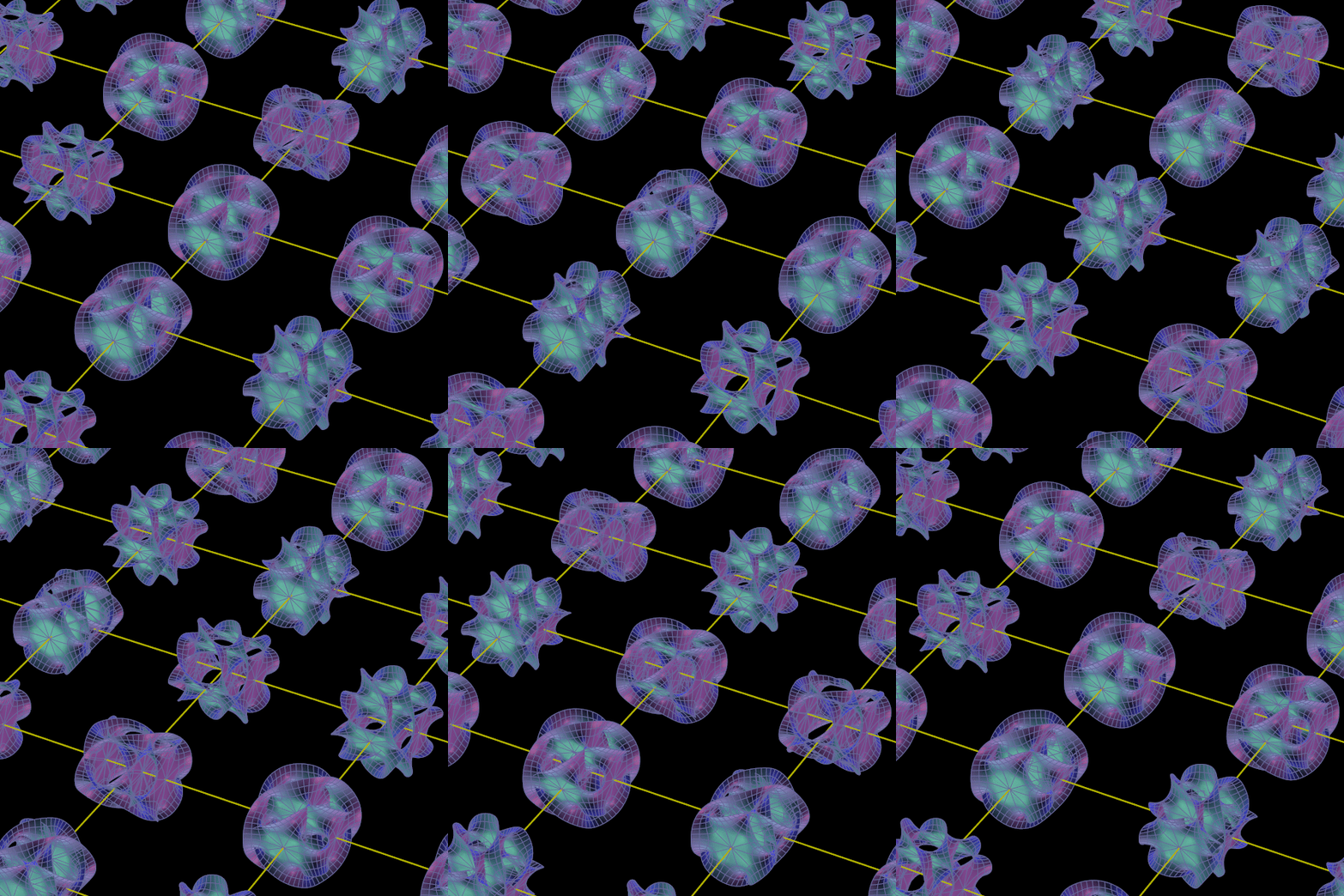
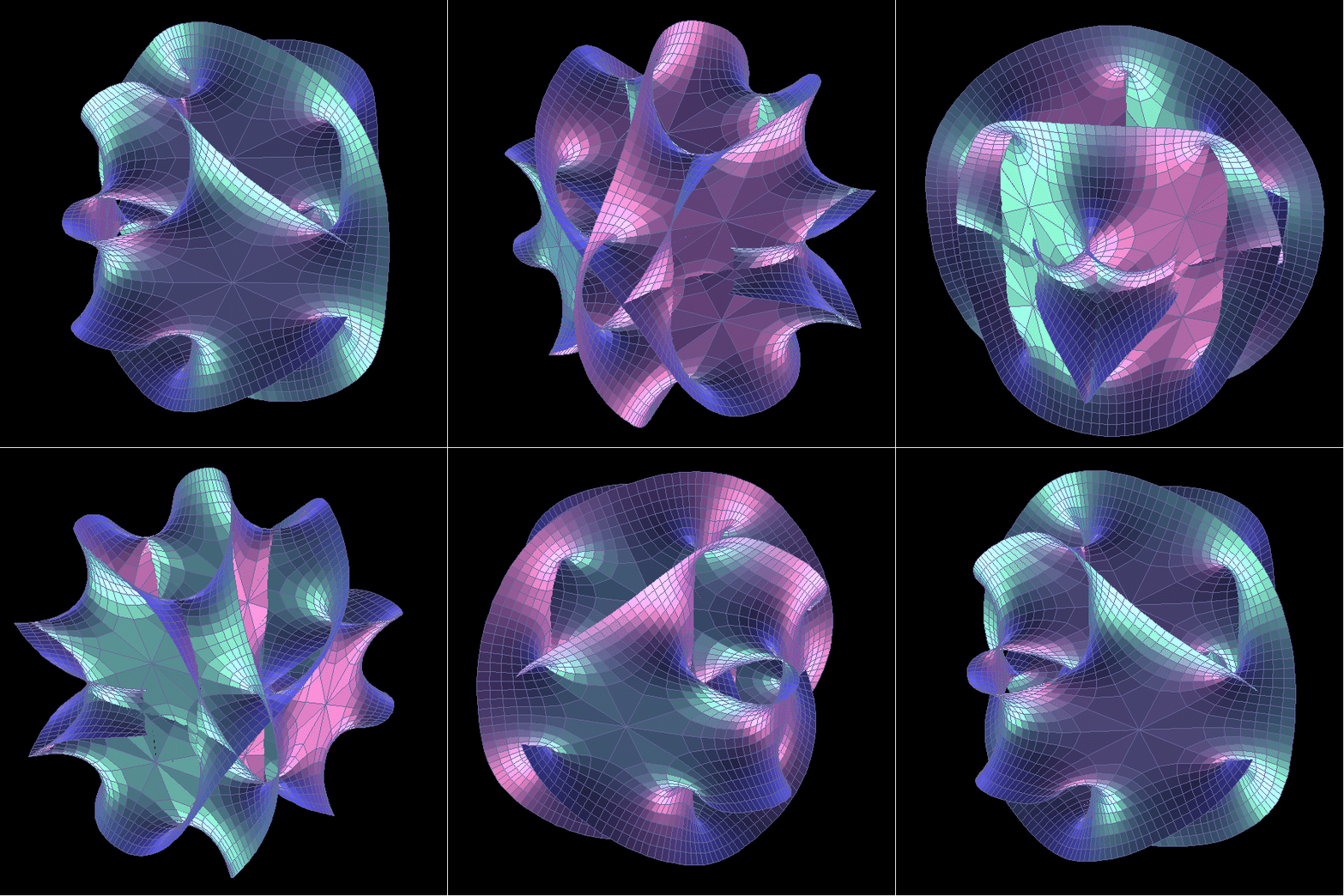
Here is a demonstration of a Calabi-Yau manifold:
Machine-translated from the Chinese original 两个哈佛数学演讲和一个杨振宁1988年采访的演讲Math-Science Literature Lecture Series (published 2020-10-12). WeChat original ↗