
This article was first published with permission from the author. Reprinting requires authorization.
The epidemic in the United States continues. Before the start of school in August this year, I applied to my school district for the option of allowing my children who were about to enter eighth grade (second grade of junior high school) not to go to school but to study online at home, and the school district approved it.
Unlike the last semester, where classes were temporarily switched to online teaching but were still taught by teachers from the school, this online school is actually an education company covering the United States that is independent of schools and school districts. They developed online courses covering five subjects: English, American history, science, mathematics and physical education, and connected the entire platform to the websites of school districts that purchased their services. School district leaders and teachers can also access the system to check the academic progress of students studying at home. Before the outbreak, a very small number of students' parents chose to use this platform to educate their children at home for various personal reasons, while retaining their student status and participating in the state's unified examination. However, this time the epidemic has increased this number of students to more than 20 people, including us.
The online school platform employs teachers of various subjects from different places across the United States to correct homework and communicate with students and parents through email and the platform’s homework system. There are no class hours in online classes, and teachers do not use video to teach in real time. They only correct part of the homework. Most of the homework is completed directly online with a single click, and the computer automatically determines the correct and incorrect multiple-choice questions. However, each unit is set to be printed and handwritten, and then the returned homework is scanned, and the teacher will mark and comment on this part. The platform also provides online tutoring and customer service for various subjects. Generally speaking, this learning method is similar to self-study, which combines online problem-solving tests with remote tutoring and communication. Therefore, it also requires more active supervision and guidance from parents.

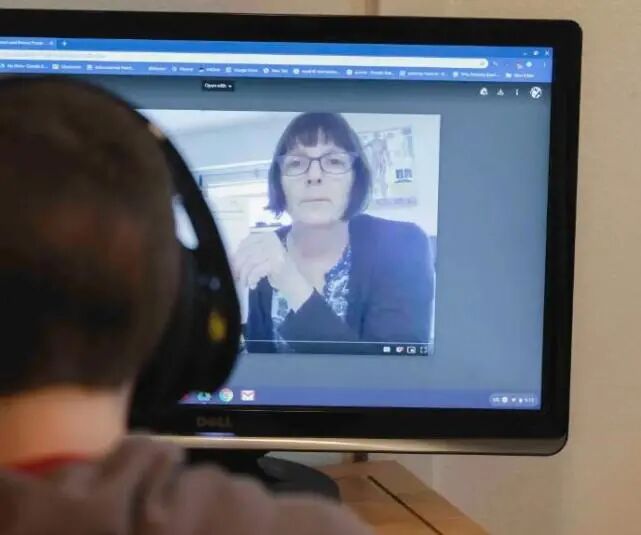
Pictures from the Internet
Among the five subjects in the online course, "Science" follows the current practice of primary and secondary education in the United States and does not distinguish between "physics", "chemistry" and "biology", but pays more attention to the definition of science and the mastery of coherent knowledge and methods, such as how to design experiments and models, display and interpret data, learn to distinguish between qualitative and quantitative data, understand the definition of "variables", and learn to interpret models composed of multiple data in the same virtual experiment.
There is no opportunity for face-to-face classes in physical education, but the content focuses on the mastery of fitness and health care knowledge. For example, students are required to self-check their heart rate, count pulses, calculate body fat ratio, understand the relationship between exercise and cardiovascular disease, design their own fitness methods, arrange fitness plans, etc. The homework focuses on the popularization of some basic knowledge of sports science.
English and history subjects, which I personally value more, also have their own characteristics. In English education, students need to look at texts and literary creations from a theoretical perspective, and understand the importance of point of view and perspective, the difference between limited perspective and omniscient perspective, the use of first person and third person, and the technique of irony. The textbook also tells students the elements of a typical storyline, from the beginning, through tension and conflict, to the climax and ending, and tells students how conflicts advance the plot and how responses to conflicts reflect the character's personality. In terms of style and style, students will be taught to understand what "epic" is, what is figurative literary language, and what are recurring "motifs" that are often related to ancient Greek culture and have been transformed into modern times. Teaching also guides students to distinguish whether the author's purpose of writing is to explain, persuade, entertain, or enlighten others. A more challenging assignment included a structural and thematic analysis of one of Shakespeare's sonnets.
These teaching contents tend to enable students to gain a macroscopic understanding of the writing process and certain rules, learn how to clearly judge the theme of a work, and evaluate the author's purpose and techniques. During the tutoring process, I also told the children that the story of two people falling in love and one of them unfortunately passing away in the American novel and movie "Love Story" can be said to be a typical "motif" (in Chinese movies, it can be reminiscent of the Hong Kong movie "New Love" and Zhang Yimou's "Love at the Hawthorn Tree"). This kind of early training and continuous study of "creative writing" in college help adults who have become film and television screenwriters and novelists to rationally write stories with logical character settings and plot conflicts, and in line with popular psychology.
The teaching of American history begins with the original inhabitants of the North American continent, focusing on their interaction with the environment and the evolution of production and lifestyle. When talking about the American Revolution, it explains that the entire process of revolution and founding was full of difficulties and contradictions, a complex and continuous game process. It also explains that the ideological basis of the American Constitution is the European Enlightenment. The founding fathers of the United States established a government that combined federalism and republicanism and established a decentralized and balanced government through the formulation of the Constitution. However, even after the constitution was made, there were still differences in political views between the Federalists and the Anti-Federalists.
Just as English teaching emphasizes "how" a work was written, history teaching, in addition to basic events and the causal relationships between events, also focuses on explaining "how" historical works are written and "how" historical research is conducted, which is what professional historians know as "historiography." One assignment requires students to judge whether a "nonfiction work" can be used as a source of information to understand history, and prompts students to pay attention to three criteria: validity, credibility, and whether there is circumstantial evidence. Another assignment asked students to think about why two authors came to different conclusions when studying the same historical topic, and how the author's own stance and views would affect the conclusions of the work.
The distinction between primary data and secondary data is something we often teach students in college, but I only discovered that Americans have already begun to explain it at this stage when I came into contact with the second-year junior high school curriculum. Of course, after re-learning this part at the university level, the most important thing is to effectively integrate the two, as well as the analysis of different interpretations of different secondary data authors into your own thesis writing.
The online education platform used by our school district mainly relies on course content and assignments developed by this Seattle-based company. The lack of teacher explanations is a shortcoming. However, for immigrants who have not experienced primary and secondary education in the United States, supervising and helping them learn as parents, while investing some time and energy, can also get a glimpse of some characteristics of American basic education.
Excluding mathematics subjects that I am unfamiliar with and difficult to compare, I do not think that the quality of junior high school education in the United States is low or that the content is radical and left-leaning, nor do I think it is inferior to basic education in China (in school education before the epidemic, I never heard my child say that the teacher made any specific remarks that deviated from mainstream values, but he did learn the fundamental spirit of diversity and tolerance). On the contrary, the content and thinking training of American basic education are worthy of reference by domestic and Chinese parents. Some people have raised questions about why basic education in the United States is in such a mess and higher education is so developed. In my opinion, this contradiction does not exist, because even logically speaking, a country cannot have high-quality higher education without foundation and castles in the air. In addition, the quality of basic education cannot be measured solely by the difficulty of mathematics education.
ScholarScholar
Machine-translated from the Chinese original 从疫情期间的初中网课看美国基础教育 (published 2020-11-21). WeChat original ↗