Some recent scientific and research advances are fast and effective.
How to integrate simulation, experiments, mathematical tools, and machine learning tools can create a new scientific research paradigm.
If physics, mathematics, biological knowledge and experimental information also serve as a language (formal symbol system). Use natural language processing tools, graph theory, machine learning and other tools to process these formal languages, combine experimental data, do formal symbolic deduction, and then verify through experiments based on the inferred conclusions. Some meaningful formulas, such as Jones polynomials, can be deduced through data and formal symbol systems, given some knowledge structures in advance. Even some equations with profound physical meanings such as the Schrödinger equation and the mass-energy conversion equation. Then we will look for the logical relationships and physical meanings behind some equations.
Category theory [15] should be of basic help.
If you are interested, you can join the group to find out more.
Harvard’s online lecture on January 13 (registration required):
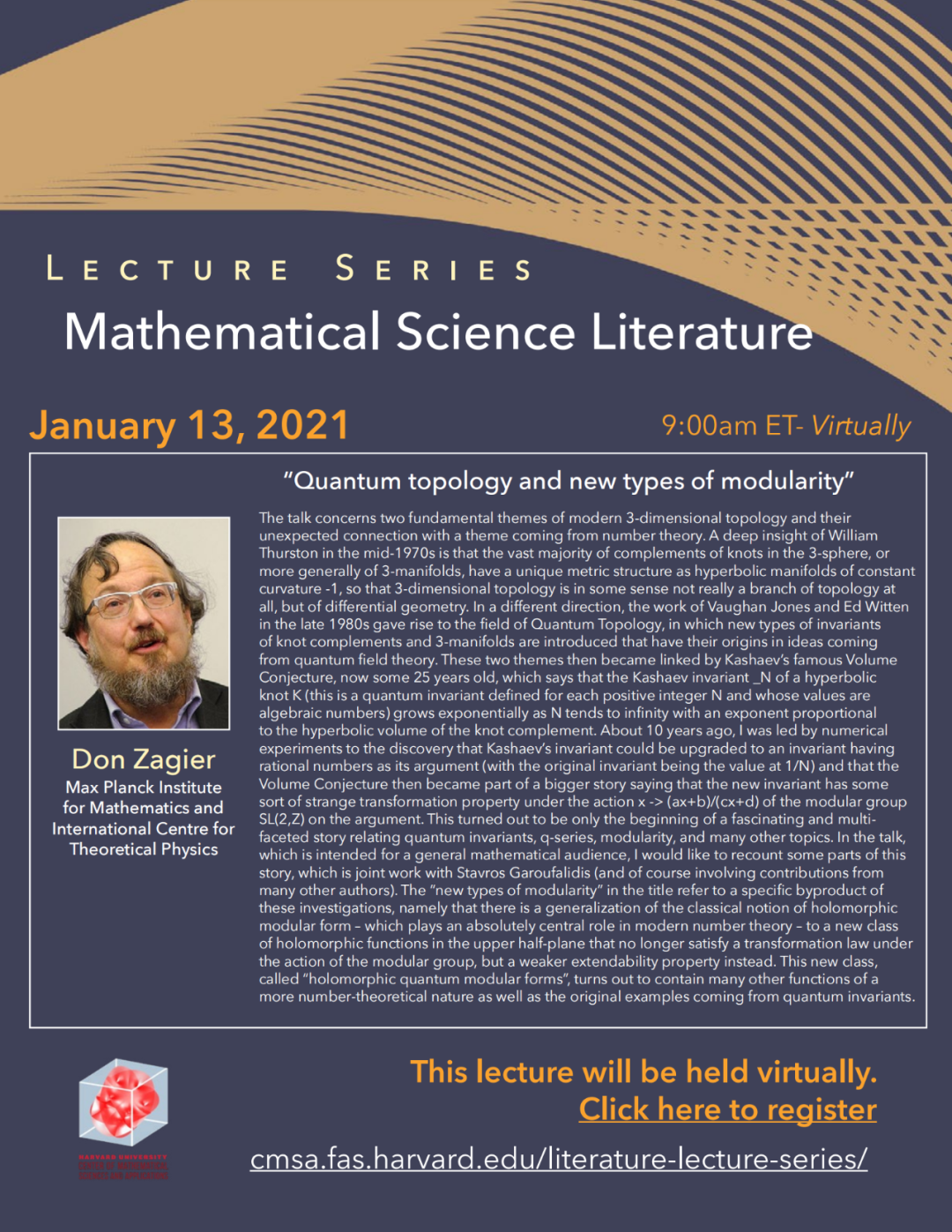
Registration URL:
https://harvard.zoom.us/webinar/register/WN_9Qb6IBIfQ0ujujfLvue2eA
"The talk concerns two fundamental themes of modern 3-dimensional topology and their unexpected connection with a theme coming from number theory. A deep insight of William Thurston in the mid-1970s is that the vast majority of complements of knots in the 3-sphere, or more generally of 3-manifolds, have a unique metric structure as hyperbolic manifolds of constant curvature -1, so that 3-dimensional topology is in some sense not really a branch of topology at all, but of differential geometry. In a different direction, the work of Vaughan Jones and Ed Witten in the late 1980s gave rise to the field of Quantum Topology, in which new types of invariants of knot complements and 3-manifolds are introduced that have their origins in ideas coming from quantum field theory. These two themes then became linked by Kashaev’s famous Volume Conjecture, now some 25 years old, which says that the Kashaev invariant _N of a hyperbolic knot K (this is a quantum invariant defined for each positive integer N and whose values are algebraic numbers) grows exponentially as N tends to infinity with an exponent proportional to the hyperbolic volume of the knot complement. About 10 years ago, I was led by numerical experiments to the discovery that Kashaev’s invariant could be upgraded to an invariant having rational numbers as its argument (with the original invariant being the value at 1/N) and that the Volume Conjecture then became part of a bigger story saying that the new invariant has some sort of strange transformation property under the action x -> (ax+b)/(cx+d) of the modular group SL(2,Z) on the argument. This turned out to be only the beginning of a fascinating and multi faceted story relating quantum invariants, q-series, modularity, and many other topics. In the talk, which is intended for a general mathematical audience, I would like to recount some parts of this story, which is joint work with Stavros Garoufalidis (and of course involving contributions from many other authors). The “new types of modularity” in the title refer to a specific byproduct of these investigations, namely that there is a generalization of the classical notion of holomorphic modular form – which plays an absolutely central role in modern number theory – to a new class of holomorphic functions in the upper half-plane that no longer satisfy a transformation law under the action of the modular group, but a weaker extendability property instead. This new class, called “holomorphic quantum modular forms”, turns out to contain many other functions of a more number-theoretical nature as well as the original examples coming from quantum invariants."
Google Translate:
"The talk touches on two fundamental topics of modern 3D topology and their unexpected connections with topics in number theory. William Thurston Thurston's insight in the mid-1970s was that in 3-spheres, or more generally 3-manifolds, the vast majority of the complements of knots have a unique metric structure, like a hyperbolic manifold of constant curvature -1, so that in a sense 3D topology is not actually a branch of topology at all, but is differential geometry. In a different direction, Vaughan Jones and Ed Witten. Witten's work in the late 1980s led to the development of the field of quantum topology, which introduced new types of knot complementarity and three-manifold invariants, which had their origins in quantum field theory. These two topics were then linked to Kashaev's famous Volume Conjecture, which is now 25 years old. Conjecture says that the Kashaev invariant _N of the hyperbolic junction K (which is a quantum invariant defined for every positive integer N, whose value is an algebraic number) grows as N goes to infinity, and its exponent is proportional to the volume of the hyperbolic junction. About 10 years ago, I was inspired by numerical experiments and found that Kashaev's invariant can be upgraded to an invariant with rational numbers as parameters (the original invariant is 1/ value of N), and then the volume conjecture becomes part of a larger story about new invariants having some strange transformational properties under the action of x->(ax + b)/(cx + d) on the module group SL(2,Z). It turns out that this is just the beginning of a fascinating and multifaceted story about quantum invariance, q-series, modularity, and many other topics. In a talk for the general mathematics reader, I would like to tell some parts of this story, which is related to Stavros The "new modularity" in the title, co-authored by Garoufalidis (and of course with contributions from many other authors), refers to a specific by-product of these studies, namely the generalization of the classical concept of holomorphic modular forms (which plays an absolutely central role in modern number theory) to new ones. Under the influence of modules, the holomorphic functions of the upper half plane no longer satisfy the transformation laws, but have weaker scalability. This new class is called "holomorphic quantum modular form", which contains more other functions with number theory properties, as well as original examples from quantum invariants."
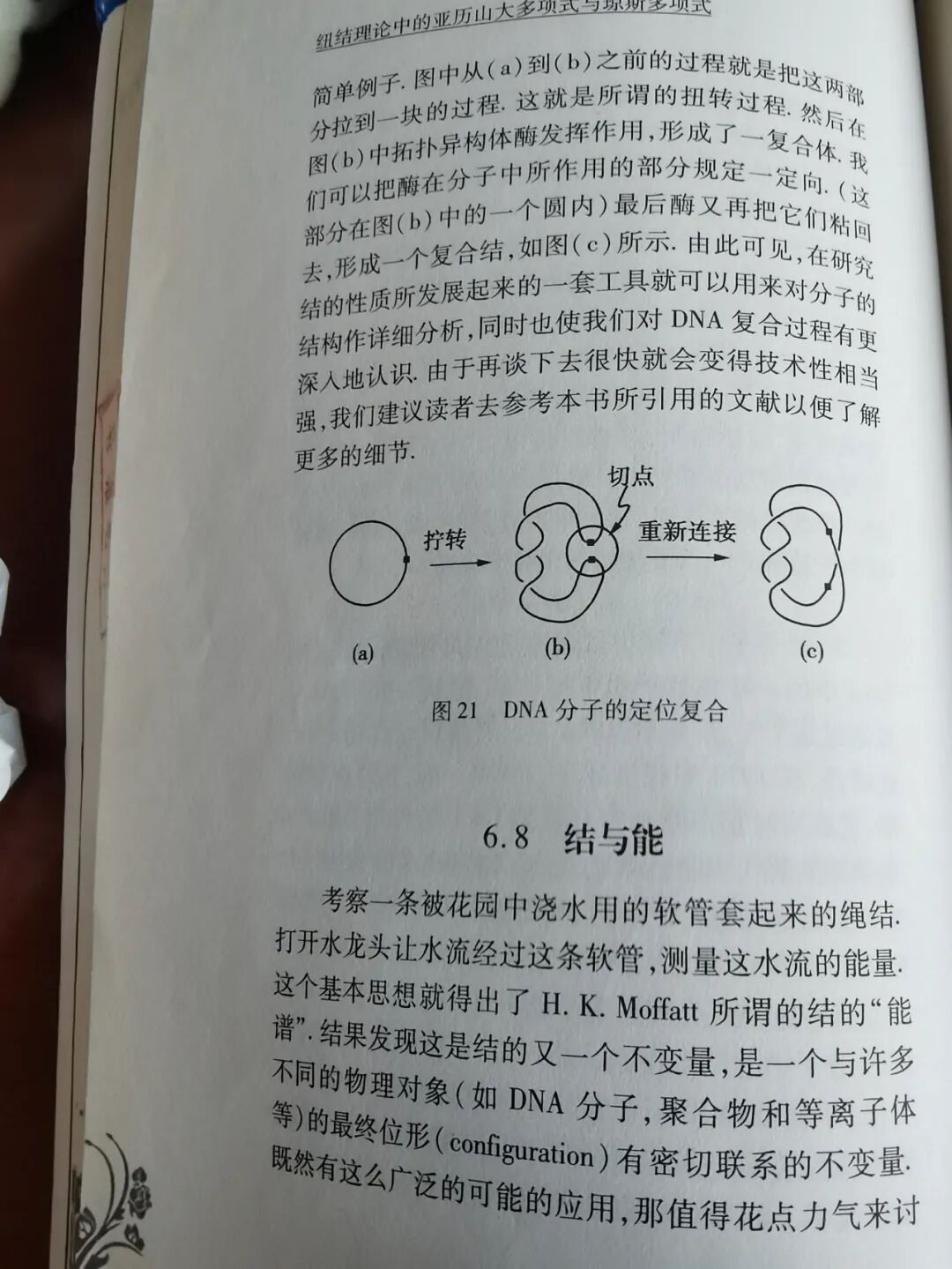
Figure 1
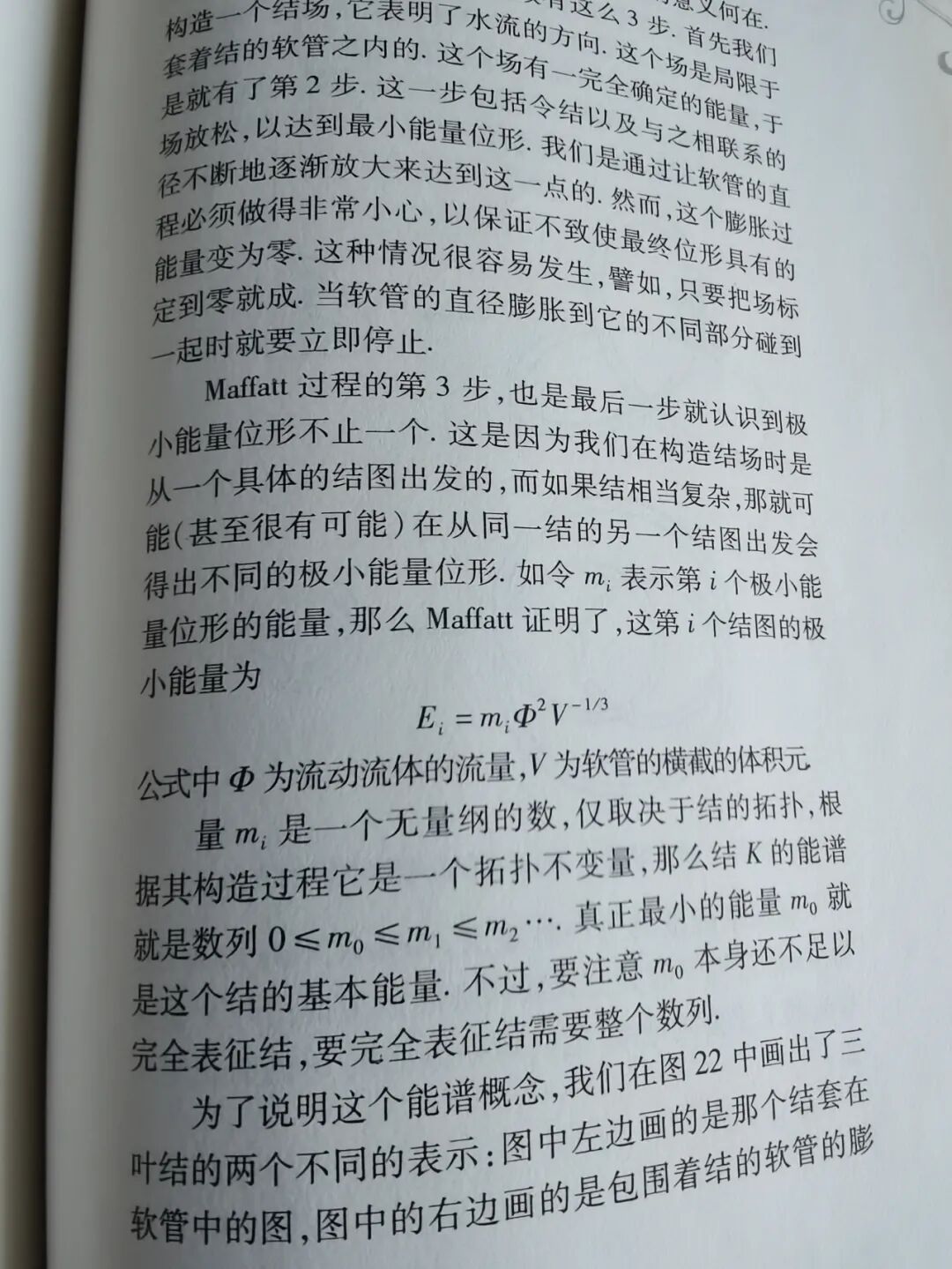
Figure 2
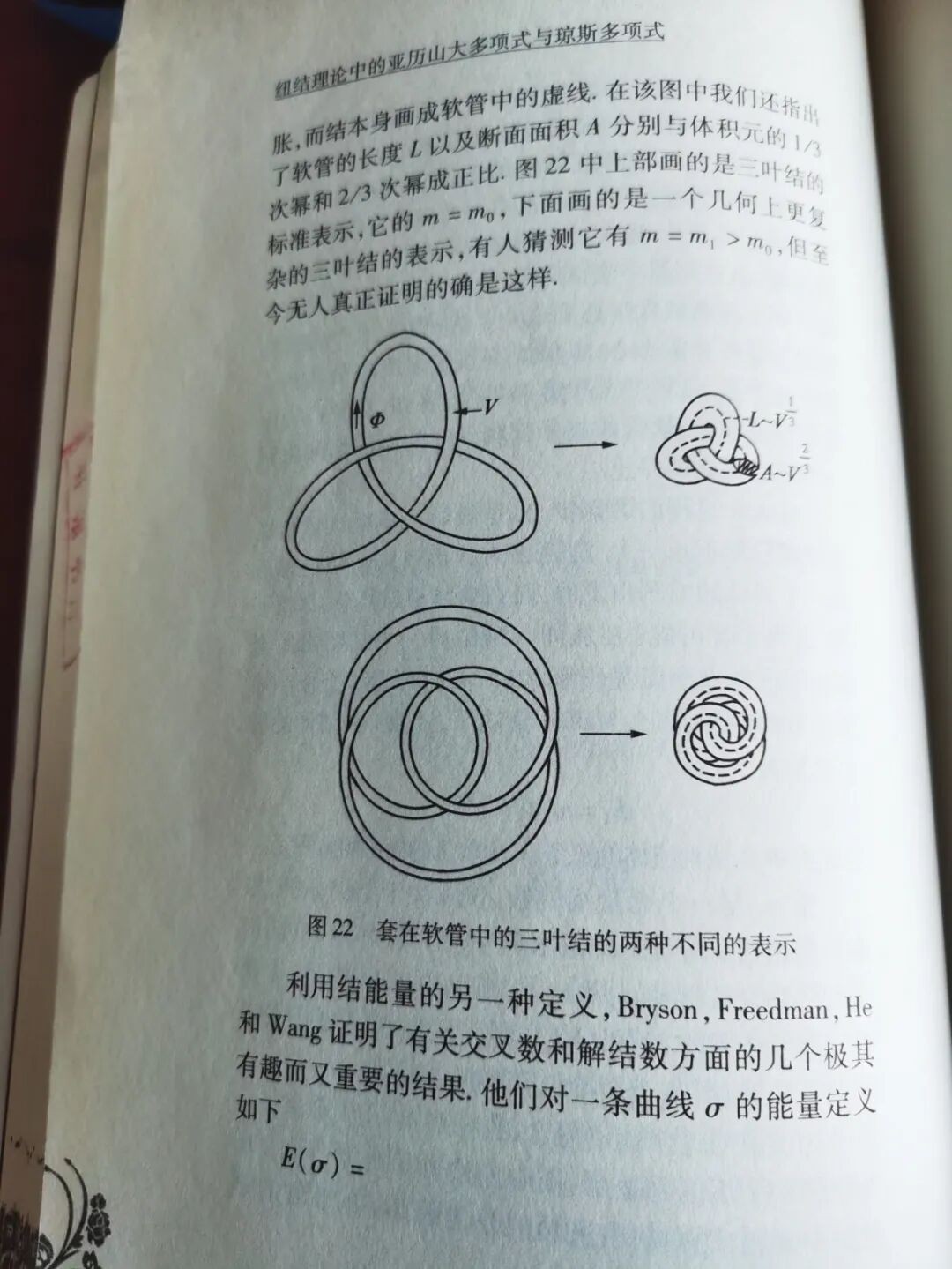
Figure 3
Figure 4

Figure 5
If you use Feishu, you can join the Feishu team, which contains some accumulated information from the past:
You are invited to join the exploration of structural biology. You can join the team through this link https://go.feishu.cn/Jn1Qy7H/ or the 8-digit team code XNNYKNVB

1. Is the era of RNA drugs coming at an accelerated pace?
In the future, it may even be possible for human drug development to be completely personalized. "There is a reason why RNA COVID-19 vaccines are quickly on the market." At the end of 2020, two COVID-19 vaccines developed by the German company BioNTech and the American company Moderna have been officially approved for marketing in the United States and Europe.
Both vaccines are RNA vaccines. The development logic is somewhat similar to inclisiran. The main body is also an RNA chain composed of four bases. However, inclisiran interferes and destroys the original RNA in cells and prevents protein synthesis, while the RNA of the new coronavirus vaccine enters human cells and guides protein synthesis. They are designed with reference to the genome sequence of the new coronavirus. They can produce part of the spike protein on the surface of the new coronavirus in human cells and release it into the blood for the human immune system to recognize and capture, thereby forming an immune memory of the new coronavirus. "
2. We are also rapidly understanding the pathogenic mechanisms of some other diseases that have a great impact.
On December 28, 2020, the team of Academician Shi Yigong, President of West Lake University, published a latest research paper titled: Structural basis of γ-secretase inhibition and modulation by small molecule drugs in Cell magazine.
The study reports for the first time four atomic resolution cryo-electron microscopy structures of γ-secretase combined with three small molecule inhibitors (Gamma-Secretase Inhibitor, GSI) and a modulator (Gamma-Secretase Modulator, GSM), clarifying the molecular mechanism by which γ-secretase recognizes different types of inhibitors and modulators.
This study for the first time fully demonstrates the entire process of binding substrates and drugs by γ-secretase, providing an unprecedentedly precise blueprint for understanding the regulation mechanism of γ-secretase activity, and will also greatly promote the design and optimization of the next generation of γ-secretase inhibitors and modulators.
b. New ideas: from drug confrontation to cutting off nutrition
"The research team further explored the antimalarial feasibility and mechanism of action of this type of inhibitor molecule in a new research paper published in the Proceedings of the National Academy of Sciences. Through structural analysis, the researchers found that under the action of the same inhibitor, the human glucose transporter (hGLUT3) There is no significant change in the conformation and there is no new cavity structure similar to that in the PfHT1 protein - this shows that the design of inhibitors targeting the specific allosteric cavity of the PfHT1 protein is the key to achieving selectivity. Based on the original research, the research team targeted the allosteric position. The inhibitors were further modified and optimized, and a series of TH-PF compounds with improved activity and selectivity were obtained. A series of protozoan experiments proved that this series of compounds is highly lethal to Plasmodium and its inhibitory activity increases with the glucose concentration in the culture environment. It decreases and enhances, and at the same time effectively inhibits the glycolytic activity of Plasmodium by blocking the uptake of glucose. More importantly, this series of compounds has a good inhibitory effect on all sub-stages of intraerythrozoic Plasmodium, and shows a different mode of action from the existing antimalarial drug (dihydroartemisinin).This represents the development idea of a new antimalarial drug, thus laying the foundation for the further development of this series of antimalarial drugs.
"
[1] AI solves the Schrödinger equation with both accuracy and computational efficiency, published in "Nature-Chemistry"
【1】Wang Liming: Is the era of RNA drugs coming? | Mountain patrol report
[3] Wang Shuguo, President of Xi’an Jiaotong University: What kind of university do we need?
【4】http://m.hao123.com/news/shoubaiDetail/9423795792214990176
【5】Scientific research results | Yin Hang’s team and Yan Ning’s team have made new progress in the research on “starving Plasmodium to death”
【6】The latest discovery! 5,336 protein molecules changed in patients with COVID-19
【7】Scientists in the three fields of chemistry, physics, and quantum physics work together to achieve a key breakthrough in the application of hydrogen energy with new catalysts
【8】Harvard Lecture: https://cmsa.fas.harvard.edu/literature-lecture-series/
【9】Once again conquering the field of materials - assisting the research of amorphous structural materials
[10] Long article of 10,000 words | Professor Jiang Tianzai, Chinese Academy of Sciences: Brain networkome map and its application in brain cognition and brain diseases
【11】A new receptor for the new coronavirus to enter human cells has been discovered! Westlake University and Fudan University have joined forces to have major potential clinical applications.
【12】"Science": Challenge the classics! What is a chemical bond?
【13】Swallow “Surgeon”? The Chinese Academy of Sciences develops micro-nano biorobots that can autonomously swim to tumor lesions to achieve active targeted cancer treatment
【14】Category Theory: Mathematics of Mathematics | The Door to Wonders
Machine-translated from the Chinese original 量子拓扑讲座,琼斯多项式,RNA 药物,冷冻电镜的进展,AI求解薛定谔方程,储能,教育的几篇文章 (published 2021-01-12). WeChat original ↗