Recently I am reading the book "A Geometric Life: The Autobiography of Yau Shing Tong". As a great master, Mr. Qiu's autobiography is full of wonderful life wisdom and profound academic thoughts. The author feels that any scholar will be inspired by it. Especially young people who are determined to devote themselves to scientific careers will definitely benefit from it throughout their lives if they can seriously study the ideas in this book.
Engineering graduate students have relatively weak basic scientific training. They often spend many years carefully crafting an algorithm in a very narrow field, but they lack a macro view of basic mathematics, especially topology and geometry. Therefore, learning from Mr. Qiu's lofty views and methods is not only essential for the study of pure mathematics, but also crucial for the development of engineering technology.
For example, looking back on his years as a student at Berkeley, Mr. Qiu once wrote this paragraph: "When I studied the development of algebraic geometry and arithmetic geometry from the mid-19th century to the early 20th century, I felt that they were extremely rich in content, and their important method was to use the algebraic structure of functions on space to determine the properties of algebraic spaces. I think this idea is very good. In general spaces, these functions can also be described by the structure of functions. Geometric properties of space. These functions must be closely related to the geometry of space to be useful. Generally speaking, they are solutions to linear or nonlinear differential equations, but the definition of the function needs to be generalized, sometimes to the cross section of the fiber bundle. I spent a lot of time along this path, and later collaborated with a large number of friends and students to solve many important problems in geometry. Everyone calls this subject geometric analysis. "
This passage is written calmly and slowly, and is unremarkable. However, based on the research experience of the past many years, the author feels that this passage is shocking and enlightening! The thoughts condensed in this passage are very vast, profound and far-reaching, and the historical story behind it is even more ups and downs and magnificent. The author has been working hard in the fields of computer science and applied mathematics, and has witnessed the birth and growth of many algorithms in different engineering fields. In essence, this is the route pointed out by Mr. Suiqiu. History has verified the depth and power of geometric analysis time and time again.
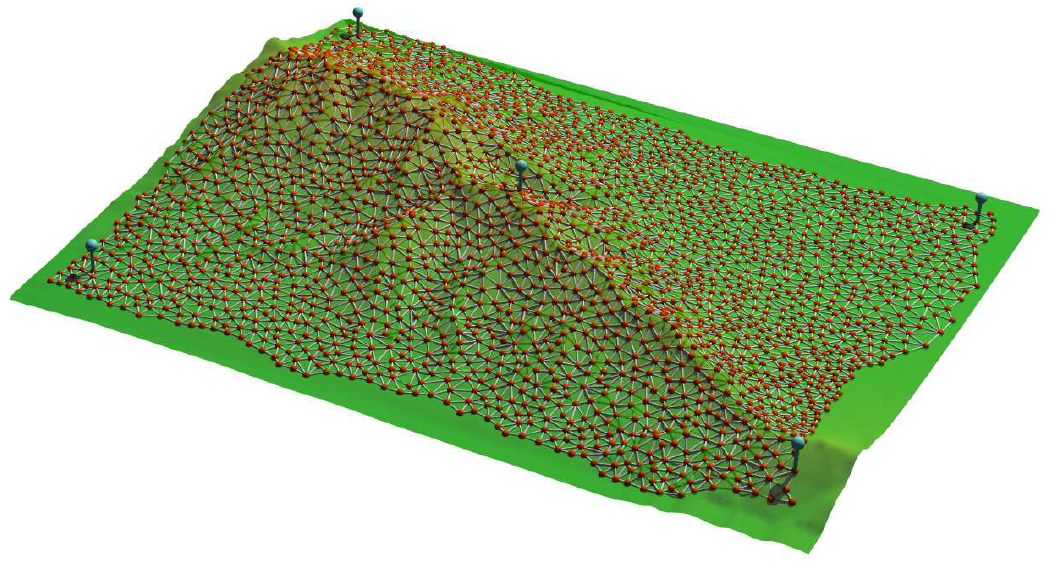
Figure 1. IoT routing.
One of the simplest examples is as follows: on the Euclidean plane, the curvature is 0 everywhere. According to Liouville's theorem, the bounded harmonic function must be a constant; on the hyperbolic plane with the same topology, the curvature is negative everywhere, so there is a non-constant bounded harmonic function. The harmonic function satisfies the Laplace equation and describes the Riemannian metric on the plane. More generally, the harmonic function on the Riemannian manifold reflects the dimension and curvature information of the manifold. In network research, harmonic functions are used to estimate the dimensionality and curvature of local networks. For example, the backbone of the Internet has negative curvature and the edges have positive curvature. Various probabilities related to random walks on manifolds are often represented by harmonic functions, from which we can infer the geometric and topological properties of the manifold through the behavior of random walks. For example, a random walk starting from the origin on the Euclidean plane will continue to return to the origin, while a random walk starting from the origin on the hyperbolic plane will never return and will never return to the origin. These properties can be used for network security. For example, rumor makers on the Internet often use random walks to hide themselves. By monitoring the probability of receiving rumors at a specific node in the network, we can determine the location of the rumor maker.
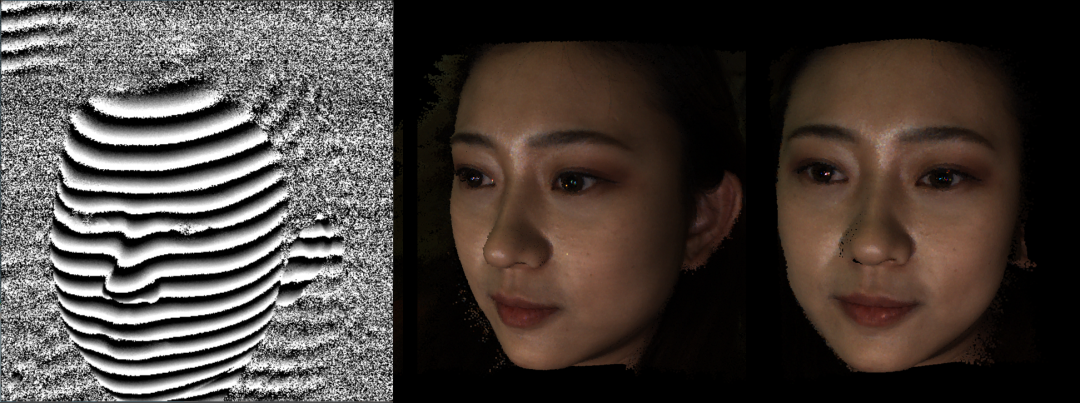
Figure 2. Phase unwrapping and point cloud reconstruction.
Another example is the harmonic section on the cotangent bundle of the surface, which is also controlled by the Laplace equation. All harmonic sections form a group, and the algebraic structure of the group reflects the topology of the surface. For example, the dimension of the group is equal to twice the genus of the surface. Dual, the smooth tangent vector field on the surface can be uniquely decomposed into a harmonic field, a vector field with zero spinor (gradient field) and a vector field with zero divergence (divergence field). This theorem is called the Hodge decomposition theorem. This method is widely used in 3D technology. Currently, one of the main methods for 3D data collection is the scanning method based on structured light. This method turns distance into phase information, and then encodes the phase into image grayscale. The fringe image is obtained through structured light, and the relative phase can be calculated back, that is, the absolute phase modulus is 2pi. Inversely calculating the absolute phase through the relative phase is the key to structured light 3D scanning. This algorithm is called phase expansion. Essentially, we hope to use the relative phase to calculate the gradient field. Due to the existence of noise, the vector field obtained in this way may not be a gradient field. Therefore, we can use Hodge decomposition to obtain the gradient field, divergence-free field and harmonic field. Then the integral of the gradient field gives the absolute phase. From this we get a 3D point cloud. Further by estimating the surface normal vector at each point, we obtain the vector field defined on the point cloud. At this time, we define the distance function to the scanned surface in the 3-dimensional space, then the normal vector field of the surface is the gradient field of the distance function. We perform Hodge decomposition on the vector field on the point cloud to obtain the gradient field of the distance function. Then the zero level set of the distance function is the surface reconstructed from the point cloud.
We then use the idea of geometric analysis to examine the characteristic roots and characteristic functions of the Laplace-Beltrami operator on the surface. All characteristic roots of the surface constitute the spectrum of the surface. In engineering and medicine, the spectrum is often regarded as the fingerprint of the shape for shape classification. As a generalized Fourier decomposition on surfaces, eigenfunctions are often used in signal processing on surfaces, such as signal compression and filtering. The combination of characteristic roots and characteristic functions constitutes the thermal kernel of the manifold, and the thermal kernel completely reflects the Riemannian metric information and is often used for shape feature extraction and surface matching.
|
|
|
Figure 3. Meromorphic cross-section of a holomorphic line bundle on the Riemann surface.
Orientable metric surfaces have a conformal structure and can be viewed as Riemannian surfaces. The meromorphic sections of the holopure line bundle of the Riemann surface form a group, and its algebraic structure reflects the conformal structure of the surface. For example, the singular point (divisor) of a fixed cross-section. The dimension of the linear space formed by the cross-section is characterized by the Riemann-Roche theorem and is related to the genus of the surface. The divisor is characterized by Abel's theorem and satisfies a specific equation. In the fields of computational mechanics and computer-aided geometric design, the core of regular quadrilateral meshing of surfaces is to calculate the meromorphic cross-section of a pure line bundle.
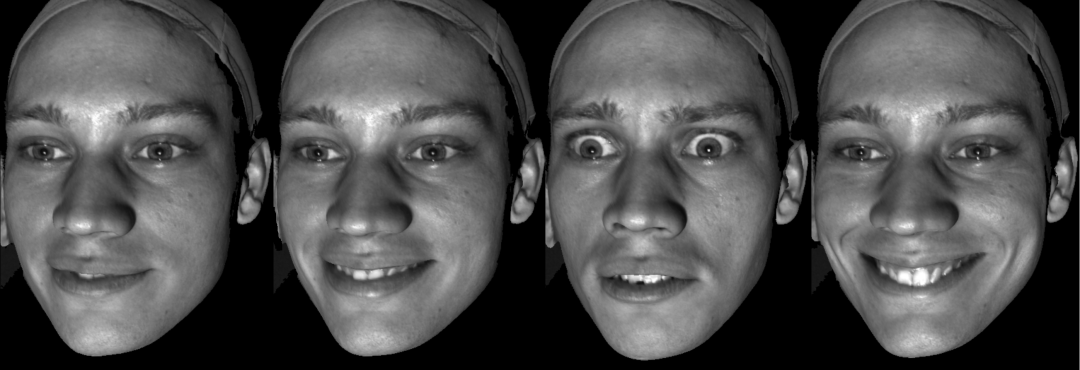
Figure 4. Dynamic facial expression tracking.
For another example, there is a special positive function on the metric surface, and its product with the Riemannian metric tensor results in a constant curvature metric. This particular metric depends on the topology and conformal structure of the surface, which is exactly what the surface univaluation theorem is. This metric is widely used in surface texture mapping in computer graphics, dynamic surface tracking in computer vision, virtual colonoscopy technology in the field of medical imaging, etc.
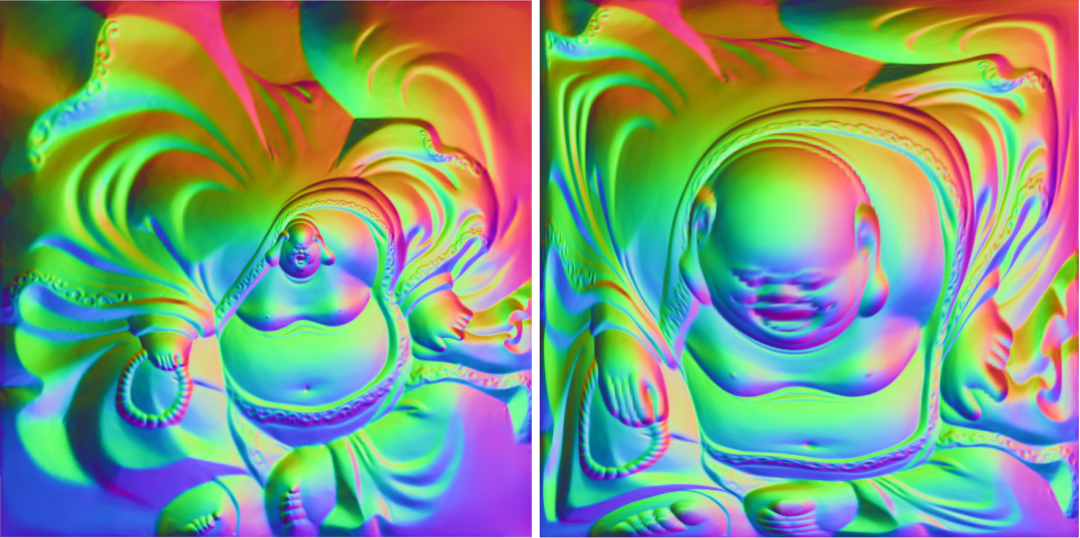
Figure 5. Optimal transmission mapping.
If there is a probabilistic measure on the manifold, then we need to consider the optimal transmission mapping, and this mapping is controlled by a Monge-Ampere type equation. Recently, people have gradually realized that optimal transmission is one of the theoretical foundations of deep learning. Mr. Qiu’s team decouples deep learning into manifold learning and probabilistic measure learning, and probabilistic measure learning is mainly based on optimal transmission theory. The Monge-Ampere equation is strongly nonlinear and the solution algorithm is relatively complex. Due to the development of deep learning, approximate algorithms for optimal transmission have been widely studied, and various generative models have emerged in endlessly.
Most of the algorithms mentioned above in the field of computer science have been gradually developed in the past two decades with the development of various software and hardware technologies: with the maturity of nuclear magnetic resonance and CT scanning technology, image recognition and registration in medical images have developed; with the maturity of laser technology, mems structured light technology, 3D scanning, point cloud reconstruction, digital geometry processing, and autonomous driving technology have gradually developed and expanded; With the development of line sensor networks, geometric routing algorithms and Internet of Things technology have matured; with the development of CNC machine tools and 3D printing technology, the development of algorithms such as surface mesh generation and metamaterial design has been promoted; with the development of Internet technology, the popularization of digital cameras, and the rapid development of big data science; with the maturity of GPU technology, individuals have increasing computing power, and deep learning methods based on statistics have become popular. Although these fields are diverse, various technologies are developing rapidly, and various algorithms are emerging one after another, their mathematical foundation has not changed. Of course, as the times progress, the mathematics used in the field of computer science becomes increasingly difficult and modern. From linear partial differential equations to nonlinear equations, from flat space to curved manifolds, from low dimensions to high dimensions. But the core idea of using partial differential equations to solve topological and geometric problems has always been universal.
Mr. Qiu also mentioned many times in his memoirs that during the era when he was studying, geometers were not very concerned about the progress in the field of partial differential equations, and conversely, analysts did not know much about the field of geometry. Mr. Qiu took the initiative to break the barriers in the field and studied geometry with Mr. Chen Shengshen and partial differential equations with Master Morrey, thereby groundbreakingly establishing the school of geometric analysis. This is even more enlightening for contemporary scholars. At present, the division of labor in the academic field is more detailed, industry barriers are higher, and cross-field research requires more courage and training. For example, optimal transmission in deep learning research can be attributed to solving the Monge-Ampère equation. The essential engineering difficulty lies in the complexity of the solution, and the accurate solution exceeds the current hardware computing power. Tracing back to the source, at the level of basic mathematics, in order to ensure the existence, uniqueness and well-posedness of the solution, we need convex differential geometry theory, optimal transmission and partial differential equation theory, and a priori estimation of the solution of the key Monge-Ampere equation; with the theoretical guarantee of basic mathematics, in the field of computational mathematics, we need to design various discretization methods, time domain frequency domain transformation, iterative format, preprocessing method, multigrid method, convergence order estimation, error estimation. This step requires a lot of numerical calculation skills, these skills are related to The prior estimation skills of partial differential equations are different, but the prior estimation will bring essential inspiration to the design of numerical algorithms; with stable and accurate numerical methods, in various fields of computer science, we need to design specific algorithms according to specific applications. In the field of computer vision, high-precision algorithms in general two-dimensional areas are needed. Surface parameterization in graphics requires high-precision algorithms in flat square areas. In medical images, high-precision algorithms between three-dimensional volume images are needed. In the field of deep learning, high-dimensional and low-precision algorithms are needed. Different applications, different accuracy requirements, real-time response requirements, hardware budget requirements, require different data structures, algorithm design, parallel design, memory management, data flow control, hardware configuration, interface design, etc. At this level, numerical calculation methods are often encapsulated into library functions and called by the application layer, so the skills required are very different from computational mathematics. Due to the social division of labor and the refinement of the education field, technical personnel with a computer background generally do not have skills training in a priori estimation of partial differential equations, and there is insufficient training in in-depth and sophisticated numerical approximation theory. However, to invent revolutionary algorithms from zero to one, only skills in the field of computer science are often not enough. In many cases, a deep understanding of basic mathematics theory is required. The optimal transmission mapping algorithm in deep learning we currently design is based on Mr. Qiu’s theory on the Minkowski problem and the Monge-Ampere equation. Regarding the optimal transmission algorithm in medical images, its convergence is essentially based on the regularity theory of the Monge-Ampere equation by Mr. Qiu, Caffarelli and others. Therefore, young students should expand their horizons, preferably have cross-field training, and think and create from a natural basis. Only in this way can they make major breakthroughs!
By reading "A Geometric Life: The Autobiography of Yau Shing-tung", the author realized many strategic ideas that provide an overview of the overall academic situation. These ideas are much more important than specific geometry or partial differential techniques. At the same time, Mr. Qiu very sincerely reviewed the major events he experienced in his memoirs and summarized very valuable life experiences, which are extremely valuable for young people. For young people who are open-minded and seek advice, this book will definitely benefit them for life!
Machine-translated from the Chinese original 读《几何人生:丘成桐自传》的一点感想 (published 2021-04-22). WeChat original ↗