Today there is a blizzard, the wind is howling, the sky is covered with snow, and the sky and the earth are vast. Getting up early to shovel the snow, wielding the snow shovel feebly against the cruel nature, once again experienced the primitive productivity level of the Stone Age. Suddenly, I felt that being able to think about abstract mathematics in front of my desk was actually a kind of supreme happiness that humans have accumulated through generations of hard work.
These days, I have been discussing the topological Galois theory founded by Arnold with my old friend Wang Haoran. Wang Haoran agrees with Arnold's point of view. Arnold believes that modern mathematics should be explained from an elementary classical point of view, rather than from a mysterious modern abstract point of view. Here, we use Arnold's topological method to explain the abstract Galois theory.
Solvable group
Solving polynomial equations is one of the fundamental problems in algebra. Abel proved that the quintic equation has no "algebraic" solution (that is, the solution cannot be expressed by the coefficients of the equation through arithmetic operations and root operations). Galois completely solved the problem of solving the roots of polynomials: he gave the necessary and sufficient conditions for the polynomial roots to be solvable. A group closely related to polynomial solvability is the symmetry group.
The so-called group is a set and a multiplication operator, satisfying the conditions
- Closeness:
- Unit Yuan: , , all
- Reversibility: , , making
- Associative law: , all
For example, by examining all the permutations of a sequence, using the compound of the permutations as multiplication, we form the so-calledSymmetry group. Symmetry groups are generated by so-called permutations, and all permutations generated by an even number of permutations constitute the so-calledInterlaced group。
We note that commutativity, i.e. possibility, is not included in the conditions of the group. If multiplication is commutative, then a group is said to beAbel group, otherwise it is a non-Abelian group. To measure the distance from a group to the Abel group, useChange seatsgroupconcept. Let it be a group, called a set by
The generated subgroup is the transposition subgroup (Communtator Group), denoted as. If it is an Abelian group, the transposition subgroup is. We recursively construct as follows:
If there exists an integer such that then we say that a group is aSolvable group. (The definition of solvable group here is different from the traditional definition, but they are equivalent to each other). For example, let, directly calculate the number of elements in,
| group |
G
|
G'
|
G''
|
G'''
|
|---|---|---|---|---|
|
S2
|
2 | 1 |
|
|
|
S3
|
6 | 3 | 1 |
|
|
S4
|
24 | 12 | 4 | 1 |
|
S5
|
120 | 60 | 60 | 60 |
This means that is a solvable group, but not a solvable group. The transposition subgroup of its intersection group is equal to itself, so it is not a solvable group.
Existence of radical solutions given a polynomial
We merge the complex plane to a point at infinity,
Projected onto the unit sphere through the stereographic projection. Then regard as a holomorphic mapping from the sphere to itself. At that time, , we draw a small circle around the infinity point on the plane. The highest term is the circle around the point on the plane. This means that the source sphere is wrapped around the target sphere, with a total of wrapping layers. Therefore, for any point on the target sphere, there is a preimage on the source sphere, so
That is, a subalgebraic equation has a complex root. At this time, there is factorization,
From this, we get Vedic theorem
That is, the coefficients of a polynomial are determined by the basic symmetric polynomials of its roots. We rearrange these roots, , , and are invariant by Vedic's theorem, that is, the polynomial equation is invariant.
Galois theory basically says that if a subalgebraic equation has an algebraic radical solution, then it is a solvable group. For and , is a solvable group, so there is a root-finding formula; for , is not a solvable group, so there is no root-finding formula. The proof of traditional abstract algebra requires more basic knowledge, including domain expansion theory. Arnold's topological proof below is very elementary and concise.
Arrangement of roots
We examine polynomials
Denote the complex vector composed of all coefficients as,. Let all the roots change with time, and their trajectories are,. At this time, the polynomial on the left side also changes with time,
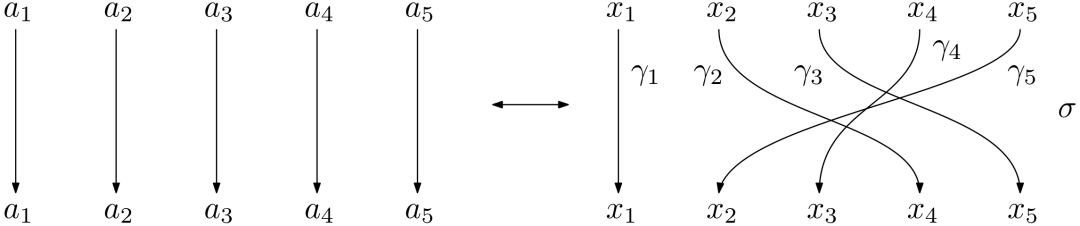
Figure 1. Design root path.
As shown in Figure 1, for any arrangement, we can design a path that satisfies
By Vedic theorem, we have, which means that the coefficient vectors form a cycle, denoted as .
Lemma 1.If there is a root finding formula for an algebraic equation, , and the coefficient runs along a circle, then naturally we have the following equation
Here is the abbreviation of , that is, the arrangement of the starting and ending point function values of the root formula is equal to the arrangement of the roots of the equation.
For example, we examine the quadratic equation of one variable
Let , , then, . Let be the exchange,
Constructed as the upper semicircle, from reach; let be the lower semicircle, from reach,
From this we get the coefficient loop,
We know that the formula for finding the root of a quadratic equation of one variable is:
here
When from changes to, from changes to; from changes to. This means that the starting and ending values of the root formula result in an arrangement of roots equal to those used in the initial design,
The general root finding formula is composed of a rational function and the root operation, for example:
Here is the rational function of .
Core idea:We wish to verify that any form of root-finding formula is not true if we can find a loop in the coefficient space such that the equation in Lemma 1 does not hold. We construct such a loop below so that, however, the arrangement of the roots on the right side is not an identity transformation, which creates a contradiction. This can be accomplished using the position-changing technique.
Monodromy
In the above discussion, one thing is very confusing: we made the coefficient run a loop back to the starting point, but the root formula is indeed not equal to. This involves the concept of monodromy. We explain it from a topological point of view.
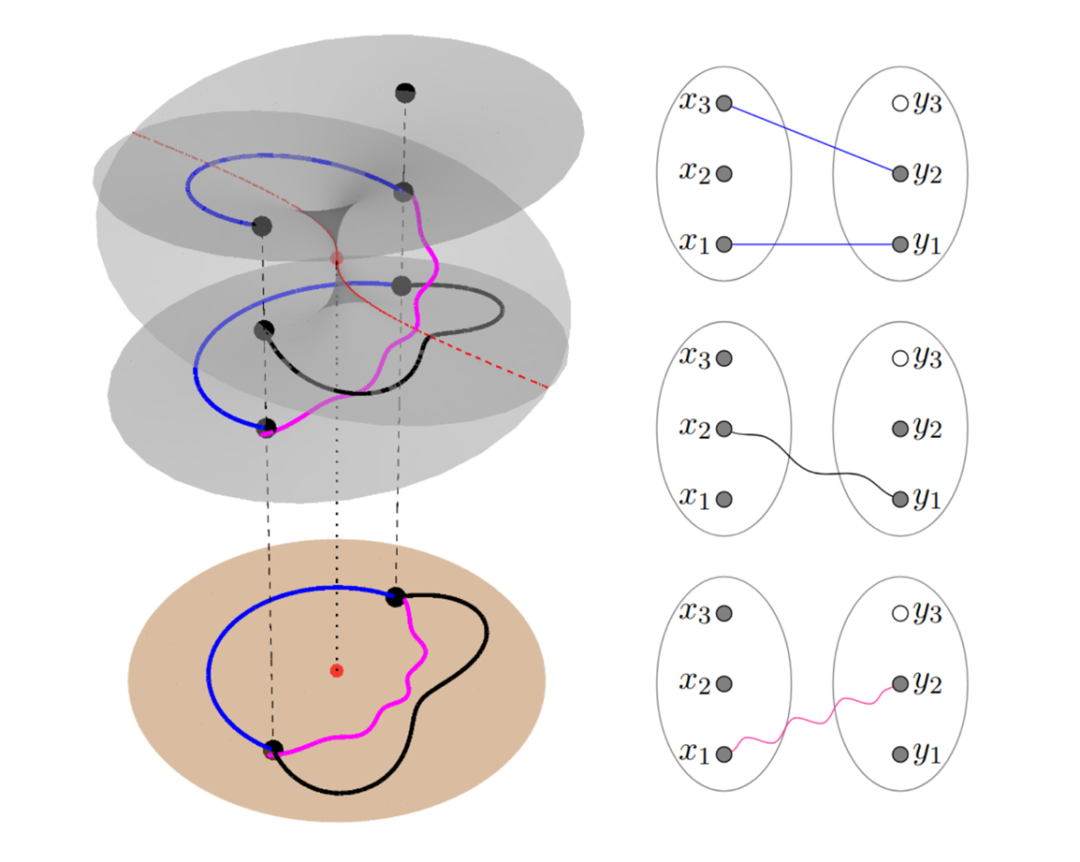
Figure 2. Road lifting and Monodromy.
As we mentioned earlier, the polynomial can be regarded as a conformal transformation from -sphere to -sphere, wrapping the source sphere on the target sphere and wrapping the layer. As shown in Figure 2, the derivative of the mapping is
The zero point of is the branch point of the mapping, and at other normal points, the mapping is locally reversible. The overall mapping is a heavy branch coverage, and we regard the sphere as a sphere.Cover space. The original image of is the root of , assuming they are all normal points. We draw a loop on the sphere. A neighborhood we select is always different in this neighborhood, so the mapping is reversible. We map the curve back to the sphere through inverse mapping, and obtain a curve, marked as, we say it is inpromote. Then, we select a neighborhood on the sphere, which is non-empty and invertible on the sphere, so we can upgrade it to medium. Repeat this until you lift it to a path in the covering space (-sphere). By,, ,we get. In the same way, we ascend from the beginning to the coverage space and obtain, then the starting and ending points of these ascending roads give an arrangement:
Then we will be monodromy.
In our case, the variables of the loop are coefficients instead, but the idea is similar.
Changing seats skills
Now let’s examine the core skills,Change seats. Given two permutations, the corresponding coefficient loops are and . The transpositions of the permutations and the transpositions of the loop are respectively
Here is an arrangement, which is still a loop in the coefficient space. First, walk along it for a circle and return to the origin, then walk along it for a circle, then walk along it in the opposite direction, and finally walk along it in the opposite direction and return to the origin.
Let us first prove a simple proposition:
Proposition 1: The algebraic root finding formula for a cubic equation cannot have the form:
The following observation is key:
Lemma 2: Given a degree polynomial, for any, any,, is a loop constructed as above, and changes along the loop, then
Here is the rational function.
Proof of Lemma 2: This proof is elementary, , so their arguments differ by an integer multiple of . by definition
The changes in the argument angles cancel each other out, and the total change in the argument angles is the proof of the lemma.
Proof of Proposition 1: From the above table, we have an element, so there is an arrangement such that. Construct the loop of the coefficient space as above, and examine the starting and ending values of the root formula in Proposition 1. According to Lemma 2, they are equal, but on the right side of Lemma 1, the arrangement of the three roots is, so the equality in Lemma 1 does not hold, which is a contradiction. Therefore Proposition 1 is correct.
Let us prove a similar proposition again:
Proposition 2: The formula for finding the roots of a quartic equation cannot have the form:
Proof: From the above table, we have an element, so there is an arrangement such that
Same as above to construct a loop of coefficient space,,,. Using Lemma 2 once, we have: when running along a circle, or running along a circle, we get
Using Lemma 2 again, when running in a circle, we have
But on the right side of Lemma 1, the arrangement of the four roots is, so the equation in Lemma 1 does not hold, which is a contradiction. Therefore Proposition 2 is correct.
We can now prove the classic Abel-Galois theorem:
Theorem: There is no algebraic root finding formula for quintic algebraic equations (only arithmetic operations and radical operations are included).
Proof: Proof by contradiction, assuming there is a root finding formula, and a total of multiple root signs are nested. Because there is an element, there must be a permutation.
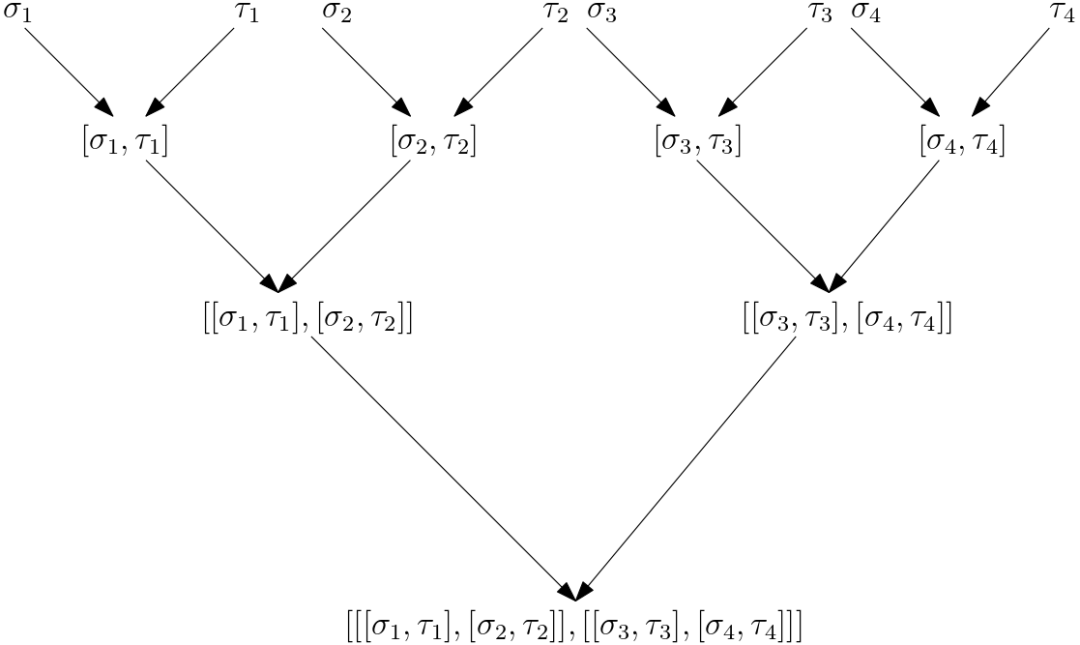
Figure 3. Multiple position changes.
As shown in Figure 3, there is an arrangement, , which is equal to , under the re-transposition operation. The loop sum of the coefficient space is constructed as above, and the re-transposition operation is also used to obtain. Applying Lemma 2 for the first time, we get the conclusion: If you run along a circle, then the root formula is,
However, the arrangement of the roots on the right side of the equation in Lemma 1 is, the equation in Lemma 1 does not hold, and is a contradiction. So the assumption is wrong and there is no root formula with heavy nested roots. Due to the arbitrariness of , we know that there is no root finding formula for the quintic equation that only includes arithmetic operations and radical operations.
Higher degree equationThe existence proof of the root formula is similar to this. It is unsolvable. For any , we can find , and thus construct. For any expression with re-nested radicals and arithmetic operations, let run along a circle, , but the arrangement of the roots is, contradictory.
Summary
Here we use the topological method to prove the Abel-Galois theorem of the existence of the root finding formula for subpolynomial algebraic equations. The core idea is the idea of a monodromy covering space in topology: if the order symmetry group is unsolvable, for any formula containing re-nested radicals and algebraic operations, we can find a special coefficient loop, so that the coefficients run in a circle and the roots of the equation are rearranged, but the starting value does not change, so it is not a root finding formula.
This method is more intuitive and concise than the abstract algebra method. In essence, this idea is stronger than Galois's conclusion. This method can be extended to more complex expressions, including arithmetic operations, radical operations, differential, integral operations, and even more complex operations. At the same time, for algorithm design, this method directly points to the powerful homotopy algorithm, which plays an important role in the field of computational algebra. We also realize that topology and algebra are entangled with each other and harmonious and unified!
In the evening, when the snowstorm stopped, neighbors pulled sleds and walked their children on the street, and the sky was filled with colorful clouds in the distance...
——The Year of the Tiger is approaching. I would like to write this article to commemorate Abel and Galois.
Machine-translated from the Chinese original 浅谈拓扑伽罗华理论 (published 2022-03-29). WeChat original ↗