Today, many people still regard ERP system implementation as developing an information technology system. In fact, ERP systems (Including any enterprise management information system, such as customer relationship management CRM, human resource management HCM, enterprise data management platform, etc.) implementation is a management change that standardizes, rationalizes and optimizes a series of business processes, rules and data; the so-called "implementation" is to promote the realization of management change expectations.
This process is called "change management"Not only information system implementation, but also any enterprise transformation process requires management change. For the concept of change management, please refer to the following old articles. This article will not go into details. I will mainly talk about my own practical experience in promoting enterprise-level change management.
Change management for digital transformation | Open defecation and ERP implementation
Change Management | Why Most Enterprise Architectures End Up Just Fake
Digital Transformation of State-owned Enterprises | Project Organization Development Methods of Change Management
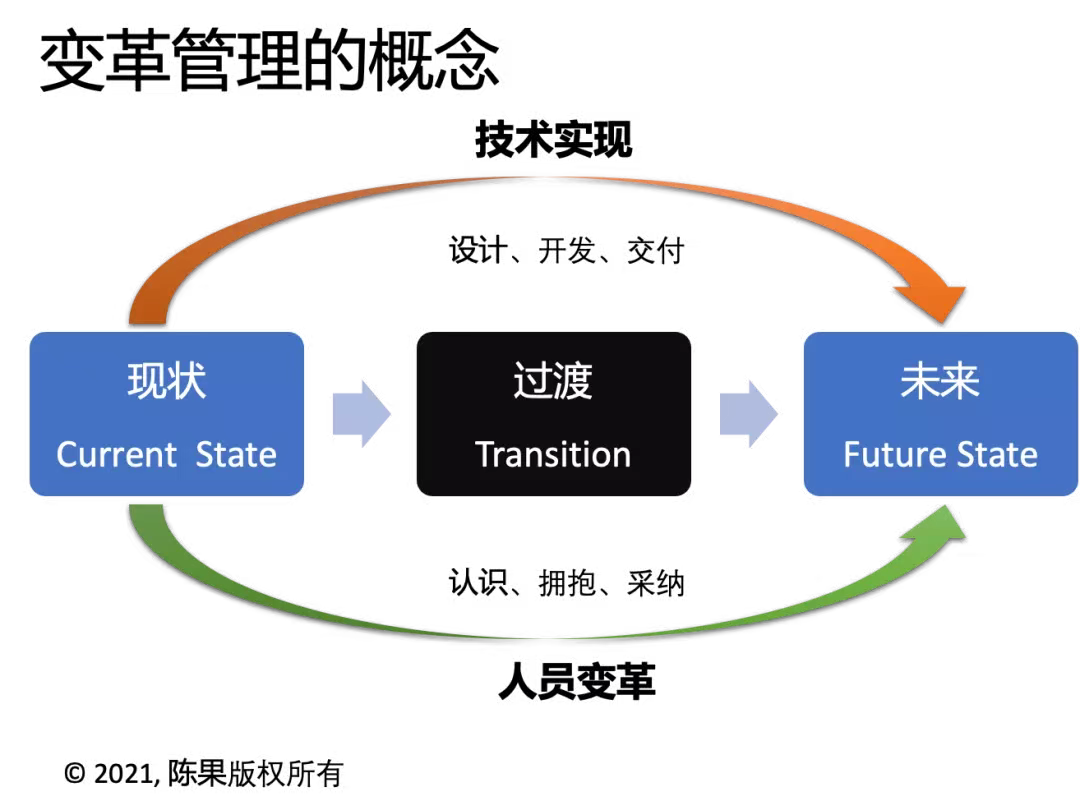
I summarize the change management process into three main aspects: change participants, key decision-making content and consultant facilitation, summarized in the following model:
(one)
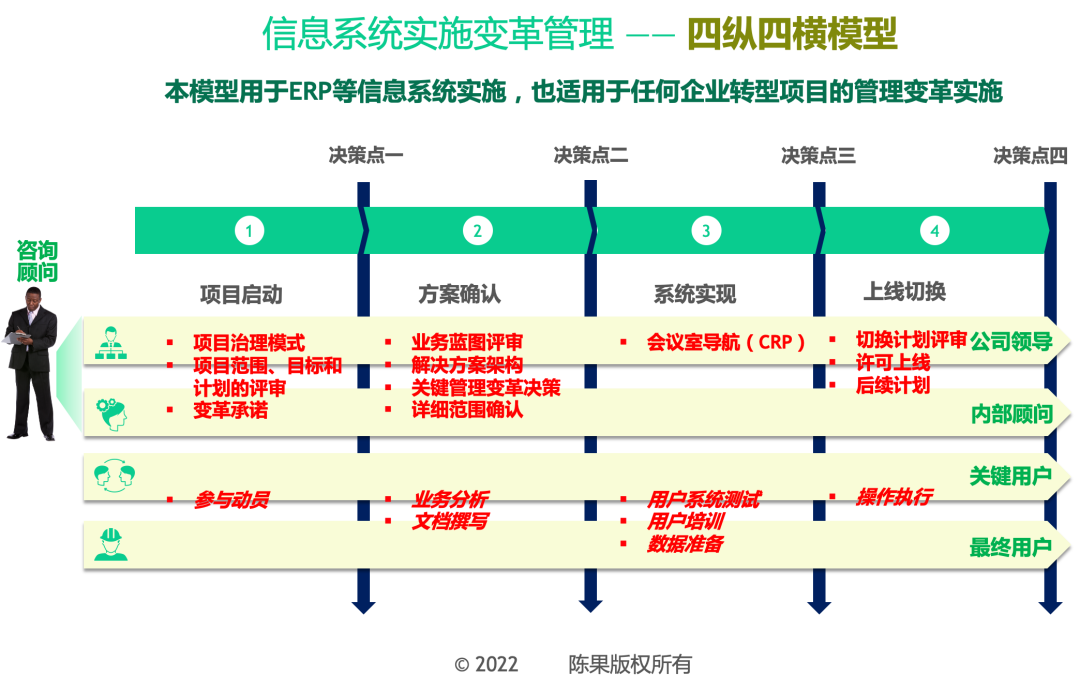
There are four participants in the changes implemented by information systems: First,Company leadersResponsible for establishing determination, grasping the direction, making decisions on key issues, ensuring project resources, giving money when required, and giving people when required. The second isinternal consultant(Usually in the enterprise's process and IT management department) Responsible for various internal and external coordination and docking, responsible for plan formulation and technical implementation. The third iskey users(Key users) As representatives and seed players of specific execution business units, they are responsible for explaining the business and confirming specific plans, participating in plan formulation, document writing, system testing, user training, data preparation, etc., and promoting the formulation of plans in this department. The fourth isend user(end user), specifically execute business processes, operate IT systems, and process data.
Whether it is information system implementation or enterprise transformation, people often refer to "Leading project"Respect is the first principle of management change. However, in fact, the "top leaders" often have limited energy and abilities, and it is impossible for them to do everything themselves and intervene in decision-making. Therefore, the top leaders take the lead and are composed of senior leaders related to the change project.steering committeeHow it actually works becomes important.
The most important role in the steering committee is the leaders who are under the leadership of the leader. These leaders cannot just name the project, but must actually manage things and make decisions within their own management scope. We usually refer to this type of organizational role as "Business process owner”, should be responsible for at least functional system-level decisions, such as finance, sales, supply chain, etc., and preferably be able to take on cross-functional, end-to-end business process business decisions, such as from opportunity to order (LTC), from order to delivery (OTD), etc.
I have always adhered to one principle when managing ERP implementation projects: the two most important key nodes in the entire project process are:Blueprint report and CRP report(More details below) Reports to top leaders cannot be made by consultants. The "business process owner" in the steering committee must report to the top leader in person. Only when the leader in charge has a first-hand understanding of the business process and system implementation plan and personally explains it to the top boss can such a plan be taken seriously and implemented. In order to do this, consultants need to spend a lot of energy explaining things to leaders and teaching them step by step.
In some ERP implementation methodological frameworks, there is no strict distinction between the two roles of "internal consultant" and "key user". In practice, I believe that the IT department must cultivate a team of full-time internal consultants. If an enterprise does not have a sufficient number and ability of internal consultants, or is not determined to have a group of people who understand the business and have IT system knowledge, they can become full-time and capable of taking on solutions through learning in the project process. Without internal consultants who design and implement projects internally, it is impossible for the consulting company to transfer knowledge to the client company and get rid of the problem smoothly, which puts project delivery at risk; on the other hand, the company does not have the ability to continuously operate and maintain the system and iterate system solutions to continuously meet business needs and support the improvement of corporate management level.
When I manage an ERP project, I regard whether the company's "internal consultants" are available and capable as the main risk factor in project management. If the company cannot guarantee the participation of its own internal consultants, I would rather not start the project.
(two)
Generally speaking, the optimal cycle for each implementation wave of ERP projects in medium and large enterprises is nine months to one year. If the time is too short, the implementation depth is not enough, and the business value is low; if the time is too long, the project team and business personnel will be exhausted. In recent years, due to the influence of agile methodologies, digital construction tends to talk about "quick wins". However, ERP is a complex enterprise management reform. There is no benefit in engaging in small tricks and pretentiousness that seek rewards and quick success. ERP reforms need to be down-to-earth and step-by-step, and "quick wins" are rarely talked about.

In the entire ERP implementation process, there are four key nodes that require the in-depth participation and decision-making of the project steering committee - in my implementation experience, they are often referred to as "Four meetings were held”, the “ceremonial sense” and the effect of these four meetings are crucial to the success of the project:
The first one will be "Project kick-off meeting"Before the project is launched, it is first necessary to clarify the project goals and project scope. Secondly, it is necessary to straighten out the governance model, that is, during the transformation, the division of responsibilities and management and control relationships among the business departments, operations management departments, processes and IT management departments. Thirdly, there must be detailed project plans, project charters, project management manuals, etc. Senior leaders must have a full understanding of these three points and fully educate relevant project leaders and participants;
The second session will be "Program review meeting”, the plan formed by the project includes the business process plan (also known as “business blueprint", business blueprint-BBP, including business rules, management tools, data management related requirements), system application architecture and functional description (sometimes also called "Solution documentation”, solution design documents-SDD), these solutions should be used as the business demand baseline for specific technology implementation, and need to be personally reviewed by senior decision-makers of the enterprise. It is particularly important to pay attention to two points: First, this stage will produce severalmanaging changeThe requirements are decided by the senior management of the enterprise. Secondly, because the enterprise information system itself is very complex, it is usually difficult to "implement" it in the business stage.scope of work document"(SOW) clearly states the specific scope of online acceptance. This node is also the best time for Party A and Party B to reach a consensus and avoid risks. From my past experience, if such a meeting is carried out one by one according to the end-to-end process or functional modules, it will take at least two to three days.
The third game will be "Conference Room Navigation (CRP)"Conference room navigation is a system that has passed user unit testing and integration testing, and is demonstrated to leaders using real business data and scenarios. It is also called "online simulation." This system is close to a real production system and is also a systematic verification of the business blueprint that was reviewed a few months ago. Leaders may not care about the details of system operation. The importance of CRP should be to combine the system demonstration and explain the business process and management plan again to obtain the recognition and consensus of leaders at all levels of the enterprise on the application of the new system.
The fourth game will be "Online mobilization meeting"The launch of the ERP system requires the formulation of a careful switching plan. Not only does the system initialization during the switching process have impact assessment on enterprise operations and business operations in the transition phase, but more importantly, when switching to a new operating state, problems, difficulties, errors, etc. are inevitable. The company's senior management needs to set a good tone and encourage the team to meet the challenges. The longest meeting I have ever experienced in my life was the launch coordination meeting for the launch of Oracle ERP in a large enterprise that I was personally responsible for in 2013. The customer was a manufacturing enterprise with a scale of tens of billions of dollars. The general manager personally held an on-site launch meeting, which lasted from 8:30 am on the first day to 5 am on the next day...
(three)
To manage the "four horizontals" of the project participants and the "four verticals" of the key nodes of the project puts forward very high requirements for ERP consultants. Therefore, I have always believed thatERP consultants are the most capable professionals in the management consulting industry——You can not only be able to go to the hall, play politics, act cool, win over the boss, persuade the masses, but also be able to work in the kitchen. Whether it is a system plan or a business plan, you must have a clear plan in mind.
Unfortunately, in the past two decades, the market price of ERP consulting in China has basically not increased much. It was originally a high-end management consulting service, but it has been dragged down to the price of IT outsourcing. The ERP consulting routine that promoted change seems to be almost lost in the industry.
Among the four horizontal lines, the main focus of ERP consultants (especially project managers) should be on dealing with the upper two horizontal objects - obtaining the recognition and support of company leaders, and educating the client's internal consultants; while for promoting the lower two horizontal objects, excellent consultants are good at placing the responsibility on the shoulders of the enterprise's project managers and internal consultants.
The consultants of the consulting company should bring the corporate team together. When I manage projects, I often say to my team:A consultant who works overtime every day is not a good consultant. You are a good consultant when you organize users to work overtime and go back to the hotel to recharge.。
This is not to encourage the consultants on my team to be lazy, but to encourage consultants to focus on the most valuable work. It is not a good thing for a consultant to do what the client user does. When I work on a project, I have to establish rules with the other party from the beginning: project documents that are not intellectually challenging must be written by the client as much as possible, such as drawing flow charts, compiling management systems, writing test cases, operation manuals, etc. Consultants should not write them themselves. A consultant's identity in an enterprise is a coach or a teacher. Have you ever seen a coach on the basketball court grab the ball for a layup, or a teacher in the examination room scratching his head while writing papers?

ERP consultants have a unique growth pattern: the first level of an ERP consultant is to be a qualified engineer, master the special knowledge of a module, and have an in-depth understanding of the system itself; the second level is to be a currentSolutions Architect, have an overall view outside the system and be able to creatively find solutions to solve corporate problems; the third level is to be a "rainmaker", not only paying attention to things, but also paying attention to people, promoting changes, and driving customer teams; the fourth level is to be the leader and spiritual mentor of the customer. What you say is right, and the customer will obey you.
ERP consulting is not a new thing. It has been in the field of enterprise management for more than 30 years. However, these seemingly old-fashioned but correct things feel like they are almost lost in the hustle and bustle of digital transformation. Information technology is developing at a rapid pace. However, in the process of applying technology, enterprises actually face greater system implementation and governance risks. This is a long-standing thing. Many of the tricks mentioned above are not in books, and may not be taught in formal training. They must be learned through practice. In recent years, I have seen information system implementation projects or management change projects that were poorly done. They did not manage the "four vertical and four horizontal" models well, and the consultants did not stand up for the station.
Related old articles:
Forever ERP consulting
FCT model | Governance system for business processes and data of large enterprises
Result-oriented or system-oriented, two different digital value propositions
Exploring the digital transformation of a listed company: BTIT (governance mechanism for business processes and IT implementation)
[Must-read for CEOs] You will regret if you don’t read this article before going to SAP (Part 2)
Even if ERP is not done well, let’s build a Mao Zhongtai|Take “Sales Configurator” as an example
Using digitalization to deny informatization and using the middle platform to deny ERP are both misleading enterprises.
Enterprise Architecture | How the messy system construction is formed and how to deal with it
The legendary “Transformation Consulting”
How to solve the problem of management consulting or management software "cannot be implemented"
The relationship between management consulting, implementation consulting and IT consulting
Strategy Execution Process CPP | Common practice in large industrialized companies
Machine-translated from the Chinese original 系统实施和企业转型 | 变革管理的四纵四横模型 (published 2022-03-29). WeChat original ↗