Previous article: Clearing the fog of data center selection and discussing the business models of these suppliers
On April 6, Google Cloud initiated and took the lead in establishing the "Cloud Data Alliance", uniting leading software manufacturers including databases, stream processing, data lake warehouses, graph databases, data access, data virtualization, search analysis engines, machine learning tools, etc. There are also two leading system integrators in the United States as participants. This is a very typical industry alliance combination of "cloud platform + domain technology + consulting integration services". It can be regarded as a supply-side model of the current "enterprise data platform" (roughly equivalent to the "data middle platform" in China, and I will not analyze the concept here).
I recently communicated with several domestic industry insiders (founders of leading startups in the industry), and they all said that the "data middle platform" is a quagmire, and that there is something wrong with the entire industry model: practitioners are struggling to work, capital investment is in vain, and enterprise user satisfaction is low.
The common reaction of industry insiders to "data middle platform" is that this thing is actually a data-related technology development base for engineers and scientists. It has no applications for business personnel, so it cannot directly solve specific problems for business departments, causing corporate management to fail to see the business value of this thing. On the other hand, the founder of a company in a certain industry said: "It is difficult for Chinese technicians to earn money."
The industry chaos in the data center actually reflects the problems existing in China's entire "enterprise IT" industry. This is no longer a problem for a certain company in this industry, but a huge difference between the Chinese industrial chain and the American industrial chain. I list the comparison in detail as follows:
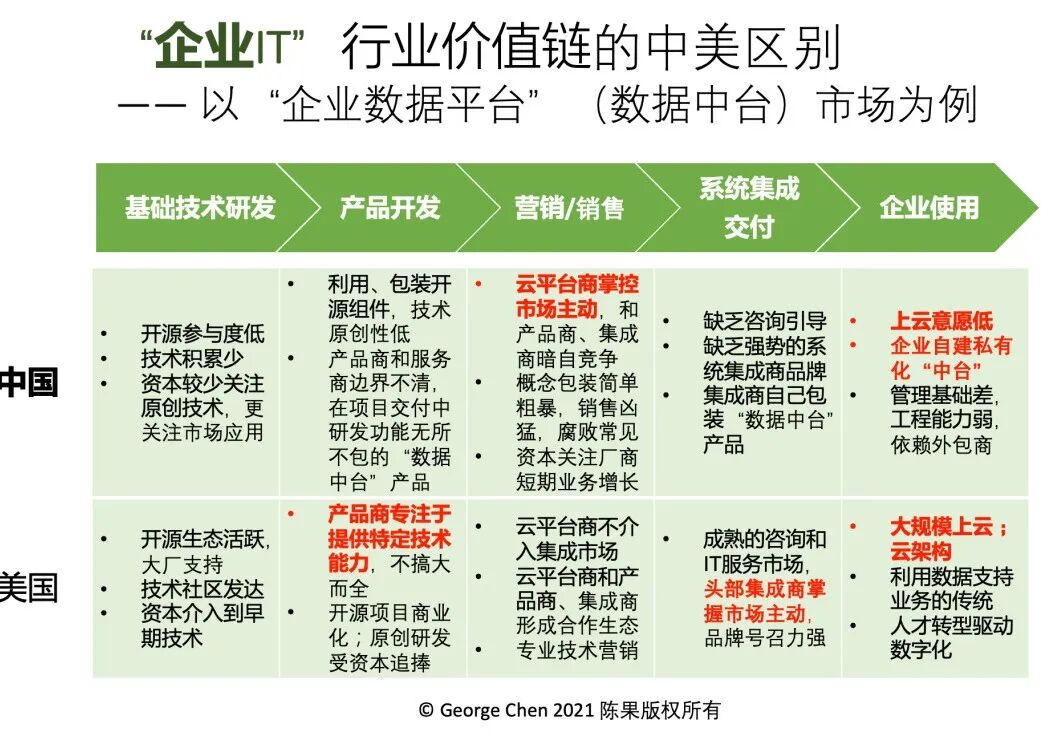
In China's industrial and market environment, the symptoms are: a lack of suppliers with deep professional capabilities. As mentioned earlier, in the US market, the valuation of data lake warehouse company Databricks is as high as 38 billion U.S. dollars, and the valuation of Fivetran, a data access tool provided in the SaaS model, is as high as nearly 6 billion U.S. dollars. Most of the "data middle-end" suppliers that have received large amounts of financing in the Chinese market provide all-inclusive solutions.It looks like a product provider, but it’s actually a service provider., whose market value is far less than that of professional products companies in the United States.
We can’t blame China’s technology entrepreneurs for not working hard. 996 is not enough, because the characteristics of Chinese enterprise IT industry have created huge obstacles for their development. There are four main reasons:
1. Cloud and Ecology
The current explosive growth in the demand for enterprise data platforms and data analysis applications in the U.S. market is inseparable from the fact that enterprises are increasingly putting enterprise application systems, business systems, and Internet of Things systems (such as industrial Internet platforms in the manufacturing industry) on the cloud, or using cloud services and third-party big data services. It is precisely because data is distributed on different clouds that "data grids" and "data grids" have emerged.data fabric” and other new-generation distributed data management architectures or methods, this has led to the emergence of a technology supplier ecosystem with the decentralized characteristics of the Internet era, and excellent startups continue to emerge.
The following are two examples of U.S. data platform technology supplier ecosystem maps:
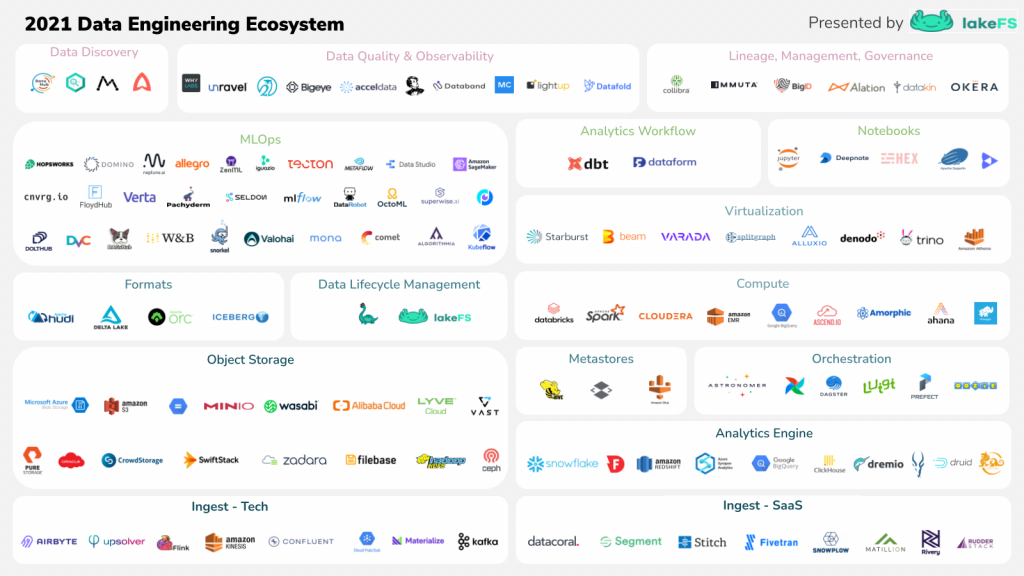
Source https://lakefs.io
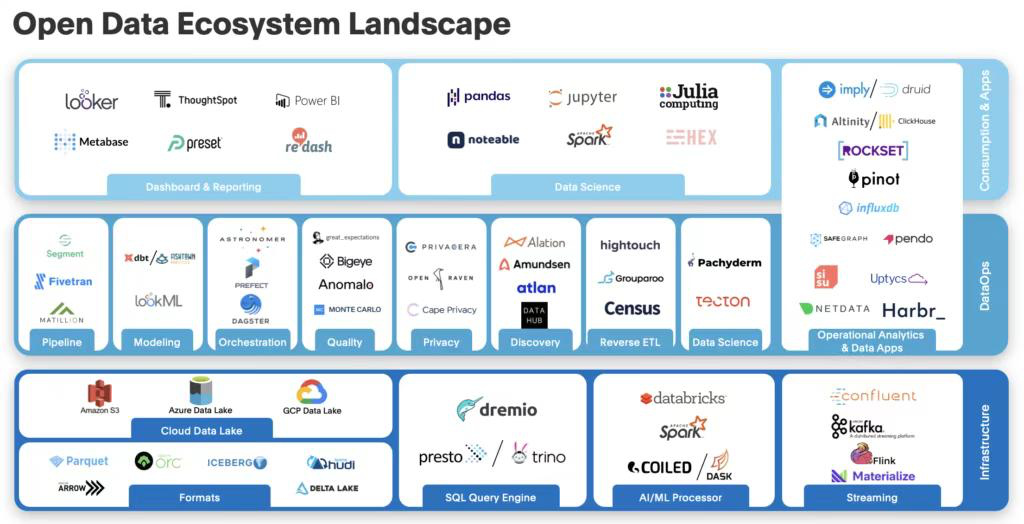
Source https://7wdata.be
The word "中" in China represents centralization. This may be the innate gene of Chinese enterprises. The cloud adoption rate of Chinese enterprises is much lower than that of the United States. They are unwilling to put data on the cloud beyond the control of the enterprise. They all hope to build, use, own and control the platform themselves. When looking for suppliers, they also hope that one company can own all the technologies.
Therefore, in the Chinese market, there are very few technology providers that are as segmented as the picture above. In order not to miss business opportunities, most technology providers give themselves a general label: I work as a "data center".
2. Platform Competition and Monopoly
Even if enterprises go to the cloud, data technology suppliers in each subject area provide services on the cloud platform. In fact, the reason is the same as merchants selling clothes and cosmetics opening stores on Tmall and JD.com platforms. How to ensure the profit model of the platform operator? How to balance the interests between the self-operated platform and merchants settled on it?
How do e-commerce platforms compete for traffic, and how do small and medium-sized businesses survive and make profits on the platforms? China's e-commerce platforms have already given the answer in the past few years. We can foresee the fate of data-centered startups on various cloud platforms in China.

3. Enterprise’s Digital Operation Capabilities
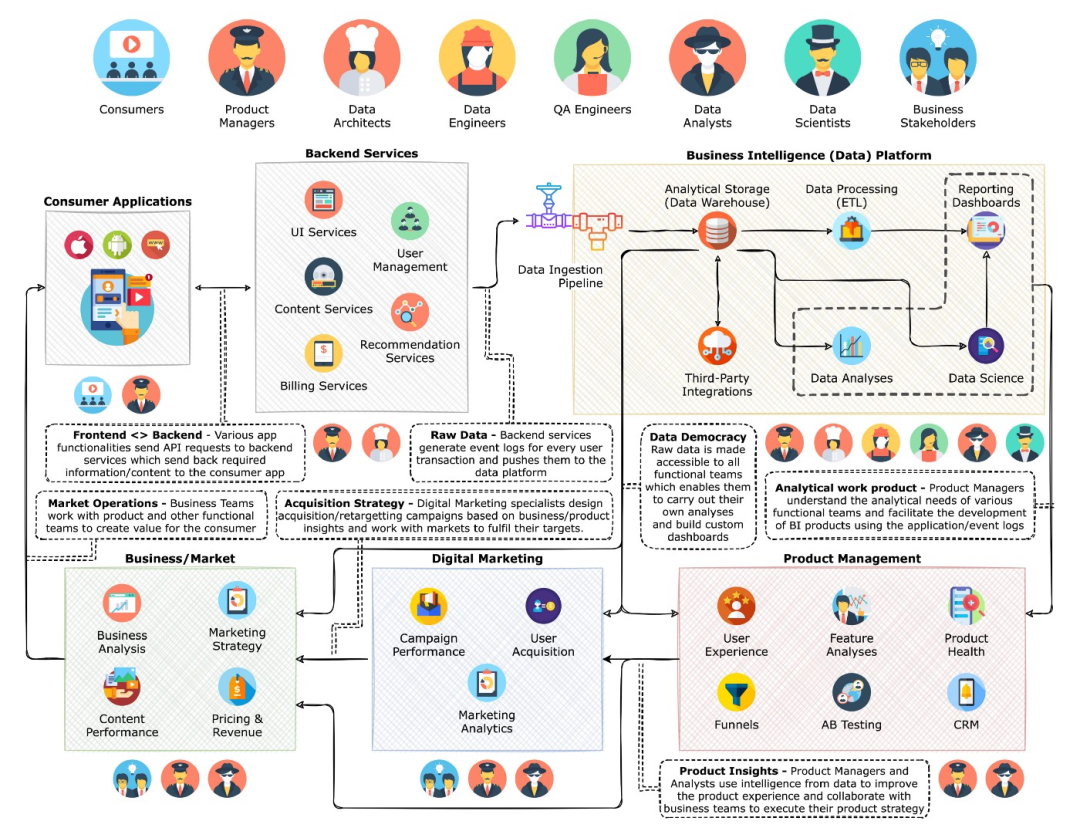
Enterprises' application of data to support business is an organizational capability. Although the principles of "data is the new oil" and "data assets" are accepted by more and more Chinese enterprises, it is a challenge for most Chinese enterprises to establish a series of organizational roles including product managers, data architects, data engineers, data scientists, data analysts, data governance administrators, etc., and to establish operational processes and engineering capabilities from data source to consumption (as shown in the figure below); when enterprises do not have the ability to manage and use data themselves, the demand for tools cannot keep up.
4. Marketing and consulting traction
Regarding the impact of data platforms on enterprise users, public opinion in the US market is dominated by professional and neutral technology consulting organizations, such as Gartner. The recent Data Fabric was also proposed by Gartner, as well as technology implementation companies, system integrators and management consulting companies that maintain vendor neutrality.
However, China's enterprise IT market is inherently deficient. It has not produced authoritative technical consulting organizations, management consulting organizations with strong consulting capabilities, or strong local system integrators. Many mid-level system integrators are envious of the high gross profit and capital market value of their products. When working on projects for customers, they package the development output of their projects into "products" and sell them to the next customer, destroying the industry ecosystem. The large cloud platform manufacturers have the dominant voice in the market. This coincides with the geopolitical frictions between China and other countries in recent years, and the entry of foreign cloud services and data technologies into China has slowed down. As a result, the market is full of buzzwords, vicious competition, and players harming each other...
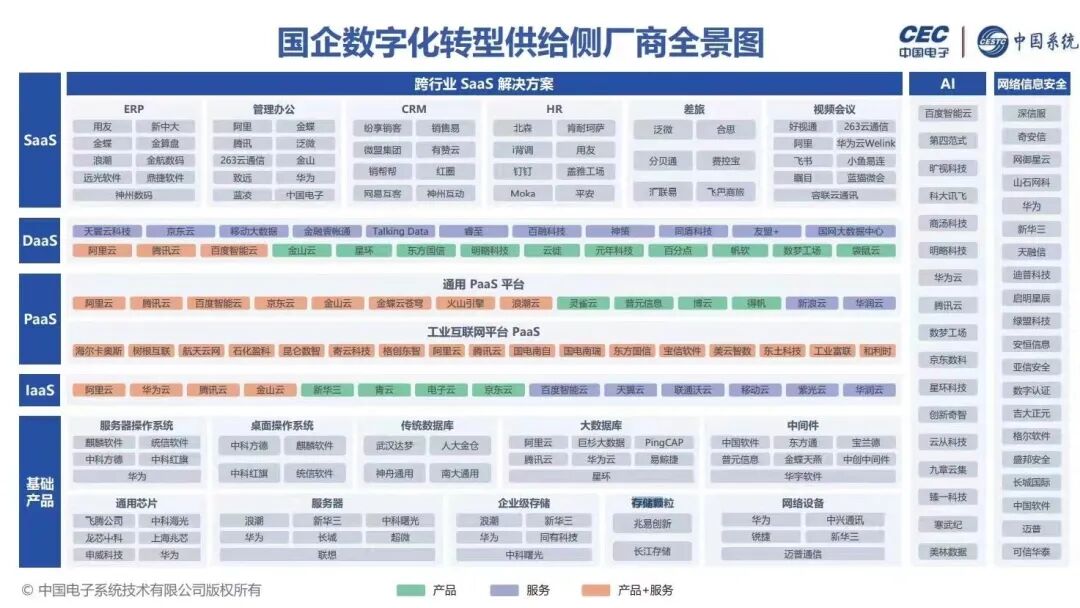
I personally support domestic software manufacturers, but the industry of localizing data centers is really difficult now and is almost ruined. Finally, here is a panoramic view of domestic software manufacturers. Which one do you think can excel in the "data middle platform"?
Machine-translated from the Chinese original 二论数据中台选型 | 为啥中国这条跑道里跑不出大的创业公司 (published 2022-04-14). WeChat original ↗