Computational conformal geometry is an interdisciplinary subject in the fields of basic mathematics and computer science. It combines differential geometry, conformal geometry, Riemannian geometry, Riemann surface theory, algebraic topology and partial differential equations with computational mathematics and computer science. It is widely used in computer graphics, computer vision, CAD computer-aided design, CAE computer-aided engineering, intelligent manufacturing, medical imaging and other fields.
This course introduces basic concepts and theorems in the fields of algebraic topology, differential topology, surface differential geometry, Riemann surface theory, optimal transmission theory, etc., and systematically extends these basic theorems to discrete situations, establishes a theoretical system of discrete conformal geometry, optimal transmission, and explains the algorithm in detail. Main applications include global surface conformal parameterization in computer graphics, area-preserving parameterization, dynamic surface registration in computer vision, quadrilateral meshing in the CAD field, etc. If time permits, we will discuss more applications in the field of 3D vision, such as stereo vision, point cloud fusion, surface reconstruction, mesh generation, geometry compression, etc.
This course is mainly aimed at senior undergraduates and graduate students with basic mathematics, applied mathematics, computer science, electronic engineering, mechanical engineering and other science and engineering backgrounds, as well as engineers in the IT field, CAD/CAE field, digital art field and other industrial fields. Preliminary knowledge only requires linear algebra and multivariable calculus, and we start from basic concepts to abstract theory. This course covers many modern mathematical theories. Because the concepts and theorems are relatively abstract and the class time is short, students are expected to understand and consolidate them by implementing various computational topology and geometric algorithms. Due to the complexity of geometric programming data structures, we advocate the use of C++ language to improve operating efficiency in the future, but students are also allowed to use Python and other implementations. When it comes to image processing, we use the OpenCV library; for three-dimensional display, we use the OpenGL and freeglut libraries; for linear algebra, we use the Eigen library. The course will provide skeleton code to help you implement it. Teaching assistant Dr. Wei Chen will provide assistance with programming.
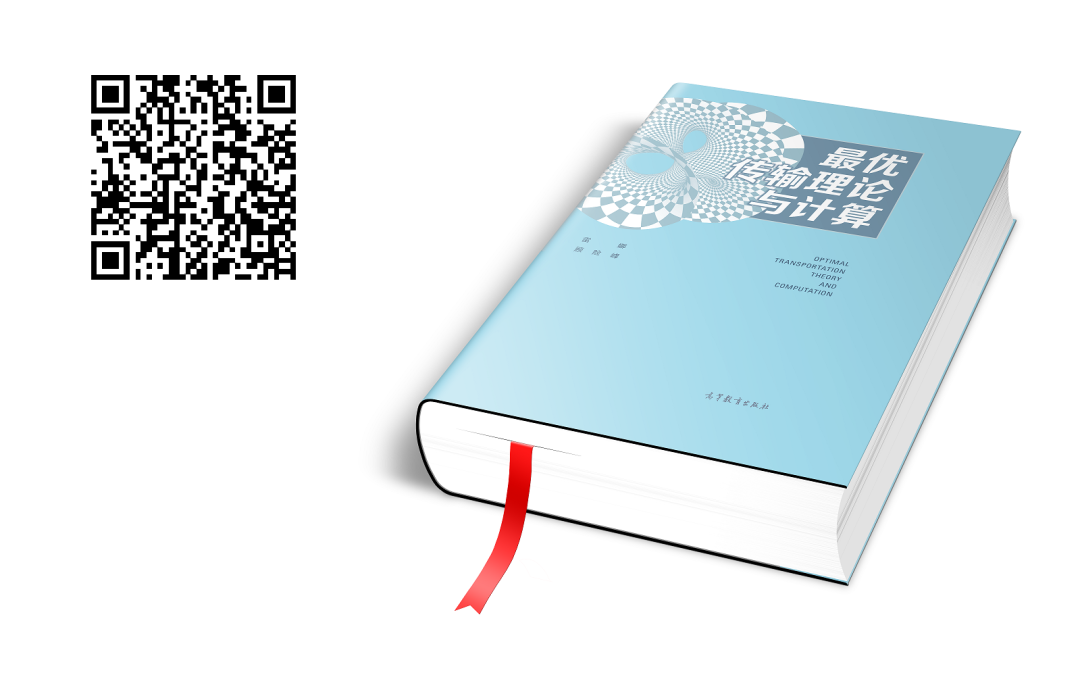
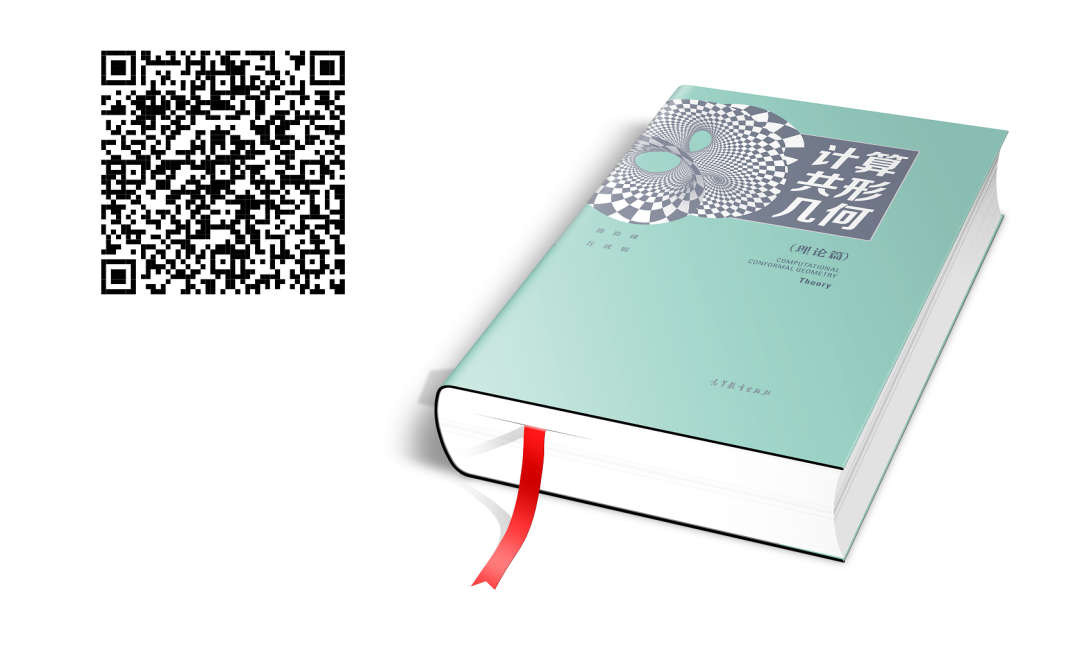
The textbook for computational conformal geometry is "Computational Conformal Geometry - Theory" co-authored by Mr. Qiu Chengtong and the author, published by Higher Education Press in May 2020. The textbook for optimal transmission theory is "Optimal Transfer Theory and Computation", published by Higher Education Press in October 2021.
|
|
|
Reference books include:
|
|
|
|
|
|
Compute conformal geometry
algebraic topologyHomotopy equivalence, basic groups of surfaces, Seifert-Van Kampen theorem, canonical representation of basic groups, classification theorem of surface topology, overlapping spaces, overlapping mappings, basic group relations of overlapping spaces, universal overlapping spaces, ascension and ascent, CW-cell decomposition, simple hypohomology group, simple mapping, mapping degree, continuous homology, Brouwer fixed point theorem, Lefschetz fixed point theorem, Poincare-Hopf index theorem. The algorithm includes cut graph, basic group representation, universal complex space, homotopy detection, persistent homology handle, tunnel loops, and simple cohomology.
differential topologyDifferential manifolds, tangent spaces, unit tangent bundles, obstacle classes, differential forms, Stokes theorem, de Rham cohomology, Hodge operator, Lapalce-Beltram operator, harmonic differential form, Hodge decomposition theorem. Algorithms include Hodge decomposition, harmonic differential form.
Surface Differential GeometryMovable frame, Weingaren map, Gauss curvature, Gauss's brilliant theorem, Levy-Civita connection, geodesic equation, Gauss-Bonnet theorem, isothermal coordinates, Weiestr of minimal surfaces ass represents, Yamabe equation, harmonic mapping, Rado theorem, Hopdf differential, spherical harmonic mapping, negative curvature metric surface harmonic mapping, existence, uniqueness and regularity. The algorithm includes topological disk harmonic mapping and topological spherical harmonic mapping.
complex functionNormal function family, Weierstrass theorem, Hurwitz theorem, Montel's theorem, Bieberbach's theorem, Koebe's quarter theorem, Riemann's mapping theorem, conformal module, Hilbert's theorem, Koebe's theorem, Liuville's theorem, surface singularization theorem, algorithms include topological ring conformal module, slit conformal mapping, Koebe's iterative algorithm,
Riemann surface theoryRiemann surfaces, meromorphic functions, holomorphic differentials, divisors, periodic matrices, Jacobi varieties, Strebel differentials, surface leaf structures, Abel-Jacobi theorem, Riemann-Roch theorem, holomorphic line bundles, representative classes. Algorithms include holomorphic differentiation, Abel-Jacobi conditions, and meromorphic differentiation. Quasi-conformal mapping, Beltrami equation, Teichmuller mapping, Teichmuller space theory. Surface Ricci flow theory, disc filling metric, discrete conformal equivalence, discrete Ricci flow, existence and uniqueness theorem, convergence theorem, algorithms including Euclidean and hyperbolic Ricci flow.
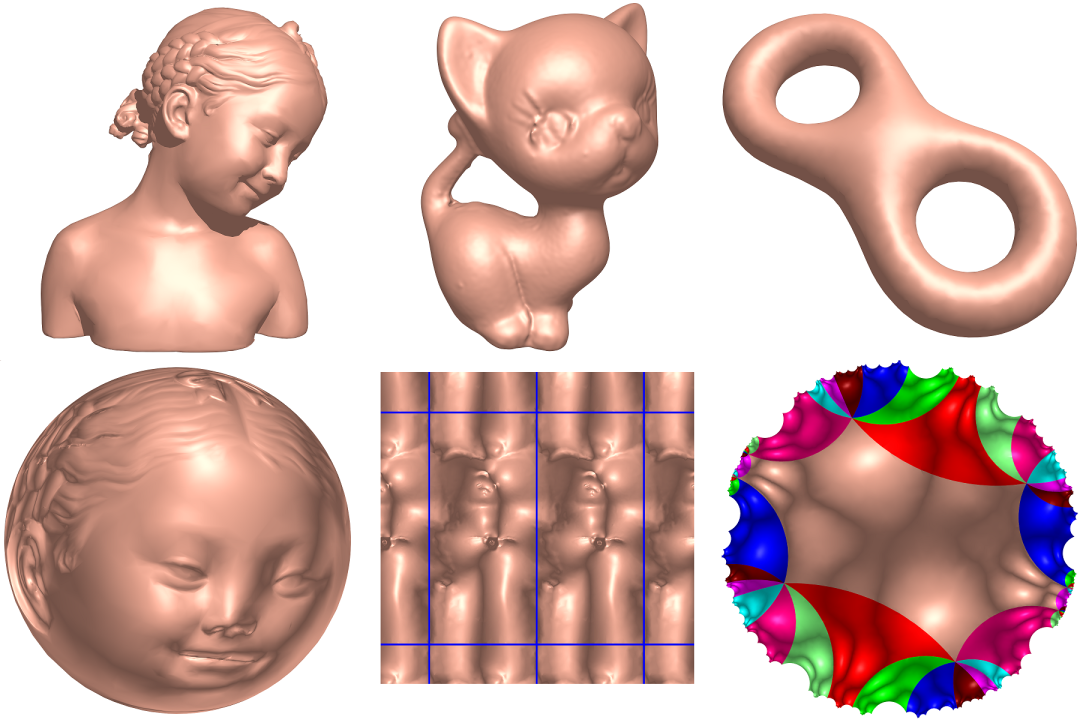
Figure. Surface singularization theorem, the mapping algorithm is harmonic mapping, holomorphic differential and surface Ricci flow.
optimal transmission theory
Optimal transmission theory can be learned from different perspectives, including the Monge-Kantorovich-Briener theory from the perspective of classical probability and statistics, the Minkowski-Alexandrov-Yau theory of convex differential geometry, the Menamo-Brenier theory of fluid mechanics, and so on. The main concepts and theorems in each theory are as follows:
Monge-Kantorovich-Brenier theoryMonge problem, Kantorovich theorem, Kantorovich duality theorem, c-transformation, monotonic cycle property, equivalence of Kantorovich problem and dual problem, transmission scheme under convex transmission cost is transmission mapping, Brenier theorem, Monge-Ampere equation, Brenier polar decomposition theorem.
Convex differential numberHepoint of viewMinkowski problem, Minkowski theorem (type I), Brunn-Minkowski inequality, Alexandrov theorem, Alexandrov mapping lemma, Minkowski problem (type II), spherical optimal transmission theory, mirror design problem, refractive lens design problem.
fluid mechanics perspectiveEuler equation, Arnold geometrization theory, time-dependent optimal transmission, McCann geodesic translation, Benamou-Brenier theorem, Otto geometrization theory, Wasserstein metric.
Optimal transmission mapping calculation methods include: geometric variation method, Monge-Ampere operator linearization algorithm, fixed point algorithm, FFT algorithm, Angenent-Haker-Tannenbaum algorithm. Computational geometry algorithms include: convex hull algorithm, envelope algorithm, Power Diagram algorithm, Weighted Delaunay triangulation algorithm.
|
|
|
|
|
|
optimal transmission theory
time: Starting from July 4, 2022, each course will be held from 20:30-22:00 PM Beijing time
Link: Tencent Conference: 933-8415-7259
Station B:http://online.conformalgeometry.org (automatically jump to station B live broadcast)
Attendance: Free and open to all listeners
Preliminary knowledge: Linear algebra, multivariate calculus, preferably programming in C++, OpenCV and OpenGL
Reference materials: "Computational Conformal Geometry", "Optimal Transmission Theory and Computation" Higher Education Press.
Machine-translated from the Chinese original 2022《计算共形几何》课程提纲 (published 2022-07-02). WeChat original ↗