
IT, consulting, engineering and moreWith personnel as the main resource, the company is organized into a multi-dimensional matrix organization of professions/industries/regions, and provides service delivery in the form of "projects" to customers.The business model is what I call a "professional service project company", and operation and maintenance and product businesses are not included in this category.
I am going to use a few short articles to introduce the financial management, project management, sales management, production and sales balance management and other operational management methods and IT management platforms of this type of company.
The main operating processes of the project company are:
Sales Management:Carry out sales activities, manage customers (accounts) and business opportunity funnels (pipeline), manage business opportunities separately according to different "order probabilities", and drive sales conversion efficiency
Contract Management:Before the customer signs the order, that is, the project contract is signed, a contract review needs to be conducted, including legal, price, resource, technical solutions, risk and other control links.
Project management:Establish projects based on customer contracts to drive the efficiency and speed of converting contracts into revenue, especially for listed companies, which need to achieve current financial goals
Project management:Delivering projects to customers, the operating characteristics of this type of company are that the project has a certain cycle, which can be as short as a few months or as long as a few years. The company's profit is composed of project profits. It is necessary to strengthen project process control to ensure that the company's profit goals are achieved. Therefore, during the project process, on the one hand, it is necessary to ensure the project progress and drive the achievement of revenue. On the other hand, it is necessary to ensure the project quality, control risks, and predict future resource investment and profits at the end of the project on a monthly basis.
Resource management:The main cost of the project is the investment of labor resources. As a characteristic of the organizational structure of project-based enterprises, these professionals belong to the professional resource pool in terms of personnel relations. They carry out work in the project as needed, fill in the project working hours, and accordingly include the standard cost of their working hours into the project cost, "charged working hours ratio" ( Utilization or billability) is an important indicator of the company's operating efficiency. From the perspective of the income statement, the part of the overall working hours of the resource pool that can be recorded in the project becomes a cost that can be converted into income, while the remaining part that cannot be recorded in the project becomes the company's administrative expenses.
Expense management:Management of other costs and expenses, including project-related subcontracting, travel, and company management fees
Capacity management:The company's different service products (Offering) require resources with different professional capabilities. The resource demand generated by front-end sales and project delivery needs to be matched with the supply of professional and appropriate resources in the resource pool. This is the supply chain management of project-based companies to ensure the balance of production and sales. It is exactly the same as the principle of manufacturing supply chain management. Organizationally, similar to the supply chain management center of the manufacturing industry, service companies must also have resource (Resource) and capacity (Capacity) management (R&CM) departments.
Experience management:The service industry is a people business. Only satisfied and dedicated employees can have satisfied paying customers and the company's profits. Therefore, it is necessary to closely monitor the satisfaction of employees and customers.
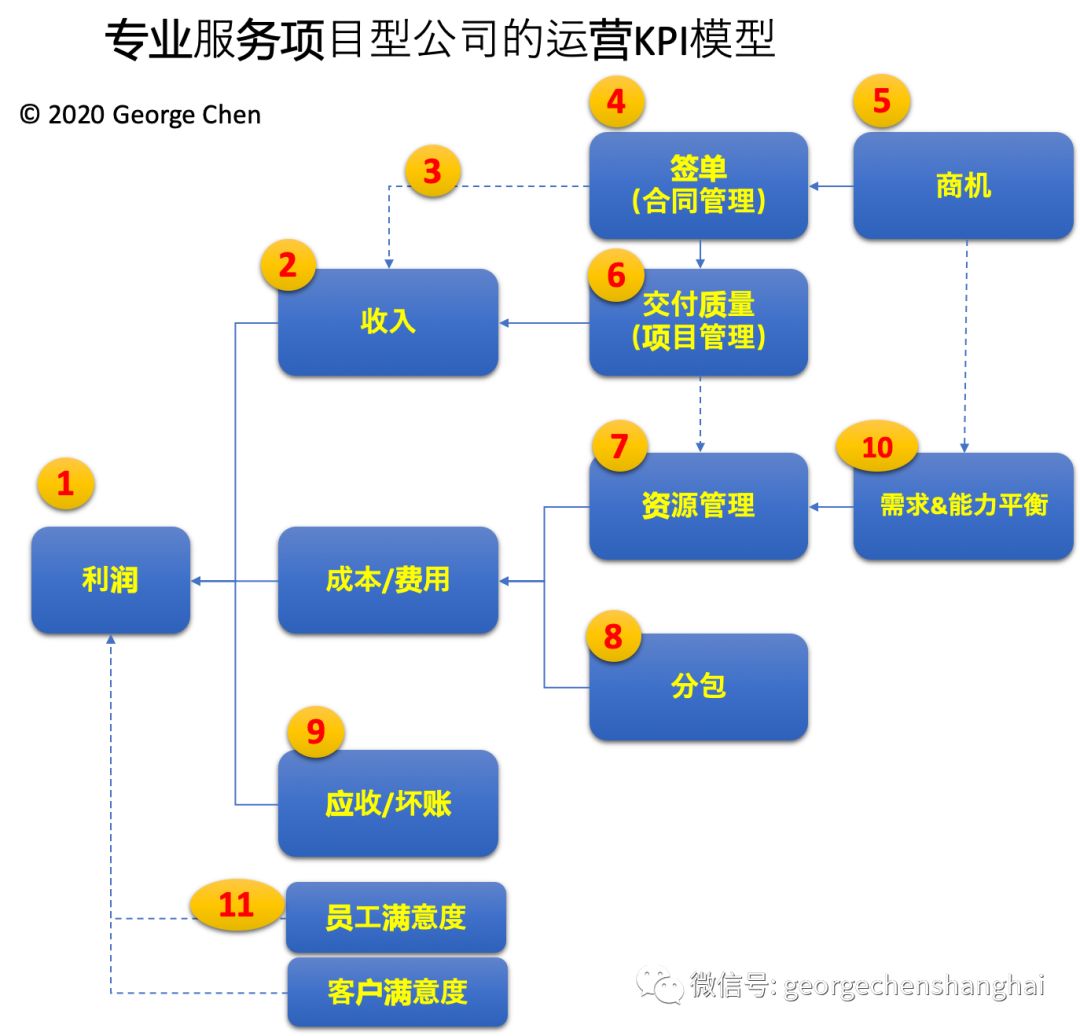
Based on this operating system, the company isWeekly, monthly and quarterly business analysisIt is usually necessary to use these KPIs to analyze and monitor the operations of the company and each business unit, as shown in the figure above.
It should be noted that the specific caliber and time point for obtaining the numbers of these KPIs depend on management needs and accounting principles. Some are monthly, some can be weekly, some are current period numbers or current period (quarter/year) cumulative numbers, and some are forecast numbers by the end of the year (quarter/year):
1. Profit KPI: operating gross profit of the company and each line business unit
2. Income KPI:The operating income of each line business unit is converted from projects; new orders and the undelivered amount of orders on hand (backlog) are the sources of income.
3. Pre-contract income KPI:The customer has confirmed the order, but the contract is still in the signing process, and the down payment invoice has not yet been issued. Based on prudent accounting principles, construction will start before the contract and revenue will be converted in advance. This is of great significance for listed companies to increase revenue.
4. Signing KPI: Actual contract signing amount (signings)
5. Business opportunity KPI:The rolling contract signing forecast is particularly important based on the figures reported according to the estimated amount, order completion time and order completion probability. Within a quarter, for business opportunities with high order completion probability (for example, 90%, 75% stage), the number of signed orders should be based on weekly commitment (commit). It is necessary to clearly propose and follow up on order closing measures for key sales projects. If committed orders slip, we must seize the business opportunities with medium probability (such as the 50% stage); at the same time, we must have a certain degree of visibility into the business opportunities in the next six months to one year after this quarter to ensure healthy operations.
6. Delivery quality KPI:From the perspective of each business department, comprehensive evaluation indicators for overall project management must be formulated. This is a dynamic indicator that is updated and summarized by project on a monthly basis, including forecast project gross profit margin, deviation of forecast cost from planned cost, process compliance requirements, etc. At the same time, key projects and key negative problem projects (serious cost overruns) must be specially listed, and improvement measures must be proposed.
7. Resource management KPI:If an effective working hours management system is implemented, resource utilization indicators can be divided into billable/chargeable utilization and productive utilization. The latter includes the former as well as effective but non-revenue-generating activities such as R&D and pre-sales support. Resource utilization is the lifeline indicator of the company. If it is lower than a certain value, it means that resources are seriously idle. Either it is a problem of production capacity management (no one will work on signed-in projects, and idle people will not work on newly signed-in projects), or recruitment restrictions or even layoffs will be required.
8. Subcontracting KPI:Subcontracting needs to account for a certain proportion of costs, and appropriate use of subcontracting can help improve resource utilization; the main purpose of professional service companies using subcontracting is not to reduce costs, but to optimize resource utilization.
9. Receivables and bad debts KPI:Accounts receivable for more than half a year, provision for bad debts, recovery of bad debts that have been provisioned, and other sub-division indicators, as well as the presentation of major projects, have a direct impact on profits
10. Demand and capability KPI:Exactly the same as supply chain management, it needs to be differentiated from two aspects: demand and supply, and from the dimension of professional capabilities (for example, strategic consulting, supply chain consulting, financial consulting, human resources consulting, technical consulting of consulting companies). From the time dimension, data on projects started, planned projects, booked for projects, and resource gaps in the future are given, and measures such as training, outsourcing, recruitment, and recruitment plans are provided.
11. Experience KPI:The company's employees work in the project, and periodic employee satisfaction surveys are conducted during the project to form a comprehensive employee satisfaction index; the principle of the customer satisfaction index is similar.
The next issue will talk about project financial management.
Related articles:
The Collapse and Perseverance of the Ivory Tower – Professional Services Firm of One-firm Firm
Business Strategy | Discover the strategic path to winning in the professional services industry
Operations Management | Enterprise project classification method
运营管理 | 关键运营指标DSO在项目型组织中的定义
Supply chain management framework for manufacturing enterprises
Design of production and marketing model for food production enterprises
Operation management, please pay attention

Machine-translated from the Chinese original 专业服务项目型公司的运营管理(一)KPI体系 (published 2022-07-02). WeChat original ↗