
Management accounting serves the purpose of management, and cost management is an important part of management accounting. The essence of "cost" is the allocation of responsibilities for reducing costs and increasing efficiency of the enterprise and the corresponding performance management. The specific assigned organizational object is the "responsibility center", among which the person responsible for the cost is the "cost center" (the expense center or profit center is also associated with it), so management accounting is also called responsibility accounting (responsibilty accounting).
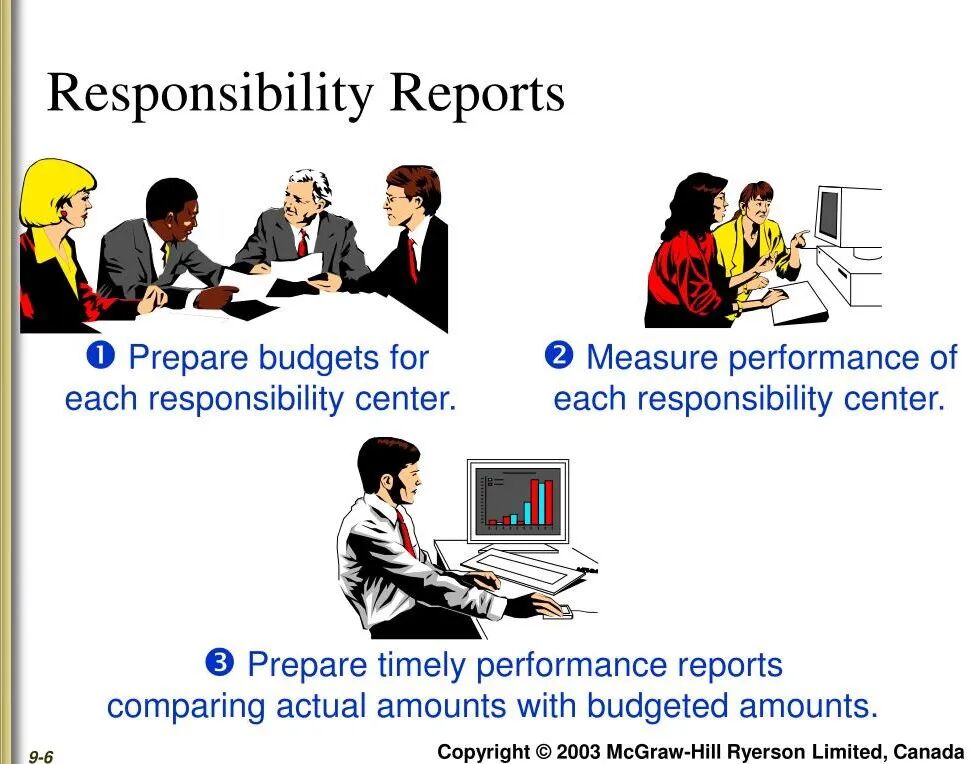
An enterprise's cost control responsibility for delivering "products" can be managed from different dimensions, such as:
1- Product management dimensions:The total life cycle cost of a product from planning to development to production, as well as product-related decisions during the operation process, such as launch, pricing, etc. The specific person responsible for this dimension is the product manager of the product line, the general manager of the product division, etc.;
2 - Functional Management Dimension:In the process of product formation, each organizational function, including R&D, manufacturing (supply chain), procurement, logistics, sales, etc., needs to bear respective responsibilities;
3 - For large organizations, there may be a matrix organization in which product dimensions and functional dimensions intersect, and there may also be other dimensions, such as customer dimensions or project dimensions.
Assume that a high-tech company operates on a project basis. The project content includes hardware products (equipment), software products, and integrated services. It is necessary to calculate both the total project cost and the cost of the hardware products. The cost components of different types of products and examples of responsible organizations for each component are as follows:
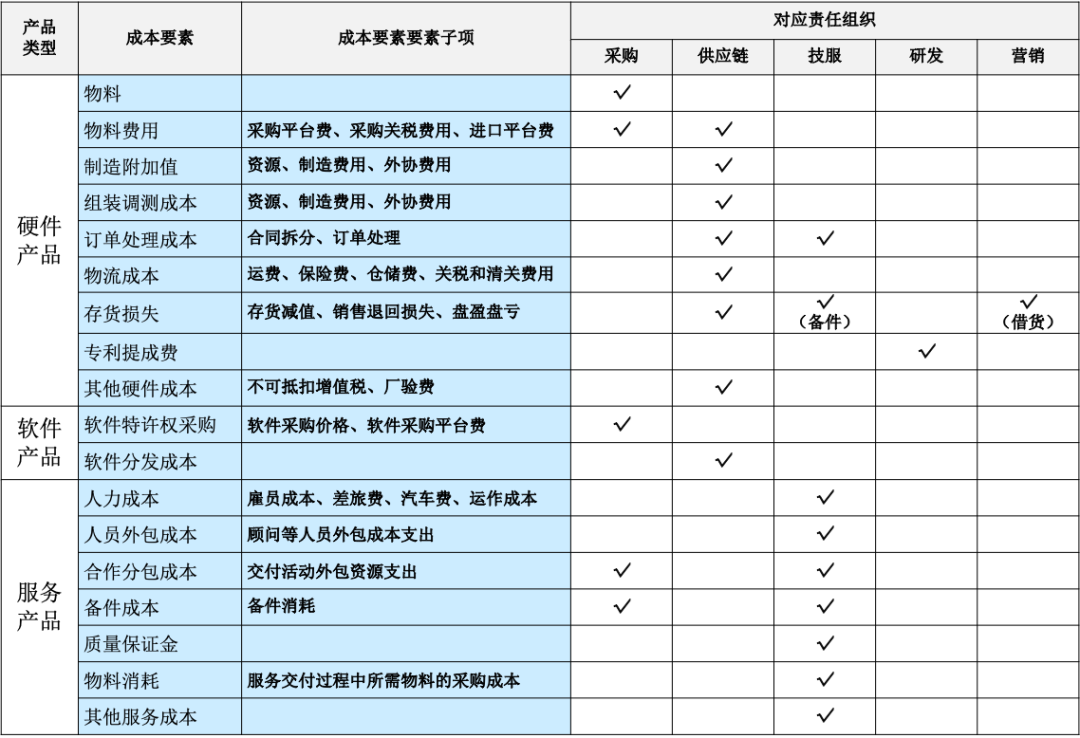
In terms of management and assessment of these cost responsibilities, it is necessary to clarify the accounting standards, accounting methods, and assessment target values based on corporate management accounting rules.
Establish an end-to-end product cost management system. The "cost" management perspective has multiple dimensions. Here are a few examples:
- The overall profit and loss perspective of the accounting cycle: from the profit and loss statement of the financial statement, the control of overall product costs, the effectiveness of this cost depends on the effectiveness of financial management controls;
- The total cost perspective of the entire life cycle of a product: from the launch of a product to its withdrawal from the market, which can range from a few years to decades, the overall cost control of the product, and the cost effectiveness depends on the optimization of product design and strategic sourcing;
- The cost control perspective of a certain product in a certain time period: that is, the average cost of a certain product in a certain time period (such as a month or quarter), controlling the difference between the cost and the standard cost during that period, and the cost effectiveness depends on tactical cost reduction optimization measures, such as procurement optimization;
- Cost control perspective of an order or production batch: Actual cost accounting of an order or production batch, evaluating the difference between the order/batch cost and the planned cost/standard cost. The cost effectiveness depends on the effectiveness of business execution, such as lean production, avoiding scrap rates, etc.;
The flow chart of end-to-end cost management is as follows. The key steps are:
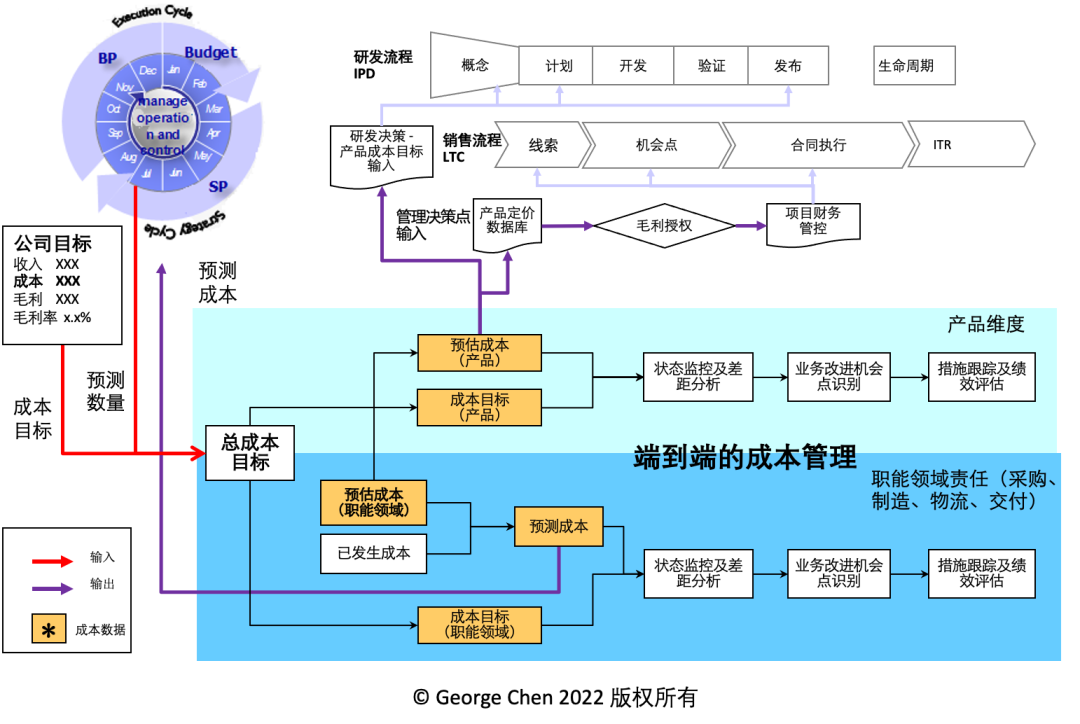
1. Top-down budgeting: Determine the total cost target based on the company's business plan, budget and rolling forecast (PB&F), and decompose it from the two dimensions of product and function to clarify the cost targets in the two dimensions.
2. Bottom-up budget: Under the guidance of the overall cost target, the costs are estimated in each cost responsibility area, and summarized (convolved) by product dimensions into the estimated costs of each product.
3. One direction for estimated costs is to return to the PB&F process to revise or adjust the budget.
4. Another direction of estimated costs is to serve as a decision-making basis for cost management and enter the company's research and development process (IPD) and sales process (LTC) to support product development stage decisions in the IPD process. And the cost model that supports quotations in the LTC process.
5. Cost target serves as the overall goal of the department/product, and the estimated product cost serves as the baseline of standard cost. Each order (or production batch) generates the planned cost of the order (or production batch) based on the actual situation based on the standard cost, which serves as the cost control target of the order (or production batch). Because standard cost formulation is based on assumptions of certain ideal conditions, such as market purchase price, manufacturing batch size, etc., and each order (or production batch) may be different from the assumptions when it is actually put into operation, so it is normal for the planned cost to deviate from the standard cost.
6. During the operation of the enterprise, different management dimensions track different cost statuses such as "total cost target - product standard cost - order (batch) planned cost - order (batch) actual cost - actual total cost", identify cost differences, analyze the management issues behind the differences, and implement targeted management measures
In product cost accounting, you can use the "standard cost method" or the "moving average cost method" for accounting. For manufacturing business entities of manufacturing enterprises, such as factories and supply chain systems, it is recommended to use standard cost for cost accounting of related inventories (raw materials, work-in-progress, semi-finished products, and finished products); for sales business entities, such as sales companies, it is recommended to use the moving average cost method (MAC) or weighted average cost method (WAC) for cost accounting of related inventories (finished goods).
Usually wholesale and retail enterprises also use the average cost method for cost accounting.
weighted average cost methodThere is no need to maintain cost data in advance, but because material batches need to be separated during the process, business operations are complex, standards-based analysis cannot be provided afterwards, and insights into cost reduction management measures are limited.
standard costingTo be implemented, it must be based on an ERP system that integrates business and finance. The standard cost flow and cost difference flow are recorded in parallel with the logistics/information flow. The amount of data maintenance beforehand is large, and the operation during the event is simple. The powerful ERP system can generate detailed cost difference information to support cost management."Standard-Plan-Execute-Improve"PDCA closed loop, while moving average is difficult to achieve this.
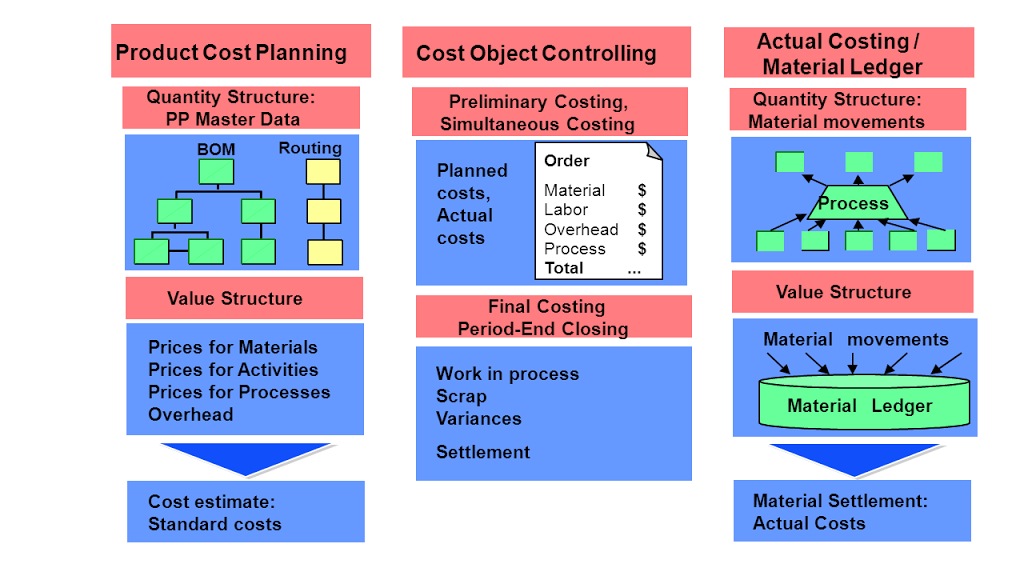
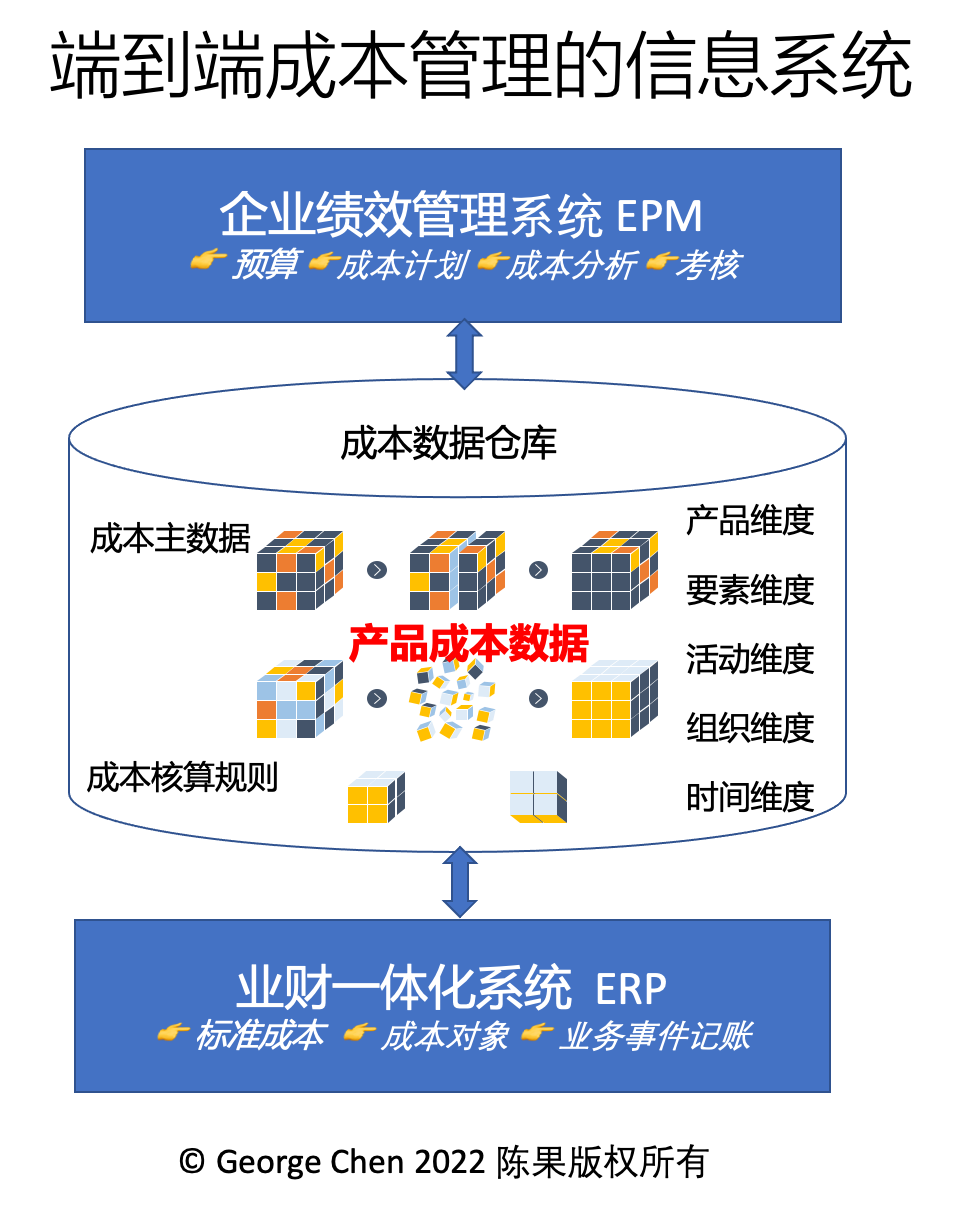
To sum up, whether it is cost planning, cost accounting, or cost analysis, it is almost impossible to do it without a powerful information system. From the application architecture, the information system of end-to-end cost management consists of three parts: 1. Accounting system, that is, the ERP system integrating industry and finance, 2. Cost data warehouse, 3. Analysis system, that is, the EPM system of enterprise performance management:
This Thursday night at 7 o'clock, the second issue of the series of digital forums on industry and financial integration hosted by me will meet with you. Welcome to scan the QR code below to make an appointment:

Review of the content of the previous issue: Next-generation ERP|Architecture modernization for digitalization of industry and finance integration
Machine-translated from the Chinese original 业财一体化的数字化(二)| 端到端的成本管理 (published 2022-11-13). WeChat original ↗