This article includes the following issues that I have been thinking about recently and what I have been doing. If you are only interested in one of them, you can jump directly to the relevant part.
1. Artificial intelligence and mathematics research 2. Three-dimensional packing optimization and two-dimensional discharging optimization 3. Use of infrared part of solar energy 4. Video illustration of ring dancing and general relativity
-
Artificial Intelligence and Mathematics Research
With the hot launch of ChatGPT, it is said that it will soon be added to Microsoft search engine Bing. Whether search on Google is a huge challenge remains to be seen.
But how to use artificial intelligence to help us do research and a lot of work has increasingly become a problem that requires serious thinking and discussion in all walks of life.
Whether it is possible to combine language learning and logic learning, as well as the symbolic artificial intelligence tradition, to help establish the foundation for logic and mathematics learning and research. You can refer to the Math-AI website below, where many researchers from Google, OpenAI, and various universities participate in research and discussions. If quantum chips can continue to be blessed, our intelligence will develop faster and faster. We will face the challenges of how to control these new technologies. What kind of "consciousness", what kind of "ethical concepts", "values", etc. will be formed by these new silicon-based intelligences (including quantum intelligence)? Will there be a concept of autonomy? How do these artificial intelligences and the groups behind them regulate the methods used and balance the distribution of benefits? Philosophers, ethicists, and sociologists need to participate in establishing basic rules, ethical principles, and profit distribution principles for the coexistence of carbon-based (human beings and various living things) and silicon-based (artificial intelligence).
https://mathai-iclr.github.io/papers/
https://mathai-iclr.github.io/
Symbolism and connectionism in artificial intelligence (Gu Xianfeng’s blog on Science Network, the middle image is missing):
https://blog.sciencenet.cn/home.php?mod=space&uid=2472277&do=blog&id=962797
Connectionism and symbolism in artificial intelligence (Gu Xianfeng in the WeChat version of Science and Technology Herald, the middle image is more complete)
On the first day of 2023, please check ChatGPT’s year-end summary!
https://chat.openai.com/chat
Comprehensively understand the three principles of artificial intelligence
Machine learning helps with reasoning
-
Three-dimensional packing optimization and two-dimensional nesting optimization
A specific problem in logistics is the discrete optimization problem. Scenarios are still widely used, and there will be some new problems and scenarios in the future.
Future optimization goals may include:
-
optimal overall cost
-
Minimum outer packaging materials
-
In the future, it may be combined with path optimization and carrier packing optimization to establish an overall optimization goal.
-
It can also be used in conjunction with recycling packaging boxes to save resource consumption through the recycling of packaging materials.
The following are selected from the JD competition questions on the website:

JD Logistics-3D Packing (Record):
JD Logistics-3D Packing (Record)__WILLPOWER_'s Blog-CSDN Blog_3D Continuous Packing
The following is Shanshu Technology’s LCL solution:
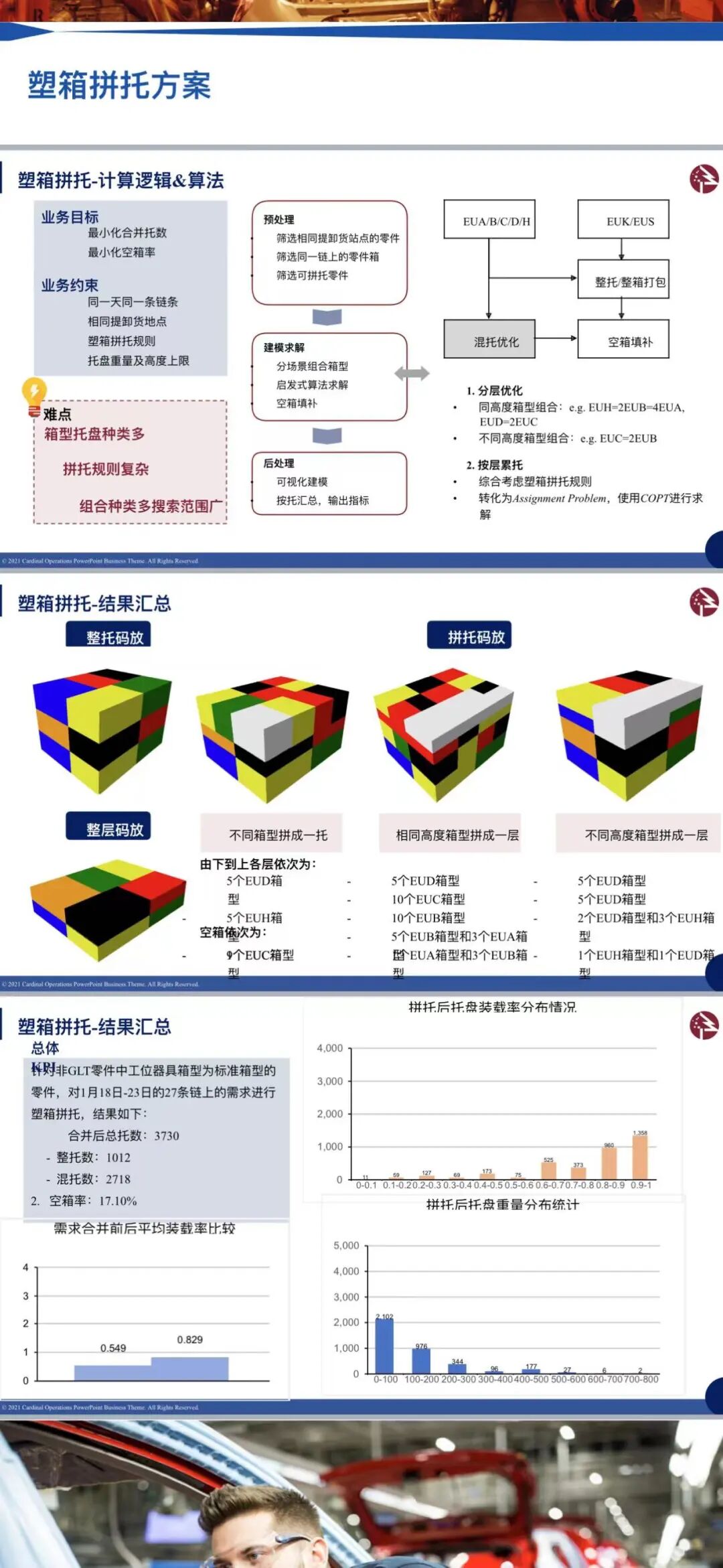
After modeling the problem, you can use a solver to solve it, such as Gurobi. There are domestic Xide software constraint solvers - SAT and SMT solvers.
You can also consider reinforcement learning algorithms and combine some heuristic algorithms to solve the problem.
Similar models and algorithms can also be used to model two-dimensional nesting problems. And combine the layout with the process. There is a company in the United States that does two-dimensional marker making and CAD/CAM with very good results. We need to learn to catch up.
SigmaNEST | Nesting Software | CAD/CAM | Automation
How to design, construct, and assemble similar building configurations (such as photovoltaic power plants), airplanes, ships, automobiles, and many steel structures and building structures in the future will involve many modeling, algorithm, and optimization issues.
I tried it below using ChatGPT, and the response I gave actually included a prototype of a greedy algorithm.
Question: Please write me a three-dimensional binning optimization algorithm program
ChatGPT answered:
Packing problem is a common type of operations research problem. Its purpose is to load as many items as possible in a specified space, or to save space as much as possible while loading as many items as possible. In the three-dimensional packing problem, we need to pack as many items of different sizes as possible in a three-dimensional space.
Here we can use the greedy algorithm to solve the three-dimensional binning problem. The idea of the greedy algorithm is to select the optimal solution at each step to ultimately obtain the global optimal solution.
Here is an example of a three-dimensional binning optimization program based on a greedy algorithm:
# define the dimensions of the 3D space
space_x = 100
space_y = 100
space_z = 100
# define a list to store the items
items = []
# define a function to add an item to the list
def add_item(x, y, z):
items.append((x, y, z))
# define a function to sort the items by volume
def sort_by_volume():
items.sort(key = lambda item: item[0] * item[1] * item[2], reverse = True)
# define a function to check if an item fits in the space
def fits(x, y, z):
return x <= space_x and y <= space_y and z <= space_z
# define a function to pack the items
def pack():
sort_by_volume() # sort the items by volume
packed_items = [] # list to store the packed items
remaining_space = (space_x, space_y, space_z) # tuple to store the remaining space
for item in items:
if fits(*item, *remaining_space): # check if the item fits in the remaining space
packed_items.append(item) # if it fits, add it to the packed items
remaining_space = (remaining_space[0] - item[0], remaining_space[1] - item[1], remaining_space[2] - item[2]) # update the remaining space
return packed_items
# add some items to the list
add_item(50, 50, 50)
add_item(30, 30, 30)
add_item(20, 20, 20)
-
Use of infrared part of solar energy
How to utilize both the high-energy part and the low-energy (infrared) part of the solar spectrum,
"According to the researchers, this outstanding achievement comes from progress in two aspects. The first is to withstand high-intensity light irradiation without damaging the semiconductor device.
"We reduced the size of the semiconductor by more than 100 times compared to some semiconductors that only operate at low light intensities," said Peng Zhou, an electrical and computer engineering researcher at the University of Michigan and first author of the study. , “Producing hydrogen with our technology could be very cheap.”
The second is that the new device can use the higher energy part of the solar spectrum to split water, while using the lower energy part of the spectrum to provide heat to promote the reaction. This "magic" is made possible by a semiconductor catalyst that, while using sunlight to drive chemical reactions, repairs itself with use, mitigating the degradation reactions that catalysts typically experience.
Specifically, the catalyst is made from indium gallium nitride nanostructures grown on the surface of silicon. Semiconductor wafers capture light and convert it into free electrons and holes. The nanostructure is filled with nanoscale metal spheres 1/2000 millimeter in diameter, using these electrons and holes to help guide the reaction.
A simple insulating layer on the panel keeps the temperature at a comfortable 75 degrees Celsius, hot enough to promote decomposition reactions but also hot enough for the semiconductor catalyst to work well. In the outdoor version of the experiment (where sunlight and temperature are difficult to control), the efficiency of converting solar energy into hydrogen fuel reached 6.1%. Indoors, the system's efficiency reaches 9% efficiency.
Notably, the researchers note that in addition to handling high light intensities, it can also work better at high temperatures that are typically not good for semiconductors. High temperatures speed up the process of water decomposition, and the extra heat also encourages hydrogen and oxygen to stay separated rather than recombine and form water again. Both methods helped the team harvest more hydrogen.
Don’t just use it to generate electricity. Breakthrough in solar hydrogen production! 10 times efficiency and lower cost--Quick Technology--Technology changes the future (mydrivers.com)
How to find suitable semiconductors and molecular motors, establish similar systems, and improve the overall efficiency of solar energy conversion.
Solar-to-hydrogen efficiency of more than 9% in photocatalytic water splitting | Nature
https://www.nature.com/articles/s41586-022-05399-1
A teacher's advice on harnessing the power of infrared rays:
"For the infrared part, systems with small gaps are generally used. Current solar cells are mainly single p-n junctions. If solar energy is used as much as possible, the usual approach is to use multi-junction cells. Generally, two materials of about 0.8 eV and 1.5 eV are used. Of course, the cost of multiple junctions will be high, so there are not many commercialized ones.
Powering rotary molecular motors with low-intensity near-infrared light:
https://www.science.org/doi/pdf/10.1126/sciadv.abb6165
An in-depth interpretation of the 2016 Nobel Prize in Chemistry: Molecular Motors and Nanorockets
http://www.sinano.cas.cn/kxcb/kpwz/201610/t20161008_4673124.html
Cao Junwei: Energy Internet supports the distributed development of new energy
-
Video illustration of ring dancing and general relativity
Qiu Chengtong talks about geometry: from Riemann and Einstein to string theory
Machine-translated from the Chinese original 1,人工智能与数学研究 2,三维装箱优化与二维排料优化 3,太阳能红外线部分的使用 4,圆环跳舞与广义相对论视频图解 (published 2023-01-08). WeChat original ↗