Anxiety in the GPT era
In the first half of 2023, ChatGPT became the focus of the entire technology world. Many people believe that with the iteration of large models, human civilization will become a transitional stage for silicon-based civilization. Traditional scientific methodology is about to be completely overturned, and large models with tens of trillions of parameters will become the ultimate answer to everything. For example, the recent emergence of ChatGPT has caused scholars in the field of traditional natural language understanding to lose their research positions overnight; the Segment Anything released by Meta and the subsequent Track Anything have almost ended the two most important subfields in the field of computer vision. The only subfield that has not yet been swept by the wave of large models seems to be 3D vision, but it is very likely that a giant company will suddenly announce the generation of all 3D large models overnight. So will traditional human intelligence be replaced by artificial intelligence emerging from large models? Will the quintessential mathematical theory that humans are proud of eventually be knocked off the altar by AI like the art of Go, and abstract and profound thoughts will end up being nothing more than a huge network search? In particular, is it necessary for young students to spend huge efforts and endure frequent mental blows to learn abstract theories such as modern algebraic topology and differential geometry?
The author frequently uses ChatGPT during the course preparation process to discuss in-depth understanding of mathematical concepts and clarify the overall theoretical system. Overall, the performance of ChatGPT is unsatisfactory. On the one hand, GPT has powerful literature search and language organization and integration capabilities, and it can pick up mature concepts and theories at ease. On the other hand, GPT is limited to the understanding of surface language, and cannot truly understand the connotation behind the language. In other words, GPT cannot understand the real physical world that the language points to. Compared with Zhihu, ChatGPT can provide very limited help for self-study systematic knowledge systems. It cannot explain high-level concepts clearly with low-level concepts. Instead, concepts at the same level refer to each other cyclically. It cannot use phenomena in daily life as metaphors, and it cannot make analogies between different theoretical systems. ChatGPT is good at organizing existing human knowledge systems, but it is currently unable to generate new knowledge. The abstract ability to form concepts in human thinking and the understanding of macroscopic natural structures. These unique thinking qualities of human beings are more dependent on human aesthetic intuition than on human language. Currently, ChatGPT strongly relies on the feedback of human users, which is called reinforcement learning, which means that ChatGPT does not have its own judgment ability and aesthetic standards. Large models can quickly discover certain laws that humans have not yet recognized, but currently GPT does not have this ability to integrate various complex laws into a concise and self-consistent theoretical system. It is still unknown whether the characteristics of human mathematical thinking can be explained and replicated by the emergence phenomenon of very large-scale neural networks.
On the other hand, the outbreak of ChatGPT has brought anxiety to engineers in the computer field. Musk fired most of Twitter's programmers, but Twitter's system performance was not greatly affected. This is like revealing the emperor's new clothes in the IT industry, triggering a frenzy of layoffs, and all kinds of human tragedies are heard from time to time. Friends in Silicon Valley also revealed that Meta is trying to replace middle managers with AI technology, and Google’s underlying code is also completed by AI. What kind of abilities should the younger generation learn to be invincible in the future competition with AI? The author believes that shallow-level thinking abilities and engineering skills can easily be replaced by AI, so mastering profound mathematical theories will become the real core competitiveness.
In the spring semester of 2023, the author taught the course "Computational Conformal Geometry" online. Similar to previous years' course settings, this year's content covers the basic concepts and theorems of surface algebraic topology, differential geometry, Riemannian geometry and conformal geometry, as well as mature calculation methods; different from previous years, this year's course focuses on the introduction of modern perspectives, especially the Abel-Jacobi theorem, holopure line bundle theory, and Riemann-Roch theorem. Unfortunately, due to time constraints, we did not explain the interpretation of the Riemann-Roch theorem by the cohomology of the bundle section layer, which is the key entrance to high-dimensional complex geometry theory.
In the first week, we introduced the topological structure of surfaces. The main concepts are the basic groups of surfaces, covering spaces, simple homology groups, deRham homology groups, harmonic differential homology groups, etc. Computational tools include CW-cell decomposition, graph theory methods, continuous coherence and surface finite elements. The main algorithms include surface homotopy group bases and relations, cohomology bases, Hodge Star algorithm, and harmonic form algorithm. Topological structure theorems include surface topology classification theorem, Van Kampen-Serfeit theorem, Hodge decomposition theorem, inter-structure theorems include Gauss-Bonnet theorem between topological structure and Riemannian metric structure (proven by topological degree), Hodge decomposition theorem between topology and analysis. In the second week, we mainly talked about the theory of Riemann surfaces, including the most critical basic theorems, the Riemann-Roch theorem, the Abel-Jacobi theorem, and the singularization theorem; we also talked about the applications of Abel differential, holomorphic differential for surface conformal mapping, surface conformal modules, holomorphic quadratic differential for surface leaf-like structures, and Teichmuller space coordinates. Modern viewpoints, holopure line bundles, Picard groups, Chen classes, etc. were discussed. In the third week, we mainly used the moving frame method and differential forms to study surface differential geometry. We introduced connections, curvature forms, Gauss-Bonnet theorem, first-order and second-order variations of geodesics, minimal surface and area variations, harmonic mapping theory, proving the first-order and second-order variations of harmonic energy, and the existence, uniqueness, stability and regularity of harmonic mapping. In the fourth week, we introduce hyperbolic geometry and discrete surface Ricci flow theory. We apply the region invariance theorem and Teichmuller space method to prove the existence and uniqueness of Ricci flow solutions, thereby obtaining the discrete singularization theorem.
We regard the surface as a two-dimensional manifold, covered by local coordinates. If the transformations between local coordinates are biholomorphic transformations, the surface has a complex structure (conformal structure), thus becoming a Riemannian surface. We can directly define the concepts of holomorphic, meromorphic functions and differentials of classical complex analysis on the Riemann surface. The central theorem of the open Riemann surface is the uniformization theorem, while the central theorem of the compact Riemann surface is the Riemann-Roch theorem.
Unique value theorem
Single valueThe theorem asserts that there are only three types of simply connected Riemannian surfaces: sphere, complex plane and unit disk. As shown in the title picture, the differential geometry interpretation of the singularization theorem is more intuitive. Given an orientable metric surface, there is a function that causes the metric to induce constant Gaussian curvature: If the Euler characteristic number of the surface is positive, zero, and negative, the corresponding constant values are, and. This theorem means that we can conformally map any three-dimensional surface in physics to a two-dimensional plane, thereby reducing the dimensionality of a three-dimensional geometric problem into a two-dimensional plane problem. This dimensionality reduction idea is expected to greatly improve the quality and efficiency of engineering algorithms. The singularization of a zero-deficiency closed surface can be achieved by using a spherical surfaceHarmony and Reflectionto calculate (left frame). The so-called harmonic energy is the elastic deformation potential energy of the surface. We use Gaussian mapping to map the surface to the unit sphere, and then use nonlinear thermal diffusion to optimize the harmonic energy, and finally obtain the harmonic mapping. According to Hopf's theorem, the harmonic mapping between topological spheres must be a conformal mapping. A genus surface can be univalued usingholomorphic differentialto calculate (mid-frame). According to Hodge theory, there is a unique harmonic differential in each de Rham cohomology class of the surface. The harmonic differential and its conjugate form a holomorphic differential. The integral of the holomorphic differential on the universal covering space of the surface obtains a single-valued mapping. In our class, we introduced the algorithm of pure homology and discrete Hodge decomposition to obtain holomorphic differentials. Currently, there is only one algorithm for calculating the single-valued metric of a general surface (right frame):Surface Ricci flow. Ricci flow evolves the Riemannian metric of the surface over time. The evolution rate is proportional to the Ricci curvature. The curvature evolution satisfies the diffusion-reaction equation and eventually tends to a constant value: , here is the Gaussian curvature of the surface. We introduced the theory of discrete surface Ricci flow in class, proved the existence and uniqueness of the solution, and also gave the convergence from discrete solution to smooth solution.
Riemann-Roch theorem
Dividers, Jacobi clusters and holomorphic line clustersGiven a Riemannian surface, the genus is. The linear combination of integer coefficients of discrete points on the Riemann surface is called a divisor, and the sum of the integer coefficients is the degree of the divisor. For example, given a meromorphic function, its induced principal divisor is, where are the zeros and poles of the function, and are the orders of the zeros and poles. Two divisors are linearly equivalent if they differ from each other by a principal divisor. Division subclasses are formed under additionExclude subgroups, the subgroup composed of divisor classes with degree zero is called the zero-degree divisor class.
Assume that the canonical basis of the homology group under the surface is, and the dual basis of the holomorphic differential group is. The periodic matrix of the surface is,
A linear group of integer coefficients of column vectors of a periodic matrix forms a lattice. The vipin ring is called yesJacobi cluster. Fixed a point on the Riemann surface, we define the Abel-Jacobi mapping, for any point, choose a path to connect the sum,
Abel-JacobiThe theorem asserts that the Abel-Jacobi image of the principal divisor is 0, , which is injective. Jacobi's theorem proves that it is surjective, so the zero-degree divisor group is isomorphic to the Jacobi variety.
We examine the holomorphic line bundle on the surface, assuming it is a meromorphic section, and obtain the divisor. If they are all meromorphic cross sections, then their divisors are equivalent to each other, that is, they are some meromorphic functions. On the contrary, given a divisor, we construct an open cover , which is satisfied that the divisors have no intersection. Construct a meromorphic function on each open set, so that a double holomorphic transformation function is obtained, and a holomorphic line bundle is constructed. Holomorphic line bundles are isomorphic to each other if they are linearly equivalent to each other. At the same time, given two holopure line bundles and their product, all holopure line bundles form the Riemann surface under this multiplicationHolopure line cluster group. In this way, we obtain the zero-degree holomorphic line bundle group of the compact Riemann surface and the zero-degree divisor group isomorphic.
Riemann-RochThe theorem gives the relationship between meromorphic functions that satisfy certain conditions and the dimensions of meromorphic differential spaces. Given a divisor, it represents the linear space composed of all meromorphic functions that satisfy the conditions; it represents the linear space composed of all meromorphic differentials, where the conditions are satisfied. The Riemann-Roch theorem asserts
On the other hand, the divisor determines the holopure line bundle, the cohomology group of the cross-section layer is sum, and the Euler characteristic number of the line bundle is. The Riemann-Roch theorem can be understood as:
potential applications
Computational conformal geometry has been widely used in the field of medical imaging. For example, traditional methods first segment medical images to obtain the outline of the organ surface in each picture, and then restore the surface through the segmented binary image. Due to random noise and segmentation errors, the surface obtained in this way has many false ring handles, which is the so-called topological noise. Automatically detecting and removing these ring handles requires the use of computational topology methods, such as finding the basis of the basic group, calculating the continuous homology group, etc. The initial surface is too large and often needs to be simplified and geometrically denoised. A common method is the surface average curvature flow method, which comes from the minimal surface theory. In order to detect geometric feature points, we often use differential geometry methods to calculate various curvatures and geodesics of surfaces. In order to compare and register different surfaces, we calculate the single-valued metric of the surface, conformally map the surface to a planar area, and then use planar harmonic mapping or quasi-conformal mapping with feature restrictions to achieve mapping between surfaces. These basic algorithms have been widely used in fields such as placement box diagnosis of cranial nerve diseases and virtual colonoscopy.
|
|
|
Fig1. Conformal brain map.
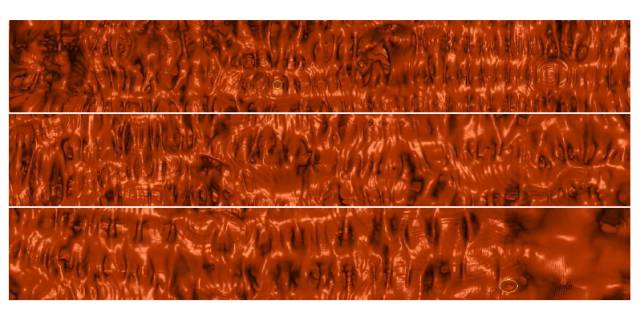
Fig2. Virtual colonoscopy.
On the other hand, algorithms for calculating conformal geometry are now widely accepted by academic circles and have been widely used in the field of medical imaging. In the field of game animation, surface parameterization and texture mapping based on conformal geometry are also very common. However, it has not been widely used in other industrial fields. In the field of CAD/CAE, the isogeometric analysis (Isogeometric Anylasis) method founded by Professor Tom Hughes, an academician of the American Academy of Sciences, has increasingly become a strong competitor to the finite element method. Isogeometric analysis requires structured meshing of surfaces and solids. However, structured grid generation has always been a field that relies heavily on engineers' manual experience and lacks a solid theoretical foundation. In recent years, through cooperation with the Hughes team, the author and his collaborators have gradually realized that the surface structured grid is equivalent to the overall meromorphic section of the Riemann surface holopure line bundle, and the configuration of its singular points is governed by the Abel-Jacobi theorem.
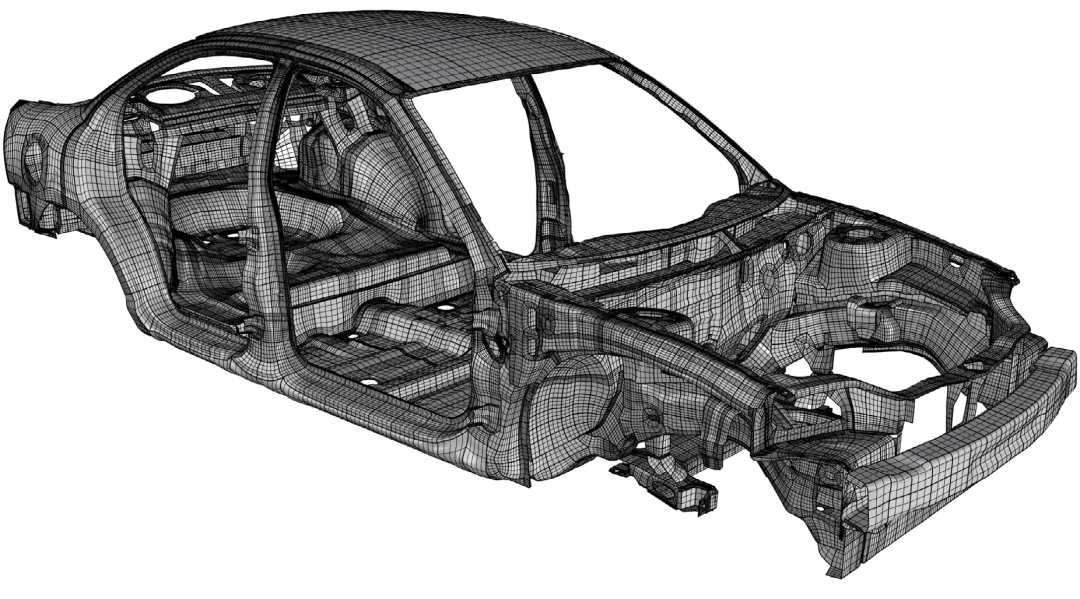
Fig 3. IGA model of the car.
future outlook
From a historical perspective, the development of most topology and geometry disciplines has gone through the basic theory of continuous manifolds, the generalization theory of discrete manifolds, the proposal and proliferation of calculation methods, and the refinement and improvement of industrial processes. Computational conformal geometry has now reached between the third and fourth steps. For example, according to Teichmuller theory, the Teichmuller map has the smallest distortion in the mapping between metric surfaces. The Teichmuller map is determined by specific holomorphic quadratic differentials on the two surfaces. However, there is currently no universal and mature algorithm to calculate these two holomorphic quadratic differentials. For another example, according to Loftin's theory, the projective structure of a surface is determined by the holomorphic cubic differential on the surface. Currently, there is no algorithm to construct the projective structure from cubic differentials. The author hopes that these problems will be completely solved in the next few years. Generally speaking, it takes decades for the mature results of academia to be truly recognized by industry. The robustness, efficiency, convergence accuracy, etc. of computational conformal geometry algorithms need to be improved through industrial practice to truly meet practical requirements. We hope that more young people can become familiar with modern topology and geometry by learning computational conformal geometry, thereby becoming more passionate about mathematics and computer science, promoting theoretical development, and achieving technological innovation!
Machine-translated from the Chinese original 2023春季《计算共形几何》课程总结 (published 2023-05-10). WeChat original ↗