During the summer vacation of 2023, the author was entrusted by Mr. Qiu Chengtong to adhere to the tradition of more than ten years and teach the "Computational Conformal Geometry" course online. At the halfway point of the course, the course content is beginning to be closer to modern times, and the students’ enthusiasm for learning is still high, which is deeply inspiring and touching.
Last year's hot topic in technology was generative AI. The author focused on explaining the Minkowski-Alexandrov theory of convex differential geometry and the Monge-Kantorovich-Brenier theory of optimal transmission. This year, the relevant theories of industrial software have attracted much attention. In CAD/CAE applications, many engineering problems can be summarized as the following mathematical problems: How to generalize the local geometric structure of a surface or solid to the global situation? In modern mathematics, the cohomology theory of layers is a powerful tool for dealing with the relationship between parts and the whole. Therefore, in this year's course, the author focuses on the Cech cohomology theory of the pure line bundle cross-section layer, which is the theoretical basis for regular grid generation.
The concept of sheaf is very similar to the concept of differential form. At first glance, they both feel ethereal, abstract and obscure, like echoes within echoes. However, after truly understanding them, you will deeply realize that the introduction of these concepts has raised the level of abstraction, breaking away from the cumbersome and cumbersome elementary derivation process. They are simple and elegant, and can be sealed with a sword. Applying the differential form to the moving frame method can break away from the tensor derivation of local coordinates, and obtain the core concepts and theorems of differential geometry such as connections, curvature, transitions, and Chen classes in just a few strokes. By applying the cohomology of the fully pure line bundle cross-section layer, the most concise and universal proof of Riemann-Roch can be obtained, and it can be directly extended to high-dimensional complex manifolds to obtain high-dimensional Riemann-Roch theorem, Kodaira Kunihiko elimination theorem and other theorems, which have become a key tool of algebraic geometry. This method of expressing geometric problems with appropriate homology groups and the method of geometric analysis using partial differential equations complement each other and complement each other. They are very exciting! Such a wonderful idea can be directly applied to automotive aerodynamics simulation (Figure 1, Cadence) and automotive white-body collision simulation (Figure 3, Beta-CAE). This is indeed beyond the author's imagination. This once again verifies the incredible aesthetic and practical value of mathematics!
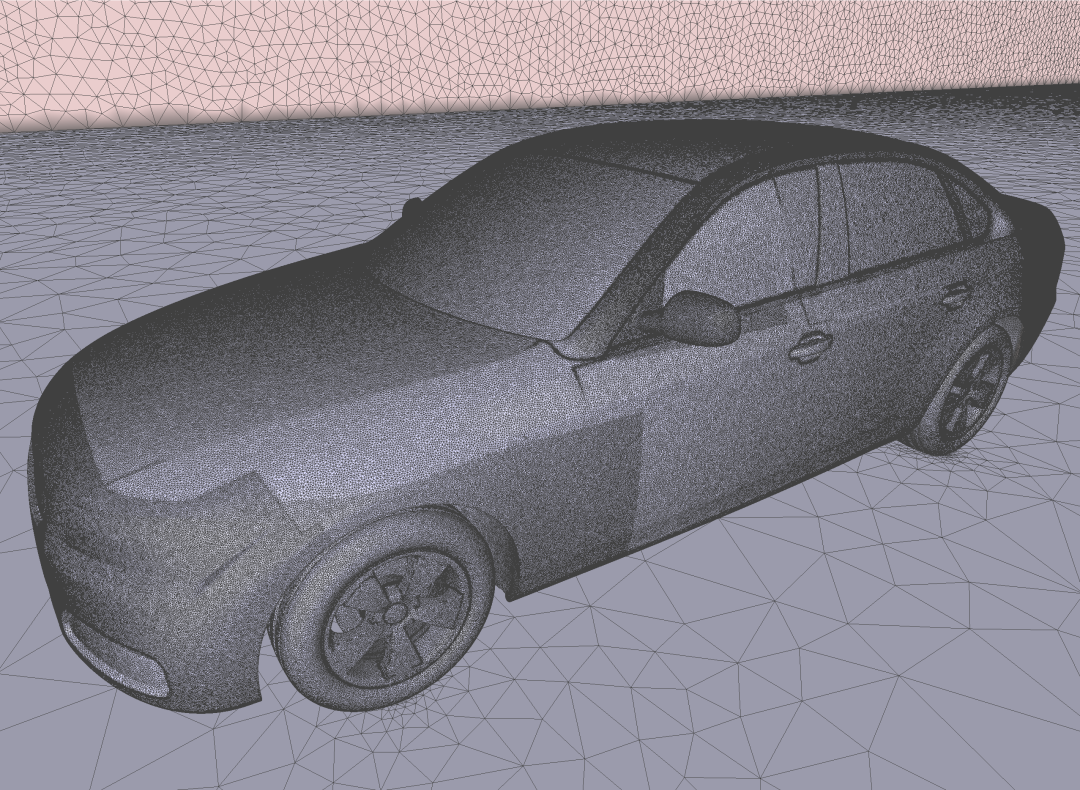
Figure 1. Mesh generation based on computational conformal geometry, applied to computational fluid dynamics (with Hang Si, Chuanlin Lv and Ben Gu, Cadence Research).
Modern physical theories are often expressed in terms of fiber bundles. The physical field is often regarded as the global cross-section of a certain fiber bundle, and the singular points of the field are determined by the representative class of the fiber bundle. For example, a certain force field on a manifold can be expressed as a tangent vector field. Locally, it is very easy for us to construct a vector field that is non-zero everywhere, but when extended to the global situation, we will inevitably encounter topological or geometric obstacles, and zero points will inevitably appear. A vector field can be viewed as a section of the tangent bundle of a manifold, and its zero points are the representative classes of the tangent bundle. This theoretical framework is also applicable to various global geometric constructions of CAD and CAE, such as structured grids. For structured grids, it is very easy to construct locally, but it encounters obstacles when generalizing to the global situation. This obstacle is manifested by the existence of singular vertices (that is, vertices with a topological degree not equal to 4). We can regard the structured grid as the global cross-section of some kind of pure line bundle. The singular vertices constitute the representative class of the line bundle and satisfy the specific global Abel-Jacobi equation; at the same time, the existence of this kind of grid is guaranteed by the Riemann-Roch theory. Because the structured grid naturally has a conformal structure, the fiber bundle here is stronger than the usual vector bundle, but is a pure line bundle based on complex geometry. Its representative class is also stronger than the usual Chen class, satisfying the more demanding Abel theorem. The space formed by the global section of a fully pure line bundle, as well as the obstacles to the existence of the global section, can be accurately described by the Cech cohomology theory of the line bundle section bud layer. Therefore, the author's course setting this year emphasizes the theory and calculation in this area.
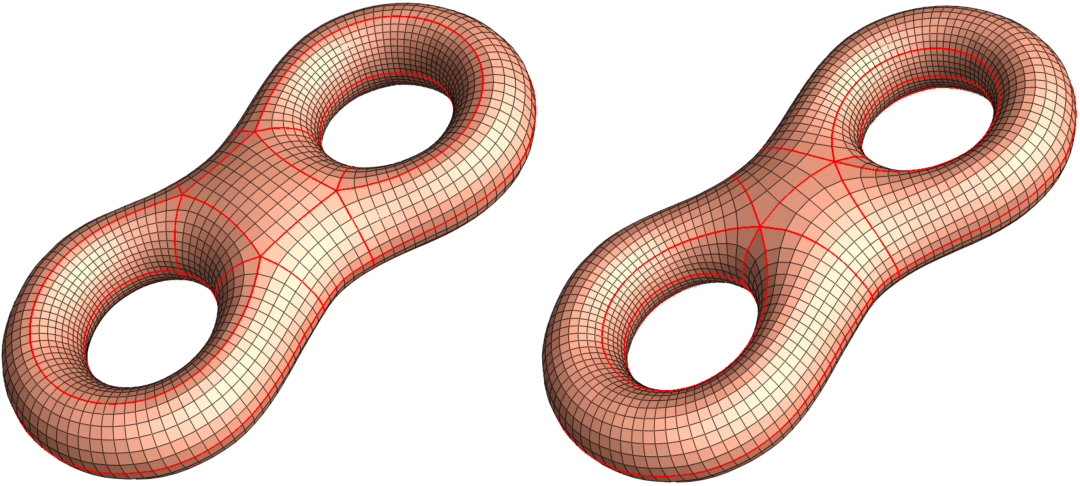
Figure 2. Surface quadrilateral meshing can be viewed as the overall cross-section of a pure line bundle.
In mathematics, a basic problem is to study the relationship between local and global, and layer cohomology is a powerful tool invented for this purpose. For example, the Abelian differential on the Riemann surface is a very basic geometric existence, the conformal mapping between surfaces relies on the holomorphic 1 form, the Teichmuller space of the surface relies on the holomorphic quadratic differential, the measurable leaf structure of the surface relies on the holomorphic quadratic differential of the surface, the real projective structure on the surface relies on the holomorphic third differential, the quadrilateral mesh of the surface relies on the meromorphic fourth differential, and so on. These Abelian differentials can be regarded as global cross sections of different holomorphic line bundles on the Riemann surface. For example, a quadrilateral grid naturally induces a meromorphic fourth differential, and the corresponding fiber bundle is the 4th power of the surface holomorphic cotangent bundle. Then the zero-pole distribution, that is, the divisor, is an indicative class that satisfies the Abel-Jacobi equation, where it is an arbitrary holomorphic 1 form. So if we give a few points at will, is there a quadrilateral mesh that satisfies that the vertex is at and the degree is? If so, how many types are there? In other words, we construct local grids near points. Can we generalize these grids globally and get the global grid exactly? This depends on the conformal structure of the surface itself and the distribution of the divisors, and can be answered by the Cech homology theory of the pure line bundle cross-section layer.
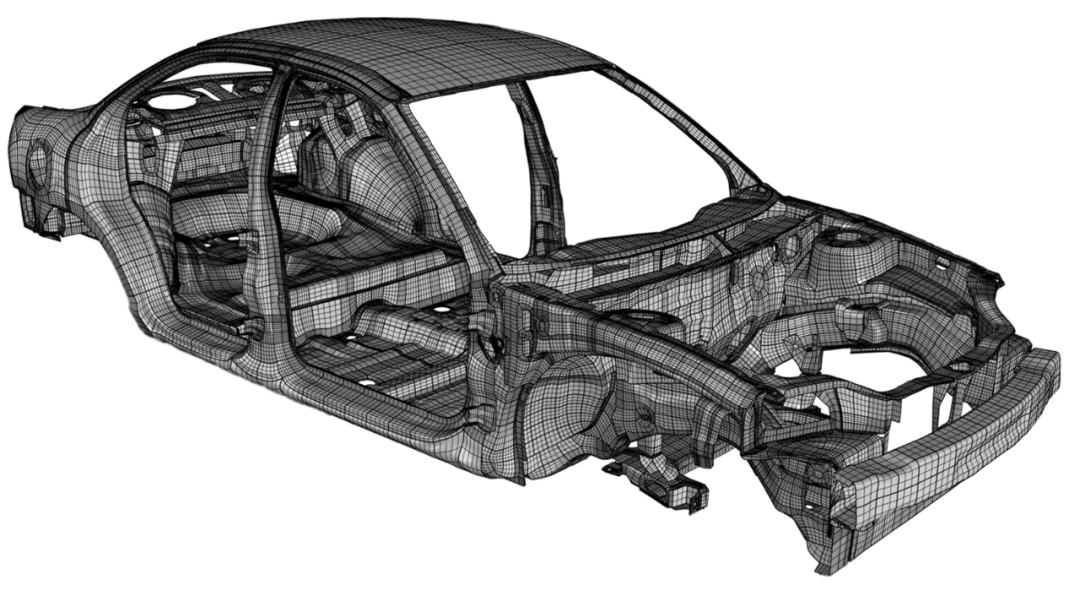
Figure 3. Watertight NURBS representation of a car, used in Iso Geometric Anylasis simulations to simulate white-body collisions (with Tom Hughes, Kendrick Shepherd, Beta-CAE research).
The basic idea is as follows: Assume it is a holomorphic line bundle on the Riemann surface, and a local holomorphic section can be defined on any open set of . Near any point, we can define a local holomorphic section, thus defining the so-called section bud (germ). Given an open covering of the Riemann surface, we define a map that assigns a local holomorphic cross-section to each open set. So does the whole define a global cross-section? The local and global compatibility conditions are naturally as follows: For the intersection of any two open sets, on the intersection. For this purpose, we introduce the differential operator, . Then it is equivalent to the global cross section of . From this, we see that the local construction on each open set is given, and the overall compatibility condition of the local construction is given.
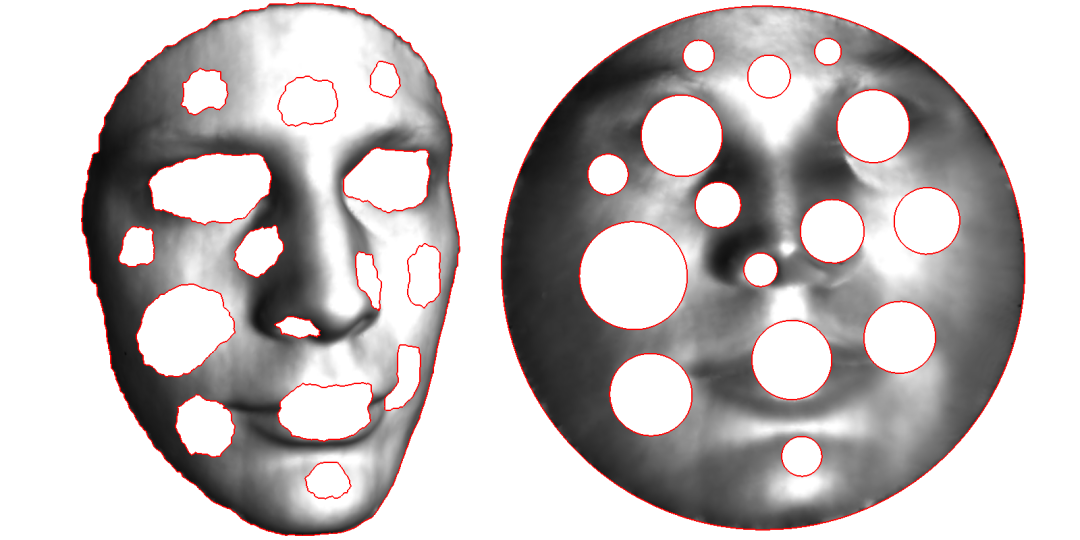
Figure 4. Surface conformal mapping obtained from holomorphic 1 form, and conformal mode.
We generalize this idea and open coverings define so-called Cech complexes, where each open set corresponds to a vertex, and each -simplex corresponds to the intersection, edge operator. The dimensional-uplink will be mapped to a holomorphic section on the intersection, and all the-uplinks constitute the uplink space. Introduce differential operators. In this way, we can define the Cech cohomology group of the cross-section bud layer
All global sections are given, which can be regarded as the characterization of global section obstacles. The staggered sum of homology group dimensions is given by the Riemann-Roch theorem, which defines the Euler indicator number of the line bundle, from which the dimension of the global section space of the line bundle can be derived. In practical applications, how to map specific geometric structures to the cross-sections of corresponding fiber bundles, and how to connect singular collections of geometric structures to representative classes of fiber bundles, all require in-depth thinking and bold creation.
|
|
|
Figure 5. Ricci flow-based mesh generation for CAE simulation.
Course content outline
At the beginning of the course, the author explains from the perspective of combinationalgebraic topology, mainly the theory of homotopy and homology, introducing the concept of simple cohomology group, and also introducing the calculation method of sustained cohomology.
Then, the author introducesRiemannian metricconcepts, thereby introducing the basic concepts of isothermal coordinates, geodesics, parallel movement and Gaussian curvature. For the convenience of calculation, we introduce Cartan external differential. The calculation in differential form does not depend on the local coordinate system, which is simple and elegant. Combined with the moving frame method, we obtain the differential form expression of contact (parallel movement) and curvature, thereby obtaining the implicit proof of the Gauss-Bonnet theorem. Furthermore, we obtain the Chen Shengxing class of the curvature form as the tangent bundle of the surface.
From the differential form, we introduce the concept of de Rham cohomology group, and from the Riemannian metric we get the concept of harmonic differential,Hodge theoryAssert that a unique harmonic differential form exists in each de Rham cohomology class, thus linking topology to analysis. Equivalently, for any differential form, there is a unique decomposition:
Here, and are respectively, and harmonized forms. From the isothermal coordinates, we obtain the concepts of conformal structure and Riemann surface. We give the ordinary differential equation of the geodesic on the Riemannian surface, further extend the geodesic to the harmonic mapping between surfaces, and use analytical methods to study the existence, uniqueness and regularity of the harmonic mapping, thereby gaining the insight that the second-order variation of the harmonic energy depends on the curvature.
From Hodge theory and harmonic differential, we get the holomorphic differential on the Riemann surface. The interaction between the holomorphic differential and the hypohomology group results in the periodic matrix of the Riemann surface, and the periodic matrix is the conformal invariant of the whole system of the Riemann surface (conformal mold). We apply geometric complex analysis methods and algebraic topology methods to give conformal modes with different topological Riemann surfaces. From a computational perspective, holomorphic differential is equivalent to the differential of conformal mapping between surfaces. By constructing a holomorphic differential with constraints, we can calculate the conformal module of zero-genus and boundary surfaces, and the conformal module of 1-genus surface. For a fixed surface topology, the space composed of all possible conformal structures is called Teichmuller space, which can be parameterized by holomorphic quadratic differentials on the Riemann surface.
By applying geometric complex analysis methods, we show thatUnique value theorem, that is, the simply connected Riemannian surfaces only have spheres, complex planes and unit disks. The differential geometric interpretation of the singularization theorem is that any orientable compact surface with a Riemannian metric can be conformally transformed into a surface with constant Gaussian curvature. Depending on the topology of the surface, constant Gaussian curvature is one of them. The single-valued calculation boils down to solving the Yamabe equation. The conformal transformation of the Riemannian metric is, the induced Gaussian curvature change.
Finally, the discrete surfaceRicci flow methodsolved. Ricci flow deforms the Riemannian metric, and the deformation speed is proportional to the current curvature, making the evolution of the curvature conform to the reaction-diffusion equation, and finally tends to a constant. Our course proves the existence, uniqueness and convergence of Ricci flow solutions for discrete surfaces.
The concepts of holomorphic and meromorphic functions can be directly extended to the overall holomorphic and meromorphic functions on the Riemann surface. All meromorphic functions on the Riemann surface form a domain with a transcendental degree of 1. Two Riemann surfaces are conformally equivalent if and only if their corresponding meromorphic function domains are isomorphic. At the same time, the two meromorphic functions on the Riemann surface satisfy specific algebraic equations, so we express the Riemann surface as an algebraic curve, that is, the Riemann surface is biholomorphically embedded into an algebraic variety (a set of zero points). Another method of embedding into the algebraic family is more direct. The lattice formed by the column vectors of the periodic matrix is the genus of the Riemannian surface. The quotient space is called the Jacobi variety of the Riemannian surface. By integrating the basis of the holomorphic differential, we obtain the so-called Abel-Jacobi map, which embeds the Riemannian surface biholomorphically into the Jacobi variety. The zeros and poles of a meromorphic function constitute the so-called principal divisor,Abel's theoremThe necessary and sufficient conditions for the principal divisor are given: the Abel-Jacobi image is zero,
Holomorphic differentials can be generalized to three types of Abel differentials (meromorphic differentials) on the Riemann surface. The integral of Abel differentials on the basis of the hypohomology group constitutes its period. The periods of different types of Abelian differentials have bilinear relationships. From these bilinear relationships, we get the Riemann-Roch theorem of the compact Riemann surface: given the divisor, it is the linear space composed of all meromorphic functions, which satisfies; it is the space composed of all meromorphic differentials, which satisfies, thenRiemann-Roch theoremAssert:
The modern view interprets and as a linear space composed of the global cross-section of some kind of vector bundle. The so-called holopure line bundle on the Riemann surface is a vector bundle with the complex plane as the fiber and the base space. The bundle projection maps each fiber to a point on the corresponding base manifold. The bundle is locally mediocre and the overall distortion, that is, there is an open covering of the Riemannian surface, is restricted to the epimorphism in the direct product space, and the overall distortion is expressed as a transfer function, which are both double holomorphic functions. All holomorphic line bundles are classified under the equivalence relation of bundle isomorphisms, and the quotient space is a holopure line bundle class space. All divisors are classified. If two divisors differ by an integer divisor, they are equivalent to each other. The group composed of divisors is. Given a holomorphic line bundle, if we take any meromorphic cross section, we will get a divisor. On the contrary, if we give any divisor, we construct a meromorphic function for each divisor, which satisfies, thus obtaining the transfer function, and we can construct the holomorphic line bundle. From this we get
is isomorphic. It can be interpreted as a holomorphic cross-sectional space, which is a holomorphic cross-sectional space. Here is the holomorphic cotangent bundle of the Riemann surface. So the Riemann-Roch theorem can be interpreted as
Given a holomorphic line bundle and a divisor, a global meromorphic cross-section satisfies, then it is a global holomorphic cross-section of the line bundle, that is
Furthermore, the Riemann-Roch theorem can be expressed by the Cech cohomology of the holomorphic cross-section bud layer
Here, the cohomology group is the linear space composed of the global holomorphic cross-section of the holomorphic line bundle. The cohomology group is an obstacle to generalizing the local holomorphic cross-section to the global cross-section.
An outline of the theory of holopure line bundles
Riemannian surfaceGiven a surface M, covered by a family of open sets, each open set is a topological disk with local coordinates. If the transformation functions between local coordinates are biholomorphic functions, the surface is called a Riemann surface, and the local coordinate atlas is called a conformal structure. Assume that the canonical base of the homology group under the Riemannian surface of the genus is, satisfying the algebraic intersection number condition:
The basis of the holomorphic first-order differential group is, and the periodic vector is
The periodic matrix is . Torelli's theorem asserts that two Riemann surfaces are conformally equivalent if and only if their periodic matrices are equal. Get the lattice from the periodic matrix
The quotient space is called the Jacobi variety of the Riemannian surface.
meromorphic functionThe traditional theory of complex variable functions can be extended to the Riemann surface. A function is called aholomorphic (meromorphic) function, if it is restricted to be a classical holomorphic (meromorphic) function in every local coordinate system. Taking any point on the Riemann surface, and a local coordinate system, , there exists a Laurent expansion of meromorphic functions:
If , it is a zero point of the function, and the order is recorded as; if , it is said to be a pole of the function, and the order is. The divisor of a meromorphic function is written as the form sum
The divisor of a meromorphic function is calledmain divisor(principle divisor). Similarly, a differential is said to be a holomorphic (meromorphic) subdifferential, where is an integer, if its representation in local coordinates is , where is a holomorphic (meromorphic) function, and when the local coordinates become , here . Assuming it is a meromorphic 1st differential, the sum of its zero and pole forms can be similarly written ascanonical divisor .
Exclude subgroups Denoted as, all divisor subclasses of zero degree form a subgroup. Abel-Jacobi mapping maps divisors to Jacobi clusters. Suppose, then
Abel's theorem asserts: is the primary divisor if and only if it is zero. The Abel-Jacobi theorem asserts: is a group isomorphism.
Pure line bundle The holopure line bundle on the Riemann surface is a complex 2-dimensional complex manifold, and the bundle map is surjective.
- exist an open coverage and biholomorphic mapping , that is, cluster limited to open set Above is the direct product, called to belocal trivialization ;
- , , that is, each pointfiberis the complex plane ;
- arbitrary , there exists a holomorphic function , making , ,
That is, the local coordinate transformation is limited to be linear on the fiber. here is calledtransfer function(transition function), satisfying the conditions
A holomorphic line bundle can be represented by its trivial open covering and transfer function. If there is a holomorphic function such that the transfer function isOrdinary Cong。
Assume that is a holomorphic line bundle, and a holomorphic mapping pair is called a bundle homomorphism. If the conditions are met
- , that is , , will dot fiber reflection fiber;
- limited to each fiber They are all linear homomorphisms.
If there is a bundle homomorphism, which is a reciprocal bi-holomorphic mapping and a bi-holomorphic mapping, then andbundle isomorphism. All holomorphic line bundles on the Riemann surface are classified according to bundle isomorphisms, and all isomorphism classes are grouped, recorded as:
- The trivial bundle is the identity element
- The inverse element of
- and The product of
The holopure line bundle group is the Abelian group, the so-called Picard group.
The holopure line bundle group is isomorphic to the subgroupGiven an arbitrary divisor on the Riemann surface, we can directly construct the so-calledPure line bundleAs follows: first construct a family of open coverings so that the intersection of any two open sets is empty; then construct a meromorphic function for each open set that satisfies the conditions
That is, the zeros and poles of are given by the limits on . So at the intersection,
Therefore, it is a doubly holomorphic function, and the transfer function satisfies the condition: the holomorphic line bundle can be constructed as follows,
The equivalence relationship here is defined as follows: for any, ,
In this way, the holomorphic line bundle constructed from the divisors is denoted as . Given a holomorphic line bundle, if we choose any meromorphic cross-section, we have, from which it is easy to prove that it is a group isomorphism.
Cohomology of the fully pure line bundle cross-section layer
pure cross sectionA holomorphic cross section of a holomorphic line bundle is a map that satisfies the following conditions:
- to all points , , that is in in fibers at points;
- is holomorphic, that is, for any local trivialization , mapping is a holomorphic function, denoted as .
If, the local expression on is, then
Therefore, a holomorphic section has a local representation
All holomorphic differentials of a holomorphic line bundle are denoted by . The meromorphic cross section of a holomorphic line bundle also has a similar representation, and the set of all meromorphic cross sections is denoted as .
The Riemann-Roch theorem asserts:
Cohomology of the cross-section layerGiven a holomorphic line bundle, we consider the local cross-section of the bundle, that is, the local holomorphic cross-section on each open set, thus obtaining the concept of a holomorphic cross-section bud layer. Fix a point, and a pair of local holomorphic sections near the point are equivalent. If there is an open set, such a local holomorphic section equivalence class is called a holomorphic section bud at a point. All holomorphic section buds at a point constitute a stem, and the stem is an Abelian group. The holomorphic section sheaf (sheaf) composed of all holomorphic section buds on the Riemann surface is recorded as.
From the open covering of the Riemann surface, we can construct a simplicial complex, called a Cech complex. Each open set corresponds to a vertex, the intersection of ordered open sets corresponds to a directed edge, and the intersection of similar ordered open sets corresponds to a simplex. We use the holomorphic cross-section bud layer as the coefficient group, and the simple cohomology group is the Cech cohomology group. In this way, the Riemann-Roch theorem is interpreted as:
Here we use Serre duality and first-order Cech cohomology group
Here is the -value holo-differential cross-section bud layer. We know that the holomorphic cross section of can be expressed as , where is the holomorphic function defined on and satisfies ; The holomorphic differential section of -value can be expressed as , where is the locally defined holomorphic 1 form satisfying .
Summary
The conformal geometry course is over halfway. The author hopes that students can understand the basic ideas, proof context and calculation methods in the fields of algebraic topology, differential geometry, geometric partial differential equations, and geometric complex analysis, and appreciate the beautiful harmony of the natural structure behind these concepts, theorems and algorithms. The second half of the course is closer to modern times. Ricci flow theory is currently the only method for calculating Riemannian metrics in the engineering field. Pure line cluster representation theory and layer cohomology theory unify Riemannian surface theory and high-dimensional complex geometry theory from a more abstract level. They are more concise and clear. At the same time, they perfectly explain the compatibility relationship between local and global, and provide topological geometric obstacles for global promotion. These methods based on modern geometric theory were not popular before, but have now begun to be applied in the engineering fields of Europe and North America. We hope that all students can have an in-depth understanding of the course content, a thorough understanding of concepts and theorems, a mastery of proof techniques, a proficiency in calculation methods, and truly apply them in their respective engineering practices!
The author plans to continue the online "Computational Conformal Geometry Course", which will start at 8:30 pm every Monday, Wednesday, and Friday, Beijing time.
Tencent conference number is: 883 2148 2191,
The live broadcast URL of Station B is: http://online.conformalgeometry.org/
Machine-translated from the Chinese original 工业软件与纤维丛理论 (published 2023-09-04). WeChat original ↗