
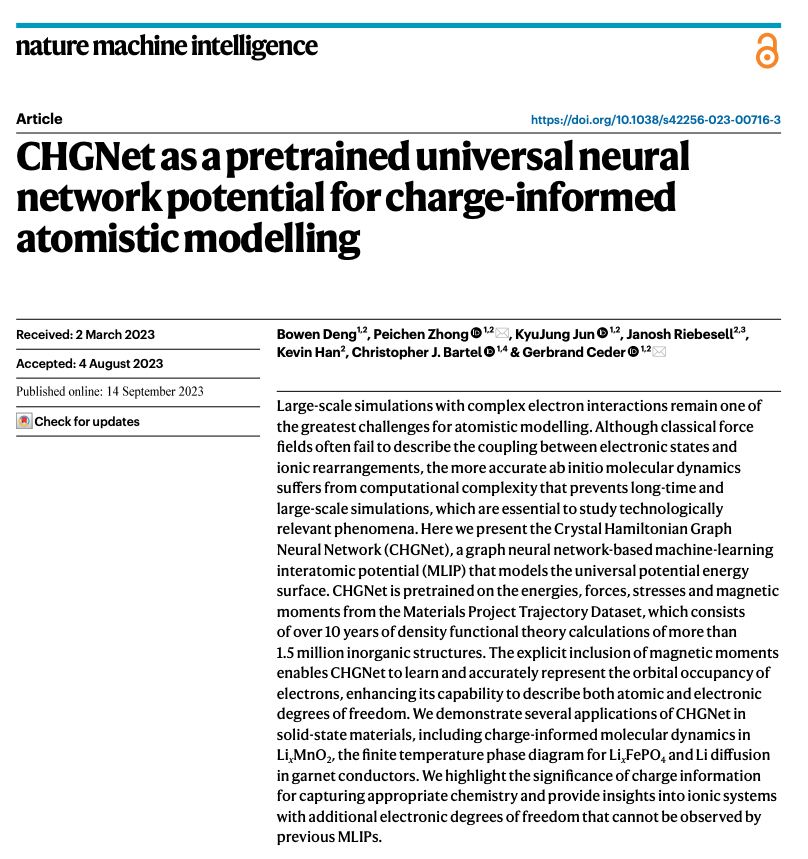
Large-scale atomic simulations involving complex electronic interactions have always been one of the biggest challenges in atomic modeling. Classical force fields are often unable to describe the coupling between electronic states and ion spatial arrangements, and more accurate first-principles molecular dynamics cannot be applied to long-term and large-scale simulations due to computational complexity. Extending the microscale accuracy of electronics to the macroscale is an extremely important but difficult to achieve problem for the development of science and industrial technology.
Ceder's research group recently proposed a pre-trained universal atomic force field based on graph neural network machine learning atomic potential (MLIP): Crystalline Hamiltonian Graph Neural Network (CHGNet).CHGNet is pre-trained on the Materials Project material database, which has accumulated more than ten years of first-principles calculations and a density functional theory trajectory data set of more than 1.5 million inorganic crystal structures. CHGNet uses magnetic moment information to regularize the charge degrees of freedom on atoms, enabling it to learn and accurately represent the orbital occupation of electrons and enhance the description of atomic and electronic degrees of freedom by graph neural networks. This work was recentlyPublished in Nature Machine Intelligence, The article demonstrates the application of CHGNet in the research of solid materials, especially lithium battery energy storage materials.
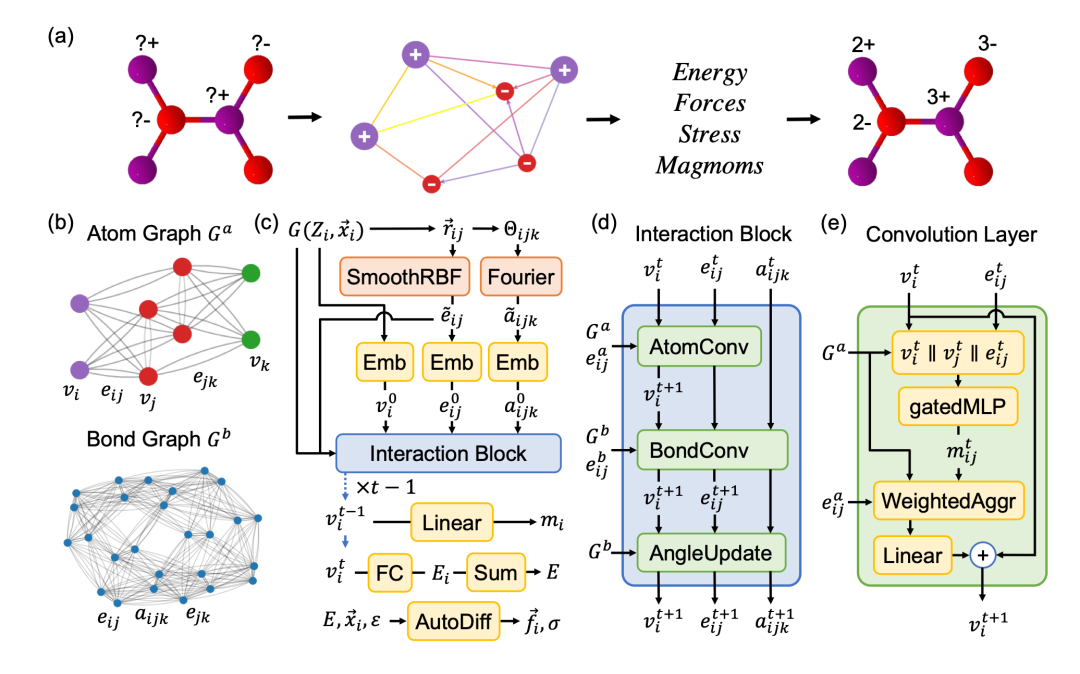
The basic framework of CHGNet is a graph neural network (GNN), which ensures the invariance of translation, rotation and arrangement by using graph convolution layers in the node graph to propagate spatial and chemical information between atoms. In the CHGNet workflow, a crystal structure is first converted into an atomic graph (Atom Graph) and a chemical bond graph (Bond Graph). In an atomic graph, atoms serve as nodes and bond lengths serve as edges; in a chemical bond graph, chemical bonds serve as nodes and the angle between two bonds serves as edges. Under such feature representation, CHGNet can directly learn the two-body and three-body interactions in atomic systems. By stacking the atomic graph convolution layer, the chemical bond graph convolution layer, and the bond angle update layer to form the atomic interaction layer (Interaction Block), CHGNet can simulate multi-body interactions between atoms up to 20A. When the penultimate atom acts on the layer, CHGNet linearly projects the hidden space vector of the atom onto the magnetic moment of the atom, making the magnetic moment of the atom a model output value. After the last atom acts on the layer,CHGNet calculates the energy of the crystal through nonlinear projection of atomic vectors, and obtains atomic forces and stresses through automatic differentiation of atomic coordinates and unit cells.
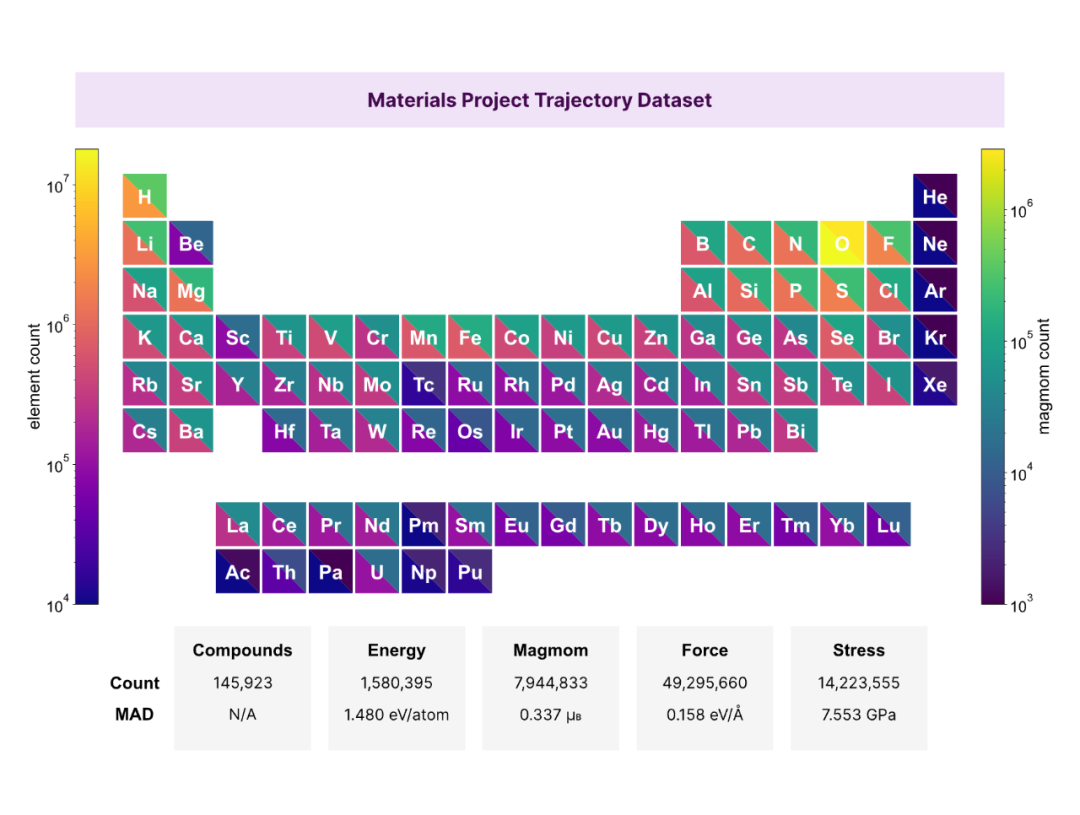
Figure 2 of the original text shows the Materials Project trajectory (MPtrj) database used for CHGNet pre-training.The database contains 1.58 million density functional theory calculations accumulated over more than ten years, including energy, atomic magnetic moment, atomic force, and stress information for more than 140,000 materials and 89 elements.Figure 2 shows the frequency of occurrence of each element and the charge information it contains. This dataset is currently the largest open source database of inorganic crystal potential energies.
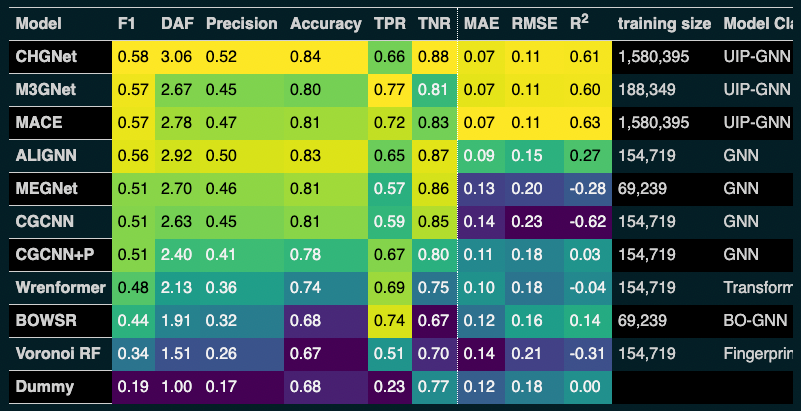
In the benchmark test of machine learning potential, the pre-trained CHGNet achieved an F1 score of 0.58 on the Matbench Discovery new material research and development task.It has achieved the best results surpassing all previous models and is the best pre-trained deep potential energy function so far.The author also welcomes and encourages workers in the field to submit the pre-trained potentials being developed to the Matbench Discovery platform for benchmark testing to jointly advance the development of machine learning potential functions. The author also demonstrated the reliability of CHGNet molecular dynamics in the supplementary material, and reproduced the solid-state lithium battery electrolyte found by first-principles molecular dynamics simulations.
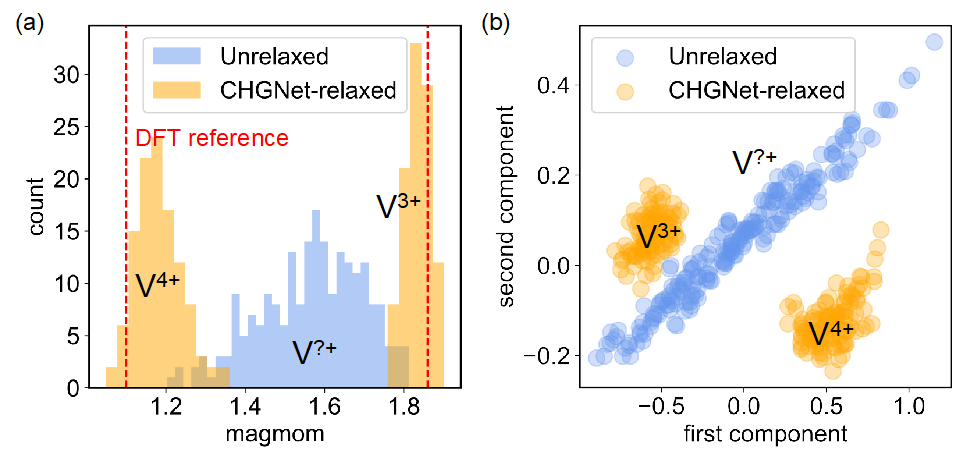
In addition to demonstrating the reliability of CHGNet as an atomic potential energy, this article emphasizes the importance of ion valence states in chemical reactions and the necessity of representing ion valence states in machine learning potential energy. For example, for the same transition metal element, the interactions of ions with different valence states in the ionic system are very different, almost equivalent to different elements. But in traditional potential fields and machine learning potentials, they are considered the same category and parameterized equally. This not only leads to our lack of complete representation of multivalent ions, but also prevents us from learning valence changes and charge transitions in ionic systems.
The magnetic moment of an atom, which is the integral of the electron spin density, is determined by the occupation number of electron orbitals. Therefore, elements with different valence states often have different atomic magnetic moments in density functional theory. Using this method to distinguish ions with different valence states has been proven in a large number of studies to be used to learn the distribution of ion valence states and the transfer of electrons.The author of this article found that introducing atomic magnetic moments into machine learning potential not only enables CHGNet to describe the degree of freedom of charges, but also strengthens the constraints on ion descriptors of different valence states.
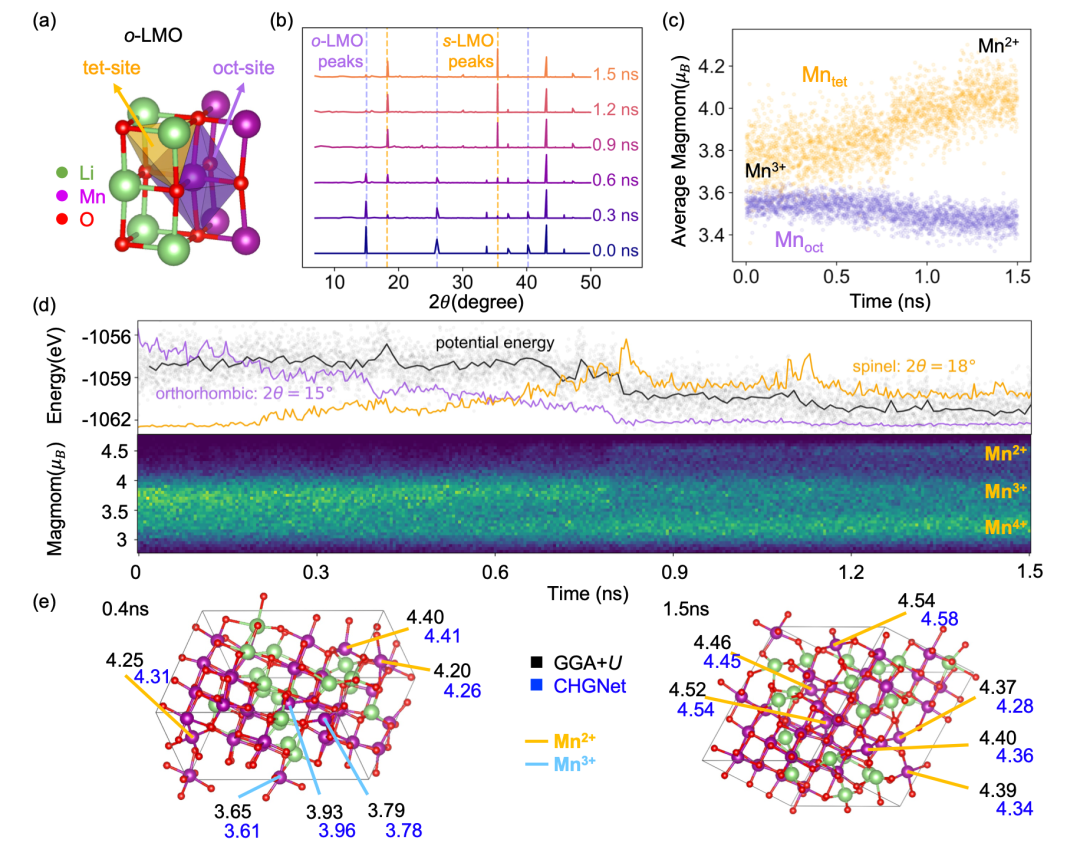
The authors demonstrate the use of CHGNet in lithium manganate (LiMnO2) Application in cathode materials. As early as the 1990s, scholars discovered that the lithium manganate cathode material would phase change from the orthorhombic crystal system to the spinel crystal system after electrochemical cycles, resulting in a decrease in battery capacity. The explanation of this phenomenon has been controversial, and one of the widely accepted hypotheses is that Mn3+Mn generated by charge disproportionation2+and Mn4+ lead to the phase change reaction. Due to the lack of high-precision, long-term simulation methods, previous research reports believed that Mn2+has a lower transition energy barrier, while the tetrahedral position Mn2+The transition marks the transformation of the spinel phase.The author of this article used CHGNet to directly simulate long-term molecular dynamics simulations with charge information, and observed a phase transition process consistent with the experimental X-ray diffraction spectrum (XRD).And surprisingly, CHGNet molecular dynamics simulations showed that Mn2+The disproportionation generation is not related to the Mn transition, but to the long-range spinel symmetry. The authors verified this finding using first-principles calculations,And thus proposed a new theory of electrochemical phase change of lithium manganate.The discovery marks new opportunities in theoretical materials science brought about by CHGNet's long-term charge simulations.
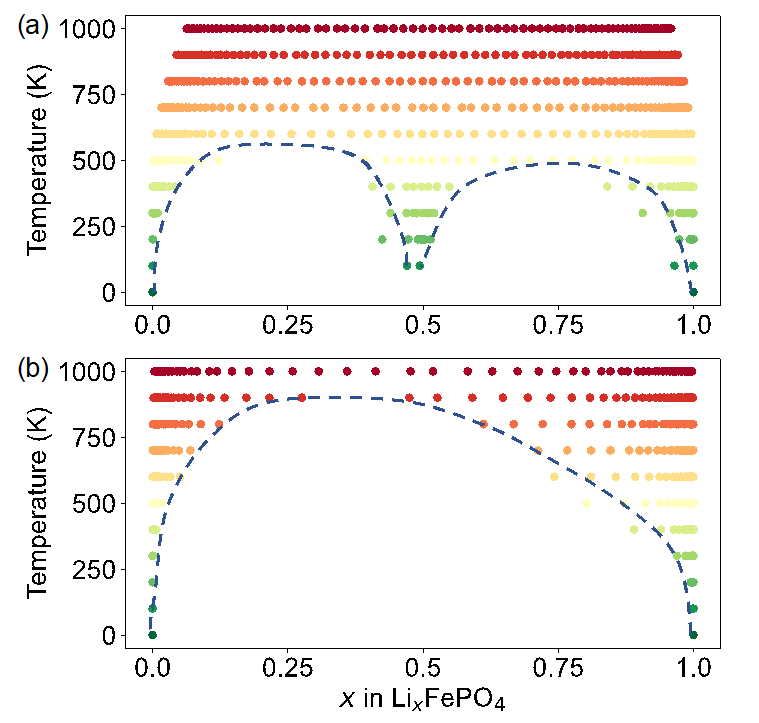
In addition, Figure 5 shows CHGNet’s phase diagram simulation of lithium iron phosphate cathode material. Relying on CHGNet's representation of divalent and trivalent iron, the author found that CHGNet can reproduce the Li0.5FePO4Metastable phase caused by electron entropy (Fig. 5(a)). However, machine learning potential that lacks charge and valence state representation can only obtain an incorrect single miscibility gap (Figure 5(b)). This case highlights the importance of charge representation in atomistic simulations.
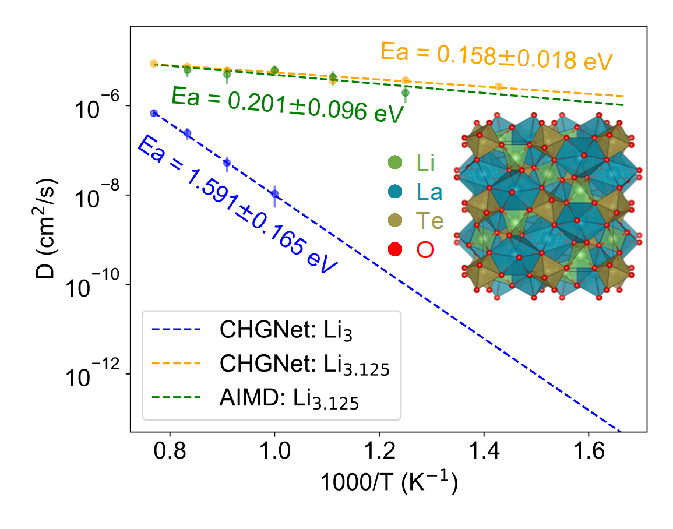
In Figure 6, the author shows the high-precision molecular dynamics simulation of the interaction of complex atoms with pre-trained CHGNet. For Li3La3Te2O12For solid electrolytes, previous studies have found that doping additional trace amounts of lithium ions can increase lithium diffusivity by several orders of magnitude. This phenomenon is called lithium diffusion network activation. In this case, the CHGNet simulation reproduced the phenomenon of a significant increase in diffusivity and a significant decrease in activation energy caused by additional trace amounts of lithium ions. It shows that the pre-trained CHGNet captures and learns the violent nonlinear response of dynamic performance to changes in chemical composition.
In summary, large-scale computing plays a key role in fields such as materials science, medicine, and molecular biology. This article demonstrates that pre-trained CHGNet provides a powerful tool for simulating charge interactions in complex ionic systems, expanding the application prospects of computational science in various fields, especially in the field of energy materials.

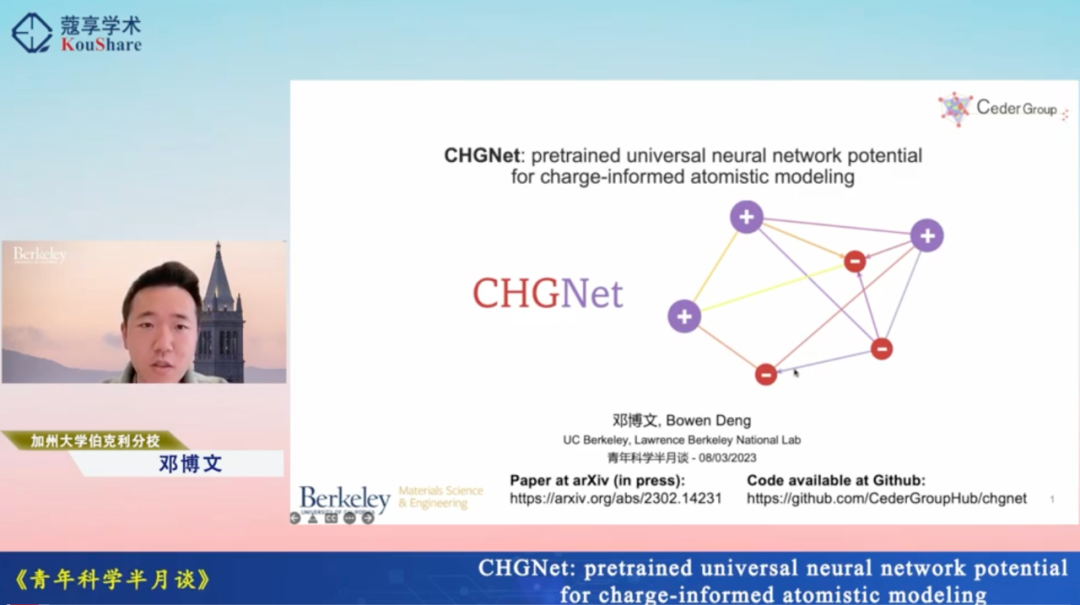
Click on the picture to jump to related videos
"CHGNet: Pre-trained universal graph neural network force field embedding charge information"
- Video playback link:
- Article link:
- Project homepage:
(Please copy the link in the article and open it in your browser)




Conference official website


To serve academics and spread science, the Kouxiang academic team launches scientists’ own professional bookstore - Kouxiang Bookstore

Shuyuan official website
Jump to related links for more details:
[alias alias alias] Kouxiang Bookstore is officially launched
[Kouxiang Bookstore] Nobel Prize-winning "Flowers Fall" Quantum Information, "How Much Do You Know" About Quantum? | Quantum Science Recommended Book List
[Kouxiang Bookstore] New Book Recommendations | A must-read list for entering the field of life sciences--Life Science Masterpiece Series
[Kouxiang Bookstore] New Book Recommendations | China’s 2035 Development Strategy Series for Academic Subjects and Frontier Fields
[Kouxiang Bookstore] Recommended new books on shelves
[Kouxiang Bookstore] Recommended books from the Ministry of Science and Technology’s National Excellent Popular Science Works and China’s Excellent Popular Science Books List
[Kouxiang Bookstore] The most popular book on science and technology in the world among readers
[Kouxiang Bookstore] Recommendations for first-class planning textbooks
Brilliant/Colorful/Review/Review
[Youth Science Seminar] CHGNet: Pre-trained universal graph neural network force field embedding charge information
[Nature Big Release] University of Washington: Observation of the Fractional Quantum Anomalous Hall Effect
【Nat. Commun.】Inherited impairment of parental histones promotes tumor progression
【Nat. Comput. Sci.】USTC develops momentum space carrier dynamics method based on first principles
[Nat. Phys] USTC has made important progress in the study of the electronic nematic phase of caged superconductivity
【Nat. Commun.】Optical chip suppresses broadband radio frequency interference

Koxiang Academic Platform Introduction
Since its establishment, the Koxiang Academic Platform has cooperated with colleagues from many higher scientific research institutes to create well-known academic platforms at home and abroad (includingKou Xiang conference affairs, Kou Xiang bookstore, live video broadcast, quality courses, special lectures, academic conferencesetc.), providing a new academic exchange platform for scientific researchers.

Machine-translated from the Chinese original Ceder课题组最新工作:利用图神经网络构造通用势能函数加速能源材料模拟研发 (published 2023-09-18). WeChat original ↗