How is the study of high school mathematics different from the study of college mathematics? This issue involves the connection between high school mathematics and college mathematics. It is particularly important for freshmen in the School of Mathematics to change their way of thinking as soon as possible and successfully enter the basic courses of mathematics majors (mathematical analysis, advanced algebra and spatial analytic geometry).
Taking advanced algebra courses as an example, there are usually 4 hours of main lessons and 2 hours of exercises per week. In the main class, the teacher will explain the concepts, theorems and theories in the textbook, and gradually build an advanced algebra knowledge system. After class, students review textbooks and do exercises to deepen their understanding of concepts and theorems, and master the preliminary applications of theorems and theories. In the exercise class, the teacher will explain the errors in students' exercises and some typical examples to help students summarize problem-solving methods and techniques.
The above course arrangement is called the foundation stage. On the surface, it is not very different from high school mathematics, but advanced algebra has profound ideological theories and various methods and techniques. Therefore, it is not enough to just stay at the basic stage. To learn advanced algebra well, you must actively enter the improvement stage. This is to choose a high-quality advanced algebra study guide and gain an in-depth understanding and mastery of the important ideas, methods and techniques in advanced algebra through "brushing out questions" after class.
The improvement stage should be the watershed between high school studies and university studies. Different from the "cramming-style" teaching in high schools, university teaching is actually "the master leads you in and practice depends on the individual", with a special emphasis on "independent learning". So, how do you choose an advanced algebra study guide? How to correctly open the "question brushing" method? How to deeply understand and master important ideas, methods and techniques?
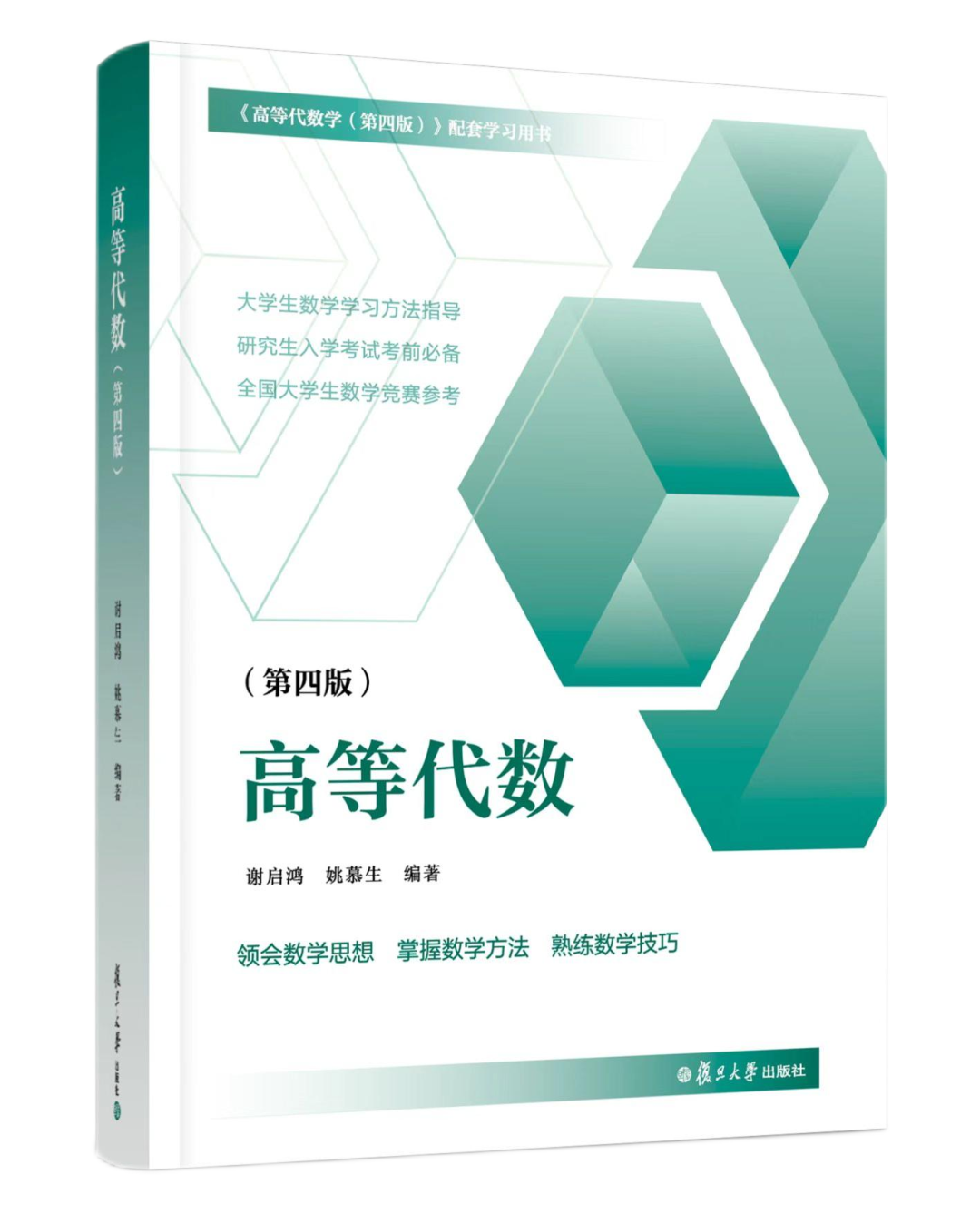
Here I highly recommend the Fudan University Advanced Algebra Study Guide to everyone! It was officially published in 2002 and revised four times in 21 years. It is deeply loved and respected by mathematics students all over the country. Because the cover is white, it is also called the "high-generation white paper". The following will introduce the role of the high-generation white paper in the improvement stage from four aspects.
"Practice method" is more important than "Practice questions"
Common upper-level study guides usually stack a large number of example questions together according to chapter content, highlighting the importance of "brushing questions". This is also in line with the "question sea tactic" in high schools. However, in the division of topics and the selection of examples, the advanced white paper is mainly classified according to methods and techniques. For example, the first section of each chapter is basic concepts, the last section is basic training, and each section in the middle basically describes a method. Therefore, the Advanced Algebra White Paper is not so much about "refreshing questions" as it is "refreshing methods." It emphasizes the important role that ideas, methods and techniques play in advanced algebra learning.
"Summary of methods and techniques" allows everyone to fly higher and see further
The Gaoda white paper pays special attention to the summary of methods and techniques. First of all, at the beginning of each section or in the notes after the answers to some examples, the problem-solving methods and techniques for the same type of problems will be summarized and summarized. Secondly, when talking about large topics, list all the methods first, and then gradually complete them in subsequent chapters. Thirdly, if the content of a certain topic is too large, it will be broken down into several subsections for detailed elaboration. Finally, for particularly important topics, summarizing and expounding with examples often takes no time to spare. Therefore, the summary of methods and techniques in the Gaoding white paper enables everyone to draw inferences from one instance and draw parallels to avoid falling into the tactics of a sea of questions.
"Quality is more valuable than quantity", typical examples connect knowledge pointsand method techniquesA complete summary and application of
The high-generation white paper explains more than 830 typical example questions (not too many), and provides a complete summary of the properties of many important knowledge points, such as §2.6 Adjoint Matrix and §2.7 Properties of Matrix Traces. In addition, although the applications of many important ideas and methods are scattered in various chapters, as long as everyone reads the whole article, they can still be connected and integrated into one. For example, after explaining the principle of the perturbation method in §2.11, 20 applications are given in subsequent chapters.
Another feature of the Gaodao white paper is that it connects the complete application of relevant methods and techniques through a typical example question. For example,
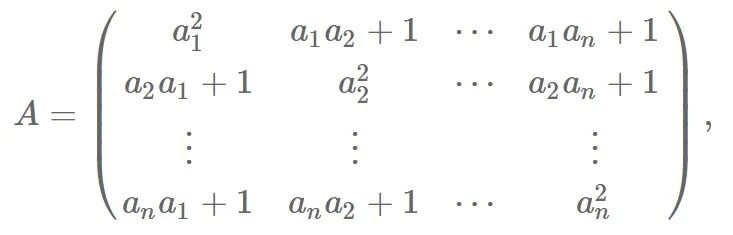
Example 2.67 → Example 3.74 → Example 6.22 → Example 8.9 → Example 8.9 (page 530, obtaining positive and negative inertia indices from characteristic values). The above matrix connects the reduced-order formula of determinant, the reduced-order formula of rank, the reduced-order formula of eigenvalue and the reduced-order formula of positive and negative inertia index.
"Unity of knowledge and action"
Advanced tips for learning advanced algebra
First, let’s talk about how to use the high-generation white paper. Because it is not a set of exercises "for the purpose of solving problems", but a study guide "for the purpose of explaining methods and techniques", it is recommended that you read the Advanced White Paper intensively for the first time, that is, learn the corresponding methods and techniques through typical examples. Some more difficult examples can be temporarily skipped. When reading the Gaoda white paper for the second or third time, you can try to give your own answers to some examples.
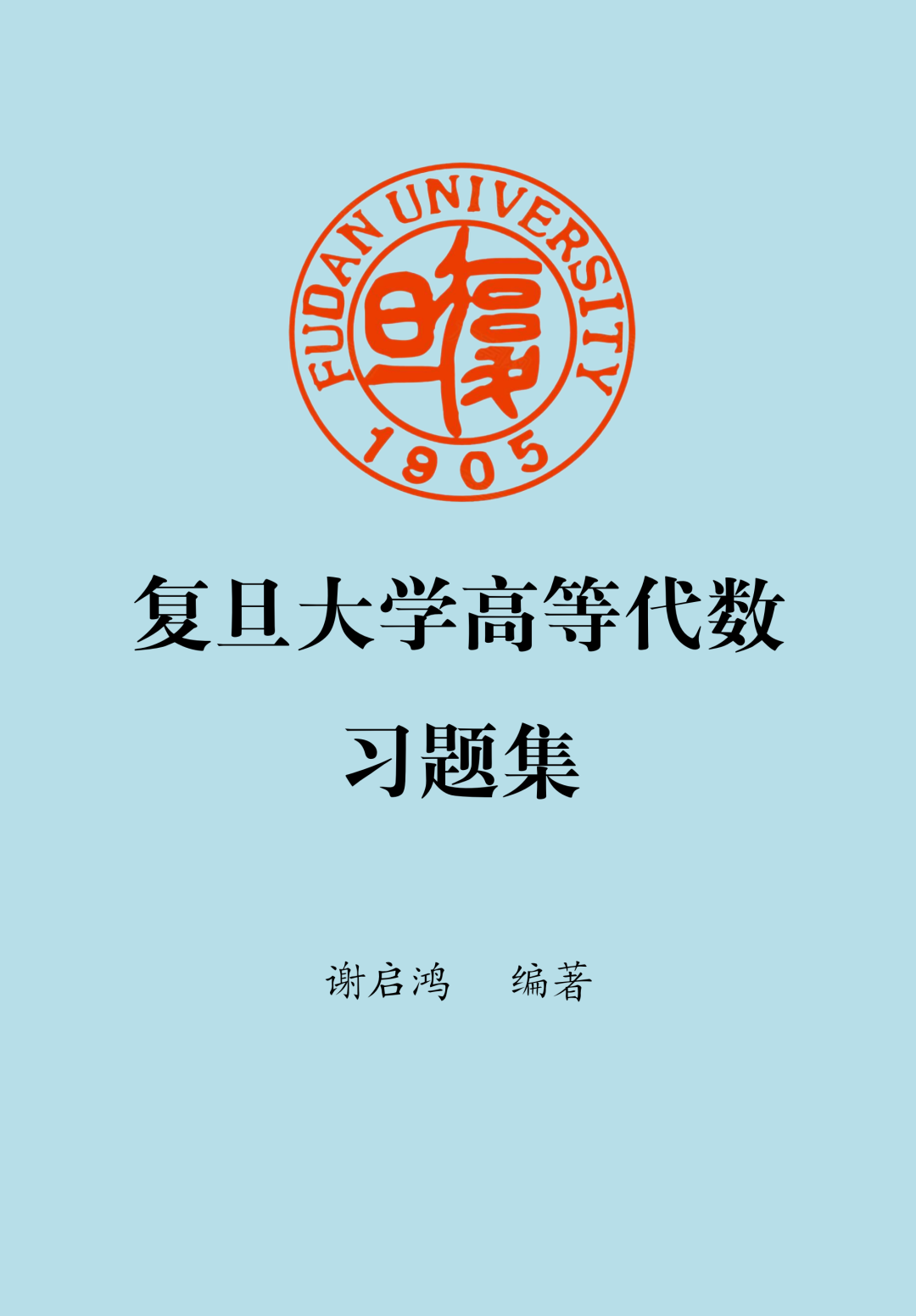
Secondly, proficiency in methods and techniques must be achieved through problem solving. As the mathematician Halmos said: "The best way to learn Mathematics is to do Mathematics", that is, the best way to learn mathematics is to do mathematics. Therefore, after intensively reading the Advanced White Paper, you need to do a certain number of exercises to consolidate. You can do the basic training questions in the advanced algebra white paper, you can also do the previous weekly advanced algebra questions, and you can also do the latest 2023-level advanced algebra weekly questions. It is worth mentioning that the weekly advanced algebra questions, final exam final questions, and midterm exam selected questions from the 2013 to 2022 School of Mathematics at Fudan University have all been included in the "Fudan University Advanced Algebra Exercise Set". You can use it as the exercise set corresponding to the advanced algebra white paper.
Finally, mathematics is a subject that emphasizes the "unity of knowledge and action", that is, solving problems through learning mathematical knowledge, and developing mathematical theories through solving problems. Therefore, "unity of knowledge and action" is also the secret to advanced learning in advanced algebra. I hope you can make good use of the advanced algebra white paper, find a learning method that suits you as soon as possible, and achieve excellent results in the study of advanced algebra!
Machine-translated from the Chinese original 高等代数学习的提高与进阶 (published 2023-09-22). WeChat original ↗