Recently, many young Chinese scholars and students from different cities in China and the United States came to Long Island to visit the author to discuss topological geometry theory and artificial intelligence algorithms. Many students are very interested in fiber cluster representation, surface classification, and the intrinsic representation of geometry. They need to understand the mathematical theories of these issues in their AI research projects. Here, the author briefly introduces the basic mathematical viewpoints on the classification and representation of surfaces, hoping to enlighten everyone.
According to Klein's Erlangen program, different geometries study invariants under different transformation groups. Each transformation group corresponds to a theoretical system that can classify all surfaces. All surfaces in each equivalence class have the same invariants, and the abstract space formed by all equivalence classes is called the modulus space of the corresponding transformation group. The main transformation groups are topological homeomorphism group, conformal transformation group, isometric transformation group and rigid body transformation group.
These groups form a sequence of nested subgroups, and the corresponding theoretical system is
Invariants also increase layer by layer.
surface topology
The topological homeomorphism between surfaces means that there is a continuous bijection, and the inverse mapping is also a continuous mapping. Surface topological invariants include orientability, genus, and number of boundaries. Surface orientability can be understood as the existence of a triangulation in which the vertices of each triangle choose an arrangement such that if two triangles share an edge, the vertex arrangements of the two triangles are constrained to be exactly opposite on this edge. If such a triangulation does not exist, the surface is not orientable. The so-called genus is the number of handles of the surface ring. It can also be understood as the maximum number of cuts we can make when cutting the surface along the loop so that the surface is still connected. This number is twice the genus. Each boundary of a compact surface is a loop, and the number of such loops is the number of boundaries of the surface. Therefore, the topological invariants of the entire system of surfaces are directivity, genus and boundary number. From the perspective of algebraic topology, the surface can be expressed as a simple complex (triangular mesh), and the invariants of the surface topology can be expressed as the basic group of the surface, the simple hypohomology group and the simple cohomology group; from the perspective of differential topology, the surface topology invariant can be expressed as the de Rham cohomology group; from the perspective of Riemannian geometry, the surface topology invariant can be expressed as the harmonic differential form group; from the perspective of Riemann surface theory, the holomorphic differential group on the Riemann surface can be investigated, and so on. The calculation of these group bases is introduced in detail in the course on computational conformal geometry.
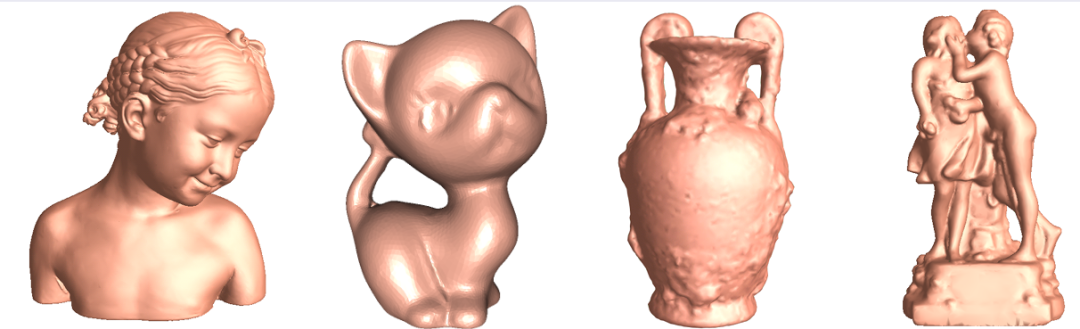
Figure 1. Genus of a surface.
Things get very complicated when we consider the embedding of surfaces in a three-dimensional background space. At this time, we can select a set of typical homology group bases. A closed surface will be divided into two connected branches, the branch with finite volume is called the interior, and the branch with infinite volume is called the exterior. If a loop is homogeneous to zero internally and non-zero externally, the loop is called a ring-stem loop; conversely, if a loop is homogeneous to zero externally and non-zero internally, the loop is called a tunnel loop. There is a unique set of ring-shank rings and tunnel rings, which form the basis of the surface homology group. Ring stem groups and tunnel rings can be calculated using persistent coherence methods. If one surface can deform smoothly to another surface in three-dimensional space, and self-intersection is allowed during the deformation process, then we say that the two surfaces are smoothly homotopic. Assuming a topological homeomorphism, the basis of the fundamental group is , and the corresponding basis is . Each loop on the surface induces a natural frame field: for any point, is the unit tangent vector of the curve, is the normal vector of the surface, . After walking around and returning to the origin, the frame field also walks around, and we get a so-called spin homomorphism. We know that is called spin. If two surfaces are smooth and homotopic, if and only if. If one surface can continuously deform to another surface in three-dimensional space, and self-intersection is not allowed during the deformation process, then the two surfaces have the same trace. Same-trace equivalence is very complex and actually involves kink theory. One way to determine whether two knots have the same trace is to examine the fundamental groups of their complementary spaces in . If the two fundamental groups are isomorphic, then the kink has the same trace. However, determining that two non-Abelian groups are isomorphic is essentially an NP-hard problem. Another idea is to assign a standard metric to their complementary spaces, such as a hyperbolic metric. If the complementary spaces are equidistant, then the kink has the same trace. You can also examine the hyperbolic volume of the complementary space. If the volumes are the same, the two kinks are very likely to have the same trace. From a practical application point of view, the most effective method is to calculate the Jones polynomial and then compare the two polynomials.
conformal geometry
For topologically equivalent surfaces, we can further distinguish them by using the conformal transformation group. A diffeomorphism is said to be a conformal map if there exists a function such that
Intuitively speaking, for any two intersecting curves above that intersect at a point, the intersection angle of the tangent vector of the curve at the point is, and its image intersects at the point, and the intersection angle is also, that is, the mapping keeps the angle unchanged (conformal). Conformal geometry is far away from people's daily experience, and it is not easy to establish intuition, but it determines many physical phenomena. For example, the temperature distribution of a curved surface in the thermal equilibrium state, the distribution of the electric potential in the electromagnetic equilibrium state, the equivalent resistance of the curved surface, etc. are all determined by its conformal structure. According to the conformal structure classification, complex topological surfaces can be divided into very fine details.
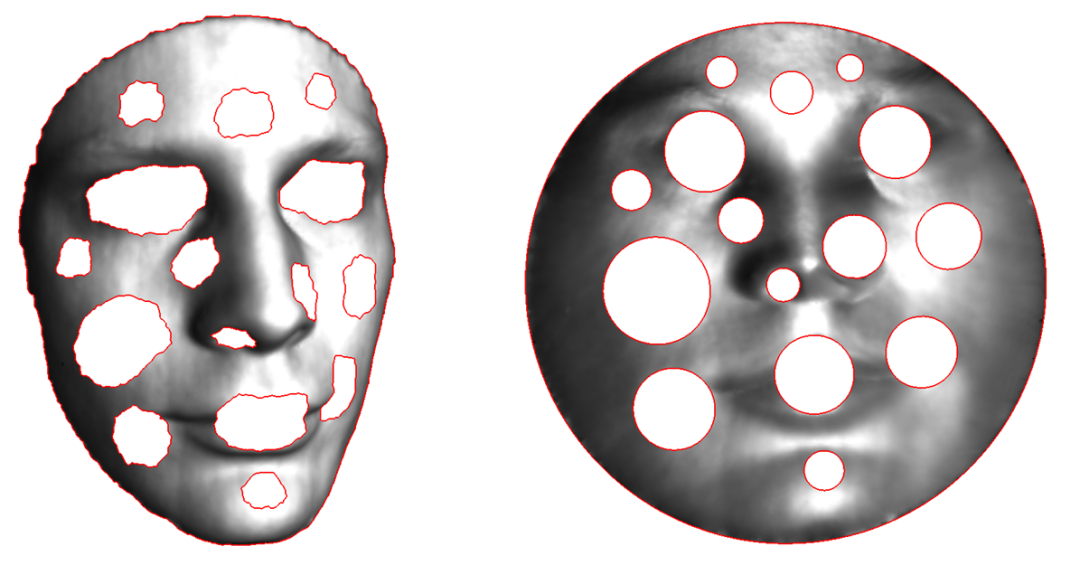
Figure 2. Surface conformal invariant.
Two surfaces are conformally equivalent to each other if and only if they have the same conformal invariants. There are many ways to calculate the conformal invariants of surfaces, such as periodic matrices. All orientable metric surfaces with zero genus are conformally equivalent to the unit sphere, and therefore cannot be directly distinguished in terms of conformal structures. For closed metric surfaces of genus, we can calculate the basis of the fundamental group and the basis of the holomorphic differential group, and construct a periodic matrix
With an appropriate choice of the basis of the fundamental group, surfaces are conformally equivalent if and only if their normalized periodic matrices are equal to each other. Here, calculating the holomorphic differential requires Hodge decomposition, which is equivalent to solving the Poisson equation on the surface. It is explained in detail in the computational conformal geometry course.
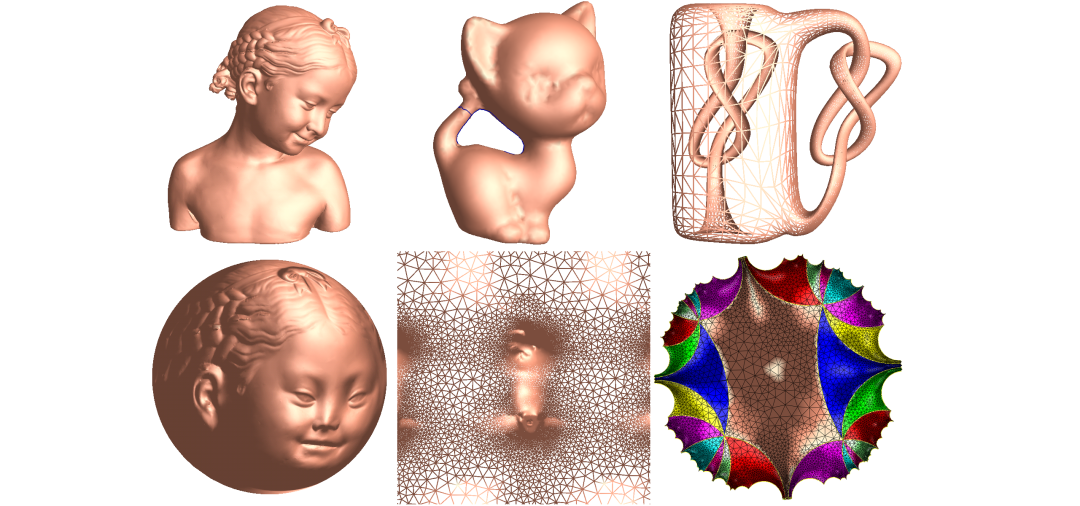
Figure 3. Surface unitization.
A more general method for calculating conformal invariants comes from the singularization theorem. For any compactly orientable metric surface, we can find functions such that the metric induces a constant Gaussian curvature, constant one of , which is equivalent to solving the Yamabe equation:
Here is the Gauss curvature, the target curvature, and the unknown conformal factor function. The Yamabe equation is strongly nonlinear, and the traditional finite element method is unable to solve it. Currently, only the Ricci flow method can solve it.
Ricci flow is a classic method of geometric analysis and was once used to prove Poincare's conjecture. The Ricci flow itself is a gradient flow of a certain energy and can be calculated using convex optimization. In the computational conformal geometry course, we provide detailed theoretical proof and algorithm description of Ricci flow on discrete surfaces. Assuming that the surface is genus, the universal covering space of the surface is, the projection mapping is, and the deck mapping of the universal covering space is an automorphism that keeps the projection mapping unchanged. All deck mappings form a group, isomorphic to the fundamental group of surfaces. Assume that the single-valued metric of the surface is the hyperbolic metric and the Gauss curvature is. We match the universal overlapping space of the surface with the hyperbolic metric and embed it equivalently on the hyperbolic plane. At this time, the deck mapping group of the universal overlapping space is a subgroup of the hyperbolic plane isometric transformation group, which is called the Fuchs group. Assume that the fundamental group of the surface is
Then the corresponding Fuchs group is
These are all Moebius transformations,
Here, each Möbius transformation requires 3 parameters to express, and there is a limit. At the same time, for any Möbius transformation, it constitutes an equivalent representation of the Fuchs group. Therefore, for a closed surface with a genus of , its conformal invariant requires 3 parameters. For a compact surface with boundaries, it is conformally equivalent to digging out several geodesic circles from a constant curvature surface, which is represented by the Fuchs group generator, plus the center and radius of the geodesic circle.
For any given metric surface, for any given point on the surface, there is a neighborhood on which the isothermal parameters can be taken, so that the Riemannian metric is expressed as. The atlas composed of such isothermal parameter coordinate cards is called a conformal atlas of the surface, which is also the conformal structure of the surface. A surface with a conformal structure is called a Riemann surface. Given the sum of two Riemann surfaces, a differentiable map has a local representation, and the map satisfies the so-called Beltrami equation:
It is called Beltrami differential here, and its module represents the distortion of the conformal structure caused by mapping. The smallest one is called a Teichmuller map. Classical quasi-conformal geometry theory asserts the existence and uniqueness of Teichmuller maps.
Fixed surface topology, if we regard each conformal equivalence class as a point, the abstract space composed of all conformal equivalence classes is called Teichmuller space, its dimension is, and the topology is a simply connected topological disk. Any point in this space is a Riemann surface, and there is a Teichmuller map between the two points. The module of the Beltrami differential of the Teichmuller map is called the Teichmuller distance between the two points. This means that Teichmuller space has a Riemannian metric and we can measure the distance between different surfaces. The computation of Teichmuller maps is strongly nonlinear and is currently not common. Whether Teichmuller space can be used as a practical shape space is still in the process of exploration.
Isometric and rigid body transformation classification
Conformally equivalent surfaces can then be distinguished using isometric transformations. If it is an isometric mapping, the pullback metric is equal to the initial metric
For any pair of points, the geodesic connecting them is , then the geodesic connecting and is equal in length. For any region, the areas are equal. Gauss curvature is determined by the Riemannian metric of the surface, so the Gauss curvature at corresponding points is equal. The Laplace-Beltrami operator of the surface is, and its characteristic roots and characteristic functions are:
The spectrum of a curved surface is, and if the spectrum is equidistant, the spectrum is the same. The heat kernel of the surface is
Surfaces are equidistant if and only if their thermal cores are equal. This means that the heat diffusion process is the same on equidistant surfaces, etc.
If it is a Riemannian surface, (if it is a genus, it can be expressed as), its Riemannian metric can be expressed as a single-valued metric multiplied by a conformal factor, so the Riemannian metric is represented by a function. Equivalently, for a fixed conformal structure, the Riemannian metric and Gauss curvature of the surface determine each other.
Isometric surfaces may be embedded differently in , and they can be further classified by rigid body transformation groups. We say that two surfaces embedded in are equivalent to each other if they can coincide through rotation and translation. The classical differential geometry theory of surfaces asserts that if the average curvatures of equidistant surfaces are equal and the boundary conditions are the same, they differ from each other by a rigid body transformation. At this time, the average curvature and conformal factor are not independent of each other, but need to satisfy the Gauss-Codazzi compatibility equation.
The Hausdorff distance between surfaces is defined as follows: We thicken the first surface along the positive and negative directions of the normal vector to form a shell-like structure to accommodate the second surface, and obtain the minimum thickness; similarly, we thicken the second surface along the positive and negative directions of the normal vector to form a shell-like structure to accommodate the first surface, and obtain the minimum thickness; the largest of these two minimum thicknesses is called the Hausdorff distance between the two surfaces. Measuring the Gromov-Hausdorff distance between surfaces is to examine all possible surface equidistant embeddings and then select the one with the smallest Hausdorff distance. According to the geometric approximation theory, the Hausdorff distance is a very weak measure. We can construct a series of discrete surfaces. The Hausdorff distance converges to a smooth surface, but the surface area element, Laplace-Beltrai operator, geodesic, Gauss curvature, and average curvature do not converge. Therefore, the Hausdorff distance is not a strict surface measure. At this time, we need to consider the Hausdorff distance between the unit normal bundle (normal cycle) of the surface. Convergence under this metric can ensure the convergence of various curvature measures and the Riemannian metric.
Summary
At this point, we can write down all the invariants of the surface, which is also a complete description of the surface: (orientability, genus, boundary number), (generators of the Fuchs group, geodesic center and radius), (conformal factor or Gauss curvature), (average curvature).
Of course, mathematical descriptions do not completely coincide with human intuitive experience. Topological geometric theory can reach a depth and breadth that intuitive experience cannot reach, but it does not meet human psychological expectations. How to get close to application scenarios requires bold business imagination and hard engineering efforts.
Machine-translated from the Chinese original 浅议曲面分类的数学基础 (published 2023-11-06). WeChat original ↗