
I often see various jokes on the Internet promoting Huawei's hiring of consulting companies. Because of Huawei's success, many companies today hire real Huawei, fake Huawei, and consulting companies and consultants who claim to understand Huawei to learn from Huawei. I often say that most companies cannot learn from Huawei by learning from consulting companies, because they lack Huawei's critical thinking to transform external consulting services into their own organizational capabilities.
When business owners buy consulting services, they either do not follow the advice of the consulting firm and regard the consultant as a "master", or they treat the consulting company consultant as a secretary who writes speeches for him or a coolie who writes operation manuals. No matter what the situation is, he always struggles with whether what the consulting company says is right or wrong.
In my opinion, as long as there is no deviation from the facts, what the consulting company talks about does not matter whether the theory is right or wrong; what is important is whether the business owner has the ability to distinguish right from wrong, knows what he wants, and knows what to get from the consultant.
A few days ago, a friend said: "If my son went to school and the teacher said 1+3 equals 5, I might have to file a complaint. But in the MBA class, a few years ago the teacher analyzed GE's legendary CEO as a success story. Now, if Welch is not mentioned as the root cause of GE's decline today, and we start to study it based on failure cases, will anyone complain to the teacher who originally analyzed this case as a success case?"
What my friend said actually happened in reality. My middle school Chinese teacher always pronounced the word "galloping" in the word "galloping the battlefield" as chi ping in class. My parents didn't go to the principal to complain about the teacher at that time. My Chinese scores in the college entrance examination were also good. To this day, I am still very grateful to my Chinese teacher. Of course, Mr. Guo’s writing style for public accounts is not good, and he often offends all the revolutionary young generals and gangsters when he fails to express his ideas. We must have found the reason.
Consultants are teachers of enterprises. How do you learn from your teacher? Do you obey every word of the teacher, or do you use your own brain, heart and hands to explore in practice under the leadership of the teacher?
A few weeks ago, I had dinner with an old Huawei person. When talking about the way Huawei cooperates with consulting companies, he himself participated in many consulting projects while working at Huawei. He told me that every time after the consulting company made suggestions, Huawei people spent a lot of time discussing the content of the consulting company, cross-comparing, thinking about the logic of the consulting plan, and then deciding what to do.
I have always said that almost no Chinese companies can learn Huawei's R&D management system IPD. Although Huawei's IPD was learned from IBM, the operation form is almost the same on the surface. However, why has Huawei become the most innovative technology company in the world today, while IBM continues to struggle on the road to transformation?
In "Authentic IPD | IBM's Integrated Product Development (IPD) Practice (1)", I have translated the background of IBM's IPD changes disclosed by IBM's IPD Chief Business Architecture in the late 1990s: In the mid-1990s, IBM carried out company-level process reengineering under the leadership of Gerstner. The purpose was to find ways to reduce the company's sales expenses, administrative expenses, and R&D expenses without weakening the company's market growth and innovation capabilities. These changes caused IBM's sales and administrative expenses to account for a steady decline in the company's operating income from more than 30% in the early 1990s to about 21% in the late 1990s. In terms of R&D, IBM's R&D expenses accounted for more than 10% of revenue in the mid-1980s and dropped to about 6.5% in the early 1990s. However, it is said that through the implementation of IPD, IBM's increase in new product sales and the number of patents applied for every year were in the 90s. In the late 1990s, it continued to improve year after year, reflecting the obvious effect of cost reduction and efficiency improvement.
Huawei's attitude towards R&D investment is exactly the opposite of IBM's. An old friend who personally participated in the IPD process at Huawei in the 1990s told me: "When Huawei learned IPD from IBM, IBM and Huawei said that IPD can ensure the success rate of product development, thereby reducing R&D investment. Huawei also felt that its previous R&D investment seemed a bit unreasonable, but considering the characteristics of the industry, it was determined that it would not be less than 10% every year."
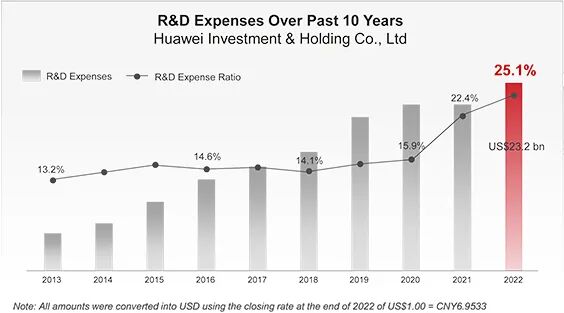
The "Huawei Basic Law" announced internally by Huawei in the late 1990s clearly stipulates the R&D investment policy: "We guarantee to allocate 10% of sales for R&D funds, and will increase the allocation proportion when necessary and possible." Therefore, Huawei learned IPD not to save money on R&D and to ensure R&D output efficiency while reducing R&D expenses, but to continue to increase R&D investment. Judging from Huawei's public financial reports, Huawei's actual R&D investment is more than 10% of operating income. 13~14%. In the unfavorable environment of US sanctions, revenue fell but R&D investment did not fall. By 2022, R&D investment accounted for an astonishing 25%:
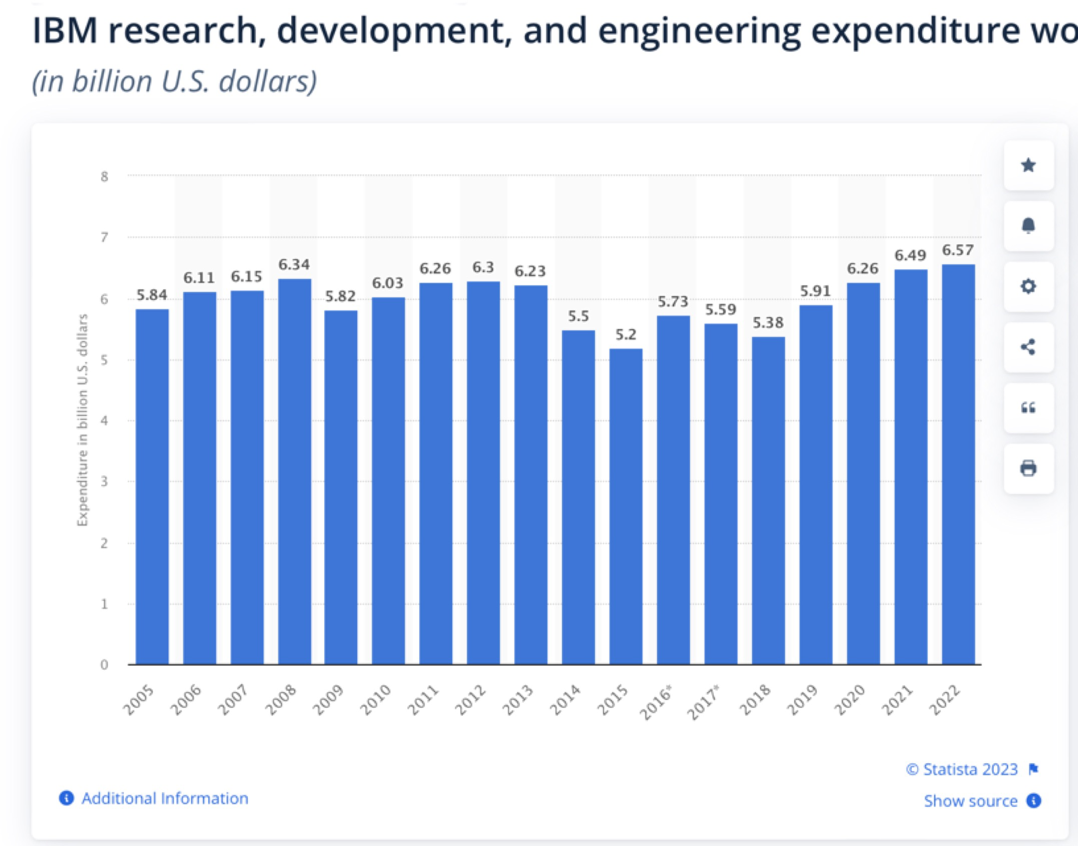
Looking back at IBM, since the implementation of IPD, the proportion of R&D expenses has dropped from 10% to 6%, and has been controlled at this level for decades:
Most domestic companies that are learning IPD have neither large-scale R&D investment nor underlying technical capabilities or product architecture capabilities. Even the industry is vastly different - there are even clothing companies that engage in Huawei IPD. More importantly, they do not learn the basic principles of IPD to form their own R&D management system.
The conclusion is: I think asking for consultation is asking for a teacher. You have to be better than the teacher, so that the consultation money is not wasted. What you learn should be methods and ideas. You have to have a brain, digest what the teacher says, and make it your own. Unfortunately, most companies do not have this quality, so successful companies are always in the minority.
Machine-translated from the Chinese original 咨询的原理 | 为什么华为请 IBM 做咨询会超过 IBM (published 2023-11-13). WeChat original ↗