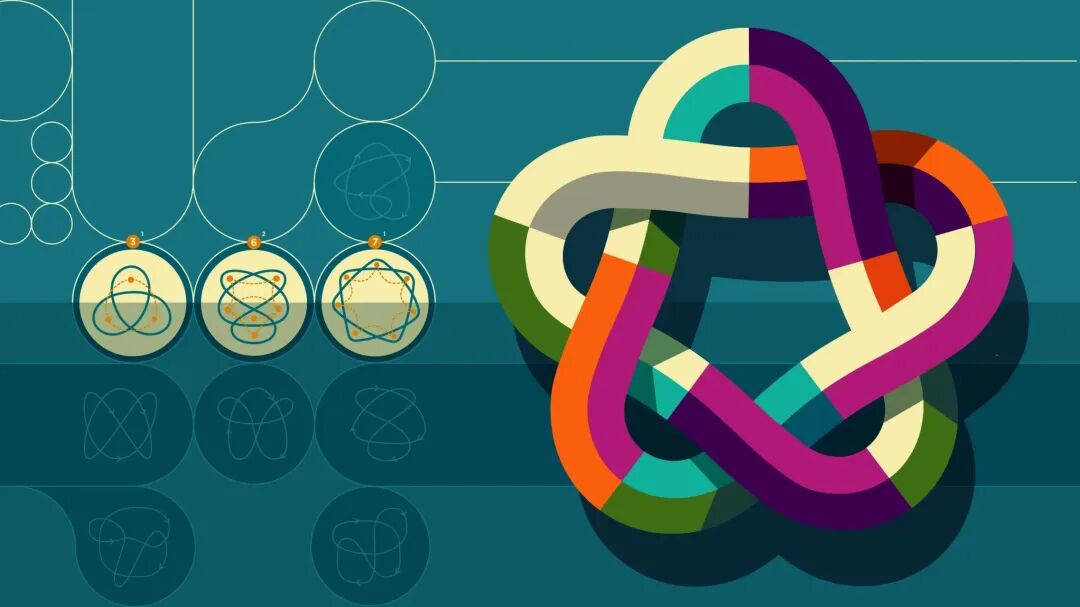
Tying knots with ropes is an essential skill for each of us, such as tying shoelaces every morning, tying bags, men wearing ties, women wearing hairbands, children tying swings to high branches... But sometimes we also need to think about how to tie knots so that they are not easy to loosen, otherwise the consequences may be serious, such as rock climbing knots, sailor knots, and bandaging knots used by medical staff.
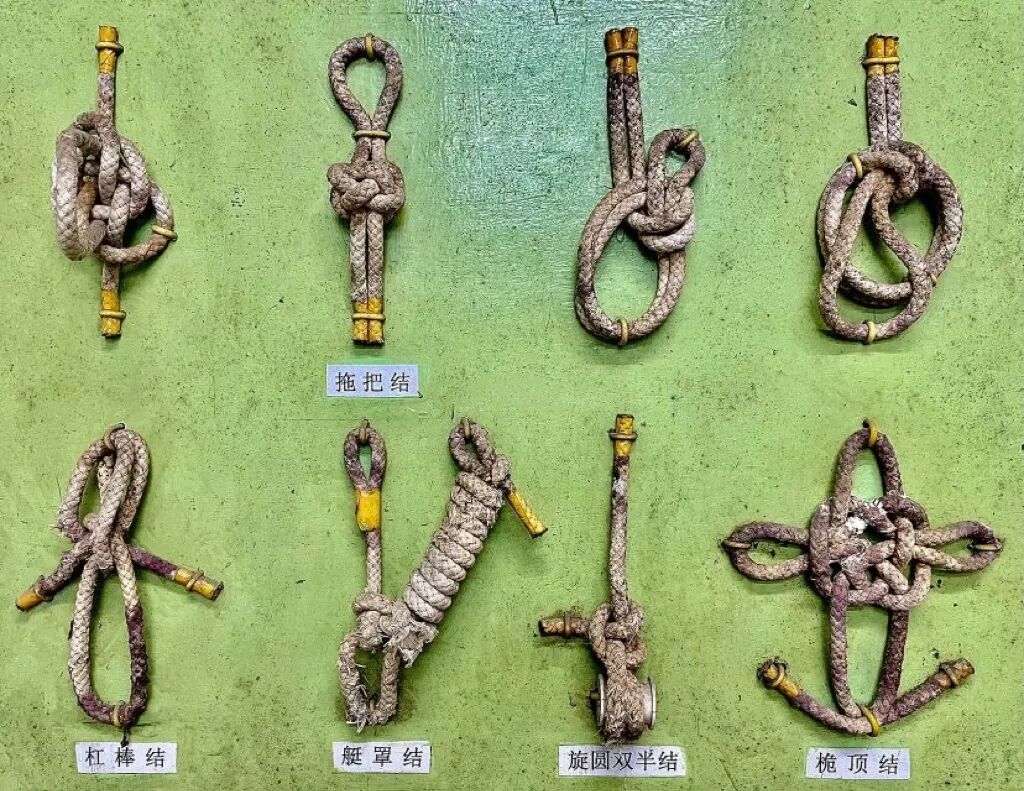
These knots are usually ropes with two ends and can theoretically be untied no matter how they are tangled. But the knots studied by mathematicians are different. They need to tie the two endpoints of the rope together to form a closed circle. Such a knot may not necessarily be untied.
Knot theory began with people's conjectures about the basic structure of the universe. In 1867, Scottish mathematician and physicist Peter Guthrie Tait demonstrated his device for producing smoke rings to his friend and compatriot William Thomson (Lord Kelvin). Lord Kelvin was attracted by the fascinating shape and stability of smoke rings, and he came up with a bold idea: Perhaps just as smoke rings are vortices in the air, atoms are also "vortex rings" knotted in the luminous "ether"! Physicists at the time believed that light propagated through the invisible medium "ether".
The vortex theory gained traction in the scientific community and inspired Tait to start cataloging all possible knots, creating what he hoped would correspond to the periodic table of elements. Unfortunately, in 1887, the famous Michelson-Morley experiment proved that there is no such thing as "ether", and without that medium, Kelvin's atomic vortex theory would not work. However, Tate, already fascinated by the mathematical elegance of the knot, continued with his list project as always. In the process, he created knot theory in mathematics.
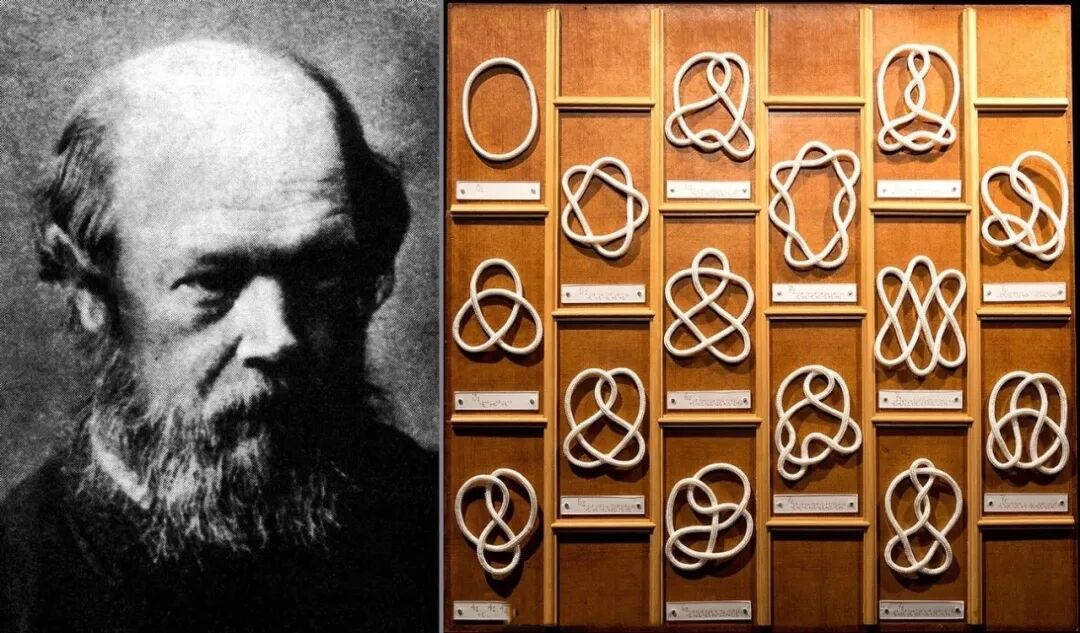
Peter G. Tait (1831-1901), pioneer of knot theory
The knot studied in mathematics is a simple closed curve in three-dimensional space, that is, a connected closed curve that does not self-intersect. A circle is called aknot(knot), multiple circles are called onechain link(link). If a knot is transformed into another knot through continuous deformation in three-dimensional space (no cutting or gluing is allowed), we say that the two knots areequivalent(equivalent), orwith the same marks(isotopic). Knots can be represented by projection diagrams. These projection diagrams must meet the following three conditions:
1. There are only a limited number of overlapping points.
2. Each overlapping point is a secondary point.
3. At each two-point point, the projections of the upper and lower lines cross each other, with the solid line at the top and the dotted line at the bottom.
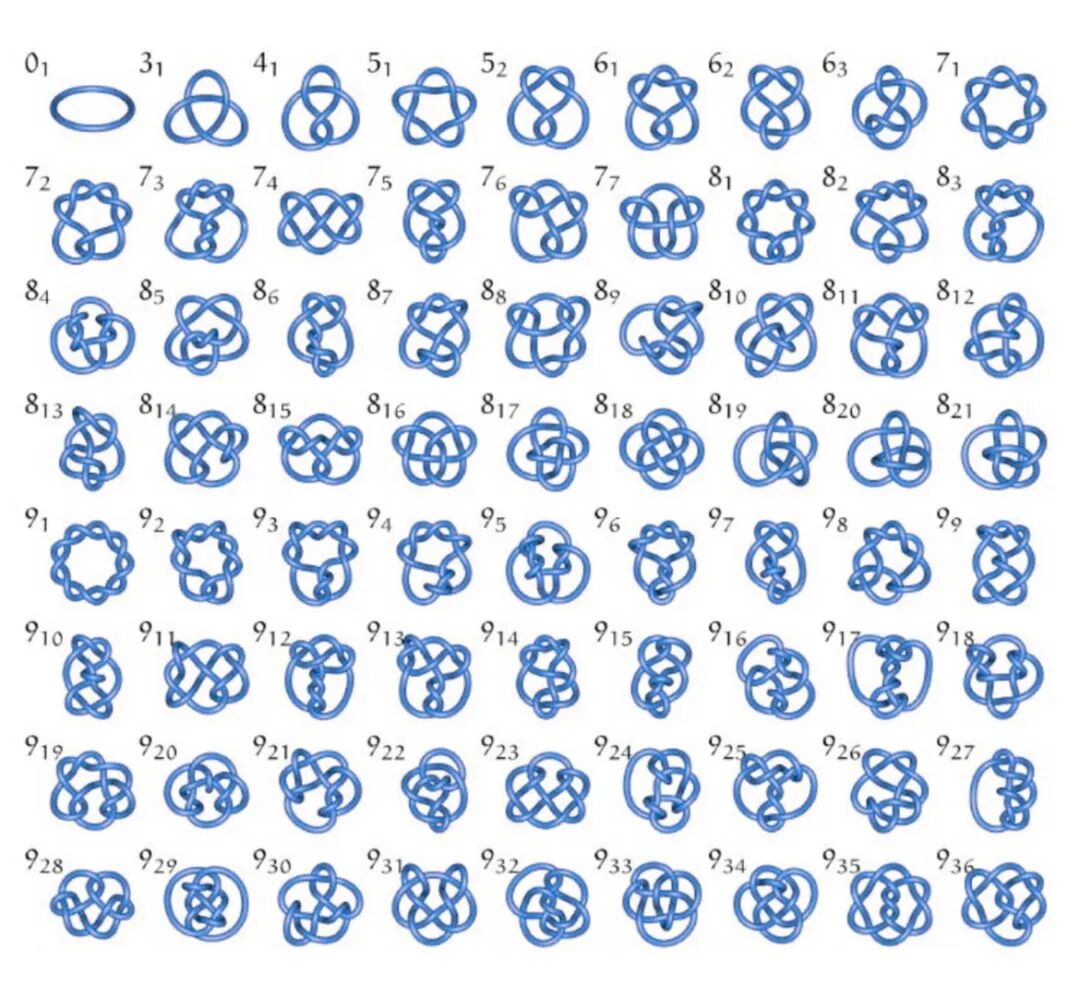
Below are projections of some knots.
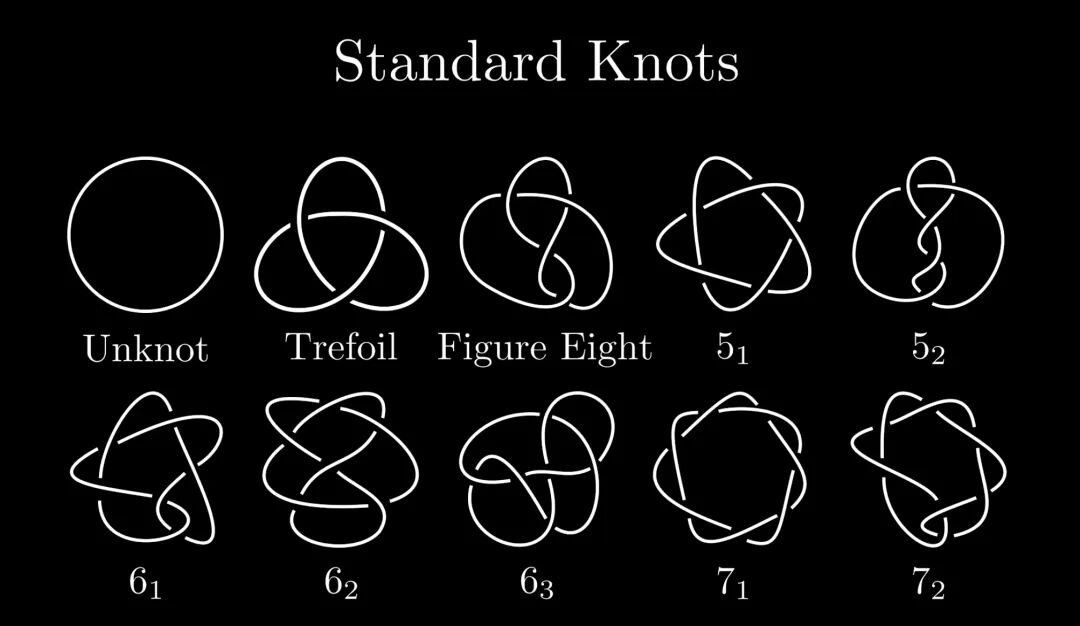
Projection of some knots with intersection number not exceeding 7
The first projection is a circle calledordinary knot(unkont), also called "unknotted" because it is not knotted and the projections do not cross. Of course, you can twist a trivial knot in the three-dimensional space a few times to make its two-dimensional projection have more intersections, but these intersections can also be eliminated by restoring the twist, so its minimum crossing number is 0. We call the minimum crossing number the crossing number, so a crossing number of 0 is a trivial knot, and a crossing number other than 0 is a non-trivial knot.
The second one istrefoil knot(trefoil knot), its crossing number is 3, which is the non-trivial knot with the least crossing number. The trefoil knot is not equivalent to its mirror image. Place a knot between you and a mirror, and the knot you see in the mirror is its reflection. Swap the solid and dashed lines at each intersection to get a mirrored projection. You can't turn a trefoil knot into its mirror image through continuous transformation, just like you can't turn your left hand into your right hand. This is calledChiralityorChirality(chirality), there is a trefoil knotchiral(chiral)。
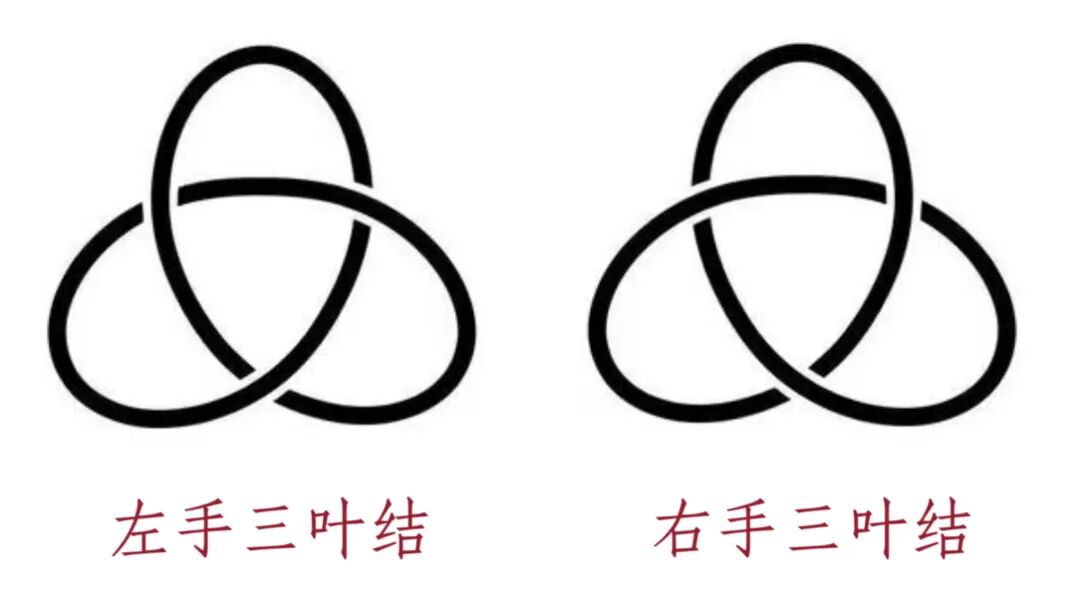
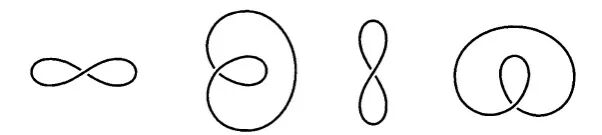
The third one is8 figure knot(figure eight knot), its crossing number is 4. The figure eight knot is equivalent to its mirror image. You can turn a figure eight knot into its mirror image through continuous deformation (more on this later). This is calledChirality(achirality)orChiral(amphichiralty)。
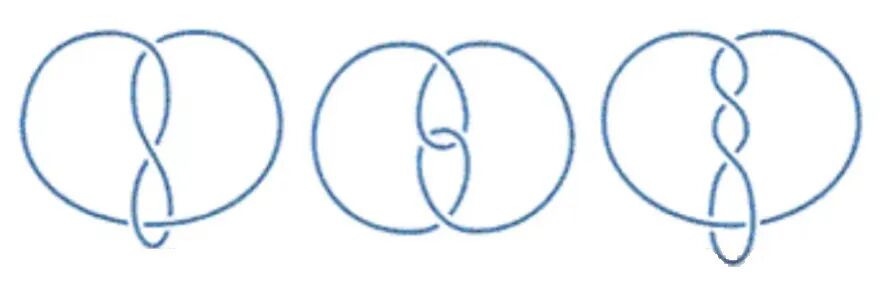
Three projections of the figure 8 knot
One projection represents a knot, but a knot is represented by different projections. It can be seen that in order to use projection diagrams to study knot theory, the prerequisite is to understand how the displacement and deformation of knots in space is reflected in projection diagrams. The German mathematician Reidemeister (1893-1971) summarized and designed three basic transformations of projection images, namelyRydermeister Sports(Reidemeister Moves), other more complex transformations can be spliced together from a combination of these three movements.
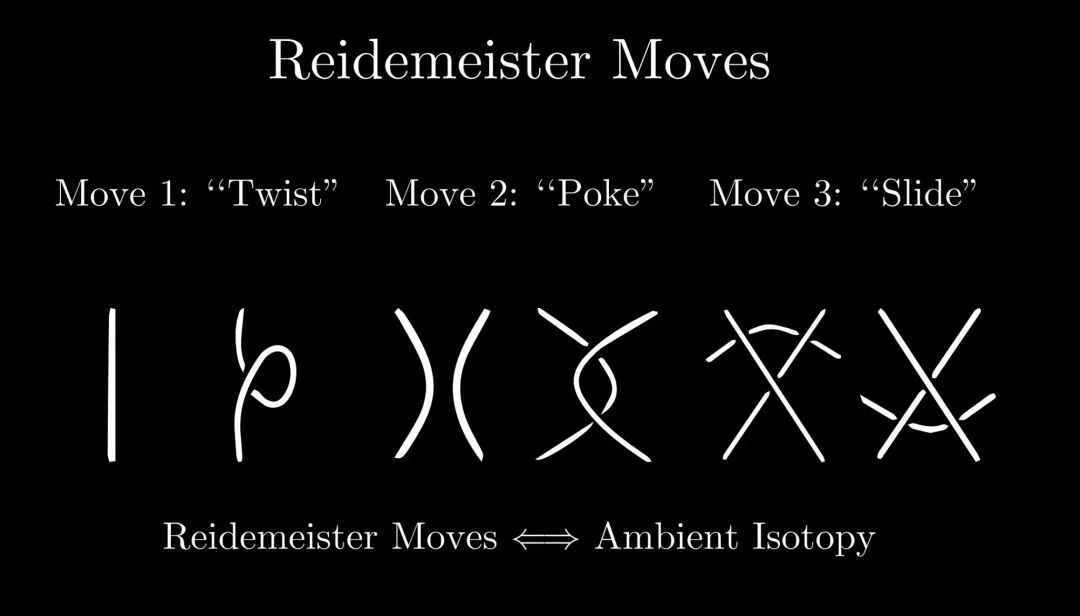
Reidemeister movement
The first movement R1 is called "Twist”, that is, adding a volume to a projection or eliminating a volume.
The second movement R2 is called "Poke”, pull one line under another to form a superimposed diagonal, or pull it out from under another to eliminate a superimposed diagonal.
The third movement R3 is called "Slide", let a line slide under the two lines and pass through the intersection, and consider the relative motion of other line segments. This actually also includes the situation of sliding on or between the two lines.
Under the definitions of the above three types of motion, Reidemeister proposed a theorem in 1927: Two knots are called equivalent, that is, ambient isotopic, if and only if there is a planar isotopy, and a series of Reidemeister motions can transform the projection of one knot into the projection of another knot.
There are a few mathematical concepts that need explaining here. In topology, a knot is an embedding of the circumference S¹ into the three-dimensional space R³, which is a simple closed curve in the three-dimensional space. Three-dimensional space is its surrounding space. The entire process of continuous deformation of knots in three-dimensional space is called homotopy, that is, the continuous transformation of mapping. However, we require that knots cannot be cut or glued during the deformation process. This requires that the mapping at each moment (i.e., section) is a homeomorphism, that is, a continuous bijection. In this way, multiple points cannot be torn or compressed into one point. Homeomorphism is also called topological equivalence. equivalence), ensuring that the knot maintains the invariance of the topological structure throughout the deformation process. This special homotopy is called ambient isotopy, or isotopy for short. The isotopy is equivalent to a single-parameter homeomorphism family. Similarly, in two-dimensional space, the continuous deformation of curves while maintaining the same topological structure is called planar isotopy. Therefore, planar isotopy does not change the number of intersection points in the knot projection diagram.
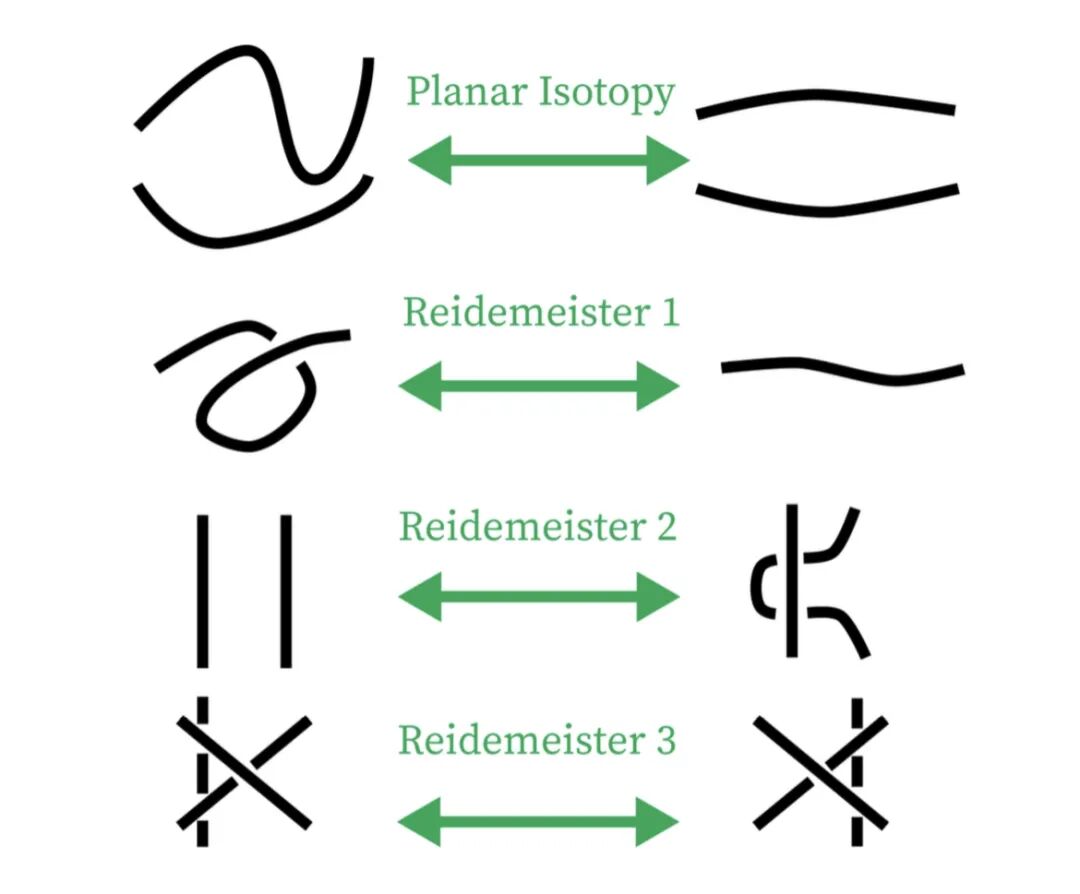
Plane homotrace and three Reidemeister movements
What is the relationship between the same traces in the plane and the same traces in the surrounding space? If there is a plane trace between the projections of two knots, then there must be a trace in the surrounding space between the two knots; conversely, it is not true. The plane projections of two knots surrounding the trace in the space can change the number of intersections. These are not plane traces, but they can be decomposed into a series of Reidemeister motions. Plane co-marking is a very ordinary motion, and we are mainly concerned with the relationship between non-trivial motion and knot co-marking. Therefore, it can be said that the kink's co-marking deformation is essentially characterized by three Reidemeister motions. In this way, the knot in the three-dimensional space is reduced to a two-dimensional projection plane for study.
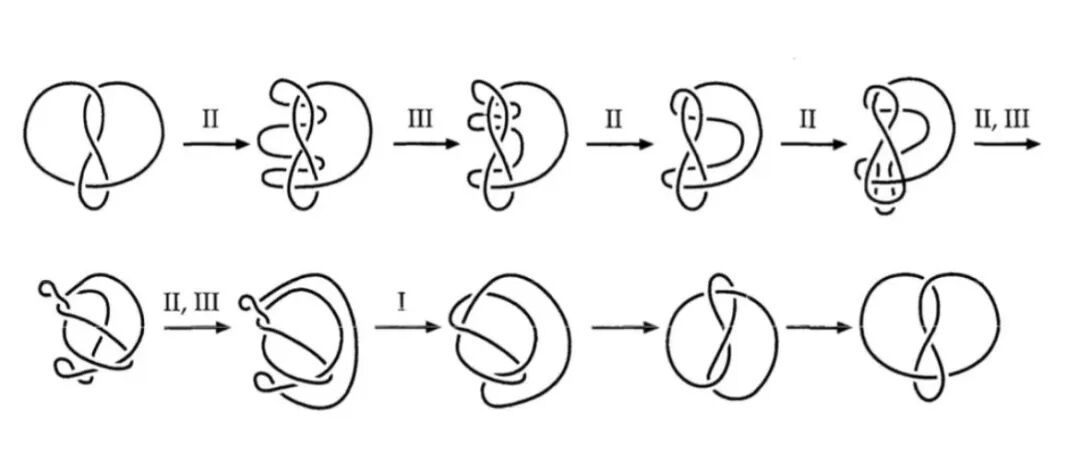
Earlier we mentioned that the figure-eight knot is equivalent to its mirror image. According to the Reidemeister theorem, there must be a series of Reidemeister motions that transform the projection of the figure-eight knot into its mirror image, as shown in the following figure:
connected and
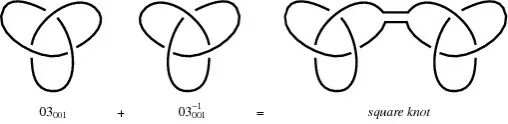
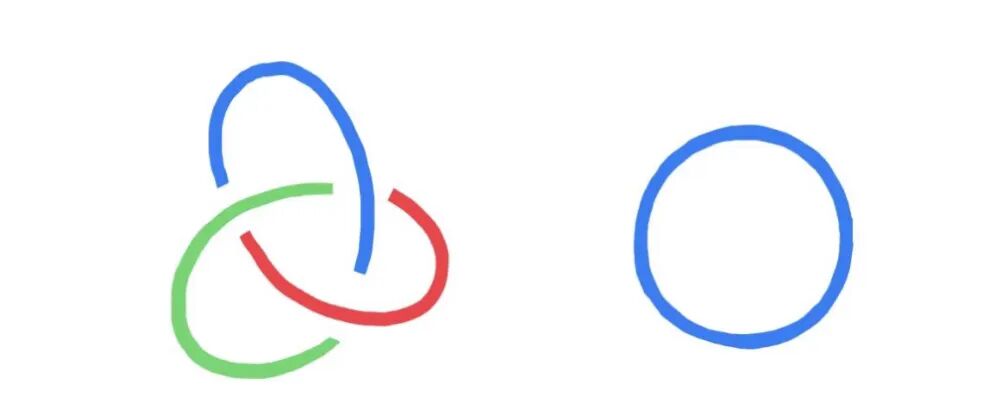
Trichromacy shows the trefoil knot is extraordinary
Trichromatism is a homotrace invariant, that is, this property remains unchanged under Reidemeister transformation (this can be proved by analyzing several situations of color configuration). The projection of the trefoil knot is three-color, but the projection of the ordinary knot is not three-color, so the trefoil knot is extraordinary!
Trichromatism can also be used to prove that some links are not separated, because the projection of a separable link must be three colors. If there is a projection that is not three colors, then the links it represents are not separated, that is, they are not separated from each other.
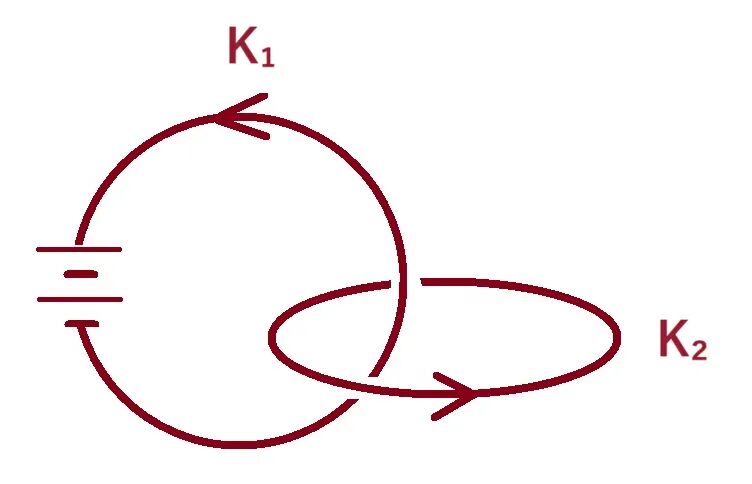
The following is an introduction to one of the simplest homogeneous invariants of directed links - the linking number, which can measure the degree to which two directed closed curves surround each other.
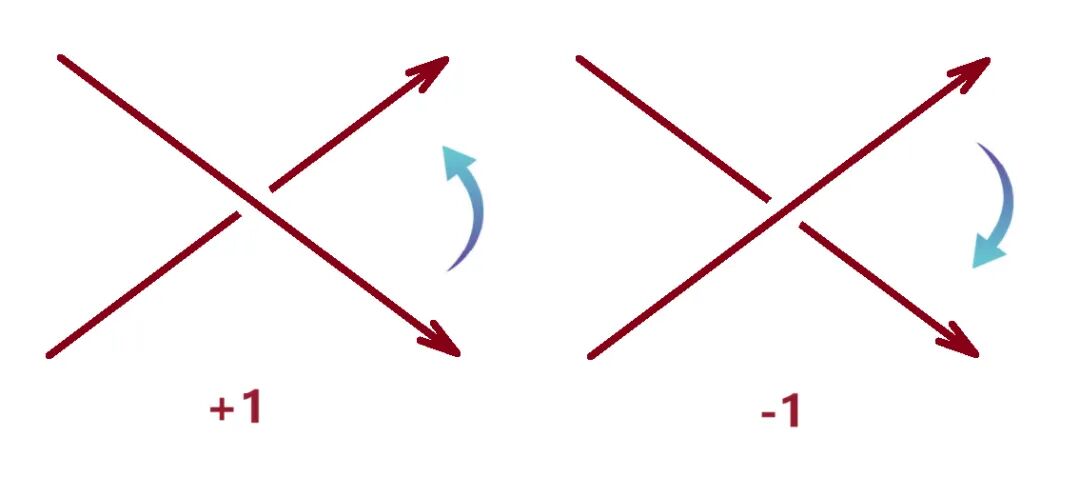
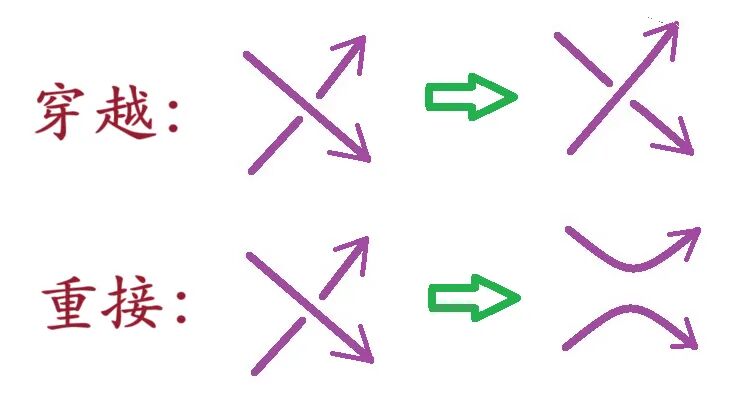
First we need to determine the sign of the intersection. As shown in the figure above, the solid line is above the intersection point and the dashed line is below. If you were asked to rotate the upper solid arrow by the smallest angle so that it coincides with the lower dotted arrow, what would you do? By observing, you will find that the left picture has the smallest angle of counterclockwise rotation, while the right picture has the smallest angle of clockwise rotation. We stipulate that the intersection with the smallest counterclockwise rotation angle is a positive intersection and is recorded as +1; otherwise, the intersection is a negative intersection and is recorded as -1.
If the positive and negative signs ±1 of all intersection points in the link L are summed up, it is the writting number of L, which is recorded as w(L). The number of twists is unchanged under the two motions R2 and R3, but it changes under R1, so the number of twists is not the same invariant. So can we make some modifications and construct a homogeneous invariant?
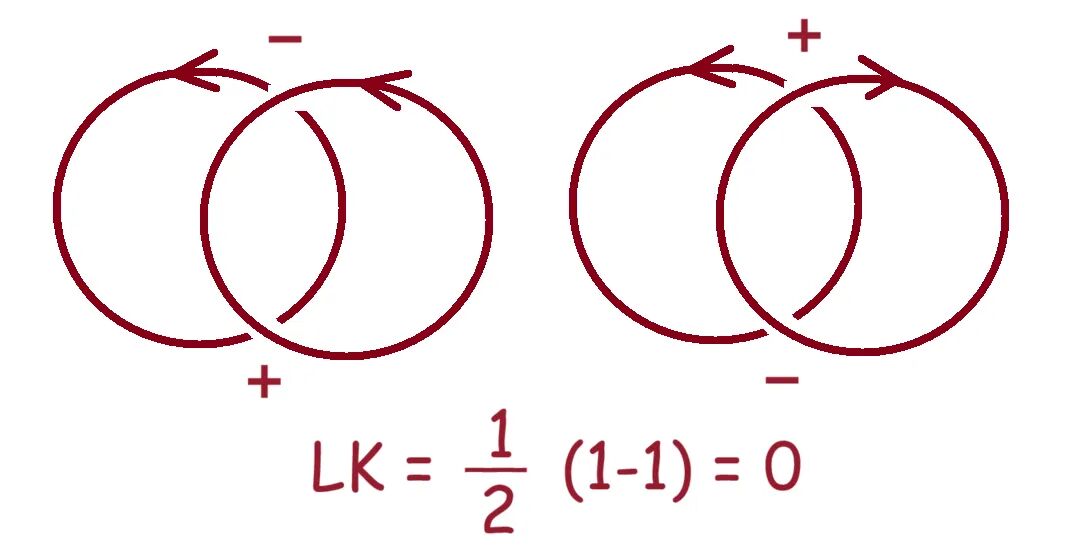
Suppose K₁ and K₂ are two branches of the directed chain ring L. Define the wrap number Lk (K₁, K₂) of K₁ and K₂ to be half of the sum of the positive and negative signs at the intersection of K₁ and K₂ (excluding the intersection of K₁ and K₂ with itself or with other branches). When the link L has only two branches, K₁ and K₂, the wrap number Lk (K₁, K₂) can also be abbreviated as Lk(L).
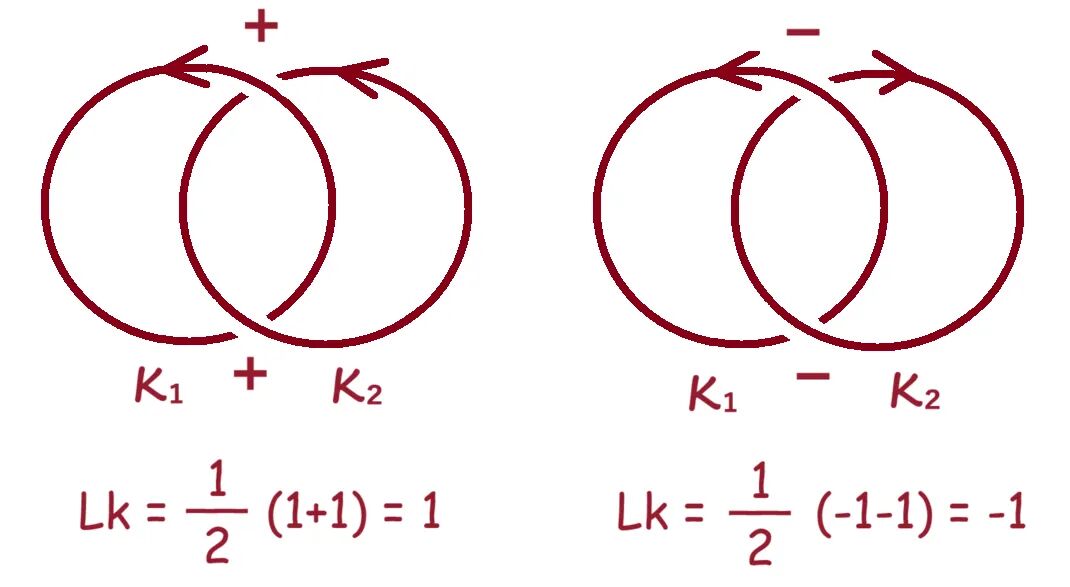
A chain link formed by two nested knots has a number of wraps of ±1
It is easy to verify that, similar to the twist number, the wrap number remains unchanged under the motion of R2 and R3. Since the wrap number is defined at the intersection of different branches, the change of the intersection point of a single branch and itself has no effect on the wrap number, that is, the wrap number does not change under the R1 motion. So we get a real homogeneous invariant - the wraparound number.
Gaussian
James Ward Alexander
braid theory
John Conway
△(○)= 1
Among them, ○ represents the projection of a knot without intersection, and its polynomial is 1.

Alexander-Conway polynomials
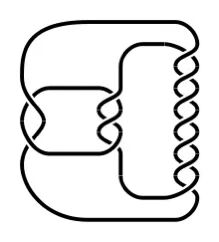
This knot called "Pretzel knot (-3 5 7)" also has an Alexander polynomial of 1 and has many interesting and unexpected properties.
To distinguish mirror images from more knots, mathematicians need to find more discriminating kink invariants. Fast forward 60 years, it was the spring of 1984, and New Zealand-American mathematician Vaughan Jones was giving a lecture introducing his research results on operator algebra. Among the audience was Joan Birman, an American topologist and authority on braid theory. She found that a set of formulas that appeared in the speech were very similar to the formulas in knot theory, so she told Jones. After several long talks, Jones finally clarified the relationship between the two, and successfully derived a new homogeneous invariant of knots and links from operator algebra - the Jones polynomial, which can distinguish most knots from their mirror images and help solve many unresolved problems. It is a powerful tool that topologists have been exploring for decades and is known as the "mathematical pearl of the 1980s". In 1990, Jones received the Fields Medal for "contributions to von Neumann algebras and knot polynomials."
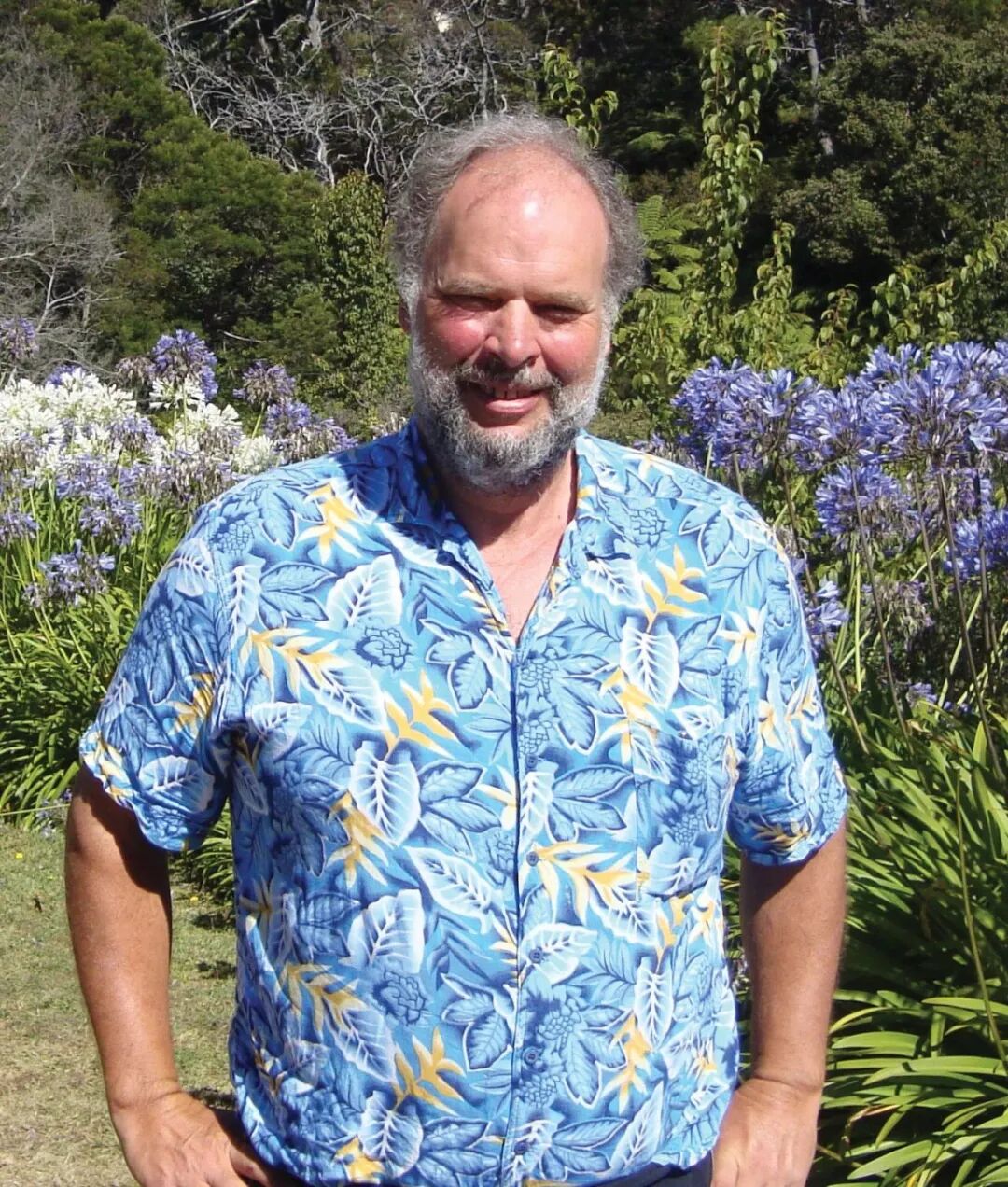
Vaughan Jones (December 31, 1952 - September 6, 2020)
Jones grew up in Auckland, New Zealand. After studying mathematics and physics at a local university, he won a scholarship to complete his PhD at the University of Geneva in Switzerland. There he became interested in the theory of operators, which led him to collaborate with Alan Connes, the foremost expert in the field.
Jones's research interests began with operator algebra in functional analysis, specifically factor theory in von Neumann algebras. He pioneered subfactor theory in the 1980s and obtained Jones polynomials from it. Subfactor theory is widely used in research in low-dimensional topology, group theory, ergodic theory, quantum physics and other fields, including a part of statistical mechanics with fully solvable models, new fields of quantum groups, Dynkin diagrams and representation theory of simple Lie algebras, etc. At the central nexus of all this mathematics is the tower of nested algebras, a result known as the "Jones Index Theorem" which states that if these algebras are nested one after another, their relative scales conform to precise but enigmatic numerical proportions.
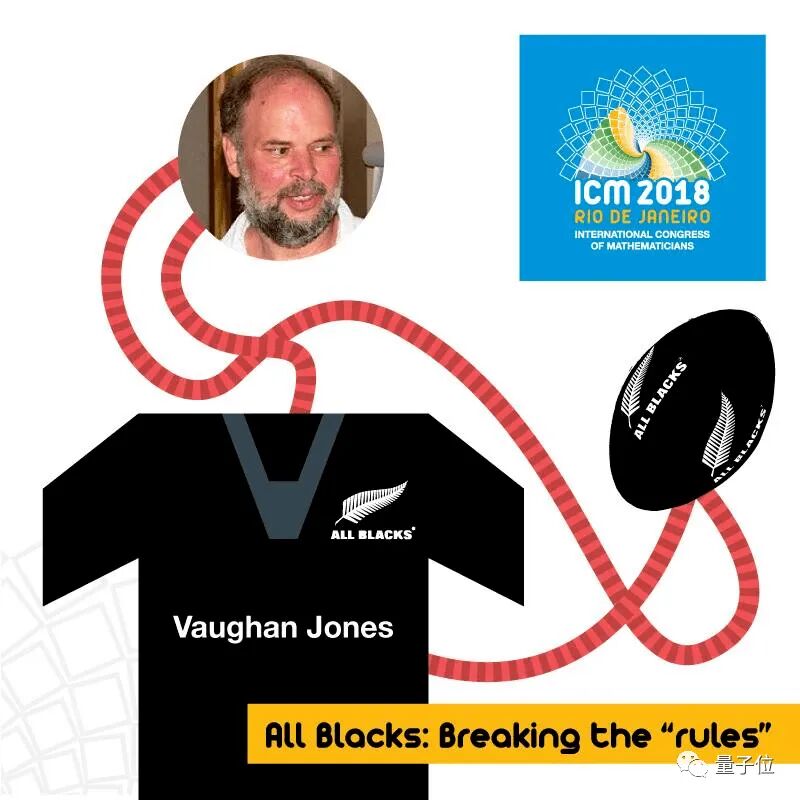
Jones has a loose and rebellious personality. At the Fields Medal award ceremony, he did not wear formal clothes like other winners, but wore an all-black jersey of the New Zealand rugby national team. The International Congress of Mathematicians (ICM) in 2018 even played an official meme and produced a poster with the theme of "Breaking the Rules" to commemorate this interesting incident.
Like the Alexander polynomial, the Jones polynomial must also satisfy the three properties, but the connection relationship is slightly different:

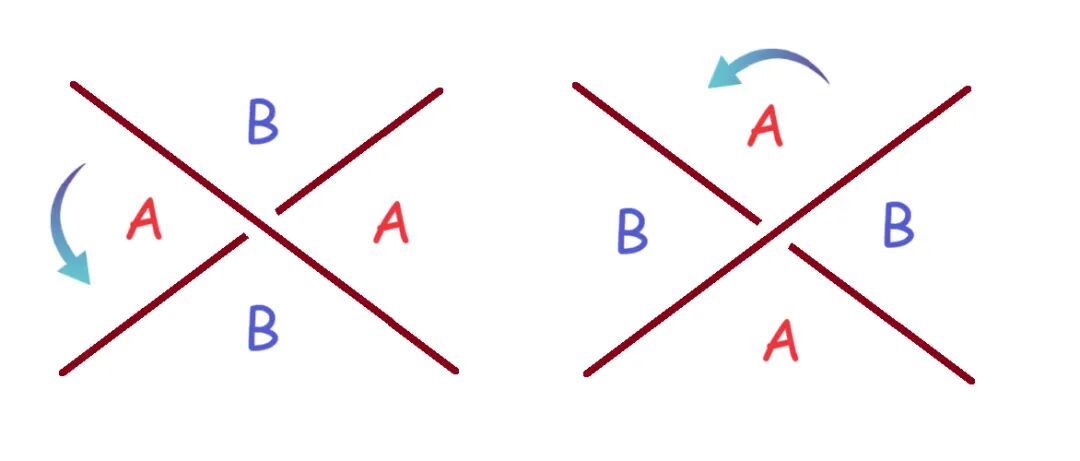
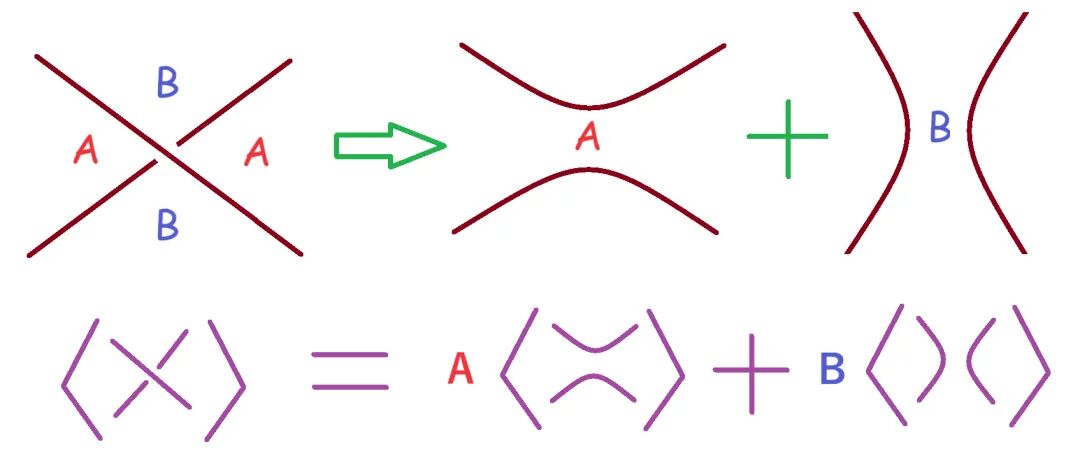
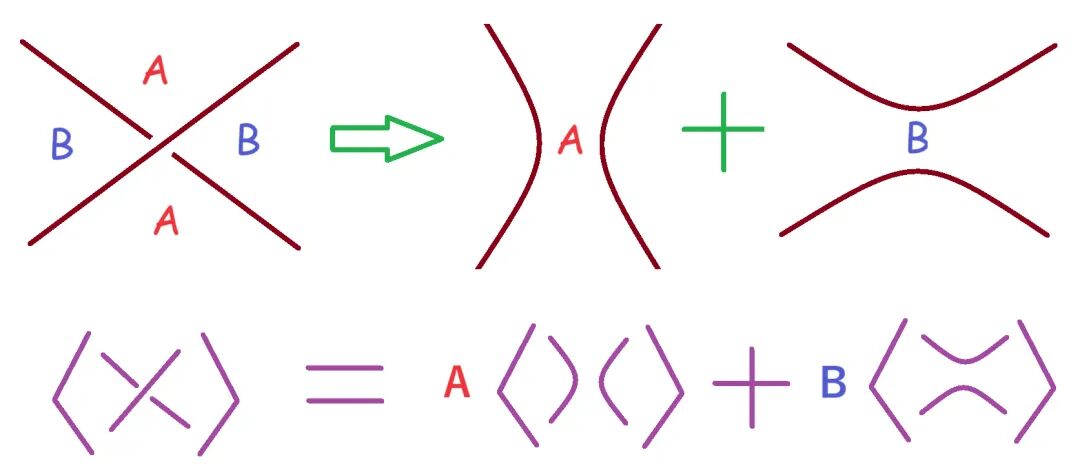
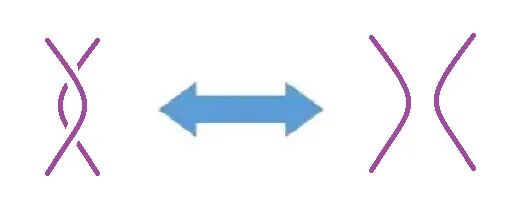
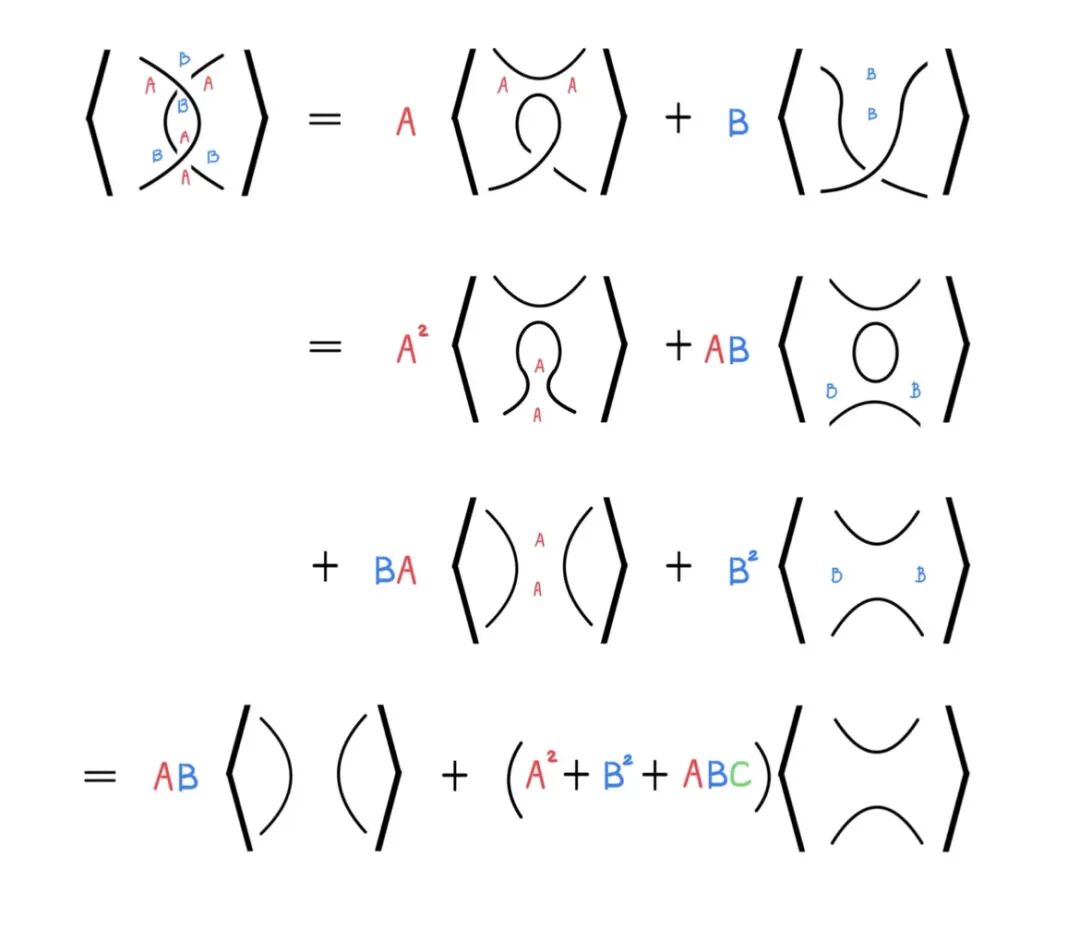
Solved
<P U ○>= [–A²–A⁻²]<P>
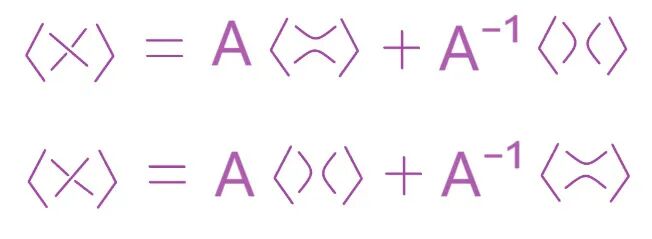
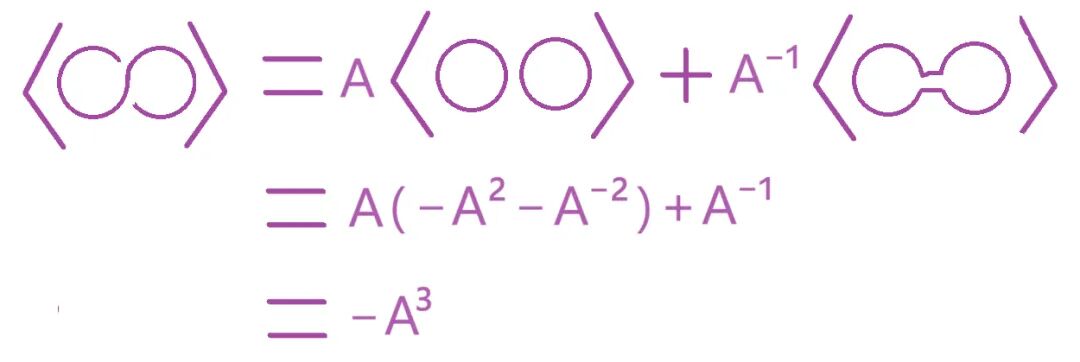
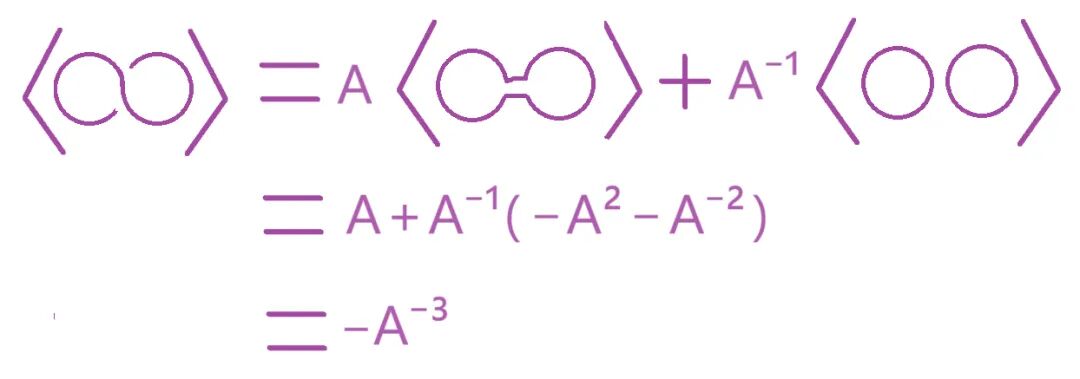
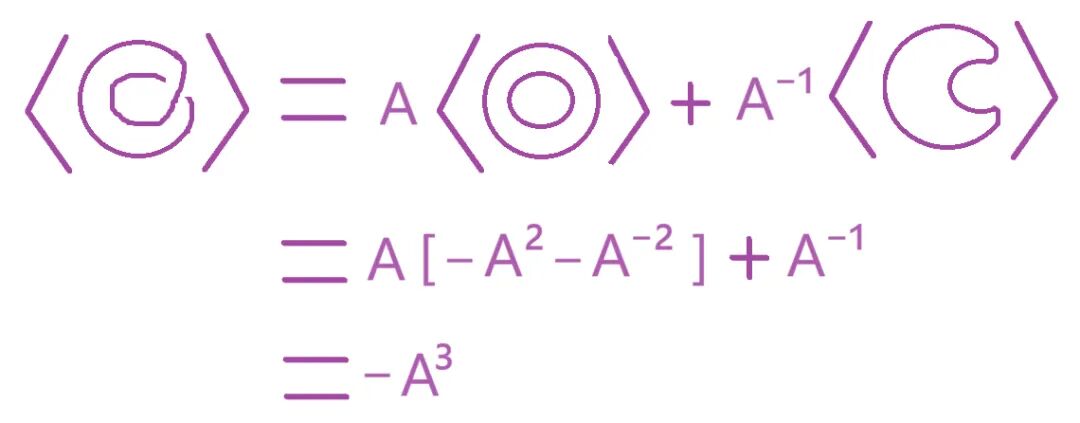
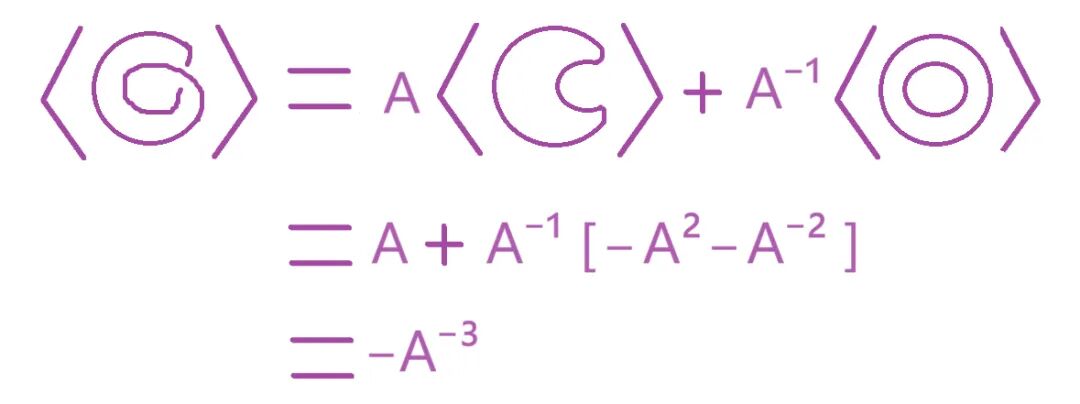
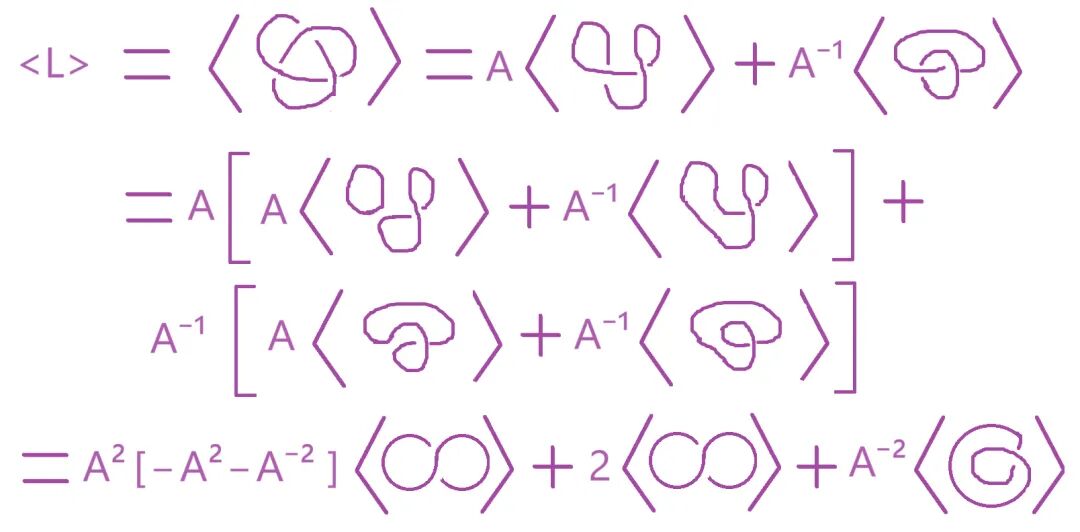
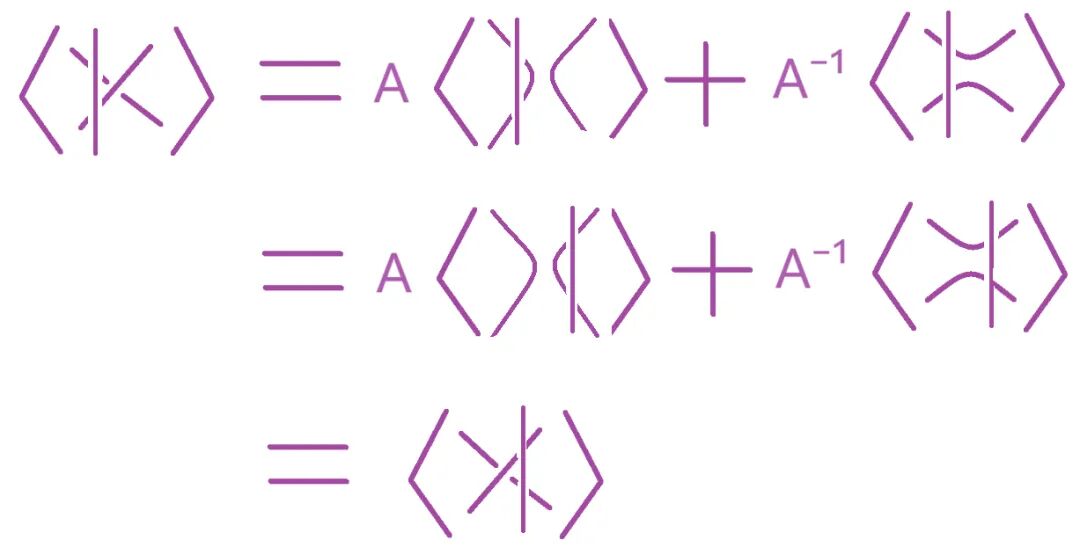
What about the R1 transformation? The angle bracket polynomial is calculated as follows:
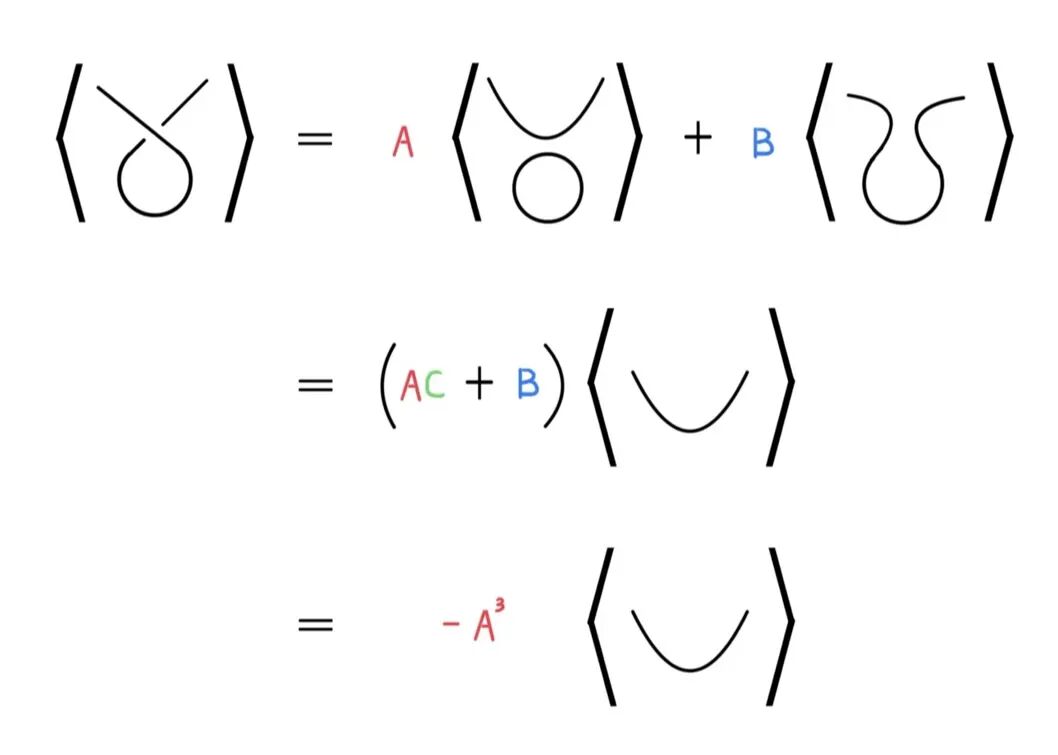
We found that the starting polynomial is a curve with a curl, and the end polynomial is a curve without a curl multiplied by a coefficient (-A³). According to the homogeneity of R1 change, a curve with a curl is equivalent to a curve without a curl, so the coefficient -A³ must be equal to 1. Assuming A=-1, and substituting the disassembly relationship, it can be seen that regardless of positive crossover or negative crossover, their angle bracket polynomials are exactly the same, which reduces the discrimination because some necessary information is lost. So can we improve it so that it not only satisfies R1 sameness but also maintains discrimination?
The answer is yes. The "twisting number" w(L) introduced earlier is used here, which is the sum of ±1 signs of all intersection points of a directed link. Let a=-A³. From the polynomial calculation of R1 transformation above, we can see that for every additional volume (twisting number plus 1), one more factor a will be multiplied. In this way, we only need to multiply one more a⁻¹ to cancel it out. So we add a product factor a⁻ʷ to the angle bracket polynomial, thus obtaining a new polynomial, called Kauffman polynomial. polynomial): Kauffman polynomial is a homogeneous invariant. If the variable is replaced by , the Kauffman polynomial becomes a Jones polynomial. Therefore, Kauffman polynomials and Jones polynomials are equivalent.
Now let's look at the left-hand trefoil knot. We have calculated its angle bracket polynomial as , and the twist number of the left-hand trefoil knot is , so its Kauffman polynomial can be calculated:
If the variable is replaced by , we get the Jones polynomial of the left-hand trefoil knot. In the same way, we can also calculate the Jones polynomial of the right-handed trefoil knot as , which is indeed different from the left-handed trefoil knot. It also proves that the Jones polynomial can distinguish chirality.
Why does the Jones polynomial have such magical power? Mathematicians can't give a reasonable explanation. The reason may have to be found in physics. 1989,Edward Witten(Edward Witten) proved in an article "Quantum Field Theory and the Jones Polynomial" that a topological field theory called Chern-Simons theory can give Jones polynomials. After that, the research on quantum field theory and knots became increasingly in-depth, and people gradually discovered that various knot polynomials in mathematics are closely related to certain quantum field theories. Even among the most cutting-edge contemporary string theories, knot theory is a powerful tool for studying complex topological structures formed by the interaction between strings.
Knot theory also has wide applications in other fields. For example, in molecular biology, when DNA is replicated, the double helix structure of DNA needs to be unraveled, and the two strands of DNA are separated by helicase. After DNA replication is completed, the two strands of DNA will form a topological connection called a knot. This knot is only connected in shape but has no chemical bonds. In order to unknot this DNA, an enzyme called topoisomerase is needed to unkink the DNA. Biochemists use the wrap number and link number in knot theory to describe the kink state of DNA.
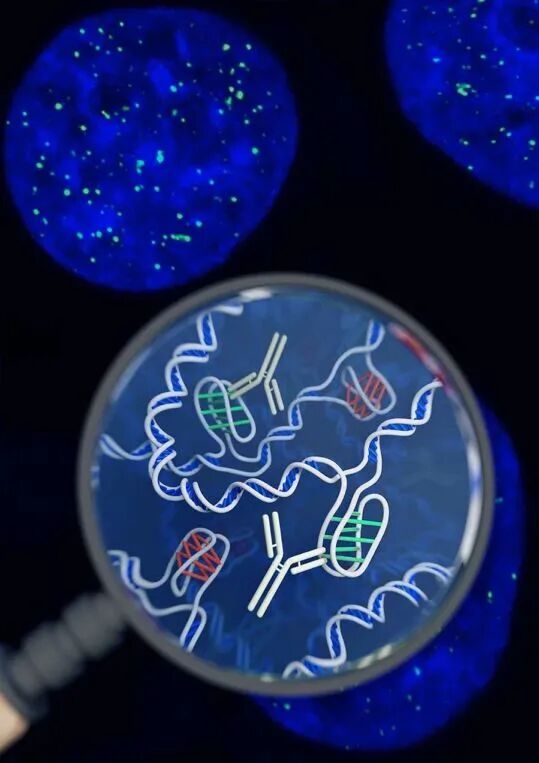
knots in molecular biology
Knot theory is also an important tool for topological quantum computing, which is still under development. In addition, recently it has even been discovered that knot theory has a profound connection with quantum materials. For example, researchers have discovered that Jones polynomials can be used to classify knotted semimetals, in which the local evolution of nodal lines or singular lines near the knot phase transition point corresponds to the overall change of the Jones polynomial. It is foreseeable that knot theory will exert greater power in a wider range of fields.
References:
[1][US] Colin Adams et al., translated by Shen Yidan et al., Fundamentals and Applications of Topology [M], Machinery Industry Press, February 2010.
[2] Jiang Boju, Mathematics of Rope Loops [M], Dalian University of Technology Press, May 2011.
[3]https://www.quantamagazine.org/why-mathematicians-study-knots-20221031/
[4]https://graphics.stanford.edu/courses/cs468-02-fall/projects/desanti.pdf
[5]https://arxiv.org/pdf/2004.00148v2.pdf

Machine-translated from the Chinese original 纽结理论和琼斯多项式 (published 2023-12-18). WeChat original ↗