
Topology, that part of geometry concerned with the properties of figures invariant under transformations that are continuous and have continuous inverses, grew from various roots in the nineteenth century to become a full-fledged division of mathematics by early in the twentieth century. The two branches of the subject to be considered here are point-set topology (also called general topology), concerned with the properties of sets of points of some abstract "space," and combinatorial topology, concerned with how geometrical objects are built up out of certain well-defined "building blocks."
注:20世纪初拓扑学有两个分支:点集拓扑学(也叫一般拓扑学),关注的是某些抽象“空间”中点集的性质;组合拓扑学,关注的是如何用某些明确定义的“构建块”构建几何对象。
Point-set topology grew out of Cantor's studies of sets of real numbers. As such, its central aim is to provide an appropriate context for generalizing such properties of the real numbers as the Bolzano- Weierstrass property(波尔查诺-维尔斯特拉斯性质,也叫聚点定理)and the Heine-Borel property(海涅-博雷尔性质,也叫有限覆盖定理). Both of these are closely related to the important modern notion of compactness(紧致性), a notion central in the generalization of the theorem on the existence of a maximum of a continuous function on a closed interval. The Bolzano-Weierstrass property is the property that every bounded infinite set of real numbers contains at least one point of accumulation(任何有界的实数无穷集至少包含一个聚点), a point in every open interval of which there is another point of the set. In other words, this property asserts the "completeness" (完备性)of the real numbers.
The Heine-Borel property, formulated by Emile Borel (1871-1956) in 1894, states that if an infinite set A of intervals covers a finite closed interval B of real numbers, in the sense that every number of B lies in the interior of at least one element of A, then there is a finite subset of A that has the same property. (有界闭集的每个开覆盖都有一个有限子覆盖)
Although Heine had used this result implicitly in the 1870s, it was Borel who first stated and proved this theorem with respect to a countable set. Henri Lebesgue (勒贝格,1875-1941) generalized it to arbitrary infinite collections in 1904.
注:下面介绍了Borel的反证法,使用闭区间套二分法来证明Heine-Borel property(有限覆盖定理)。
Borel's proof is by contradiction. Let . If the conclusion is not true, then for every there is a point such that is not in , for every . If one bisects the interval , the same statement is true for at least one of the halves. If one continues this bisection process, one obtains a decreasing nested sequence of closed intervals , each of which has the same property as itself. But contains a point . By hypothesis, is in the interior of for some , so must contain one of the intervals , a contradiction.
The key to Borel's proof is what is often called the nested interval property(区间套定理), that the intersection of a nested family of closed intervals contains a point. (嵌套的闭区间族的交集包含一个点)It was this result that was later to be abstracted into the earliest definition of compactness. It was also this result that was among the earliest presented in the first systematic exposition of set theory as a whole, the 1906 Theory of Sets of Points by William Henry Young (威廉·亨利·杨) and Grace Chisholm Young(格蕾丝·奇斯霍尔姆·杨).
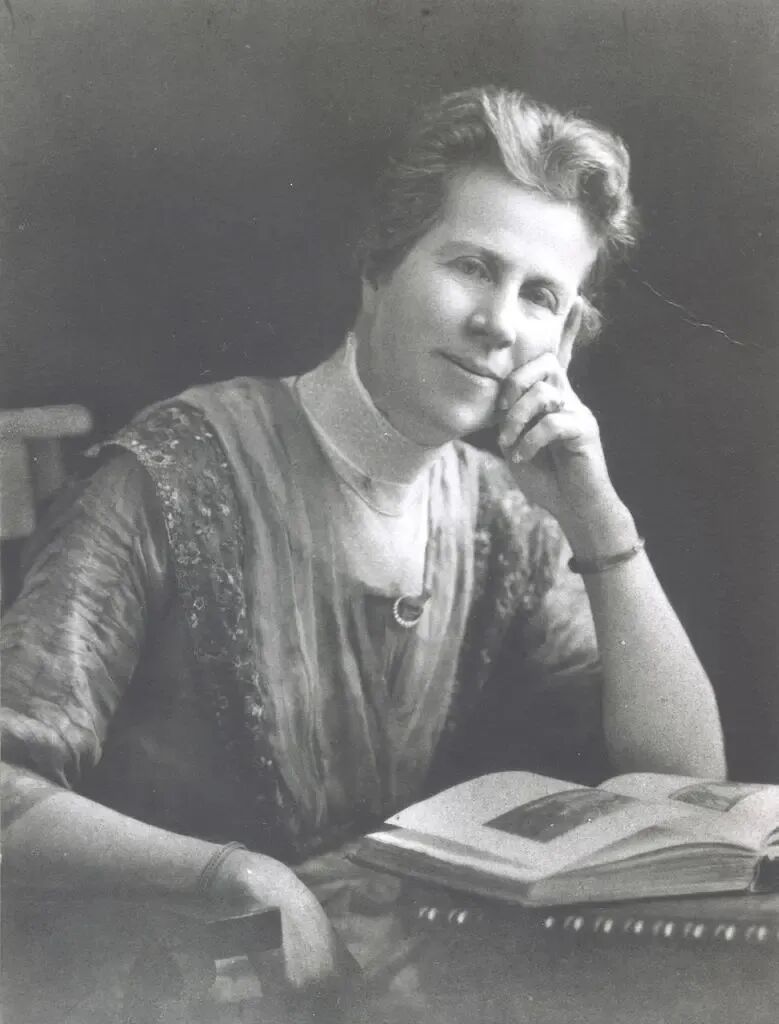
格蕾丝·奇斯霍尔姆·扬(Grace Chisholm Young,1868-1944)是英国数学家。她在英国剑桥的吉顿学院接受教育,并在德国的哥廷根大学继续深造,并于1895年获得博士学位。她的早期著作以丈夫威廉·亨利·杨(William Henry Young,1863-1942)的名义出版,他们一生都在数学方面进行合作。
The Youngs and The Theory of Sets of Points
杨夫妇与《点集理论》
The text of the Youngs deals with sets of points on the real line or in the real plane and gives explicit definitions of many fundamental concepts that were later to be generalized. For example, a point x that belongs to an interval "unclosed" at both ends is said to be an internal point(内点)of the corresponding closed interval. A point L is said to be a limit point(极限点)of a given set of real numbers if inside every interval containing L as an internal point there is a point of the set other than L. A set that contains all its limit points is said to be closed(闭的), while one that does not is said to be unclosed or open(开的). (注:此处的open set 与我们现在使用的open set“开集”的定义并不一样。) The Youngs then reformulated the Bolzano-Weierstrass and Heine-Borel theorems in terms of these definitions and presented proofs.
The Youngs next generalized the notion of "interval" in the line to that of "region" in the plane by considering the latter to be generated by a set of triangles contained in it and then generalized the notion of limit point by replacing "interval" by "region."
注:杨夫妇用平面上的“区域”代替直线上的“区间”来推广极限的概念。
They noted further that, in analogy with the properties of an interval, a region divides the plane into three disjoint sets, internal points (those internal to at least one generating triangle), boundary points (those other than internal points that are limit points of internal points), and external points (those that are neither internal points nor boundary points). They then easily stated and proved the generalizations of the Bolzano-Weierstrass and Heine-Borel theorems to the plane.
Another fundamental notion in modern topology, the idea of connectedness(连通性), stems from some considerations of Cantor. Cantor, as part of his work in dealing with the "continuum", the entire set of real numbers, tried to characterize this set. As part of this attempt, he found it necessary to define what it meant for the set to be in one piece. Because he saw this idea in terms of the minimal distance between points of the set being 0, he defined "connected" in terms of distance: A set T is connected if given any two points p and q in it and any positive number ε, there is a finite number of points t₁, t₂,…, tₙ in T such that the distances pt₁, t₁t₂,…, tₙq are all less than ε.
注:康托尔(1845-1918)从实数“连续统”的研究中发现有必要定义何为集合"连在一起"的概念。因为他认为这个概念可以用集合中两点之间的最小距离为 0 来表示,所以他用距离来定义"连通"。
The Youngs, among others, realized that it would be better to give a definition not using distance, but purely in set-theoretic terms, so they translated this notion as follows: "A set of points such that, describing a region in any manner round each point and each limiting point of the set as internal point, these regions always generate a single region, is said to be a connected set provided it contains more than one point." Using this definition, the authors then proved that a set is connected if and only if it cannot be divided into two closed components without common points.
杨夫妇以及其它一些人认识到给出一个不用距离,而完全采用集合论术语的定义会更好,因此,他们将此概念重新表述如下:“设一个点集以任何方式以该集合的每个点和每个极限点为内点在其周围形成一个区域,并使这些区域总是生成一个单个区城,若该集合包含不只一个点,则称之为连通集。”利用这个定义,他们证明了一个集合是连通的当且仅当它不能被分成两个没有公共点的闭子集。
Fréchet and Function Spaces
弗雷歇与函数空间
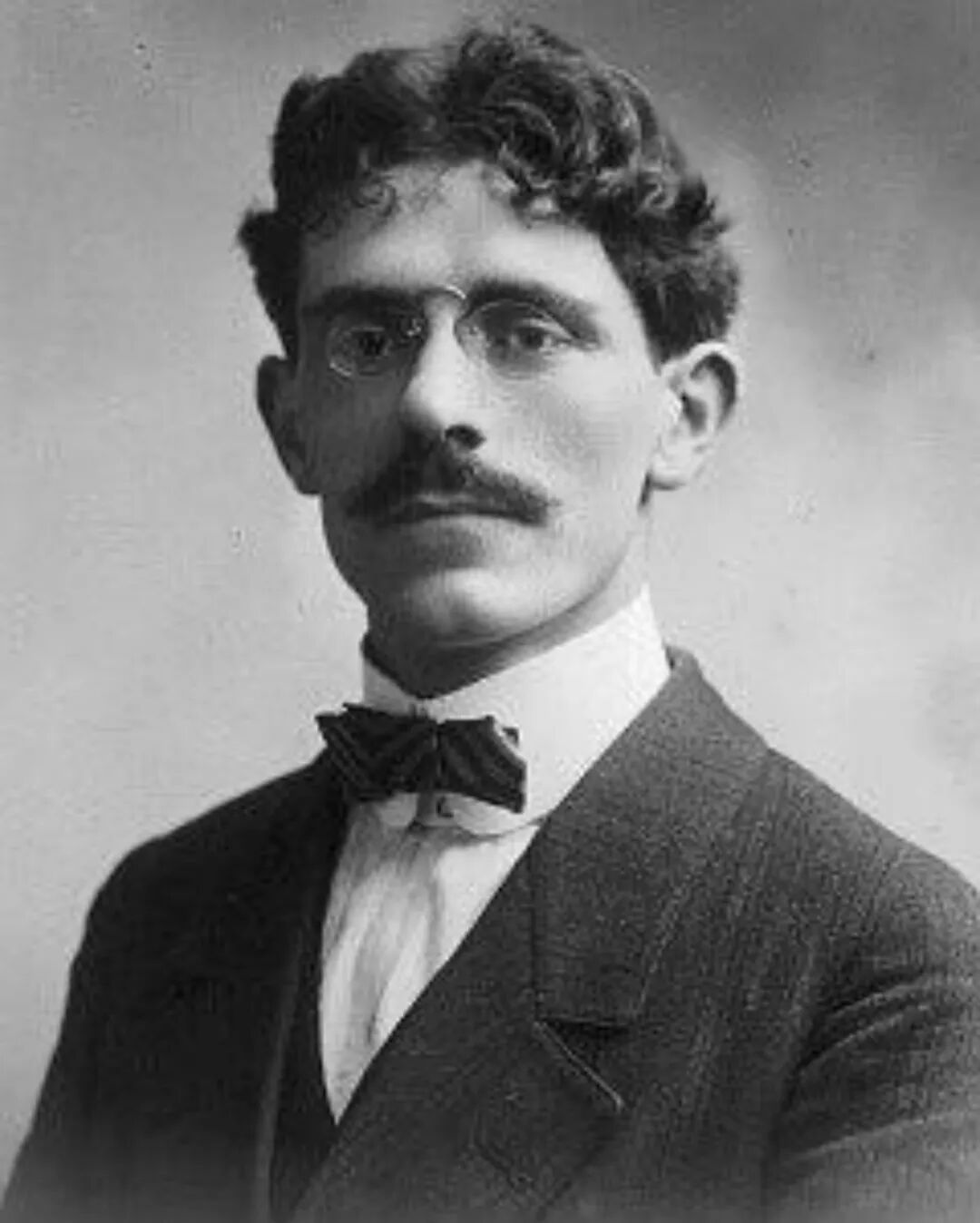
(Réne-Maurice Fréchet,1878-1973)
法国数学家,泛函分析的创始人之一
In the same year as the Youngs text appeared, Maurice Fréchet began the process of generalizing results on points in the plane to more general contexts. In his dissertation dealing with the theory of functionals(泛函), functions operating on certain sets of functions, he had to be able to decide when two functions were "close" to each other and therefore decided "to establish systematically certain fundamental principles of the Functional Calculus(泛函微积分), and then to apply them to certain concrete examples." By doing so, "one often gains thereby from seeing more clearly that which was essential in the demonstration, …from the simplification, and in the freeing [of the proofs] from that which only depends on the particular nature of the elements considered." In other words, Fréchet decided to reconsider the basic notions of the topology of the real line in terms of arbitrary sets and then apply these notions to his particular sets of interest. He realized that he could prove numerous results of topology in a general context once and for all and then apply them in concrete instances rather than prove the same result over and over again.
He especially wanted to answer questions about convergence of functionals to limits and determine the circumstances under which the limit functional has the same properties as the functionals of which it is the limit.
他尤其想解诀的是关于泛函收敛于极限,以及确定在什么条件下,极限泛函与以之为极限的泛函具有相同性质的问题。
Fréchet thus began, not by defining "limit," but by characterizing the notion by means of axioms.(不是定义“极限”,而是利用公理刻画这一概念。) That is, a set E belongs to L, the class for which limits are defined, if given any infinite subset of E it is possible to determine whether or not a unique element exists having appropriate properties. This element is to be the limit of . The limit element is subject to the conditions that if each , then the limit is , and if is the limit of , then it is also the limit of any subsequence of . With this abstract notion of a limit, Fréchet stated various definitions, some of which had already been considered by Cantor: The derived set E' of E is the set of its limit elements. The set E is closed if E' ⊆ E and perfect if E' = E. The point is an interior point of E if is not the limit of any sequence not in E.
如果对于 E 的任何无限子集 ,都可以确定是否存在一个唯一的元素 ,具有适当的性质,那么 E 就属于 L,即极限被定义的类。这个元素就是 的极限。极限元素 必须满足以下条件:若每个 ,则极限是 ;若 是 的极限,则它也是 的任何子序列的极限。有了这个抽象的极限概念,弗雷歇提出了各种定义,其中一些已经被康托尔考虑过了:E 的导集 E'是其极限元素的集合。如果 E'⊆E,那么 E 是闭集,如果 E' = E,那么 E 是完全集(注:也叫完美集,因为它没有孤立点)。如果 不是 E 之外的任何序列的极限,那么 就是 E 的内点。
As part of his study of functionals, Fréchet wanted to generalize the Heine-Weierstrass result on the existence of a maximum and minimum of a continuous function on a closed interval so that it could apply to function spaces. To accomplish this generalization, he took the central idea of the proof of the Heine-Borel theorem as a definition in a brief note of 1904: "We call a compact set every set E such that there always exists at least one element common to every infinite sequence of subsets E₁, E₂, …, Eₙ, … of E, if these (possessing at least one element each) are closed and each is contained in the preceding one." Fréchet then proved that a necessary and sufficient condition for a set E to be compact was that every infinite subset F had at least one limit element in E, an element that is the limit of some sequence of distinct points of F.
作为他对泛函的研究的一部分,弗雷歇想要推广关于闭区间上连续函数的最大值和最小值的存在性的海涅-魏尔斯特拉斯结果,使其适用于函数空间。为了完成这种推广,他在 1904 年的一个简短的笔记中采用了海涅-博雷尔定理证明的核心思想作为定义:“我们称一个紧致集为任何满足以下条件的集合 E:如果 E 的每个无限序列的子集 E₁, E₂, …, Eₙ, … (每个子集至少有一个元素)都是闭的而且每一个都包含在前一个子集中,那么这些子集总是存在至少一个公共元素。”然后,弗雷歇证明了集合 E 是紧致的必要和充分条件是每个无限子集 F 至少有一个极限元素在 E 中,即 F 的一些不同点的序列的极限。
注:弗雷歇根据Bolzano-Weierstrass定理(有界实数序列一定有收敛的子序列)给出了度量空间X“紧致性”的定义:X中的每一个序列都有收敛的子序列。而子集的聚点可以看成是子序列的极限的自然推广,于是又给出“紧致性”的另一个定义:X中的每一个无限子集都有一个极限点。第一个定义现在叫做“序列紧致”(sequentially compact),第二个定义叫做“极限点紧致”(limit point compact)。这两个定义在度量空间中是等价的。后来发现用序列和极限来刻画一般的拓扑结构并不充分,于是俄国数学家亚历山大罗夫(Aleksandrov,1896-1982)和乌雷松(Urysohn,1898-1924)又根据Heine-Borel定理换成了“开覆盖版本”,也就是现在我们对“紧致”(compact)的定义:X的每一个开覆盖都有有限子覆盖。
“紧致”蕴涵“极限点紧致”,反之则不然。比如,极小不可数良序集(minimal uncountable well-ordered set) 不是紧致的,因为它没有最大元素,但它是极限点紧致的。由此也可知, 是不可度量的。另外,满足第一可数公理的紧致空间都是序列紧致空间。度量空间满足第一可数公理和T₁分离公理。对于度量空间来说,“紧致”、“极限点紧致”和“序列紧致”这三者都是等价的。
Noting that compact sets by his definition had properties analogous to those of closed and bounded sets in space, Fréchet was able to generalize the Weierstrass result, using for his definition of continuity the property that today is generally known as sequential continuity: A function is continuous at in the closed set if for all sequences in that converge to .
注意到他所定义的紧集与空间中的有界闭集具有类似的性质,弗雷歇就能够通过对他的连续性定义使用今天一般称之为序列连续性的性质:一个函数 在闭集 中的点 处连续,如果对于 中所有收敛于 的序列 都有 ,来推广魏尔斯特拉斯的结果了。
Interestingly, in his dissertation of 1906, Fréchet took for his definition of "compact" the necessary and sufficient condition above rather than the intersection property, adding the statement that any finite set will also be considered compact.(有限集都是紧致的)
Having shown that the concept of a distance was not necessary to develop various familiar notions, Fréchet proceeded to reintroduce that notion in a more general setting. Namely, he considered a subclass E of the class L consisting of members E in which can be defined a metric, a real valued function satisfying
(1) ;
(2) if and only if ;
(3)
for any three elements of E. Using the metric, Fréchet defined a Cauchy sequence to be any sequence such that for every there is an so that for all , we have . Limit elements and the concepts associated with them are then defined in terms of the metric and Cauchy sequences.
注:弗雷歇将距离推广为度量概念,定义了柯西序列和极限概念,并用这些概念定义了紧致性、可分性、完备性等拓扑性质,从而建立了度量空间的相关理论。如果把函数看做空间中的“点”并定义范数,则函数空间也成为一种度量空间。弗雷歇的工作为点集拓扑学和泛函分析奠定了坚实的基础。
In particular, Fréchet considered the subclass of normal sets consisting of sets that are perfect, separable (contain a countable dense subset), and in which every Cauchy sequence has a limit (complete, in modern terminology). It is for sets of this type that he could prove a generalization of the Heine-Borel theorem: A normal set E is compact if and only if for every collection G of sets such that every element of E is in the interior of at least one member of that collection, there exists a finite subset of G with the same property.
特别地,弗雷歇考虑由完全的、可分的(包含一个可数稠密子集)集合组成的良序集的子类,而且在这些集合中的每个柯西序列都有极限(用现代术语说,即为完备的)。对于这种类型的集合,他可以证明海涅-博雷尔定理的一个推广:一个良序集是紧的,当且仅当对于集合 的每个使得E的每个元至少在该汇集的一个成员内部的汇集 G,存在S的一个有限子集也具有同样的性质。(注:换句话说,就是每一个开覆盖都有一个有限子覆盖。这也是现在对于拓扑空间的紧致性的定义。)
Fréchet gave a number of examples of spaces with metrics for which his general theorems held, including examples of sets of functions. One such example was the set of real functions continuous on a given closed interval. Here the metric was the maximum norm(最大范数) under which Fréchet proved that the set was normal.
A second example was the set of all sequences of real numbers with the metric Fréchet noted that this metric is better than a more standard one in the sense that the former always gives a finite distance while the latter does not. Again, Fréchet showed that this set is normal and, furthermore, that the same is true for the set of real functions defined on it with an appropriate metric.
Hausdorff and Topological Spaces
豪斯多夫与拓扑空间
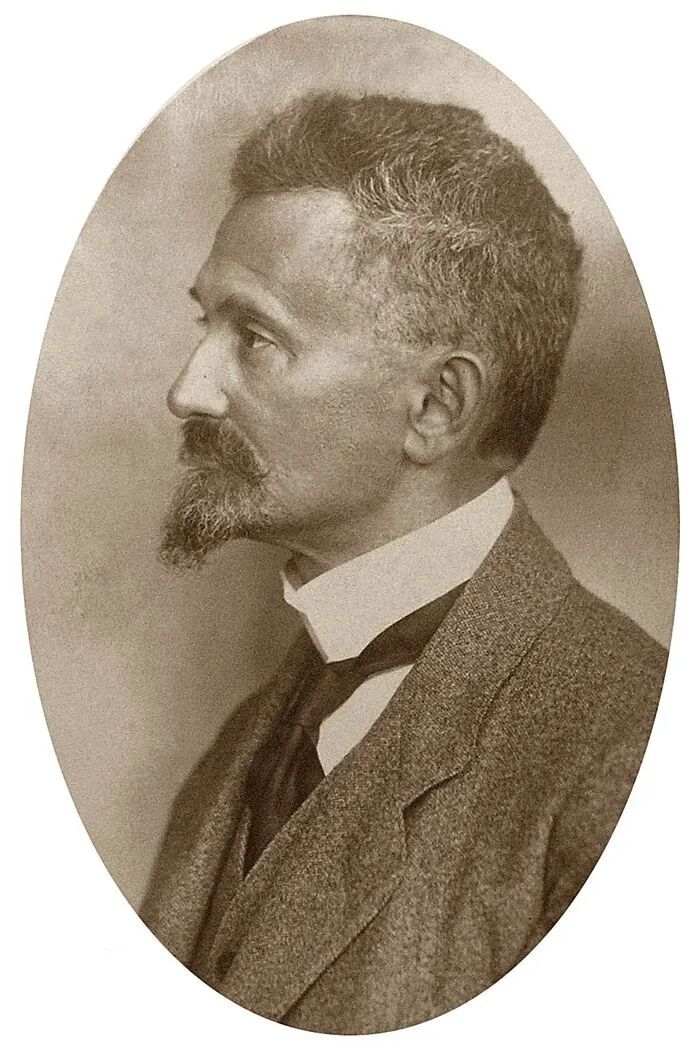
菲利克斯·豪斯多夫
(Felix Hausdorff ,1868-1942)
德国数学家,拓扑学的开创者之一
It was Felix Hausdorff who was able to give a full axiomatization of the notion of a topological space derived from standard properties of sets of real numbers. He described this axiomatization in his 1914 text, Grundzüge der Mengenlehre (Foundations of Set Theory).
从实数集合的标准性质出发,对拓扑空间的概念给出完整的公理化描述的是豪斯多夫。他在1914年出版的教材《集合论基础》中描述了这些公理。
Although his axioms and definitions have been modified since 1914 and numerous subsidiary definitions and concepts have been introduced, the basics of point-set topology as currently taught are all to be found in this fundamental work.
Hausdorff noted that there are three basic concepts by means of which one can base a general theory of topological spaces, the notions of distance, neighborhoods, and limits.
注:豪斯多夫注意到距离、邻域和极限这三个基本概念是建立拓扑空间一般理论的基础。他还发现这三个基本概念的关系是:距离蕴涵邻域和极限,而邻域又蕴涵极限,但是从极限概念出发却得不到距离和邻域的定义。用符号表示即为:距离⇒ 邻域 ⇒ 极限。
Fréchet had in effect used both the first and the third. Hausdorff noted that if one begins with the concept of distance, one can derive the other two, while if one begins with that of neighborhood, one can define the notion of limits. In general, however, one cannot reverse these procedures.
注:弗雷歇用了“距离”和“极限”两个概念,他把距离抽象为度量,进而定义度量空间和极限。豪斯多夫决定从“邻域”的概念出发来定义拓扑空间。这种空间,即今天所谓的豪斯多夫空间。
Although the method one chooses, according to Hausdorff, is a matter of taste, he decided to begin with the concept of neighborhood to define the notion of a topological space. Such a space, today known as a Hausdorff space, is a set E to each element x of which is associated a collection of subsets of E, called neighborhoods, that satisfy the following axioms:
(1) Each point x belongs to at least one neighborhood , and every neighborhood contains x.
(2) If , are two neighborhoods of the same point x, then their intersection also contains a neighborhood of x.
(3) If , then there is a neighborhood such that .
(4) For two different points x, y there are two neighborhoods , whose intersection is empty.
豪斯多夫把拓扑空间定义为一个集合,连带着它的每一元素x所关联的一族子集 ,这些子集叫做邻域,它们必须满足下列四条公理:
(1) 每个点x至少有一个邻域 ,每一个 含有这个点x。(每个点有包含它的邻域)
(2) x的两个邻域的交含有x的一个邻域。(x的任意两个邻域的交是x的邻域)
(3) 如果y是 的一个点,则存在一个 使得 。(邻域中包含其它点的邻域)
(4) 如果x≠y,则存在 与 ,使得 与 的交集为空集。(分离的点有不相交的邻域)
注:前三个条件就是现在定义拓扑空间所使用的邻域公理体系,最后一个条件被单独摘了出来,称为Hausdorff性质或者 分离公理,满足该条件的拓扑空间称为Hausdorff 空间。
After showing that a metric space, with the neighborhoods defined by for every real number , satisfies the axioms given, Hausdorff developed the same basic theory as had Fréchet. The major change is that the central concept now is the domain(区域)or, in more modern terms, the open set(开集). For Hausdorff, a domain A is a subset of E containing only interior points, where the latter are defined as points x that have a neighborhood contained in A. That the entire set E and each of the neighborhoods are domains follows from axioms 1 and 3. Hausdorff also showed that the union of arbitrarily many domains and the intersection of finitely many are domains. (注:开集的无穷并和有限交仍然是开集,如果再加上一条性质:集合本身和空集都是开集,就是使用开集对拓扑空间的定义。)A closed set, on the other hand, is one that contains all of its accumulation points.(如果一个集合含有它的所有聚点,它就是闭集。) Hausdorff then showed that the closed sets are precisely the complements of the domains.(开集的补集就是闭集)
Using Fréchet's limit definition for compact sets, Hausdorff proved the intersection property of nested, closed, compact sets and then a generalization of the Heine-Borel theorem, modifying the original proof only slightly. He also gave a new definition of limit point and convergence general enough to apply in any topological space: The point x is a limit of the infinite set , if every neighborhood of x contains all but a finite number of points of . (如果 x 是无限集合 的极限点,那么对于 x 的每个邻域 ,它都包含了 中除了有限个点之外的所有点。)Further, because any set either has a single limit x or none at all, one writes in the first case that or that converges to x.
Among the other new definitions was one for connectedness(连通性): "A set differing from the empty set is connected(连通的)if it cannot be divided into two disjoint, non-null, sets both closed relative to [that is, such that each set is the intersection with of a closed set in the ambient space ]." Hausdorff noted that because closed sets are the complements of domains, he could equally well have specified in the definition that the components needed to be domains.
Because the idea of a neighborhood was the point of departure for Hausdorff's development, it is not surprising that he defined continuity(连续性) using that concept. Namely, he took the standard ε - δ definition of continuity for functions of a real variable, noted that this definition used neighborhoods on the real line, and then translated it into a general definition for topological spaces: "The function is called continuous at the point , if for each neighborhood of the point there exists a neighborhood of the point , whose image lies in ; i.e., . " Hausdorff then generated an equivalent definition: The function is continuous at if and only if, for each subset of which has as an interior point, the inverse image also contains the point as an interior point. Using this definition, it is easy to prove that a continuous function preserves connectedness(连通性)and compactness(紧致性). Hausdorff naturally noted that the first of these facts implies the intermediate value theorem(介值定理) while the second implies the existence of a maximum and minimum value for a continuous function on a closed interval(极值定理). In other words, Hausdorff showed that a topological space is the natural setting for these classical results about functions of a real variable.(豪斯多夫说明了拓扑空间是单实变量函数的这些经典结果的自然背景。)
注:豪斯多夫通过“邻域”概念构建豪斯多夫空间,定义开/闭集、边界、极限、紧致、连通以及连续性等拓扑概念,由此创立了抽象空间的完整理论,从而使得点集拓扑学的分支正式形成。

后记:
本文尝试中英文混搭的风格,英文数学史来自Victor J.Katz《A History of Mathematics: An Introduction》,其中部分内容做了翻译和批注,并添加图片。“双语路线”带您领略更广阔的世界。
本文讲点集拓扑学的创立,主要介绍杨夫妇、弗雷歇和豪斯多夫等人的工作。点集拓扑学这个分支之所以会产生,主要有两方面的因素:一是19世纪数学分析需要找一个更坚实的基础,康托尔为此开创了集合论,为点集拓扑学提供了合适的数学语言;另一个就是公理化方法的影响,公理化思想引导了整个20世纪数学的发展,在法国布尔巴基学派的“结构主义”数学中达到顶峰。点集拓扑学的创立正体现出20世纪数学追求“一般性”和“统一性”的总体趋势。
本文不仅介绍了点集拓扑学“是什么”,“怎么样”,也探讨了“为什么”,即为什么会产生这些数学概念,是什么因素引导其发展和演变。当然这篇短文不可能讲得面面俱到,只能对几个最基础的概念做一些粗略的探讨,比如弗雷歇的“度量”,豪斯多夫的“邻域”以及对“紧致性”的多种定义等等。希望以此开个头,将来有更深入全面的研究之后再做分享。

欢迎分享 - 学习交流 - 传播思想
转载自久章智能(微信公众号,久章智能于 2023-12-19 转载),内容保持原貌,版权归原作者及原账号所有。阅读原文 ↗