At the beginning of the Year of the Dragon, Sora was born, shocking the whole world. Sora claims to be "a video generative model for world simulation", which is very impressive. Some people predict pessimistically that many traditional fields may be subverted, among which the most endangered ones may be computer graphics, short video and film and television entertainment industries. As OpenAI revealed more technical details, many videos of physical paradoxes generated by Sora were circulated on the Internet. Here, the author explains the shortcomings in the current Sora technical route based on some views in the field of modern mathematics, especially in the field of integral differential geometry. I hope to be able to inspire ideas, broaden ideas for the majority of AI research and engineering personnel, and jointly promote improvement. Here we mainly use manifold embedding theory, catastrophe theory (critical state theory), fiber cluster theory, thermal diffusion equation and regularity theory of optimal transport equation (Monge-Ampere equation) to explain.
manifold distribution rule
In the field of deep learning, a natural data set is viewed as a probability distribution on a manifold, which is calledmanifold distribution rule. We regard an observed sample as a point in the original data space. A large number of samples constitute a dense point cloud in the original data space. This point cloud is near a low-dimensional manifold. This manifold is called a data manifold. The distribution of point clouds on the data manifold is not uniform, but satisfies specific distribution rules and is expressed as a data probability distribution.
Then, we naturally have the following questions: 1. Why is the data point cloud low-dimensional instead of occupying the entire original data space? 2. Why is the point cloud collection a manifold, that is, it is locally continuous and smooth?
The answer to the first question is: because natural phenomena satisfy a large number of natural laws, the limitations of these laws reduce the dimensionality of the data sample point cloud and cannot occupy the entire space. For example, we examine a data set composed of all natural face photos. Each sampling point is a picture, and the number of pixels multiplied by 3 is the dimension of the original image space. Any point in the original image space is a picture, but very few pictures are face pictures and will fall on the face picture manifold. Therefore, the face picture manifold cannot occupy the entire original image space. The human face needs to satisfy many natural physiological laws. Each law will reduce the dimensionality of the data manifold. For example, left-right symmetry reduces the number of pixels by nearly half. There are defined geometric and texture areas such as facial features. The shape of each organ is similar, and there are not many parameters to describe, so the dimensionality is further reduced. In the end, the genes that control human faces are very limited, so the dimensionality of the manifold of human face images is far lower than the number of pixels in the image.
For another example, we observe the steady-state temperature distribution in a plane area. According to the physical heat diffusion theorem, the stability function satisfies the classic Laplace equation and is uniquely determined by its boundary value. If we have n square sampling points inside the region and n sampling points at the region boundary, then each observed temperature function is represented as a vector with dimension n squared, that is, the original data space dimension is n squared, but the actual manifold dimension is the dimension n of the boundary function. It can be seen that the dimension of the data manifold composed of observation samples that satisfy the laws of physics is far lower than the dimension of the original data space.
The answer to the second question is: in most cases, the physical system is well-posed, but in critical states, the physical system will undergo mutations (described by catastrophic theory or critical state theory). Physical laws are mostly described by a system of partial differential equations. The solution of the differential equation is controlled by the initial value and boundary value. The system is well-posed, which means that due to physical limitations such as energy conservation, mass conservation, and energy transfer smaller than the speed of light, when the initial boundary value gradually changes, the solution also gradually changes. In the theory of regularity for partial differential equations, this means that the Sobolev norm of the boundary values controls the Sobolev norm of the solution, and so on. We consider solutions as points on the data manifold, and edge values as their corresponding local coordinates (i.e., corresponding latent feature vectors in the latent space). The mapping from the data manifold to the latent space is called encoding mapping, and the mapping from latent space to data manifold is called decoding mapping. Regularity theory ensures that encoding mappings and decoding mappings are continuous or even smooth, and the uniqueness of solutions ensures that these mappings are topological homeomorphisms or differential homeomorphisms. The boundary value can be perturbed arbitrarily locally, that is, the hidden variable exists in the neighborhood of an open Euclidean disk. This means that observation samples that satisfy certain physical rules constitute a data manifold.
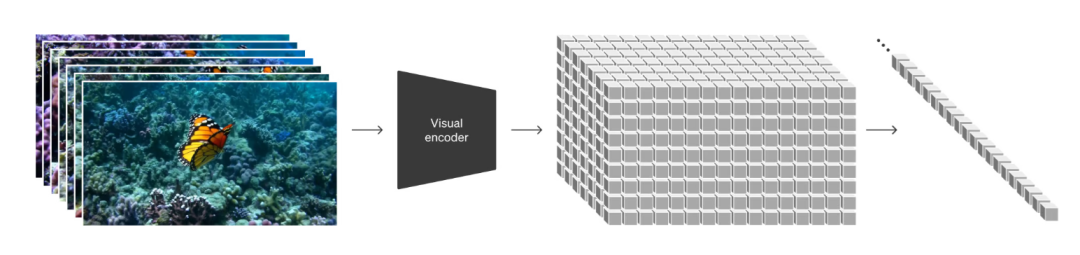
Figure 1. Sora maps video encoding to latent space and then cuts it into spatio-temporal patches, called time-space tokens. (openai.com)
As shown in Figure 1., Sora's training set is a short video set, each sample is a short video, and similar short videos form a data manifold. Sora encodes it into the latent space for dimensionality reduction, then cuts the latent feature vector into patches in the latent space, and adds time order to form a space-time patch, which is also a time-space token. The concept of space and time is crucial here. The frame sequence number (time) of each token in the short video and the row and column sequence number (space) of the current frame are recorded in the token.
Probability distribution transformation
We can further ask the following questions: 3. How to represent the probability distribution on the data manifold?
The answer to the third question is: use transfer transformation to transform the data probability distribution into a Gaussian distribution that can be generated by a computer. This transfer transformation can be performed in the original data space or in the latent space. Commonly used transfer transformations include optimal transfer transformation and thermal diffusion. We explain it from the perspective of fluid mechanics. Assume that the entire hidden space is a water tank with a certain solvent in it, and its density is the probability density. We disturb the tank, causing the liquid to flow, causing the solvent density to change. We calculate the flow direction and flow rate of each water molecule so that the entropy of the probability density continues to increase, and finally a Gaussian distribution is obtained. For example, we consider the distribution of face data, where each water molecule is a face image. We continuously add noise to the face image to obtain a series of images until it becomes a white noise image. This series of pictures is the movement trajectory of water molecules. Finally, each face picture becomes white noise, and all these white noise distributions satisfy Gaussian distribution. This process is known as Langevin's dynamics. Conversely, given a piece of white noise, we follow the trajectory of water molecules back to the source, and we get a picture of a human face. This is the principle of the diffusion model (diffusion model). Of course, you can also directly use the most transport theory to solve the homeomorphism of the hidden space to itself, turning the data distribution into a Gaussian distribution, which requires solving the Monge-Ampère equation. It can be seen that all information of the data distribution is contained by the transmission map, and the transmission map is expressed by a deep network.
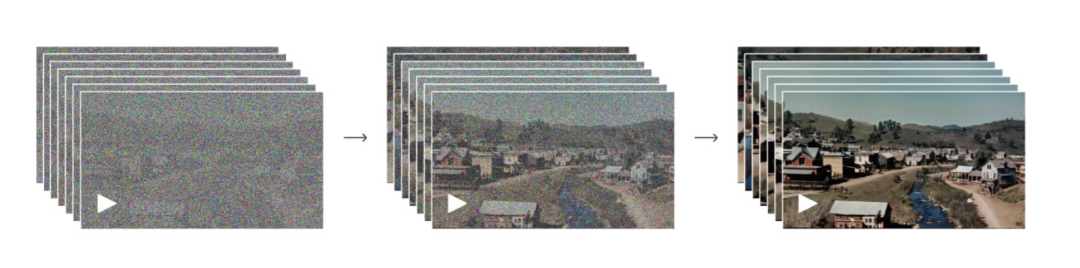
Figure 2. Sora uses a diffusion model to generate data space-time tokens from white noise space-time tokens. (openai.com)
As shown in Figure 2, Sora transforms the probability distribution of data tokens into a Gaussian distribution in the latent space through a diffusion process (Langevin dynamic system - gradually adding noise to each token), and then transforms the white noise tokens in the latent space into latent data tokens through the inverse transformation of the transmission transformation.
The blessing of large language models
Sora combines the large language model ChatGPT, which greatly improves the performance of the system. First of all, Soar’s training samples are (text, video) pairs. The titles corresponding to some videos are too short and the subtitles are missing. Sora uses Dall-E’s re-title technology.
Sora's training set contains some high-quality samples (highly descriptive subtitles, short videos), from which short video data manifolds (including spatiotemporal token manifolds) are trained, each manifold is identified by its subtitle (title). For low-quality short videos that lack titles or have ambiguous subtitles, Sora encodes them into latent space, looks for latent feature vectors adjacent to high-quality videos in the latent space, and then copies the subtitles (titles) of high-quality videos to low-quality videos. Using this method, Sora can add highly descriptive subtitles to all training video data, thereby improving the quality of the training set and further improving system performance.
At the same time, the large language model can expand the prompts input by the user to become more accurate and descriptive, so that the generated video can better match the user's needs. This makes Sora even more powerful. But Soar still has many flaws, which we can analyze through the following examples.
The contradiction between correlation and causation
ChatGPT decomposes sentences into tokens, and then uses a Transformer to learn the probability distribution of connections between tokens in context. Similarly, Sora decomposes videos into spatio-temporal tokens, then learns the probability distribution of connections between tokens in the context, and generates tokens from white noise based on this probability distribution, connects the tokens, and decodes them into short videos. Each token expresses a local area in the image or video, and the splicing between different local areas becomes the key to the problem. Sora learns each token relatively independently and expresses the spatial relationship between tokens with the probability reflected in the training set, making it impossible to accurately express the spatiotemporal causal relationship between tokens.
Video 1. A video of an old lady blowing out birthday candles generated by Sora. (openai.com)
As shown in Video 1, in the video generated by Sora, every frame is extremely lifelike, but when the old woman blew out the birthday candles, the flames of the candles did not move at all. If we narrow our field of view to the area of each token, we see a beautiful real picture, and the connection between tokens is also very smooth and natural. However, when there is a causal connection between tokens that are far apart, that is, when the blown air affects the beating of the flame, the physical cause and effect between the two tokens is not reflected. This means that Transformer is used to express statistical correlations between tokens and cannot accurately express physical causality. Although transformers can manipulate natural language to a certain extent, natural language cannot accurately express physical laws, and physical laws can currently only be expressed accurately by partial differential equations. This reflects some limitations of probability-based models of the world.
The contradiction between partial reasonableness and overall absurdity
At present, Sora's splicing between adjacent tokens is very reasonable, but the overall spliced video may have various paradoxes. This means a gap between local splicing and overall expansion.
We look at the "ghost chair" video, which makes perfect sense if we limit our field of view to a localized area in the middle of the screen. Carefully detect the direct connections between different token intervals, which are also very continuous and smooth. But the entire chair hangs like a ghost, which is contrary to everyday experience. This kind of "partially reasonable, overall absurd" generated video means that the Transformer has learned the local connection probabilities between Tokens, but lacks a large-scale overall concept of spatiotemporal context. In this video, the overall concept comes from the gravitational field in physics. Although it is not visible locally, it is always present as a whole.
Video 3. Four-legged ants generated by Sora. (openai.com)
Another example is the video of a "four-legged ant" generated by Sora. The ants' movements are lifelike, like flowing clouds and flowing water. The parts are very smooth and natural, and one can't help but think that there may be such four-legged ants on a certain planet. But overall, there are no four-legged ants in nature on Earth. The local rationality here cannot guarantee the overall rationality. The global concept here comes from biological facts.
Video 4. The polar opposite treadmill generated by Sora. (openai.com)
Another example is the "treadmill running in opposite directions" video generated by Soar. If we observe each local area, the videos we see are reasonable and the connections between video tokens are natural, but the overall video is absurd. The treadmill and the runner are in the opposite direction. The big picture in this video goes against the ergonomic facts.
These examples show that although the current Transformer can learn local context, it cannot learn a more global context. The global context here may be the gravity field in physics, ergonomics, or species classification in biology. This overall view is precisely the idea of dark matter in the AI world proposed by Professor Zhu Songchun. Although each training sample video implicitly expresses the global concept, the tokenization process separates the global concept and retains the connection probability between adjacent tokens to a limited extent, resulting in partially reasonable but overall absurd results.
Modern global differential geometry attaches great importance to the contradiction between the whole and the local part, and has invented a variety of theoretical tools for this purpose. For example, we can construct a smooth frame field locally on a topological manifold, but we cannot generalize it globally. The obstacle to global generalization is the representative class of fiber bundles. On a complex manifold, we can construct meromorphic functions locally, but overall we cannot splice local functions into an overall meromorphic function. This difference in local generalization to the whole can be accurately characterized by the cohomology theory of layers. Many physical theories are expressed as representative theories of specific fiber bundles, such as topological insulator theory. This kind of mathematical theory, which is easy to construct locally but has substantial difficulties in generalizing as a whole, is actually the crystallization of human wisdom in exploring nature in depth. This overall topological and geometric perspective has not yet been extended to the AI field. If the Transformer can learn the overall obstacles in this context by itself, then AI will explore the natural world more effectively.
Missing criticality
Most physical processes in nature are alternating changes between steady states and critical states. In the steady state, the system parameters change slowly, making it easy to obtain observation data; in the critical state (catastrophic state), the system suddenly mutates, catching people off guard, and it is difficult to capture observation data. Therefore, data samples for critical states are very sparse and have almost zero measure in the training set. As a result, most of the data manifolds learned by the Sora system are composed of steady-state samples. Critical state samples in physical processes are mostly distributed at the boundaries of the data manifold. Therefore, during the generation process, Sora easily generates video clips of steady states, but often skips critical states. But in human cognition, the most critical observation is precisely the critical state with almost zero probability.
In the juice splashing video generated by Sora, there are two stable states, the state where the water cup is upright, and the state where the juice has been splashed. However, the most critical critical state: the process of juice flowing out of the cup is not generated. Although it is only a few short frames, it is very important for human perception of the entire process. Sora's inability to generate images of key critical states may be due to the following reasons:
Different steady state samples in the physical process generate different connected branches of the data manifold. The critical state samples are near the steady state manifold boundary and between the two steady state manifold boundaries. The thermodynamic diffusion process blurs the boundaries of the manifold, thus confusing the manifold boundaries and producing a video of process ambiguity. In other words, the adjacent states correspond to the boundaries of the data manifold, and the boundary conditions should be maintained during the learning process without causing pattern confusion.
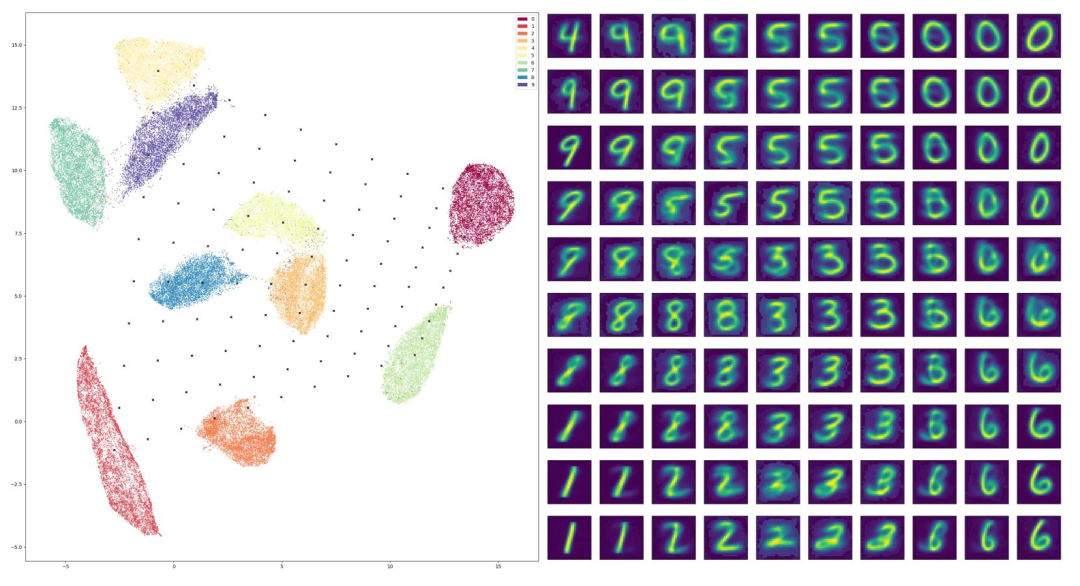
Figure 3. Mode mixture.
As shown in Figure 3, we used MNIST to train a codec and draw the latent space distribution of the data set in the latent space. 10 handwritten digits correspond to 10 clusters. Each cluster is a mode, that is, a connected branch of the data manifold. The boundary of the cluster is the boundary of the data latent space distribution support. We generated 100 sampling points in the latent space and generated 100 handwritten digit images through decoding. If the sampling point falls inside a cluster, the image generated will be very clear; if the sampling point falls outside the cluster boundary, the image generated will be very blurry, often a fusion of two handwritten digits. Therefore, identifying the boundaries of the data manifold is important to identify critical states.
The currently most popular diffusion model adopted by Sora will inevitably smooth the boundaries of the data manifold when calculating transmission mapping, thus confusing different modes and directly skipping the generation of critical state images. Therefore, the video seems to jump suddenly from one state to another, without the most critical dumping process in the middle, resulting in physical absurdity.
Video 6. Puppies generated by Sora. (openai.com)
Video 6 shows another situation where errors occur due to crossing manifold boundaries. Sora noticed that the puppies were laughing and fighting, sometimes covering each other, and sometimes spreading out. At a certain moment in the video, the three puppies on the screen suddenly turned into four puppies. We explain it this way: the pictures of 4 puppies form a manifold (or connected branch), and the pictures of 3 puppies form another branch. At the boundary of the manifold of the pictures of 4 puppies, there is a critical event: the four puppies block each other, and only 3 puppies can be seen in the picture. Sora's diffusion model does not recognize the boundaries of the manifold, but breaks through these boundaries, crossing between the manifold of 3 puppy pictures and the manifold of 4 puppy pictures. The correct approach should be to first identify the boundary of the manifold, and then return to the original manifold at the boundary when it is physically impossible to cross it (such as 3 sides and 4 sides).
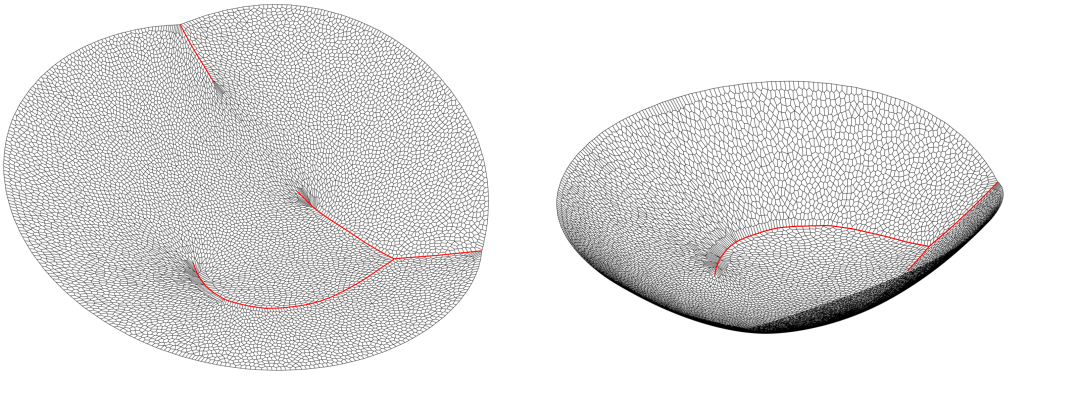
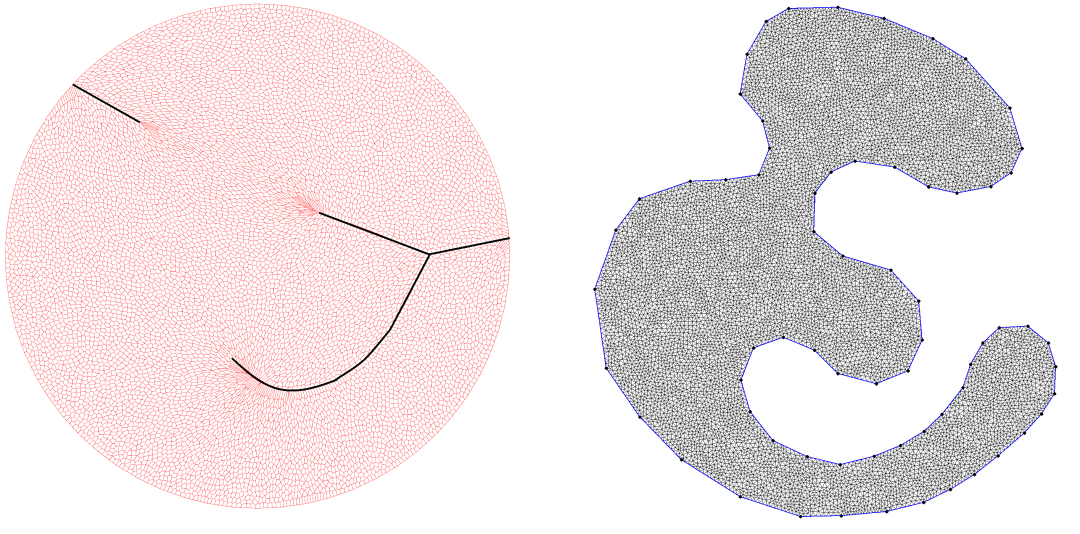
Figure 4. The optimal transmission mapping based on the geometric method can accurately detect the boundaries of the data manifold and accurately obtain the critical state.
The drawbacks of diffusion models can be overcome by optimal transport models based on geometric methods. As shown in Figure 4, suppose we calculate the optimal transmission mapping from the uniform distribution inside the disk to the uniform distribution within the hippocampus-shaped area on the right. According to the corresponding Brenier theorem, the optimal transmission mapping is given by the gradient map of a certain convex potential energy function. This potential energy function satisfies the Monge-Ampere equation. The potential energy function is not differentiable everywhere. Its continuous, non-differentiable set is projected to the singular set (black curve) of the disk area, the regular points are mapped to the regular points of the target area, and the singular set is mapped to the boundary of the target area (each singular point is mapped to the left and right boundary points at the same time). When we cross the singular set, it means that we cross two stable states, and a critical (catastrophic) event must occur, that is, a physical event in which the stable state is broken. It can be seen that accurately finding the singular set of transmission maps and detecting critical (catastrophic) states is of fundamental importance for modeling the physical world.
Summary
It can be seen that although Sora claims to be "a video generation model as a world simulation", the current technical route cannot correctly simulate the physical laws of the world. First of all, the correlation of probability statistics cannot accurately express the causality of physical laws, and the contextual correlation of natural language cannot reach the precision of partial differential equations. Secondly, although Transformer can learn the connection probabilities between nearby space-time tokens, it cannot judge the overall rationality. The overall rationality requires a higher-level mathematical theoretical perspective, or a more hidden and profound natural science. With a background in the humanities, the current Transformer cannot truly understand these global perspectives; in addition, Sora ignores the most critical critical (catastrophic) state in the physical process, on the one hand because of the scarcity of critical state samples, and on the other hand because the diffusion model blurs the boundaries of the steady state data manifold, eliminating the existence of the critical state, and the generated video shows jumps between different steady states. The optimal transmission theoretical framework based on geometric methods can accurately detect the boundaries of the steady-state data manifold, thereby emphasizing the generation of critical state events, avoiding horizontal jumps between different steady states, and getting closer to the physical reality.
Currently, the data-driven world simulation model represented by Sora and the world simulation model based on physical laws and partial differential equations established from first principles have begun to enter a fierce battle. This may be a great turning point in human history. I hope that young readers can jump into the flow of the times and use their ingenuity to promote the development of science and technology and society!
Machine-translated from the Chinese original Sora物理悖谬的几何解释 (published 2024-02-21). WeChat original ↗