This article explores the evolution of mathematical tools - the modern toolbox of mathematical researchers. It is written by MaRDI (in German and English) and is now translated into Chinese for promotion and introduction.
MaRDI (Mathematical Research Data Initiative), a consortium of 15 research institutions in Germany, led by the Weierstrass Institute for Applied Analysis and Stochastic Research (WIAS), is creating an infrastructure for processing mathematical data based on the FAIR principles (Findable, Accessible, Interoperable, Reusable, Findable, Accessible, Interoperable, Reusable). This includes the creation of data repositories, web portals, standardized procedures, search engines, and training and promotion throughout the mathematics community and beyond.
|
Author: MaRDI4nfdi.de (German Mathematics Research Data Initiative MaRDI) 2024-3-21 Translator: zzllrr Xiaole (mathematics popular science public account) 2024-3-24 |
|---|
|
What does a mathematician need? |
|---|
These needs (documentation and communication space) are universal, have not changed over the centuries, and will remain the same in the future. A basic set of tools (pen and paper, books and articles, university departments, meetings, chalk and blackboard...) can last a long time. However, the work and practice of scientific researchers (particularly mathematical researchers) evolve with social and technological times. Today's researchers need additional specialized tools to meet the specific needs of contemporary research. They use digital means to access literature and communicate with colleagues quickly and efficiently; they use the computing power of machines to explore new areas of mathematics; they use management tools to process large amounts of data and coordinate the work of distributed teams. In this article, we will review some of the practical tools that have historically transformed the practice of mathematical research. Some of these tools are technological changes that affect society as a whole, such as the Internet and the advent of the information age. Some are the result of changes in the way the field of mathematics evolves, such as the data-driven mathematics research that MaRDI is designed to help support. We will also review some initiatives that are trying to change current common practices (the CRediT system for attributing authorship), and finally we will explore some tools that may one day become a daily resource for mathematicians (The impact of formal mathematics on mathematical practice).
|
From polymath to army of experts |
|---|
We can start looking back at history with the Academy of Athens or the Library of Alexandria as the "tools and infrastructure" of ancient mathematicians. But we will jump directly to the 17th and 18th centuries and look back at some of the giants in the history of mathematics, such as Descartes, Newton, Leibniz or Gauss. They are interdisciplinary scientists who have made breakthroughs in fields such as mathematics, physics, applied science, engineering and even philosophy. Mathematics at that time was an interdisciplinary academic study, with physics or engineering problems driving mathematical progress, and mathematics driving understanding in applied fields. The circle of savants in these times was relatively small, and they mostly knew each other. They mainly use Latin as the language of professional communication because it is the cultural language learned in each country. They kept in touch through letters and often published their works in carefully edited volumes, as publishing and distribution was an expensive process. Interestingly, it was also in the 17th century that the first scientific journals appeared, such as the Philosophical Transactions of the Royal Society and the Journal des Sçavans of the French Academy of Sciences (both started around 1665). These journals are naturally not only dedicated to mathematics or specific sciences, but are more oriented towards inclusive concepts of science and culture. However, article formats quickly became the primary tool for scientific communication.
Fast forward a century, to the 19th century, and scientists' practices had changed significantly. Mathematics is fixed as a separate branch and most mathematicians study only mathematics. Applications still inspire mathematics, and mathematics still helps solve applied problems, but in this century most scientists focus on making contributions to one aspect or another. This is a process of specialization in which the "savant" who can contribute to many fields is replaced by the expert who understands a specific, narrower field more deeply. In this century we begin to find journals dedicated exclusively to mathematics, such as Crelle’s Journal (Journal für die reine und angewandte Mathematik, 1826). By the end of the century (and the beginning of the 20th century), this process of specialization had also reached various scientific fields, and mathematics was also divided into different fields, such as geometry, analysis, algebra, applied mathematics, etc. Mathematicians like Poincaré and Hilbert are often considered the last universal mathematicians, able to make important contributions to many, almost all areas of mathematics.
In the 20th century, as higher education became more widespread and accessible, the number of universities and the number of researchers increased significantly, creating more specialized research communities. The number of scientific journals has proliferated accordingly, with publication rates and article creation exceeding those of traditional book formats. Due to the large number of articles, new bibliographic tools emerged, such as tables of contents (the German Zentraralblatt MATH - zbMATH and the American Mathematical Society's Mathematical Reviews - MR started in 1931 and 1940 respectively) and other bibliometric tools (the impact factor has been calculated since 1975). These review directories have been for decades the first means by which many mathematicians communicate and discover new things in the research community. Their (now harmonized) classification of mathematical disciplines also brings a much-needed taxonomy to the growing family tree of mathematical branches. The conference format, among which there are many international participants, has also been consolidated as a scientific format, a way of disseminating results and a measure of institutional prestige.
|
computing revolution |
|---|
The next period we will consider began with the introduction of computers and later accelerated with the addition of the Internet and the World Wide Web. Computers have impacted the practice of mathematics on two levels. On the one hand, the computer itself, purely as a computing machine, opened up a new field of research, namely computer science. Many mathematicians, physicists, engineers... turned their attention to computer science in their early years. In particular, mathematicians began to explore algorithms, and branches of mathematics that were inaccessible before computing power. For example, numerical algorithms, chaos and dynamical systems, computer algebra, statistical analysis, and more. These new fields of mathematics have developed specific computer tools in the form of programming languages (Julia, R, etc.), libraries, computer algebra systems (OSCAR, Sage, Singular, Maple, Mathematica, etc.) and many other frameworks that have now become essential tools for the daily practice of these mathematicians.
On the other hand, computers have affected mathematics as they have affected all other information-processing tasks: namely, office automation. Computers help us manage documents, create and edit text, share documents, and more. One of the first computer tools to impact the lives of mathematicians was the TeX typesetting system. Famously, TeX was created by computer scientist Donald Knuth over more than ten years (1978-1989) for typesetting his "The Art of Computer Programming". However, many people use the more popular version of LaTeX (i.e. "TeX with macros, ready to use") released by Leslie Lamport in 1984. See Xiaole's popular mathematics: Turing Award winner Lamport, the father of LaTeX: How to write mathematically perfect software? - Translated from Quanta Magazine, Xiaole's popular science of mathematics: 83-year-old Turing Award winner Leslie Lamport (Leslie Lamport talks about mathematical structured proofs at GT Georgia Tech). Before TeX/LaTeX, formulas were inserted into text either by treating them as images (which had to be manually drawn by someone into the final document, or engraved onto a printed version), or by a semi-automatic process using physical font templates to combine the formulas. It's a tedious process that's only useful for printing finished documents, not drafts or early versions to share with colleagues. With TeX, mathematicians (and physicists, engineers...) can finally describe formulas the way they want them to appear, and seamlessly with the rest of the text. This had an impact on the speed and accuracy of the publishing (printing) process, but also on a new frontier that was just emerging in time: online sharing.
The early history of the Internet includes the first protocols for computer communications and the first military computer network (Arpanet), but the real driving force for civilian research and society at large was Tim Berners-Lee's invention of the World Wide Web at CERN in 1989. It was originally intended as a purely scientific research tool for the exchange of scientific information, with the goal of becoming a "universal link information system". Emerging almost simultaneously with the creation of the WWW was another key tool for today’s mathematicians: the arXiv archive of papers and preprints. First offered as an FTP service (1991) and soon on the WWW (1993), this archive managed by Cornell University has become a reference source and primary source for new work published in mathematics and many other fields of study. Many researchers post their preliminary articles to arXiv as soon as they are ready to share them, before sending them to traditional journals for peer review and publication. The arXiv thus serves a dual purpose: it is an archive for hosting and sharing results (and justifying priority where necessary), and a tool that allows many researchers to discover new works. arXiv has a mailing list/RSS feed where you can get daily news about published (or upcoming) work in your specific area of interest. arXiv has largely replaced this discovery functionality previously provided by review services (zbMATH, MR). These directories do not host works; instead, they index and review peer-reviewed articles (zbMATH Open also indexes some of arXiv's directories). As indexing tools, these services remain authoritative (complete, with well-vetted reviews, and well maintained) and provide valuable bibliometric data and linkage information, but their role as discovery tools is no longer undisputed.
|
data revolution |
|---|
At this point we have covered the main tools of mathematicians up to the end of the 20th century and into the contemporary period. One challenge facing 21st century research is data management. Most science has always been based on experiments and data collection, but the scale of data collection has grown to unprecedented levels, often referred to as "big data." Here, we use the term to refer both to specific big data sets and to the variety of projects and data (of varying sizes) that flood the scientific field.
Many data repositories have become essential tools for working with data types other than research papers. In the case of software, Git (2005) and Git repositories (GitHub, 2008) have become the most popular source code management tools and alleviate or solve many problems in managing source code versions and collaborative creation of software.
Digital Object Unique Identifiers (DOIs, 2000) have become the standard for creating reliable, unique, and persistent identifiers for ever-changing files and digital objects on the Internet. Publishers assign these DOIs to digital versions of their publications, but in reality, a DOI is essentially a generic label for any digital asset. Repositories such as Zenodo (2013) provide DOI and hosting services for common data and digital objects.
In the field of mathematics, as in other sciences, it relies heavily on data, whether experimental (statistics, machine learning...), extensive collection and classification (groups, clusters, combinations...), source code of scientific calculations, documentation of processes across disciplinary areas, etc. The scientific community, especially the mathematical community, is larger than ever, and the challenge is not only to keep track of all the progress, but also to keep track of all the methods and replicate all the results yourself. To this end, the scientific community is building research data infrastructure to help researchers in their daily lives. This is where MaRDI (and NFDI for other branches of science) strives as a project to help in this area.
Structuring research data, on the one hand, means creating the necessary infrastructure (databases, search engines, repositories) and guiding principles that guide the progress of science ethically and philosophically. The FAIR principles we discussed in previous articles (Research data should be Findable, Accessible, Interoperable, and Reusable) provide a practical implementation of these principles, as well as common ground such as the verifiability of results, researcher neutrality, or the flow of the scientific method. On the other hand, the structuring of research data will only succeed if researchers embrace new practices that are not seen as imposed obligations but as reliable, fluid tools that make their results better and their work easier.
MaRDI is intended to be a tool for mathematicians and other researchers in their daily work. Some of the services MaRDI will provide include access to numerical algorithms that are richly described, benchmarked, and curated for interoperability; browsing object collections and providing a standardized working environment (reproducible software stack) for algebraic calculations; curating and annotating tools and databases for machine learning and statistical analysis; describing formal workflows for interdisciplinary research teams, etc. All services of MaRDI will be integrated into one MaRDI portal, which will serve as a search engine (for literature, algorithms, people, formulas, databases, services, etc.). We have introduced some MaRDI services in previous articles and will introduce more in future articles.
|
Collaboration challenges |
|---|
A challenge facing many scientific fields is the growing number of research teams dedicated to specific research projects. In many experimental or modeling fields, it is not uncommon to find a long list of 8, 10, or more authors authorizing an article, as this is the visible output of a research project involving multiple people. Different people play different roles: from the person who designs the project, to the person who performs the experiments in the laboratory, to the person who analyzes the data, to the person who writes some code or runs some simulations, to the person who writes the text of the paper, etc. Listing all these people as "authors" gives no clue to their roles, and the method of ordering names by relative importance doesn't improve the situation much. This challenge requires a new consensus on good scientific practice accepted by the scientific community. The most developed solution proposed is the CRediT system (Contributor Role Taxonomy https://credit.niso.org), a standard taxonomy of 14 roles designed to cover all possibilities in which researchers may contribute to a research project in all possible ways. This system was proposed by NISO, an American non-profit publishing, bibliographic and library application standards organization.
For reference, here we list 14 roles and their descriptions:
-
Conceptualization ( Conceptualization ): idea; proposing or developing overall research goals and objectives.
-
Data sorting ( Data curation ): Management activities that annotate (generate metadata), clean data, and maintain research data (including the software code required to interpret the data itself) for initial use and subsequent reuse.
-
Formal analysis ( Formal Analysis ): Apply statistical, mathematical, computational, or other formal techniques to analyze or synthesize research data.
-
Fund acquisition ( Funding acquisition ): Obtain financial support for the research project leading to this publication.
-
Survey( Investigation ): Conducting research and investigation processes, especially performing experiments, or collecting data/evidence.
-
Methodology ( Methodology ): Develop or design methodology; create models.
-
Project Management ( Project administration ): Responsible for the management and coordination of the planning and execution of research activities.
-
resources ( Resources ): Providing research materials, reagents, materials, patients, laboratory samples, animals, instruments, computing resources or other analytical tools.
-
Software ( Software ): Programming, software development; designing computer programs; implementing computer code and supporting algorithms; testing existing code components.
-
Supervision ( Supervision ): Supervisory and leadership responsibility for the planning and execution of research activities, including guidance outside the core team.
-
verify( Validation ): Verify the overall reproducibility/repeatability of results/experiments and other research outputs, whether conducted as part of an activity or independently.
-
visualization( Visualization ): Prepare, create and/or present published work, especially visualizations/data presentations.
-
Writing - Original Draft ( Writing – original draft ) :Original Draft - Preparing, creating and/or presenting published work, especially writing an initial draft (including substantive translation).
-
Writing - Review & Editing ( Writing – review & editing ): Preparation, creation and/or presentation of published work by members of the original research team, particularly for critical review, commentary or revision - including pre-publication or post-publication stages.
Advice to academics is to start applying these roles to each team member in a research project, keeping in mind that one or more people can assume one or more roles, and only applicable roles should be used. Level of contribution is optional (e.g. 'Dominant', 'Equal' or 'Supporting').
Using author contributions can be fairly straightforward. For example, imagine a team of four people working on a computer algebra project. Alice Arugula was a professor who came up with the idea for the project, discussed it with Bob Bean (a postdoc), and together they developed the main idea. Then Bob brought in two doctoral students, Charlie Cheeseman and Diana Dough, who wrote the code, and all three studied the problem and filled in the results. Bob and Diana wrote the paper, Charlie packaged the code into a library and released it in a popular repository, and Alice reviewed everything. They published papers and all of them appeared as authors. Following CRediT and publisher guidelines, they included a paragraph at the end of the introduction:
Author contributions
Conceptualization: Alice Arugula, Bob Bean; Formal analysis and investigation: Bob Bean (lead), Charlie Cheeseman, Diana Dough; Software: Charlie Cheeseman, Diana Dough; Data curation: Charlie Cheeseman; Writing - original draft: Bob Bean, Diana Dough; Supervision: Alice Arugula.
For publishers, CRediT recommends requiring authors to detail their contributions, listing all authors and their roles, and ensuring that all contributing teams hold responsibilities assigned based on roles. Technically, publishers are also required to make role descriptions machine-readable using existing XML tag descriptors.
|
formal mathematics |
|---|
We will end with a more speculative tool that mathematicians may use in the medium-term future. One branch of metamathematics that is mature enough to permeate all other areas of mathematics is formal mathematics. Computers and formal languages, once the study of theory as part of a formal logic, or as the basis of mathematics, now allow mathematical definitions, propositions, and proofs to be transcribed in a machine-readable and processable form, allowing computers to verify proofs. Computer-aided proofs are now generally accepted in the mainstream (at least for symbolic computation), a long time since the "shock" caused by the four-color theorem and other early calculations in mathematics in the early 1970s and 1980s. In addition to using computers to perform specific calculations to aid in proofs during proofs, formal mathematics also brings the possibility of verifying entire chains of arguments and logical steps for a proof of a proposition starting from a hypothesis. The Coq system and language were used by Georges Gonthier to formalize the above-mentioned four-color theorem in 2005, and to formalize the Feit-Thompson conjecture in 2012. Most recently, the LEAN system supported Peter Scholze's condensed mathematics project in 2021, and the polynomial Freiman-Ruzsa conjecture proposed by Tim Gowers, Terence Tao, and others in 2023. (See the full text of Xiaole’s popular science of mathematics: 2022 International Congress of Mathematicians’ one-hour report “The Rise of Mathematical Formalism” Kevin Buzzard’s speech, Xiaole’s popular science of mathematics: exclusive interview with Kevin Buzzard, the one-hour speaker of the ICM 2022 International Congress of Mathematicians: Can computers become mathematicians? - Translated from Quantum Magazine)
Advocates of the “formal mathematics revolution” dream of a future in which all research articles will be accompanied by a machine-readable counterpart that encodes the same statements and proofs as the human-readable parts. At some point, AI systems can assist with human-to-machine translation. Validation and peer review of the results would then become a simple run of code in the system, limiting human intervention to pure language clarity and language style issues. Some even speculate that when logical deduction techniques can be coded into machines, AI systems can be trained to optimize, suggest, or collaborate with human mathematicians to generate new results.
Whether these formal languages will remain a niche tool for mathematicians or become widespread practice among mathematicians at large, and whether mathematical research will one day be aided by artificial intelligence systems, are open questions to be seen in the coming decades.
|
Mathematics Research Data Initiative (MaRDI) Mission |
|---|
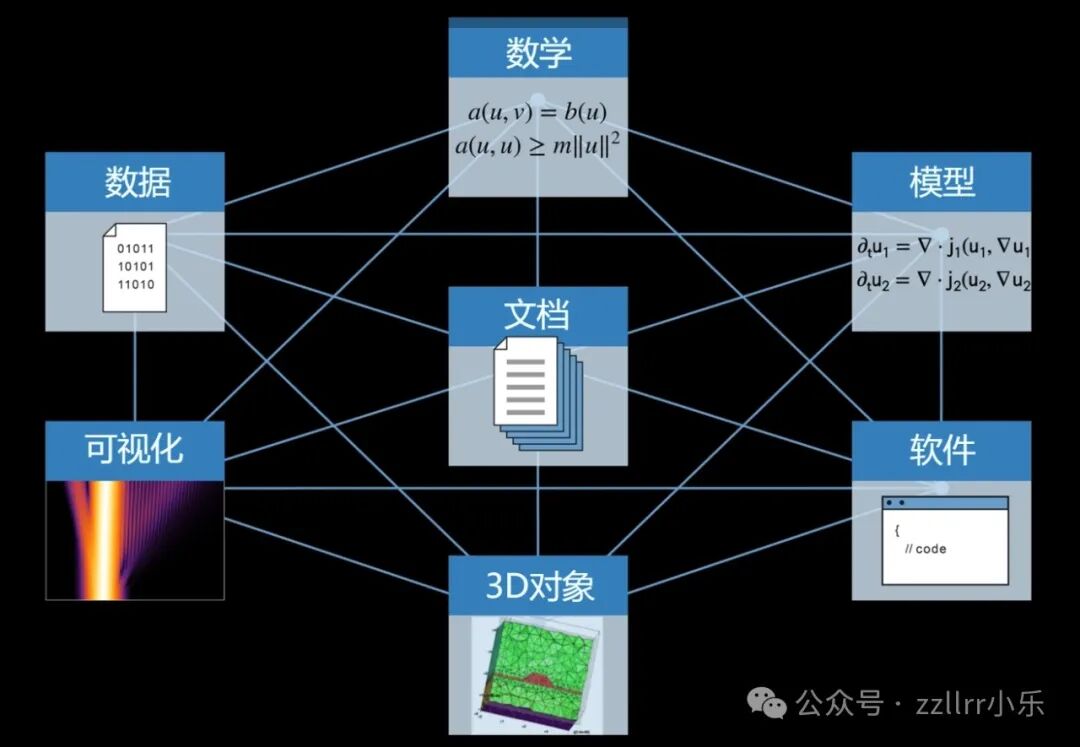
Mathematics research data is large, complex, and multifaceted. It occurs not only in mathematical sciences but also in other scientific fields such as physics, chemistry, life sciences and art. Standardized formats, data interoperability and application programming interfaces need to be developed to ensure ease of use of data across disciplines.
With this in mind, the Mathematics Research Data Initiative (MaRDI) was established as a Mathematical Sciences Alliance initiative. Its mission is:
-
Develop a robust mathematical research data infrastructure that will be useful not only within mathematics, but also in other disciplines and non-scientific fields.
-
Develop standards and verifiable workflows for certified mathematical research data,
-
and for services to the mathematical community and the broader scientific community.
All of these are essential to create and establish collaborative platforms that are critical for knowledge dissemination, quality control, and scientific discussion.
MaRDI’s vision:
Build a community that embraces FAIR principles for data culture and research workflows by sustainably enabling MaRDI discoveries.
|
References |
|---|
· Open · Friendly · Diverse · Universal · Clumsy · Make mathematics easier to learn, practice, teach, research, appreciate, play, see and obtain
Easy to spread and easy to reach
Machine-translated from the Chinese original 小乐数学科普:数学研究者的现代工具箱 by 德国MaRDI(数学研究数据倡议) (published 2024-03-27). WeChat original ↗