Translator's note:The interviewee for this article, Martin Lawson, is also the interviewer of many Abel Prize winners over the years. The translation is long and divided into two parts. This article is the first part.
Interviewer profile:Christian F. Skau (Christian F. Skau, hereafter referred to as CFS, 1939 -, professor at NTNU, Norwegian University of Science and Technology), research field is C*-algebras and their interaction with symbolic dynamical systems. He also had a keen interest in Abel's mathematical works and published several papers on the subject.
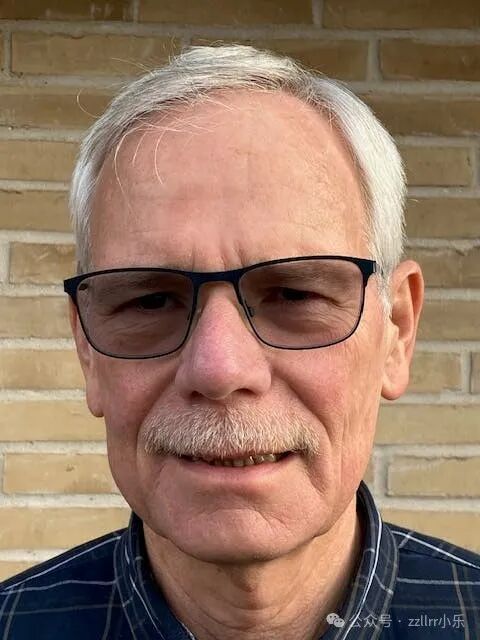
Interviewee profile:Martin Raussen (Martin Raussen, hereafter referred to as MR, 1954 -, professor at Aalborg University, Denmark), whose research results include contributions to the development of algebraic topology, especially in the context of concurrency theory. His research interests involve the application of topology in computer science, in particular the application of geometric and topological methods in computer science.
|
Author: Christian F. Skau ( Christian F. Scow )2024-3-19 Translator: zzllrr Xiaole (mathematics science public account) 2024-3-28 |
|---|
Interviewers conduct interviews with Abel Prize winners in a long-term collaboration with interviewees (from the first winner in 2003 until 2016, when Bjørn Dundas (1963-, University of Bergen, Norway) succeeded MR). Before the opening of the 29th Nordic Congress of Mathematicians (co-organized by EMS European Mathematical Society) in Aalborg, Denmark, in July 2023, CFS conducted an interview with MR. What follows is a lightly edited version of the recorded interview. (There is a YouTube video link at the end of the article)
|
Nordic Congress of Mathematicians |
|---|
CFS:Martin, we both did a lot of interviews together. This time no one else asked, just me! We have a double special occasion: this afternoon the 29th Nordic Congress of Mathematicians opens here in Aalborg, a celebration of the 150th anniversary of the Danish Mathematical Society, and after this summer you will be retiring from your position at Aalborg University. Can you tell us about your relationship with the Nordic Congress of Mathematicians?

MR: I will try my best to answer, but before that, let me thank you for coming on this special occasion. I am very grateful to you for coming here from Oslo, where we have been interviewing Abel laureates together for several years.
Before I answer your question: interviewing Abel Prize winners is like talking to the winners of the UEFA Champions League (UEFA Champions League) in football. I'm not at that Champions League level at all. I even had trouble participating in the UEFA Conference League! Therefore, I am very honored to have this opportunity to be interviewed.
I started working on bringing the Nordic Mathematicians Congress to Aalborg about five years ago. Initially, writing a letter to apply takes very little time. Forming a good and reliable team is essential for organizational work. In the final year, the mission accelerated. We have been very busy in the last month. But now we are happy to host over 400 conference attendees. There will be eight general sessions at the House of Music in Aalborg and we will have 29 special sessions in a very close university building. The only fly in the ointment, in my opinion, is that the weather has been getting worse lately.
|
First experience with mathematics |
|---|
CFS:Now let's talk about you as a mathematician. My first question is: What initially sparked your interest and fascination with mathematics?
MR:My late father was a high school math and physics teacher. He was very interested in the subject and often talked about math topics with several of our siblings. He tries to give us little challenges from time to time. The first problem I can remember happened when I was a little kid, maybe just starting school, or maybe second grade. In one situation specifically involving brown and white hens, he asked me a question that, in retrospect, could be formulated as two simple linear equations in two variables. I have absolutely no idea how to solve this problem, but the numbers involved are not very large. I could try it in my head and after a while I found the answer. He commented that it was a bit unusual for a kid that age and I was proud.
The second example I remember happened when I was a little older. I've heard of a test to determine if a number is divisible by 3 or 9 by simply taking the sum of the digits. I started thinking: What are these divisibility tests for other numbers? It was absolutely impossible for me to discover a pattern divisible by 7 at that time! But by experimenting with just two or three digits in my head, I found that for 11, it's the alternating sum that works. This makes me excited! I remember writing a little note about my discovery and passing it out to some friends in my class at school. They weren't too interested, but it was my first taste of mathematical success.
CFS:This is a good story! A natural question: When did you discover that you really had a special talent for mathematics?
MR:Talent and interest are closely related. I was a little older at the time and was still influenced by my father, who at that time became interested in Boolean algebra and concepts related to the first digital computers. He led a small seminar on Boolean algebra. I attended and got the impression that once you have something you can express in Boolean algebra, computers can work for you.
I began to study the relationship between natural numbersgreatest common divisor(gcd - greatest common divisor) andleast common multiple(lcm - least/smallest common multiple) respectively as operations. Here you get onedistribution grid(distributive lattice, a lattice that satisfies the distributive law. The lattice is a partially ordered set with two binary operations: join (denoted as ∨) and intersection (meet, denoted as ∧). They correspond to the union and intersection operations in set theory respectively. The distributive lattice is widely used in fields such as computer science, logic, and algebra. Translator's note), but in most cases, the factors of a natural number do not form Boolean algebra. it's only rightNumbers without square factors(square-free number) applies. In retrospect, this is clear because the lattice corresponds to the power set of prime factors, but I didn't know this at the time. Anyway, I wrote a small note and even tried to publish it in a small educational journal. It didn't work out, but I remember telling myself, "I can contribute to something like research in some way." All of this happened before I started college.
|
mathematics education |
|---|
CFS:Very good. So let's talk about your math training. Tell us about your mathematical education, starting at the Max Planck Gymnasium in Trier and ending with your PhD in mathematics at the Georg-August University in Göttingen.
MR:That covers a long time! I went to a school called the Max Planck Gymnasium in Trier in southwestern Germany. When people ask me about Trier, I reply: That’s the city where Karl Marx (1818-1883) was born! Except for me and many others, of course. As you can guess from the name, Max Planck Gymnasium is a middle school that places a strong emphasis on mathematics and natural sciences.
Other high schools in Trier focus either on ancient languages, such as Latin and Greek, or modern languages, such as French, which is important in Trier because of its proximity to the borders of France and Luxembourg. At the Max Planck Gymnasium, you can spend your last two or three years specializing in mathematics and physics.
This gave me something of a head start when I started studying at the University of Saarland in Saarbrücken, which is about 100 kilometers from Trier. I was 17 at the time and I started studying maths and computer science, a subject I had only started the year before. In mathematics we have to follow the standard curriculum: linear algebra and analysis. Initially, I felt more comfortable in linear algebra because I have a rather algebraic way of thinking. I also enjoyed learning about Turing machines, computability, and formal languages in computer science.
Our analysis course consisted of three consecutive semesters and was taught by a young professor, Tammo Tom Dieck (1938-), who had just received a professorship in Saarbrücken. He was a student of the famous Heidelberg topologist Dieter Puppe (1930-2005). Professor tom Dieck taught us analysis very well, starting from the basics and ending with vector analysis. In the third semester, the content is quite complex. I was attracted to Tom Dieck's personality and the dynamic of his young assistant staff. The charisma of these people transcended the discipline itself and left a deep impression on me.
Looking back, I am grateful for the inspiration they gave me. As a follow-up, there were courses in differential topology, a subject that was developing rapidly at the time. After another three semesters, we were close to the results of Kervaire (Michel Kervaire, 1927-2007) and Milnor (John Milnor, 1931-) on spherically smooth structures. Milnor later became one of our Abel laureate interviewees! I feel a real challenge and excitement: after the first three years of college, we reach a level where, at least to some extent, we can read and understand papers that we might have written five or ten years ago. There were also interesting workshops where we were challenged to give presentations on papers from the literature.
I should add that I received a grant from the German People's Academic Foundation (Studienstiftung des deutschen Volkes), a funding agency for talented university students, and this money made me financially independent. Since I was also making some money as a freshman advisor, I was feeling pretty well off at the time! The German People's Academic Foundation also offers opportunities during the holidays at summer institutes, usually held in beautiful locations in the Alps. That's challenging! I met many other eager and talented students. Additionally, interesting topics that are not limited to mathematics are taught and discussed.
All of this got me to a certain level. I requested a master's thesis topic and Tom Dieck gave me a suggestion. It took me some time to find the right mindset; the question was no longer differential topology, but algebraic topology. I've never taken a course in algebraic topology, but at the seminar I gained some knowledge. I completed this master's thesis in about a year, eventually typing it up on an old typewriter and inserting the special letters by hand.
But then something else happened: my teacher Tom Dieck was recruited to Göttingen for a professorship. Therefore, his entire team, his assistants and several students, followed him to Göttingen. I received my master's degree at Saarland University, but the final oral examination had already taken place in Göttingen.
|
gottingen |
|---|
Saarbrücken and Göttingen are very different. Göttingen has a lot of traditions: you can still walk to the observatory where Gauss worked, and the hall where you enter the mathematics department is called Hilbert Space (This has the same name as the abstract mathematical concept Hilbert space. It is a pun humor of the mathematics department staff. Translator's note). You can walk through the offices where many outstanding mathematicians worked. Buildings for the Department of Mathematics and the nearby Department of Physics were constructed with support from the Rockefeller Foundation after World War I.
CFS:Were they not destroyed in World War II?
MR:Göttingen was almost intact; only a few buildings were damaged. The city was not militarily important; this fact did not help that many other German towns...
Göttingen is a relatively small city; you can walk almost everywhere. The university is old and many of its facilities are outdated. I had to learn to appreciate its charm. Saarland University, on the other hand, was established after World War II and has modern buildings and equipment.
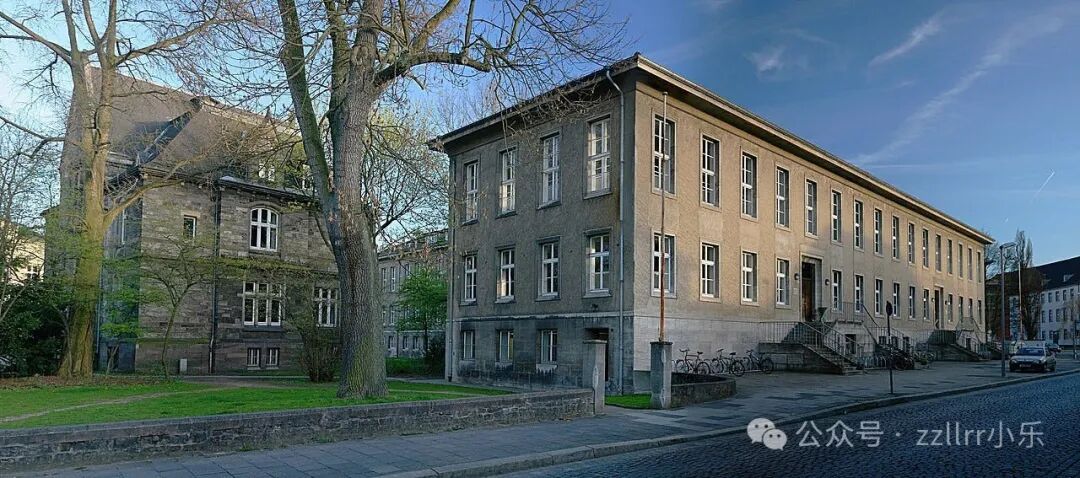
Department of Mathematics, University of Göttingen Architecture
CC BY SA 3.0 Daniel Schwen / Wikimedia Commons
CFS:Approximately how many students are there in Göttingen?
MR:Göttingen was a relatively small town with over 100,000 inhabitants at the time. I think there were about 20,000 students, maybe 30,000 now. Students were indeed (and still are) a very dominant group of the population. I don't know the exact number, but there are hundreds of math and physics students.
CFS:From what you've told me, it seems like a natural progression for Tom Dieck to be your PhD advisor?
MR:In fact, I started working under his guidance. But then Larry Smith, then a homotopy theorist, was hired as the department's new young professor. Each professor had two or three assistants, and I received a position as one of them. While I was still working on the first part of my PhD thesis, I was "taken over" by Larry Smith, and I was his assistant for several years. Then, naturally, people say: since you have to work with this professor, he should also be your mentor. In fact, the transition was very smooth.
My work topics have also naturally undergone some changes. When you write your paper, start exploring uncharted territory. Some half-baked ideas may not work, and then you try something else.
Finally, my thesis concerns the homotopic classification of fiber bundle lifts and, more specifically,smooth manifold(smooth manifold)dip(immersion) and embedding (embedding).
CFS:I understand. You said before that you started getting more interested in algebra and then moved on to algebraic topology...
MR:In my opinion, topology is an ideal combination of several disciplines. You can't do interesting topology without some knowledge of algebra, analysis, and geometry. At first, I felt like I wasn't good at geometric thinking. I've never been good at drawing. I've taught myself math-related drawing, but beyond that I don't have any artistic talent, I'm afraid.
I have taught introductory differential geometry courses many times during my teaching career. Then I try to promote the subject by telling students that you can get exciting results by cleverly combining analytical and linear algebra methods. This synthesis fascinated me, and I think it made me enjoy geometry and topology more than other areas of mathematics.
|
mathematical research |
|---|
CFS:This is a good description. Now, let’s talk about your postdoctoral research. Much of your recent research work has been on what is called in algebraic topologyhomotopy(directed homotopy) andConcurrency(concurrency), which is a concept in theoretical computer science. Can you explain it?
MR:Let me start by telling you what’s next in my career. As a PhD candidate, I had the opportunity to study in Paris for a year. When I was living in the Cité universitaire in Paris, France, I met a Danish girl who later became my wife. So I had to learn Danish and I moved from Göttingen to Denmark. I worked briefly at the Technical University of Denmark in Lingbi, near Copenhagen, with Vagn Lundsgaard Hansen (1940-), and then at the University of Aarhus with Ib Madsen (1942-), a doyen of Danish topology. From there, I applied for and was eventually offered a position as an associate professor at Aalborg University Center in the northern part of the Danish peninsula.
When I got there, I was the only topologist in the department. I regularly attend seminars at Aarhus University and consider this my research lifeline. I had to teach a lot of classes, had three young kids to take care of, and the time I had for research—which was atEquivariant algebraic topology(equivariant algebraic topology) - very limited. A few years later, my good friend and colleague Lisbeth Fajstrup, a student of Ib Madsen, joined the department.
Nonetheless, we felt somewhat alone in our research and, with the encouragement of colleagues, we began to consider research on applied areas of topology. When we heard that there was going to be a conference on new connections between mathematics and computer science at the Isaac Newton Institute in Cambridge, UK, an opportunity, a wild card, presented itself. We applied and were accepted. During that week there were many interesting talks. Two of the lectures excited me from the beginning: one was an overview of the connection between distributed computing and topology, and the other was a lecture on the connection between concurrency and topology; it turns out that the two are related to each other.
Let me tell you about concurrency and topology: the latter happens more and more when you don't just run a program on one processor, but become distributed, and that becomes interesting. You want to do a calculation, or run an algorithm, and you can distribute it across various entities on your own laptop, or even across the World Wide Web. Regardless, several units collaborated to arrive at a solution. In extreme cases, there is little or very little coordination between them. In order to rely on the results of this joint effort with little coordination, you need to have robust algorithms in the sense that whether one processor reaches the goal quickly should not be affected by the fact that the other processor slows down for some reason. On the other hand, if they communicate via some common register, the order of access may be critical.
For a simple case, consider three processors, each processing a linear code without loops and branches. You can then interpret the composite process as a path in three-dimensional space. But not all paths are possible: time is directional, so these paths will increase weakly in the direction of the coordinate; a bit like what happens in the theory of relativity. Furthermore, some regions in this three-dimensional state space are forbidden due to coordination constraints: only one or at most a limited number of processors can access the same memory at the same time.
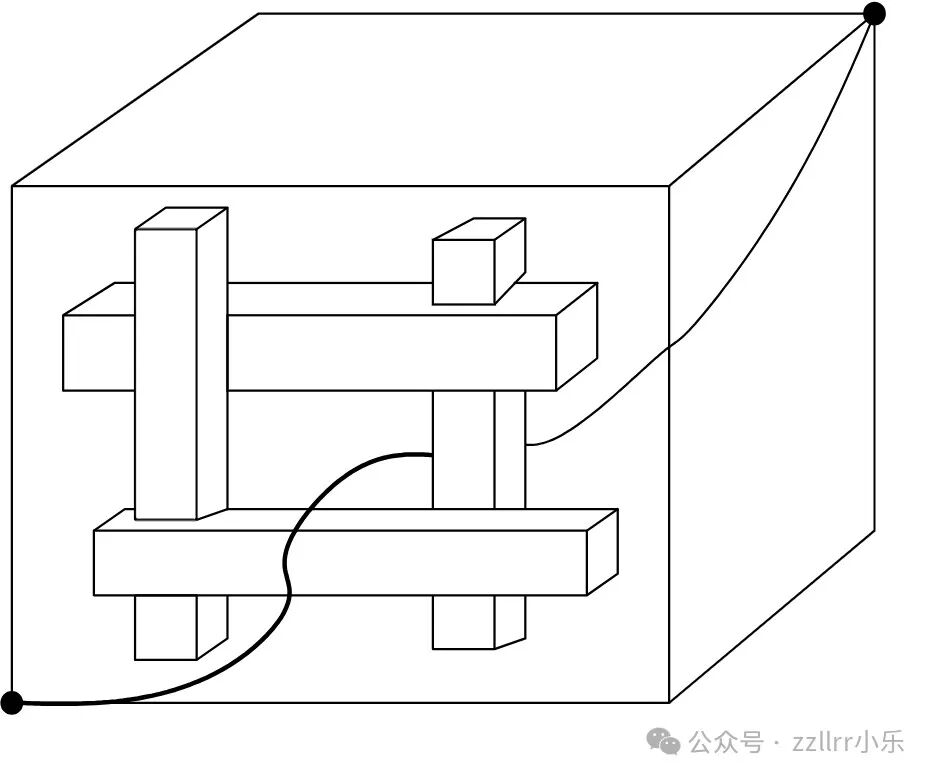
Directed paths in a cube with obstacles. This path is homotopic to the directed path on the cube boundary, but is not homotopic in any directed way. CC BY 4.0
More abstractly, we want to study directed paths in spaces with "holes", typically usingcubic complex(cubical complex) modeling. When combined with a language, these are calledHigh-dimensional automata(higher dimensional automata). It turns out that directed paths that are homotopic in a directed manner describe equivalent composition processes that always produce the same results for distributed algorithms. Directed homotopy between directed paths, and more generally,directed mappingThe directed homotopy between (directed map) is a single parameter deformation in which all intermediate steps are also directed.
directional(Directedness) is both the essence and the challenge. You cannot immediately apply the standard techniques of algebraic topology. We found some examples of directed paths that are homotopic in the standard sense but are not homotopic when all intermediate paths are required to be directed. Ultimately, you want to describe and construct the space of all directed mappings up to directed homotopies, and compute it algorithmically.
CFS:Is anyone in the theoretical computer science community interested in your approach?
MR:There is some interest, and one of our original foundational papers is still cited regularly. However, I must admit that there is a larger community in computer science working on what is calledPetri netI don’t know much about the coordination problem and algorithm of Petri net. Many of their results are similar to ours. In fact, our Dutch collaborator Rob van Glabbeek, who is now in Scotland after many years in Australia, has shown at an abstract level that high-dimensional automata are at least as expressive as Petri nets: everything they can model, we can too... but we are a small community compared to others.
I would add that we see ourselves as a branch of the rapidly growing field of applied topology, of which topological data analysis is the most important and popular member of the family.
|
Abel Prize interview |
|---|
CFS:It's all very exciting. Now we're going to switch gears completely. As you mentioned, you eventually became an associate professor and then a distinguished professor at Aalborg University. You have been heavily involved in teaching and have served as a tutor to many students on a variety of mathematical topics. You were also named Teacher of the Year in 2018 and 2019.
In addition to this, you have been involved in public outreach activities, giving public lectures on various aspects of mathematics. Raising public awareness of mathematics is more than just a slogan for you. You take this very seriously. As one of the editors of Matilde, the newsletter of the Danish Mathematical Society, and as editor-in-chief from 2002 to 2003, you published interviews with various mathematicians, which made you well suited to initiate interviews with Abel Prize winners. Can you talk about the genesis of the interview with the grand prize winner?
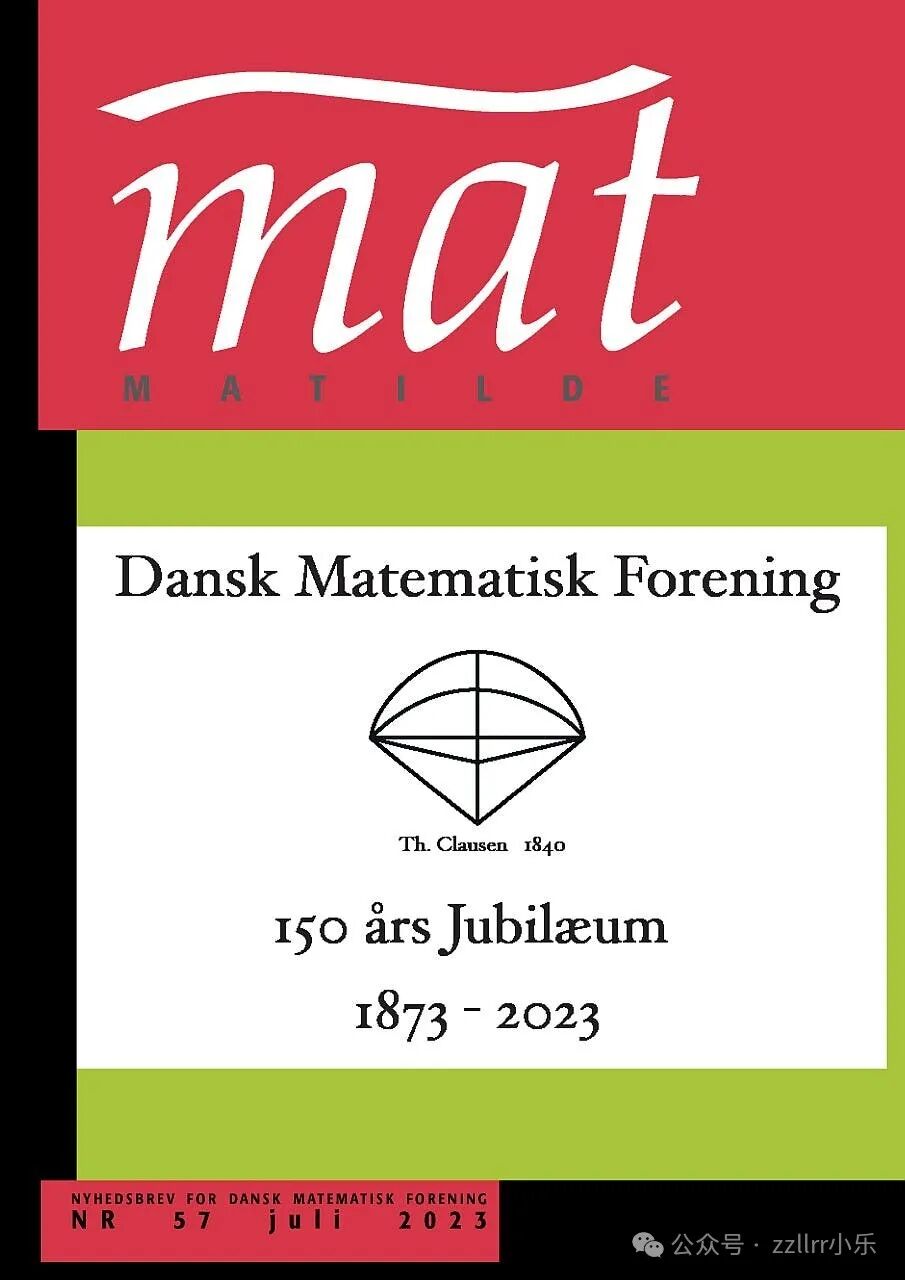
"Matilde" the last issue in 2023 CC BY 4.0
MR:"Matilde" is the journal of the Danish Mathematical Society. It was founded by Bodil Branner when he was the president of the Danish Mathematical Society. This year the Danish Mathematical Society celebrates its 150th anniversary. One of her many initiatives was to establish a regular newsletter. By the way, I came up with its name, Matilde: the word Mat (matematik in Danish for "mathematics" without the h) plus a tilde!
I became part of the newsletter editorial team and my task was to interview some of the “old-timers” of Danish mathematics, such as Ebbe Thue Poulsen from Aarhus and Bent Fuglede from Copenhagen (Bent Fuglede, 1925-2023). Of particular note is the interview conducted with Ib Madsen on the eve of his 60th birthday.
Regarding the Abel Prize, the editorial board of Matilde was contacted by the Danish Embassy in Norway to ask if we would be interested in covering the first Abel Prize ceremony in Oslo. I discussed this option with the editor-in-chief at the time, Mikael Rørdam. I mustered up all my courage and suggested that we should ask for an interview with the first Abel Prize winner, Jean-Pierre Serre (1926-).
CFS:That was in 2003?
MR:Either at the end of 2002 or at the beginning of 2003. We wrote back to the embassy and they contacted the Abel Committee. The committee agreed and informed Professor Serre. Your colleague Kristian Seip (Christian Seip, 1962 -) must have heard about this initiative...
CFS: He was president of the Norwegian Mathematical Society at the time…
MR:He felt it was a pity that the Norwegians themselves did not ask for this opportunity. I don’t know if he asked you first...
CFS:I think he asked me first.
MR:Okay, he suggests you get involved too. I don’t remember the details, but the two of us got in touch. We didn't know each other at the time. I attended the 20th Nordic Congress of Mathematicians in Trondheim in 1988, and you were involved in that, but I don't think we were in contact at the time.
Anyway, we formed a team and it turned out to be a really good idea. First of all, it makes me feel more relaxed, and in the long run, we become a "dream team," right? We complemented each other from different perspectives during the interviews. We coordinated the questions we wanted to ask, one last time the night before the interview.
CFS:In fact, you taught me a lot of interviewing techniques. I learned a lot from you.
MR:Thank you! But you always bring up lots of interesting questions and quotes yourself. I still remember how nervous we were during our first interview with Jean-Pierre Serre.
CFS:And he was not in a good mood at first!
MR:It's really not good, and I kind of understand why: all the recipients of the Abel Prize so far have been quite old. Their schedules are tight during the week-long celebration. They were asked to attend many meetings, ceremonies, they had to give speeches, and then one and more interviews! I don't know, but I imagine Serre might be thinking: "Another interview with stupid reporters asking stupid questions."
CFS:That's right. But let me tell you, the real breakthrough is when you tell him that you know how he discovered some very important concept related to fiber plexuses. His eyes immediately lit up. "Oh, you know about this?" he said, and that changed the mood. From then on, he became very active.
MR:mentionedpath fibrosis(path fibration) is a game changer in interviewing. I re-read this interview this morning and it's actually still pretty funny now!
(To be continued)
|
References |
|---|
Christian F. Skau, Interview with Martin Raussen. Eur. Math. Soc. Mag. 131 (2024), pp. 11–21
DOI 10.4171/MAG/181
https://euromathsoc.org/magazine/articles/181
https://youtu.be/4_ab-SSKLg0
https://www.imaginary.org
Xiaole Mathematics Popularization: The 2024 Abel Prize will be awarded to Michel Talagrand for his pioneering contributions and applications in probability theory and functional analysis.
Popular Science in Mathematics for Xiaole: A Conversation with Abel Prize Winner László Lovász by Raffaella Mulas
Xiaole Mathematics Science: A conversation with Karen Uhlenbeck, the first female Abel Prize winner - Unable to conceive and have children, mathematics became my comfort
Xiaole Mathematics Popular Science: Interview with the 2023 Abel Prize winner: Luis Ángel Caffarelli (LÁC) Luis Ángel Caffarelli
Xiaole Mathematics Science: 2022 Abel Prize winner Dennis Sullivan hopes you will look at mathematics in a different way and stay interested
Xiaole Mathematics Popularization: Exclusive Interview with Dennis Sullivan, winner of the 2022 Abel Prize - Translated from the European Mathematical Society EMS

· Open · Friendly · Diverse · Universal · Clumsy · Make mathematics easier to learn, practice, teach, research, appreciate, play, see and obtain
Easy to spread and easy to reach
Machine-translated from the Chinese original 小乐数学科普:采访阿贝尔奖得主的数学家Martin Raussen马丁·劳森 by Christian F. Skau(上) (published 2024-03-28). WeChat original ↗