Topics of the month:
1. How old is the decimal point?
2. Topology of Telepathy
3. The “Observer Problem” in Mathematics
|
Author: Professor Tony Phillips 2024-3-26 Translator: zzllrr Xiaole (mathematics popular science public account) 2024-3-27 |
|---|
|
1. How old is the decimal point? |
|---|
"Decimal Fraction Representation and the Decimal Point in Fifteenth-Century Italy" written by Glen Van Brummelen (Trinity Western University, Canada) was published online by the journal Historia Mathematica on February 17, 2024, and was adopted by a news report in Nature two days later, with the title declaring "The decimal point is 150 years older than historians think."
Prior to van Blummelen's paper, historians believed that the first appearance of the decimal point was in a table published in 1593 by the Jesuit German astronomer Christopher Clavius. We now know from van Brummelen that it dates back to a table of trigonometric functions written by the Venetian mathematician Giovanni Bianchini around 1440. Bianchini's table has been digitized by the Jagellonian Library in Kraków; the decimal point noted by van Brummelen is on page 108.
To provide some context, the Treviso Arithmetic published in 1478 (the earliest known printed dated arithmetic book) has no trace of this notation.
Below you can see an excerpt from the Bianchini table. The first column gives the angle in degrees and minutes. The second column gives the corresponding tangent function value multiplied by 10000 [my calculator gives tan(68°) = 2.47508]. The third column, the one in which the decimal point appears, gives the increment corresponding to one minute increase in arc. [Since 21.2 = (25387 – 24751)/30, etc., this establishes a linear interpolation between degrees and half degrees]. So for 68°5', the table would give 24751 + 5×21.2 = 24857. My calculator (multiplied by 10000) gives 24855.
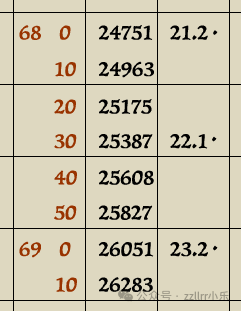
Copy of detail from page 108 of the Jagiellonian Library manuscript
In addition to demonstrating this early appearance of the decimal point, van Blummelen's paper also pointed out contradictions in European calculations in the early 15th century. While merchants and bankers were struggling to transition from Roman numerals to Indo-Arabic notation and choose the best way to perform long division, astronomers and mathematicians were calculating tables of trigonometric functions with the precision of four to five significant digits.
|
Reference 1 |
|---|
https://www.sciencedirect.com/science/article/pii/S0315086024000016/
https://www.nature.com/articles/d41586-024-00473-2
https://jbc.bj.uj.edu.pl/dlibra/publication/476393/edition/577221/content
|
2. The topology of telepathy |
|---|
A team in Japan is using concepts from graph theory to study how our brains synchronize with those of the people we interact with. This experiment was reported in the article "The Role of Interpersonal Neural Network Topology in Weak Social Ties" in Nature Scientific Reports (February 29, 2024), which focused on the difference between interacting with strangers and interacting with acquaintances. Authors Yuto Kurihara, Toru Takahashi and Rieko Osu from Waseda University explained that each experiment involved a pair of participants. There were 14 pairs of strangers and 13 pairs of acquaintances in total. Each participant wore headphones and a wireless 29-channel electroencephalography (EEG) headset; they sat back-to-back; each controlled a computer mouse that when clicked produced a sound that both parties could hear. They were instructed to listen to a sequence of eight equidistant tones produced by a metronome and then continue this sequence alternately: participant 1, then participant 2, then participant 1, until 300 clicks (150 per person), matching as closely as possible the inter-tap interval (ITI) of the metronome.
Two people sit side by side and take turns clicking
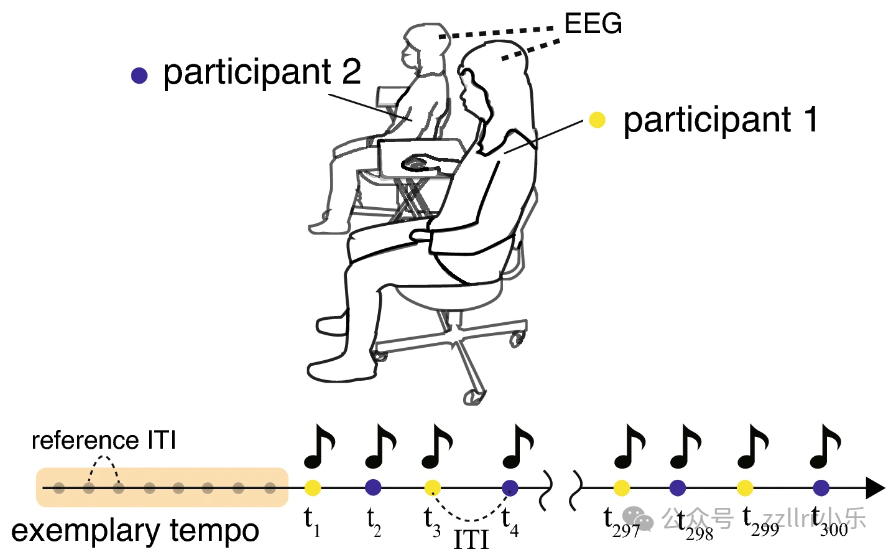
Experimental setup. Each participant takes turns clicking to extend the sequence of tones in a "demonstration rhythm" set by a metronome. The picture is adapted from Figure 1 of the article "The relationship between interpersonal coordination stability and EEG synchronization during anti-phase tapping" (Sci Rep 12, 6164 (2022)) by Yuuto Hota, Toru Takahashi, and Satie Nagao.
Used under CC by 4.0 license
The experiment tested each pair of participants under four conditions, including slow tapping (ITI = 0.5 seconds) and fast tapping (ITI = 0.25 seconds). EEG recordings were filtered into three frequency bands: low (θ), mid (α), and high (β) frequency waves, which were analyzed separately. In each case, a 58 × 58 matrix was used for inter/intra-brain synchronization, with one matrix element for each pair of monitored EEG channels (29 + 29 = 58 channels in total), including pairs of channels from the same participant. After processing to eliminate background effects, matrix elements are simplified to 1 if the synchronization between channels is significantly higher than the background and 0 otherwise. This data is used to construct a graph with a vertex for each of the 58 channels and links between pairs of channels corresponding to 1 in the matrix.
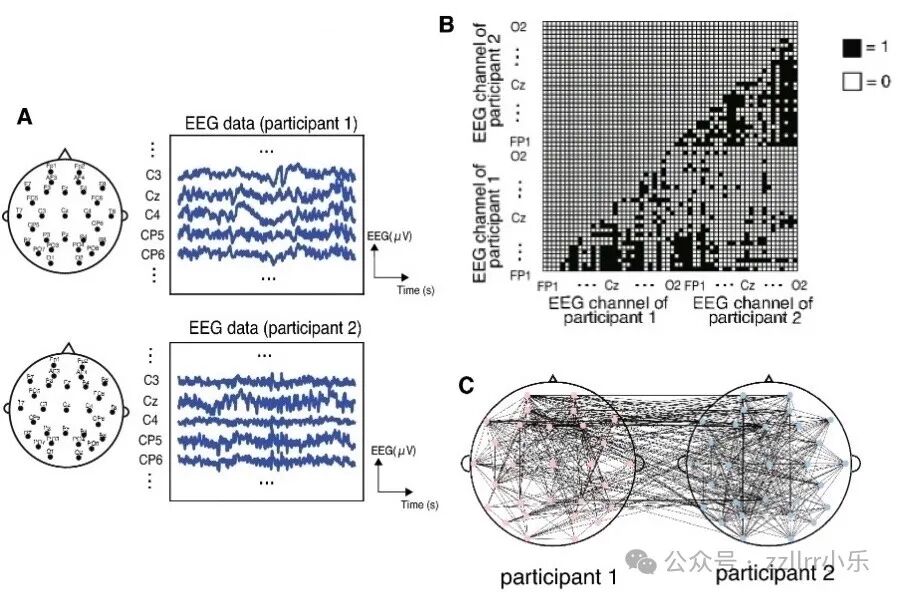
A. Electroencephalograms of two participants.
B. Matrix of gray and black squares. All black squares are in the lower right half.
C. Bipartite graph, each half focused on one participant's brain.
From EEG to Graph. For each frequency band and each set of conditions, the synchrony between the 58 channels of EEG recordings (A) was normalized and shown in a matrix of 0s and 1s (B). In graph (C), if the corresponding matrix element is 1, it means that the vertices of the channel are connected by edges. Image adapted from Figure 2 in the above quote. Used under CC by 4.0 license
The team reports that in the "fast click" condition, maps of the theta band showed significant differences between performance in pairs of strangers and pairs of acquaintances. The graph theory criterion used for this distinction islocal efficiency(local efficiency), first introduced in a 2001 paper in Physical Review Letters. This is the average of the local efficiency at a particular vertex v and is calculated as follows: look at v's neighbors, which form a subgraph Gᵥ. For each pair of vertices in Gᵥ, calculate the reciprocal of the length of the shortest path in Gᵥ. (Note that when one vertex is easy to reach from another, there will be short paths, making this number large.) The local efficiency at v is the average of this number across all pairs of vertices in Gᵥ. The overall local efficiency is the average of the local efficiencies of all vertices v.
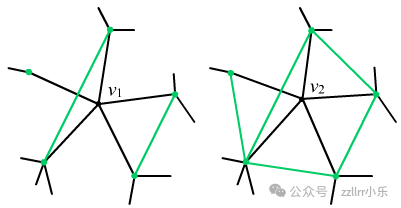
On the left, one vertex v₁ is at the center of the star, the other vertices are connected to v₁ by spokes, and only two pairs are connected in green. On the right, a similar graph, but now with five edges connecting neighbors without passing through the central vertex
The local efficiency at vertex v measures the resilience of the connections in the graph when vertex v is deleted. Calculated here in two different situations. In each case, the subgraph Gᵥ of v’s neighbors is shown in green. Averaging the reciprocal of the shortest path length gives E(v₁)= 1/5, and E(v₂)= 11/15
Image by Tony Phillips
In the Discussion chapter, the authors cite previous research on the correlation between interpersonal interactions and lower EEG frequency activity. They further commented that interacting with strangers is a more novel experience and will require more processing and retention than interacting with acquaintances. As far as I know, the question of why local efficiency should be exactly the criterion for showing this difference is not addressed.
|
Reference 2 |
|---|
https://www.nature.com/articles/s41598-024-55495-7
https://journals.aps.org/prl/abstract/10.1103/PhysRevLett.87.198701
|
3. The "Observer Problem" in Mathematics |
|---|
Edward Frenkel (UC Berkeley) published "Mathematics, like quantum physics, has an observer problem" on the Institute of Arts and Ideas website on February 6, 2024. Frenkel begins by reminding us that in the quantum world, different experimental setups can lead to seemingly contradictory results, with electrons sometimes looking like particles and sometimes like waves.
How does something like this happen in mathematics? The answer is that the mathematics we do ultimately depends on the axioms we choose to base our logic on, and there is no way to check whether we have a completely satisfactory set of axioms.
Frenkel focused on set theory, the system that provided the language of mathematics. It has its own axioms. The collection most of us currently use is calledZFC(Zermelo-Fraenkel set theory with the Axiom of Choice), but a small minority (Frenkel estimates 1%) reject one of the axioms: the axiom of infinity. The axiom of infinity asserts that the set of natural numbers 1, 2, 3, ... exists; as Frenkel explains, this is much stronger than the proposition "for every natural number there is a greater number" - where you are always talking about some finite number. Accepting the natural numbers as a set means that there can be a set containing infinitely many elements, something some "finitists" find disturbing and refuse to do so. (This is indeed disturbing, if you stop and think about it.) As Frenkel explains, Gödel's second incompleteness theorem means that it is impossible to know how the axiom of infinity affects the completeness of mathematics.
Why is this important? It turns out that there are some theorems about finite sets that cannot be proven without the axiom of infinity. One of them (see below) is an enhanced generalized version of the "Cocktail Party theorem" we discussed last November (see Xiaole Mathematics Popular Science: Professor Tony Phillips's Mathematics Reading Review 2023-11). In 1977, Jeff Paris and Leo Harrington proved this to be a theorem, but the proof essentially used the infinity axiom. Using the language of quantum physics, in one "setting" this statement is true, but in another "setting" it is unprovable. Whether the observer is a finitist or not makes a difference in the results.
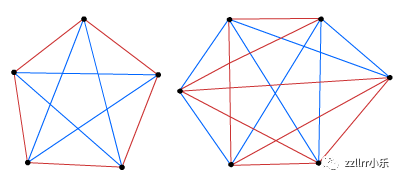
r(3,3)
The controversial theorem isEnhanced version of finite Ramsey's theorem(strengthened finite Ramsey theorem). To begin to illustrate this theorem, let's go back to the "cocktail party theorem" for a moment. It is based on a special case of the finite Ramsey theorem: Suppose N points are connected in pairs by red and blue lines. If N is large enough, then any such configuration must include either a red triangle or a blue triangle. (In this particular case, N = 6 is large enough, which is the "cocktail party theorem".) Finite Ramsey's theorem is about sets, but for convenience we continue to "visualize" it using geometric objects, here the objects are k-simplexes. A 0-simplex is a point, a 1-simplex is a line segment, a 2-simplex is a triangle, and a 3-simplex is a tetrahedron. Generally, a k-simplex consists of k+1 vertices and all line segments, triangles, tetrahedrons, etc. formed by any pair, triplet, quadruple, etc. of these points. These subsimplexes are called faces of the k-simplex: 0-faces (vertices), 1-faces (edges), 2-faces (triangular faces), etc. For the general statement of the theorem, we start with three numbers n, m and c, where m ≥ n, and an N-simplex which we call K. I first color each n-face of K with one of c colors. The Finite Ramsey Theorem asserts that if N is large enough, then K has a face Y of dimension at least m whose all n-faces are the same color. (In the context of the "cocktail party theorem", n = 1 and m = c = 2. If K has at least 6 points, then there is a 2-face whose all 1-faces - interpreted as the sides of the triangle - are the same color.)
Finite Ramsey's theorem can be proved without using the infinity axiom. The enhanced version cannot. It involves correlating the N+1 vertices of K to the integers 1, 2, ..., N+1, and the theorem says the same as above, except for the additional property that Y can be required to have a dimension greater than the smallest integer among the integers corresponding to its vertices.
|
Reference 3 |
|---|
https://iai.tv/articles/math-like-quantum-physics-has-observer-problems-ed-frenkel-auid-2733
https://plato.stanford.edu/entries/goedel-incompleteness/
https://www.math.stonybrook.edu/~tony/whatsnew/nov23/11-2023-media.html
Xiaole Mathematics Popular Science: Professor Tony Phillips’s Mathematics Newspaper Review 2023-11
|
All references |
|---|
https://mathvoices.ams.org/mathmedia/tonys-take-february-2024/
Xiaole Mathematics Popular Science: Professor Tony Phillips’s Mathematics Newspaper Review 2023-11
https://www.sciencedirect.com/science/article/pii/S0315086024000016/
https://www.nature.com/articles/d41586-024-00473-2
https://jbc.bj.uj.edu.pl/dlibra/publication/476393/edition/577221/content
https://www.nature.com/articles/s41598-024-55495-7
https://journals.aps.org/prl/abstract/10.1103/PhysRevLett.87.198701
https://iai.tv/articles/math-like-quantum-physics-has-observer-problems-ed-frenkel-auid-2733
https://plato.stanford.edu/entries/goedel-incompleteness/
https://www.math.stonybrook.edu/~tony/whatsnew/nov23/11-2023-media.html

· Open · Friendly · Diverse · Universal · Clumsy · Make mathematics easier to learn, practice, teach, research, appreciate, play, see and obtain
Easy to spread and easy to reach
Machine-translated from the Chinese original 小乐数学科普:Tony Phillips教授的数学读报评论2024-02 (published 2024-03-28). WeChat original ↗