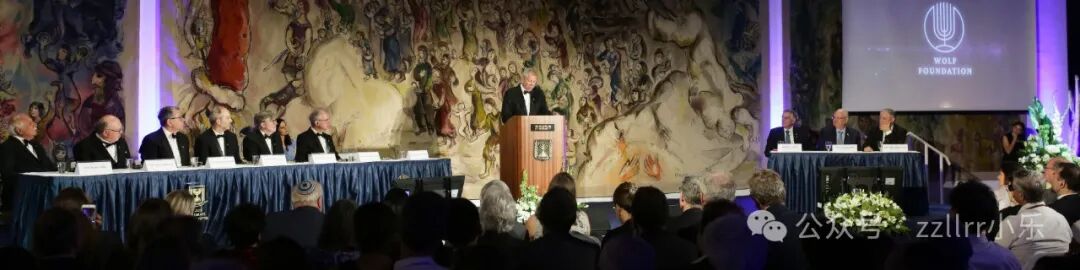
According to the latest news from the official website of the Wolf Foundation, the 2024 Wolf Prize in Mathematics will be jointly awarded to Professor Adi Shamir (1952-) from the Weizmann Institute of Science in Israel and Professor Noga Alon (1963-) from Princeton University in the United States, "in recognition of their pioneering contributions to mathematical cryptography, combinatorics and theoretical computer science."

|
Introduction to the winners |
|---|

Adi Shamir (born in Israel in 1952)
Adi Shamir is a professor in the Department of Computer Science and Applied Mathematics at the Weizmann Institute of Science and one of the most senior computer scientists in the world. He is a leading expert in the field of information encryption and decryption. Samour was one of the developers of the RSA method, which changed the face of computer communications in the world and is a fundamental pillar of electronic commerce and information security.
Samour showed an interest in science at an early age and participated in the Weizmann Institute of Science's Youth Academic Program and science summer camps. After receiving his bachelor's degree in mathematics with honors from Tel Aviv University (1973), Samour continued his studies at the Weizmann Institute, specializing in computer science, where he received his master's degree in 1975 and his PhD in 1977. He studies the properties of certain mathematical functions related to the semantics of programming languages. After completing his doctoral studies, he held a short-term postdoctoral position at the University of Warwick, Coventry, UK, and continued his academic journey at the Massachusetts Institute of Technology (MIT) in the United States, where he began to study the theory of encryption and decoding.
In traditional encryption, keys are critical for both message encryption and decryption, which creates security challenges for key distribution. Looking for a solution, MIT researchers Ron Rivest, Adi Shamir, and Leonard Adelman devised a groundbreaking public-key encryption method in 1977 called RSA (short for its three developers, Rivest, Shamir, and Adelman). This method utilizes a one-way mathematical function based on prime multiplication, ensuring that the original solution cannot be retrieved. RSA uses two different but mathematically related keys: a public key for encryption and a private key for decryption, eliminating the need to distribute keys. RSA encryption technology is globally recognized and is the cornerstone of protecting confidential data in online communications, e-commerce and transactions. Its importance extends beyond practical uses, attracting the attention of mathematicians, companies, governments and intelligence agencies. The RSA method has become the basic and almost exclusive basis for protecting computer information and electronic commerce.
Samour made numerous contributions to information security, including pioneering secret-sharing methods. This technique converts a secret into a set of random numbers that require specific combinations to reconstruct the original secret, forming the basis for secure calculations. He collaborated with peers to improve identification and signature methods through zero-knowledge proofs and designed ring signatures for group-based encryption. Samour's ingenuity extended to the encryption of television broadcasts, allowing encrypted transmissions exclusively for paying recipients. In recent years, his research has delved into T-functions, complex mathematical tools used for information encryption. Samour's influence also extends to exposing vulnerabilities in cryptographic systems, developing common mathematical methods for attacks, and pioneering side-channel attacks on both hardware and software implementations. Beyond information security, his contributions have resonated in core computer science, in particular shaping computational complexity theory.
Adi Samour was awarded the Wolf Prize for being a truly outstanding scientist and a leading force in transforming cryptography into a mathematically based scientific discipline. His fundamental discoveries combined mathematical ingenuity with an array of analytical tools. They have had a huge impact on multiple areas of mathematics, advancing mathematics and society in unparalleled ways.

Noga Alon (b. 1956, Israel)
Noga Alon is Professor of Mathematics at Princeton University, Baumritter Professor Emeritus in the Department of Mathematics and Computer Science at Tel Aviv University, and one of the most influential mathematicians in the world. His research and developments changed the face of the field, created new concepts and original methods, and made significant contributions to the development of theoretical research and their applications in discrete mathematics, information theory, graph theory and their applications in computer science theory. He is one of the world's most prolific mathematicians, publishing hundreds of articles and educating many graduate students in mathematics and computer science.
Aron has shown a keen interest in mathematics since he was a child, and was attracted by the objectivity of mathematics and the pursuit of absolute truth. Encouraged by his parents and math teachers, Aron followed his passion, delving into mathematics and participating in math competitions. After graduating in mathematics from the Technion-Israel Institute of Technology, he went on to earn his master's and doctoral degrees from the Hebrew University of Jerusalem in 1983 and held visiting positions at several research institutions, including MIT, Harvard University, the Institute for Advanced Study in Princeton, IBM Almaden Research Center, Bell Labs, Bellcore, and Microsoft Research (Redmond and Israel). He joined Tel Aviv University in 1985 and served as Dean of the School of Mathematical Sciences from 1999 to 2000. He retired from Tel Aviv and moved to Princeton University in 2018 to work today, supervising many doctoral students. He serves on the editorial board of more than ten international professional journals and has given invited lectures at many conferences. He is Chairman of the Scientific Committee of the World Mathematical Congress (Madrid, 2006) and a member of several prestigious award committees around the world. He has published more than six hundred research papers and one book.
Aron's contributions to mathematics were widespread and influenced many related areas of theoretical and applied science. He and his collaborators established a tight connection between the unfolding properties of graphs and their spectral properties and discovered numerous applications of expanders in combinatorics and theoretical computer science. His results inspired a great deal of further work and were cited by essentially all subsequent extensive work in the field. In related work, he pioneered the application of spectral methods in the study of algorithmic problems. Alon proved the combinatorial Nullstellensatz (1995), a powerful algebraic technique that has led to very important applications in graph theory, combinatorics, and additive number theory, including an extension of the four-color theorem. Together with Nathanson and Ruzsa (1996) he obtained a generalization of the Cauchy-Davenport theorem. In collaboration with Kleitman (1992), he solved the Hadwiger and Debrunner problem posed in combinatorial geometry in 1957, proving a far-reaching generalization of Helly's theorem. This approach has proven highly influential and is described in recent books and survey articles on the subject. Aron (1998) refuted the Shannon conjecture proposed in 1956 and proved a surprising fact: the Shannon capacity of the disjoint union of two channels can be much larger than the sum of their respective capacities, and even much larger than any fixed power of this sum.
Aron played an important role in the development of probabilistic methods in combinatorics, and the book he co-authored with Spencer on the subject, Probabilistic Methods (1st ed. 1992, 4th ed. 2016), is the undisputed leading work in this central area. See Xiaole Mathematics Popularization: The author of "Probabilistic Methods" won the 2021 Steele Prize for Mathematical Exposition. The color-coding method he developed with Yuster and Zwick (1995) has found applications in several other areas, including fixed-parameter tractability and bioinformatics theory. His work with Matias and Szegedy (1999) initiated research on streaming algorithms, investigating which statistical properties of data streams can be dynamically sampled and estimated. This indeed creates new active areas of streaming algorithms and sketching algorithms, with numerous theoretical and applied applications.
Aron and his collaborators (1994) developed an algorithmic version of Szemerédi's canonical lemma, discovered its connection to Grothendieck's classical inequalities, and used it to solve essentially all major open problems in the theory of property testing of dense graphs. This sparked extensive research and played an important role in the subsequent development of convergent graph sequence theory by Lovasz and his collaborators.
Some of Noga Alon's most influential works involve "expanders". These are sparse networks with strong connectivity properties. They were originally conceived as a way to build economical, powerful networks (phones or computers) and have found widespread use in computer science, designing algorithms, error-correcting codes, pseudo-random generators, and more. Together with Millman, Aron established a close connection between the expanded properties of graphs and their "spectral" properties, reminiscent of the relationship between classical and quantum mechanics, and discovered numerous applications of expanded graphs in combinatorics and theoretical computer science. Aron's results inspired a great deal of further work and were cited by essentially all subsequent extensive work in the field.
Noga Alon has been awarded the 2024 Wolf Prize for his profound impact on discrete mathematics and related fields. His seminal contributions include the development of ingenious techniques in combinatorics, graph theory, and theoretical computer science, and the solutions to long-standing problems in these fields as well as in analytic number theory, combinatorial geometry, and information theory.

|
About the Wolf Prize |
|---|
The Wolf Prize is awarded annually
For scientists and artists
for its achievements and
for the benefit of mankind
and friendly relations between peoples of all countries
The Wolf Prize is awarded annually to recognize outstanding individuals who transcend barriers of religion, gender, race, geography and political affiliation. In science, awards are given in the fields of medicine, agriculture, mathematics, chemistry and physics. In the arts, the awards recognize outstanding achievements in painting and sculpture, music and architecture.
The Wolf Prize recognizes outstanding achievements by scientists and artists around the world in advancing science and the arts for the benefit of humanity. Through the awards, we honor the leaders and pioneers in these fields who contribute to building a better world.
The Wolf Prize celebrates its 46th anniversary and has established a legacy of prestigious international recognition. To date, 382 scientists and artists have received this honor. An international jury, reappointed annually and composed of world-renowned experts in their fields, selects the winners.
Awards in each area include certificates and $100,000 in cash prizes. To date, 382 scientists and artists around the world have received this honor.
|
References |
|---|
|
Recent articles |
|---|

· Open · Friendly · Diverse · Universal · Clumsy · Make mathematics easier to learn, practice, teach, research, appreciate, play, see and obtain
Easy to spread and easy to reach
Machine-translated from the Chinese original 小乐数学科普:2024年Wolf沃尔夫奖数学奖得主出炉:诺加·阿隆(Noga Alon)、阿迪·萨莫尔(Adi Shamir) (published 2024-07-04). WeChat original ↗