
Maybe I started this topic in the industry. More and more friends in the industry are saying that "China's public cloud is no longer good", "China's SaaS is no longer good", and "China's enterprise software industry is no longer good". Indeed, if we use European and American cloud, SaaS, and enterprise software product standards to measure it, China’s industry has been deteriorating in the past few years. It’s not that manufacturers are not working hard, or that technology is lagging behind, but that the market demand for Western-style SaaS and enterprise software is sluggish in China.
However, our problem may be that we use the traditional Western definition of enterprise computing to think about China's enterprise computing industry.
The enterprise computing mentioned here today manifests itself in the two cloud service forms of SaaS and PaaS/IaaS in the West, as well as generative AI, which has just emerged as a new force, and the prospects of enterprise applications remain to be further observed.
Today's prosperous enterprise computing market in the West has experienced nearly a century of development. Its market demand did not arise out of thin air, but has been cultivated by the market for nearly a century. Enterprise users' needs for information management and work habits have become rigid needs. These rigid needs support the continuous technological innovation and business model innovation of the enterprise computing industry.
As shown below:
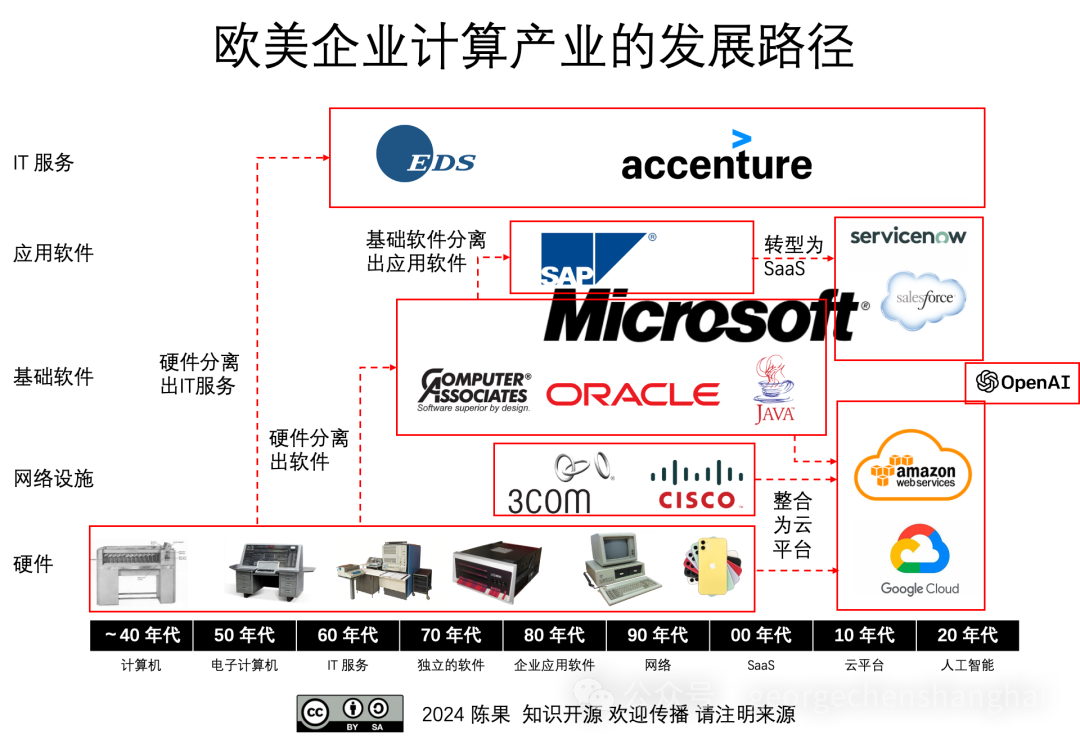
Enterprise computing started with computers. Before the emergence of electronic computers in the 1950s (the Univac computer in the picture was the earliest electronic computer to enter the enterprise), large European and American enterprises and government statistical agencies had generally adopted mechanical computers (the picture shows the IBM card sorter, or sorter, which was the earliest automated information processing equipment and can be said to be the mechanical version of today's database management software). In order to help enterprises make good use of expensive computer hardware equipment, IT service companies such as EDS and Accenture emerged.
After the 1970s, computer hardware became increasingly miniaturized, from DEC's minicomputers to IBM's personal computers.
Computer software as an independent industry only emerged in the 1970s. On the one hand, the U.S. judicial agency's antitrust investigation into IBM promoted the "unbundling of IBM software and hardware." On the other hand, software engineers and technology businessmen discovered that standardized software can be used as a tradable commodity that exists independently of hardware and IT services. Most of the early software was mainframe system management, network management, and information management. These mainframe software products were integrated by CA through capital in the early 1990s. Oracle was the greatest enterprise basic software company before the emergence of the cloud era, completing the industry integration from the client server era to the Internet era, from database software to application server software to middleware software.
After the cloud era, open source software has changed the horizon of the basic software industry.
Application software represented by SAP is another division after the separation of software from hardware. The emergence of the Internet also promoted companies such as 3Com and Cisco to create the network equipment industry. In the late 1990s, the technology company with the highest market value was Cisco, which made network equipment. Its capital market position was equivalent to Nvida in today's artificial intelligence era.
The cloud era has reshuffled the industry - hardware, network equipment, basic software and other industries have converged on cloud platforms represented by AWS and Google, and enterprise software has become SaaS without exception. The most successful cloud transformation of traditional enterprise computing companies is Microsoft, which spans all cloud service fields.
Looking back at the development history of the enterprise computing industry, we find that today's AI/SaaS/PaaS/IaaS and other runways in Europe and the United States have many years of technical historical roots, as well as the rigid needs of user application habits.
However, the history of enterprise computing in China may be less than thirty years old. Chinese enterprises have never used mechanical computers at all. Electronic computers that sprouted in the 1960s were used for scientific and military purposes (my father was the earliest computer programmer in China) and were basically not used in enterprises. In the late 1990s, although large banks and other institutions introduced IBM mainframes, they were rare. The real computing enlightenment of Chinese enterprises should be the microcomputer software represented by dBase, Foxpro, Delphi, and VB programming at that time. The ERP craze that began in 2005 has set off the scale of enterprise computing, and the revolutionary impact of mobile Internet represented by WeChat on China's enterprise computing industry can be compared to the impact of IBM personal computers on the US enterprise computing industry in the late 1980s.
Different industrial development histories have resulted in some significantly different characteristics of enterprise computing in China and Europe and the United States, such as:
* The "database" for structured management of information is the foundation of enterprise computing. Its application originated from mechanical computers before the emergence of electronic computers. This makes structuring information become the default working habit and way of thinking of enterprise computing users. However, China does not have this history. The earliest corporate information tools that most users come into contact with are mobile phones and WeChat, and their information processing is in the form of unstructured text and voice. Many Chinese companies are troubled by "data governance". It is like using chopsticks, no matter how you use a fork, you will feel awkward. To put it to the extreme, true Chinese-style enterprise computing does not require anti-human data management - I have not seen many Chinese companies manage data clearly, because this is not the Chinese way of thinking but the operation of foreigners.
* Not only the structuring of information, but also the habits of Chinese and foreign structuring of work are different. Structured work is "business process". This method comes from the scientific management and work simplification (work) that developed to its peak in the industrialization era to solve the labor conflicts that caused social crises. simplification); while China has been an agricultural society for a long time, and a large number of successful entrepreneurs after reform and opening up are peasant entrepreneurs. Agricultural production methods and rural social structures are different from industrialized collaboration and labor-capital relations. This is why "Amoeba" is more popular among entrepreneurs than business processes. It is reflected in enterprise computing technology: platform-based work distribution and benefit distribution (Meituan, Beike) surpass centralized planning and budget-driven Western organizational management. WeChat groups discuss issues and are more organizationally efficient than operating business processes.
* The West emphasizes the closed loop of "planning, execution, and analysis", so the enterprise computing model is correspondingly represented by setting quantitative standards, recording activities to generate data, and generating insights from data analysis. Faced with an uncertain environment and the desire to get rich quickly, China believes in "do it first and then cross the river by feeling the stones; if you encounter a problem, solve it." Why is supply chain planning and optimization software that is very popular in Europe and the United States difficult to sell in China? Because people in European and American society cannot work overtime casually, so Production capacity is a constraint. When encountering demand that exceeds production capacity, it must be planned in advance. However, Chinese companies believe in "as long as you can't work to death, work to death." Unlimited overtime can overcome production capacity constraints. Not only the best companies in China have their cadres sign the "Struggler Agreement", 896 Working hours are the norm, and production capacity is fully reached.
So in summary, the difference between Chinese and Western enterprise calculations is:
- Emphasis on natural language, light on structured data
- Emphasis on solving practical problems and ignoring historical data accumulation
- Emphasis on human decision-making and light on machine decision-making
- Emphasis on social relationships and light on rule distribution
- Emphasis on self-practice and light on best practices
- Emphasis on collaboration, light on process
- Emphasis on execution, light on planning
- Emphasis on efficiency, over perfection
- Emphasis on short-term effects and light on long-term planning
If we look at it in a broader social context, as the basic services of enterprise computing, cloud and large models are the most conducive to the popularization of applications through marketization, or should they be provided as social public resources? Just imagine, if it were not for the nationalized status of China Mobile and Telecom, would it be possible for China to have a situation where Huawei is the only one in the communications field and mobile payment is popular in every household in just two decades?
To sum up, I summarize the technology stack of Chinese enterprise computing into this framework. This industry needs to reshape the industrial chain like China's world-leading electric vehicle industry, rather than partial product innovation (see "Shaping the Industrial Chain | China's ERP Industry Should Learn from the Electric Vehicle Industry")
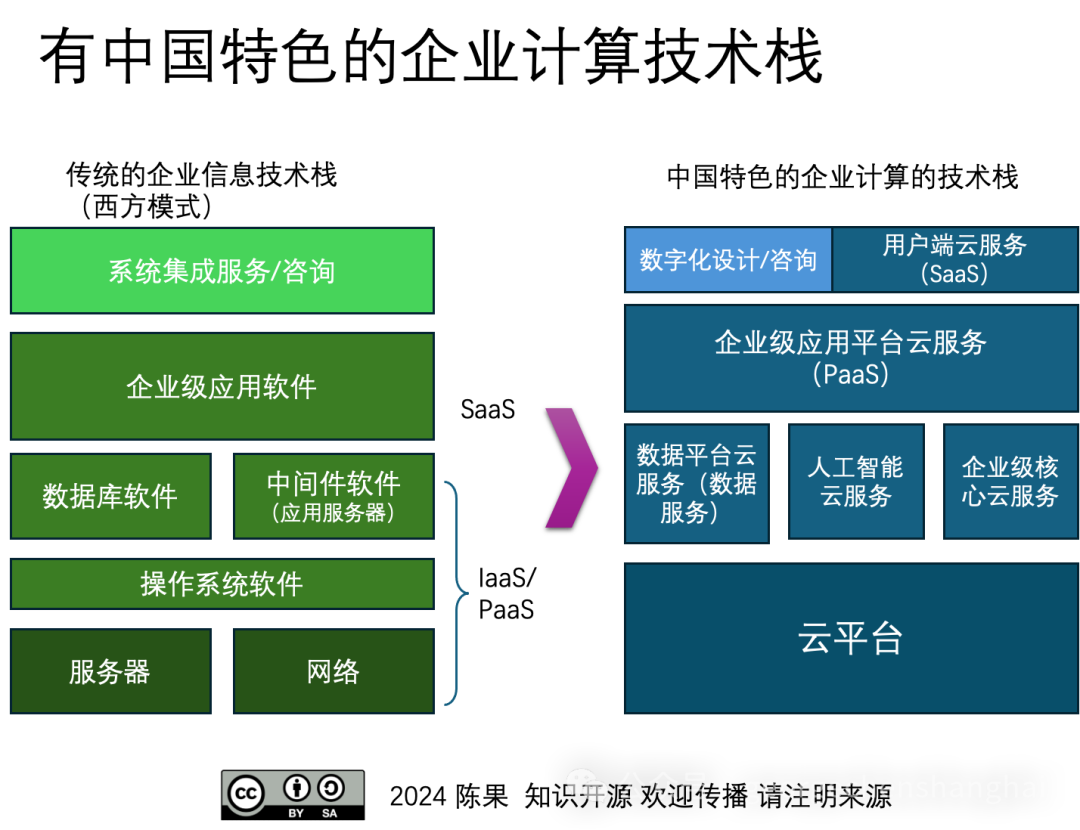
Whether this ecosystem can be formed depends on whether each player in the field can maintain an open mind. As long as they do not go offside or act randomly, China's enterprise computing industry can run on a track different from that of the West. Just like 20 years ago, when China's nascent Internet industry was still imitating Western Internet application models such as news portals, e-commerce, music downloads, and search engines, if Monternet's MMS had not saved early Internet companies, China's Internet industry might have been finished twenty years ago. However, the mobile Internet has exploded with Chinese-style social networking, video, news push, local life, payment, taxi-hailing and other Internet services that are not available in Europe and the United States.
China's enterprise computing industry will not be finished, but the premise is that it must be different from European and American enterprise software.
Machine-translated from the Chinese original 中国企业软件不是行业不行了,而是在重塑行业跑道 (published 2024-07-04). WeChat original ↗