Recently, with the popularity of DeepSeek, people are enthusiastic about large language models and thinking chains. In DeepSeek's exchanges, people marveled at its profound knowledge and quick thinking, but at the same time they were constantly troubled by its hallucinations. Especially when one asks questions involving modern mathematics, the answers provided by large models lack the rigor and depth of insight they deserve. At present, large language models are still based on probabilistic models, that is, large models learn the probability distribution defined in the space composed of token sequences from human language communication, so that the probability of the next token or sequence of tokens can be derived from the context. Thought chains are also treated as sequences of word cards, improving the accuracy of deep reasoning for large models.
In a sense, this is very similar to the basic idea in algebra: each element in an algebraic group or field is uniquely determined by its relationship with other elements. It is also similar to Marx’s view of people: “Man is the sum of all social relations.” When the large model obtains the probabilistic relationship between each word card (or word card sequence) and other word card sequences, it basically determines the word card sequence. This idea is very natural and effective when used in translation between different languages. But this idea is worth exploring in depth for modern mathematics.
Every concept and theorem in modern mathematics has a profound inner meaning, and its application is far more rigorous than natural language. The choice of words and sentences in literature is often a combination of similar words. The precise order in mathematical language cannot be disrupted, and similar concepts cannot be confused. Probability-based language models fall short. Currently, large models can learn thinking chains, which are common problem-solving routines, so they can easily solve common math problems. But in the development process of mathematical theory, the core is to develop new methods, refine new concepts, and even new mathematical language. Therefore, when cutting-edge mathematics is not yet formed, it often lacks sufficient training corpus. Therefore, current large language models still fall short of human expectations in terms of mathematical reasoning.
The author recently needed to use the theory of the Riemann Theta function in scientific research. After in-depth discussions with large language models, I still feel that the answers obtained are too vague. Although the answers are self-explanatory, I still feel that it is just scratching the surface and cannot be fully understood. The theory of Riemann's Theta function is self-contained, profound and beautiful. It also provides another partial algebraic solution to geometric partial differential equations, which is straightforward, concise and powerful. The author then throws some light on the topic, briefly discusses the outline of the theory, and discusses it with the readers.
meromorphic functions on surfaces
All entities in the physical world are embedded in a three-dimensional Euclidean space. The surfaces of entities are all two-dimensional curved surfaces, which will be divided into the inside and outside of the object, so that the surfaces are orientable. At the same time, the solid surface carries a Riemannian metric induced by the Euclidean metric. Therefore, surfaces in the physical world are all orientable surfaces with metric, denoted as . Mr. Chen Shengshen once proved the following theorem: if you pick any point on the surface, there will be a neighborhood and local coordinates of the point, making the Riemannian metric simple to express. These special coordinates are called isothermal coordinates. The curved surface is covered by the local isothermal system and becomes a Riemann Surface. Various physical fields on the surface can be expressed as various geometric realities on the Riemann surface, such as electromagnetic fields on the surface.
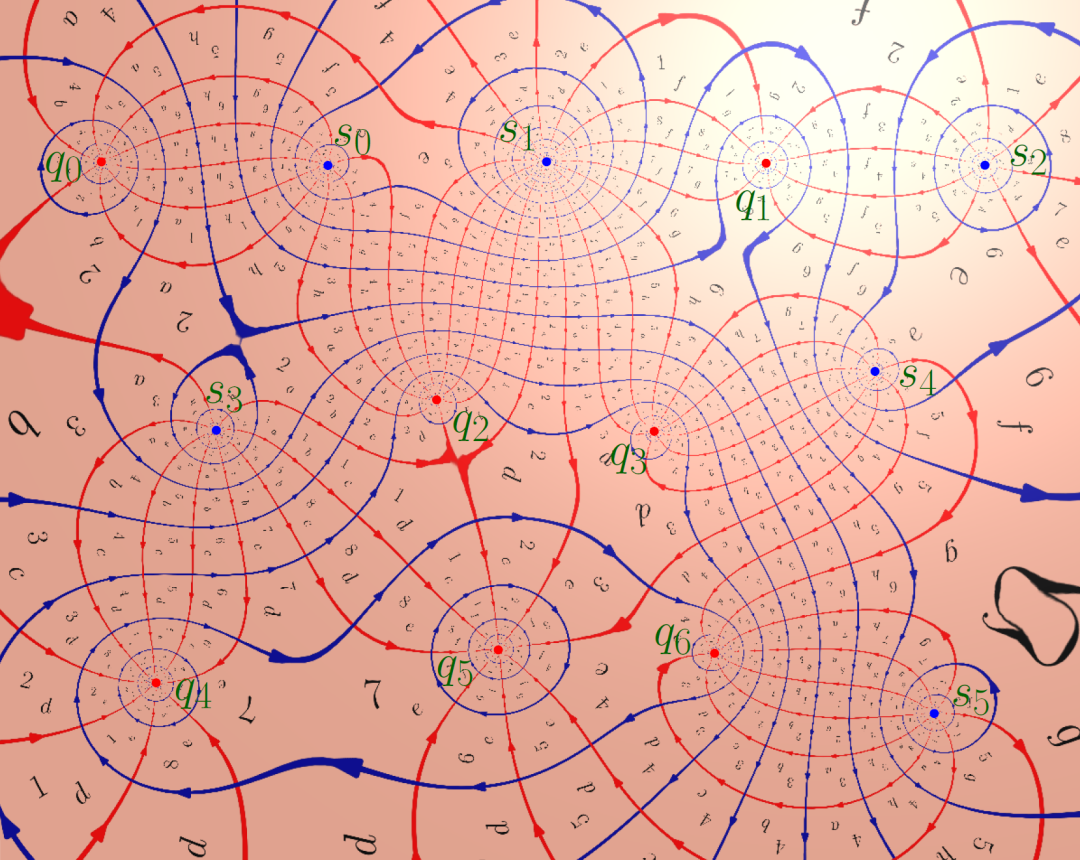
Figure 1. Complex potential of an electrostatic field on a plane.
The electrostatic field on the plane can be represented by the so-called complex potential, that is, a meromorphic function in the complex variable function. For example, given the position of a positive charge and the position of a negative charge, the corresponding meromorphic function
Expressed as:
The complex potential can be expressed as:
The above formula here is the factorization of the rational polynomial on the sphere. Figure 1 shows the complex potential representation of the electrostatic field on a plane. The red curve is the electric force line, and the blue curve is the equipotential line. The electric force line is perpendicular to the equipotential line everywhere. Positive charges become the source, negative charges become the sink, and the electric force lines flow from source to sink.
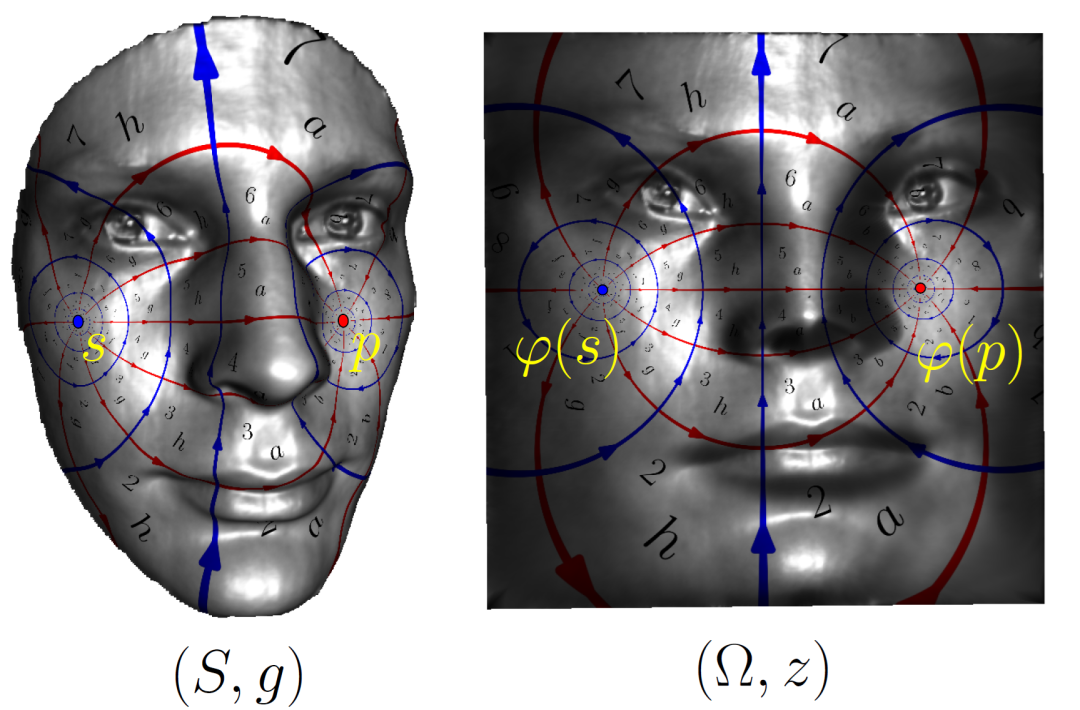
Figure 2. Meromorphic function on the Riemann surface.
A curved surface can be mapped to a planar region through conformal transformation, thereby pulling the electric field from the plane back to the surface to form an electric field on the surface. As shown in Figure 2, the three-dimensional face surface is conformally mapped to the plane area through Riemannian mapping. The electrostatic field induced by a pair of positive and negative charges on the plane is pulled back to the curved surface, and a complex potential function on the curved surface is obtained, that is, a meromorphic function on the Riemann surface.
Meromorphic functions play an important role in the Riemann surface. All meromorphic functions on a Riemann surface form an algebraic field (field), and the meromorphic function fields on two Riemann surfaces are algebraic isomorphic if and only if there is a conformal bijection (ie conformal equivalence) between the two surfaces. The central theorem in Riemann surface theory, such as Abel-Jacobi and Riemann-Roch, are all used to describe the overall behavior of meromorphic functions. The key core concepts of the Riemannian surface have deep and essential connections with many fields in geometric topology. For example, the three-dimensional manifold theory relies on the surface mapping group theory, Teichmuller theory and surface foliation structure theory, and these theories are closely connected with the special Abelian differential (the so-called holomorphic second differential); the real projective structure of the surface is equivalent to the holomorphic third differential of the Riemann surface. Abel differential (Abel differential), and its modern extension, the meromorphic cross-section layer in the holomorphic line bundle, etc., all also rely on the construction of specific meromorphic functions.
Riemann factoring theorem
From the theory of mathematical physical equations, we know that various physical fields on the Riemannian manifold are ultimately controlled by partial differential equations. For example, the electrostatic field on a curved surface can be described by elliptic partial differential equations. In Riemann's time (1826 – 1866), the theory of partial differential equations in mathematics was still in its infancy. It was not until more than 100 years later that Mr. Qiu Chengtong founded the school of geometric analysis and systematically applied the theory of partial differential equations to geometry. What is extremely surprising is that Riemann created an extremely complete and rich Riemann surface theory without the theoretical tools of partial differential equations. A large number of theorems are essentially existence theorems of solutions to specific partial differential equations on manifolds with Riemannian metrics. Modern teachings use the theory of partial differential equations to explain these theorems. Of course, there were no computers in Riemann's time, and it was impossible to borrow numerical solutions to differential equations. So, how did Riemann achieve solutions to partial differential equations without using the theory of partial differential equations? The answer lies in the Riemann Theta function theory.
With the help of the Theta function, Riemann extended the factorization theorem of rational polynomials from topological spheres to high genus surfaces, thus obtaining the so-called Riemann factorization theorem: Assume it is a Riemann surface, the genus is greater than zero, and it is a meromorphic function, that is, it is a meromorphic function on the complex plane that is restricted to each local isothermal coordinate system. The zero point is and the pole is, then there is a factorization:
Here is an optional base point on the Riemann surface, a specific holomorphic differential (Abelian differential of the first kind), the Riemann Theta function, and a zero point of . This can be calculated algebraically using infinite summations, thus avoiding the need to solve partial differential equations.
|
|
|
Figure 3. Digitally scanned sculpture of Narcissus (detail).
Basic concepts of Riemann surface
Figure 3 shows the sculpture of La Nymphe Salmacis (by Francois Joseph Bosio) in Greek mythology, now in the National Museum of Monaco. We use this surface with a genus of two to introduce related concepts. The flow field on the surface can define divergence, which is the net inflow and outflow at a given point, so the divergence can be used to identify the sources and sinks of the flow field; the spinor represents the rotational motion at a given point and is used to identify vortices in the flow field. If the spinor of a vector field is zero everywhere and the divergence is zero everywhere, we call it a harmonic field, such as the electrostatic field in a vacuum, which satisfies the classic Laplace equation. Examining the smooth non-rotational vector fields on the surface, we classify them. If two fields differ by a gradient field, we say that they are cohomologically equivalent to each other. All equivalence classes form a group under addition, the so-called deRham cohomology group of surfaces. The famous Hodge theory asserts that in each cohomology class, there is a unique harmonic field, and the group composed of all harmonic fields is isomorphic to the Dram cohomology group. The left frame of Figure 4 shows the harmonic field on a curved surface with a genus of two. We draw the integral curve of the harmonic field, which can be regarded as the electric force line of the passive electrostatic field on the curved surface. Rotate 90° around the normal vector at each point of the harmonic field to obtain another harmonic field, which is the conjugate field of the original field. The integral curve of the conjugate field gives the equipotential line. The frame in Figure 4 shows the conjugate harmonic field. Assuming that it is a harmonic field and its conjugate, then
It is called Abelian differential of the first kind, also known as holomorphic differential. All holomorphic differentials are grouped. The right frame of Figure 4 shows a holomorphic differential on the surface. Every holomorphic differential has a zero point.
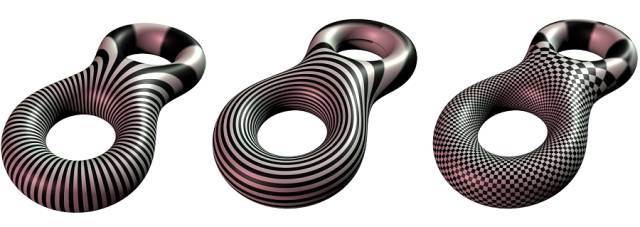
Figure 4. From left to right, harmonic differential, conjugate harmonic differential, holomorphic differential.
Assume that the basis of the one-dimensional homology group of the surface is , which is a holomorphic differential. Through integration, we can immerse the periodic (branch) of the Riemann surface into the complex plane, and the zero point becomes the branch point. We randomly select a base point and define the Abel-Jacobi mapping,
The integration path here is optional. Suppose we choose two different paths, connecting and,
Then the integrals along different paths differ from each other by an integer multiple of periods:
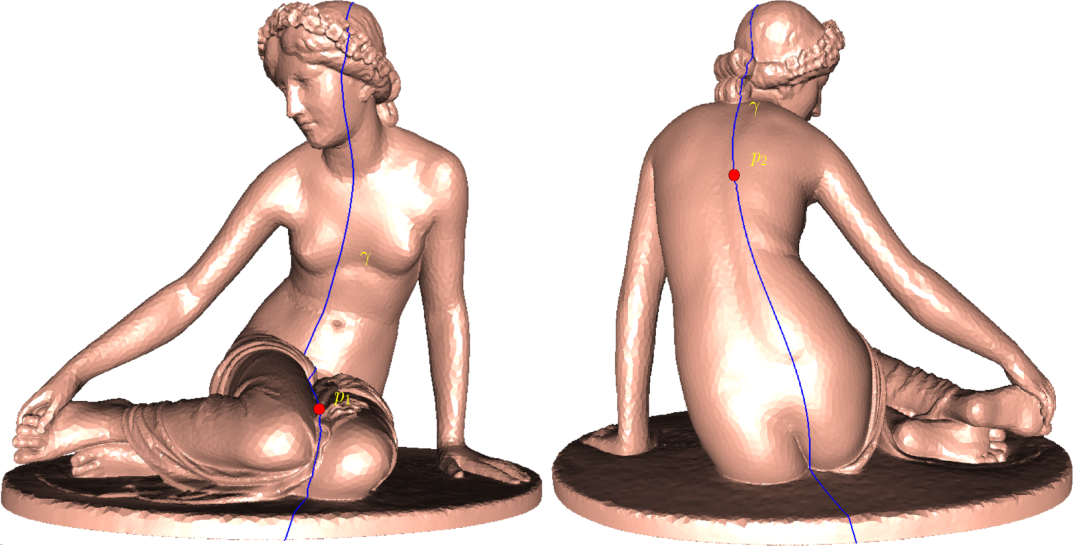
Figure 5. Geodesic circle passing through zero point.
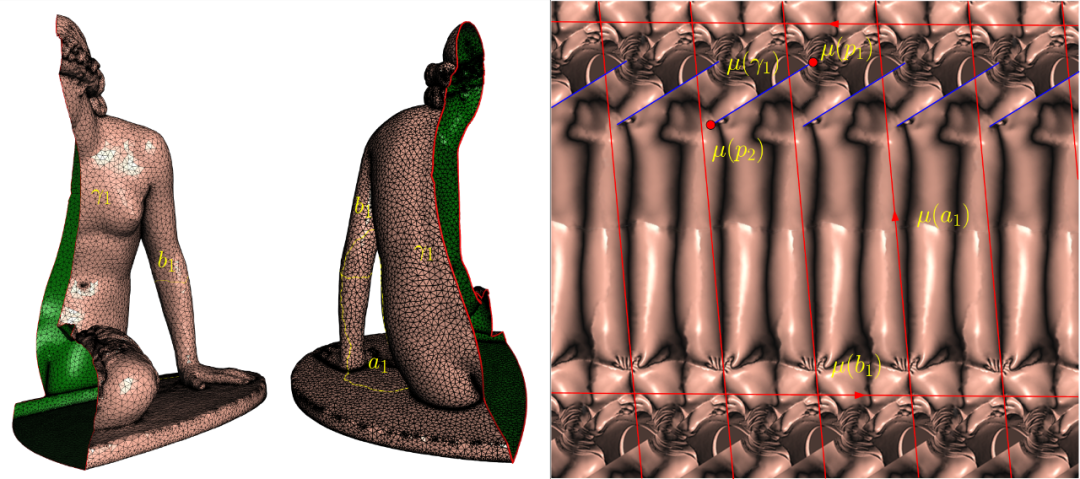
Figure 6. Abel-Jacobi mapping (left ring handle).
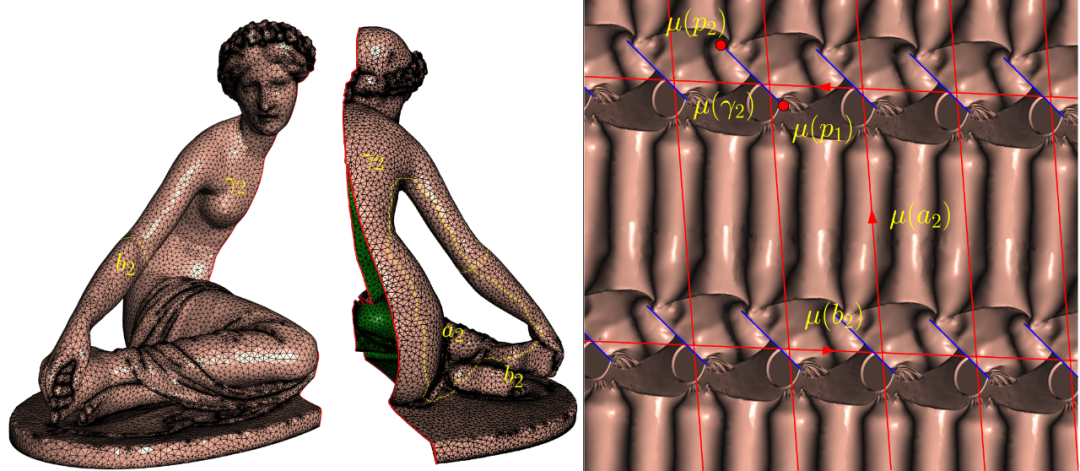
Figure 7. Abel-Jacobi mapping (right handle).
Figure 5-7 shows the concept of Abelian-Jacobian mapping. As shown in Figure 5, first of all, the pure differential has two zero points and induces a straight metric with singular points, and the geodesic passing through the zero points is . We cut along the surface and get two connected branches, each branch contains a ring handle. As shown in Figures 6 and 7, the base of the homology group on the left ring handle is , and the base on the right ring handle is . Each ring handle is periodically mapped to the plane by the Abelian-Jacobian map. Each period is a parallelogram, and the base and side are respectively the and period, that is,; Similarly, the ring handle on the right side of the curved surface is periodically mapped to the complex plane, and each period is a parallelogram, and its shape is described by the and period. Map the geodesic circle into a line segment, and the images of the left and right ring handles are staggered and pasted together along this line segment. We see that using only a holomorphic differential we can only obtain immersion maps.
Riemann proposed to use the basis of holomorphic differentials to calculate the Abel-Jacobi map:
The errors caused by different integration paths fall on the grid points,
Here is called the periodic vector:
The image falls on the complex manifold, which is called the Jacobian of the Riemannian surface.
Usually we choose the normalized holomorphic differential basis, so that
Then the -periodic matrix becomes the identity matrix, and the imaginary part of the -periodic matrix is a symmetric positive definite matrix,
Riemann Theta function The Riemann Theta function is defined as
It can be proved that it converges uniformly on compact sets and is an even function. Furthermore, it has quasi-periodicity:
Here is, the column vector of the periodic matrix. Examine compound mapping
It has a zero point on the Riemann surface, which is expressed as a divisor
Its image under the Abel-Jacobi mapping is
More generally, let be any point in the Jacobian, and we examine the composite mapping, then two situations will occur: normal situations and abnormal situations. Under normal circumstances, it has a zero point on the Riemann surface, which is expressed as a divisor
Its image under the Abel-Jacobi mapping is
At this time, the dimension of the Riemann-Roch space of the divisor is zero, and here is the linear space composed of all holomorphic differentials, where all points are zero points,
Under abnormal circumstances, there is a point that satisfies
And the dimension of is zero.
If we remember the complex manifold
Here is a permutation group of letters, that is, an additive group of valid divisors of degree. Then Riemann proved the following theorem: Mapping sequence
It is an exact sequence, that is. is a surjection, the degree of degeneration locally depends on the dimension of , and the degree of degeneration in depends on the dimension of , here.
|
|
|
Figure 8. The logarithm of a meromorphic function on a surface. The zero and pole points of the function become the simple poles of the logarithmic function.
Proof of Riemann factoring theorem
We use the Riemann-Theta function to construct meromorphic functions. First, given the sum of any two points on the Riemann surface, we examine the differential
First, and are the zero points and poles of the Theta fraction function on the right side respectively; secondly, due to the quasi-periodic condition, when moving along and returning to its own position, it becomes, the function remains unchanged; when moving along and returning to its own position, it becomes, The Theta fraction function has one more factor
Nothing to do with the point. From this is an Abelian differential of the third kind, with period:
Assume it is a non-constant meromorphic function on the Riemann surface, and its zero and pole points are
According to Abel's theorem, it is the divisor of a meromorphic function,
Construct a holomorphic differential to compensate for the period,
So we get the Abelian differential
Its period is
Therefore is a meromorphic function defined on the Riemann surface and has the same zeros and poles as
In this way we get the Riemann factorization theorem. Figures 8 and 9 show the zero-pole distribution of different meromorphic functions on the surface.
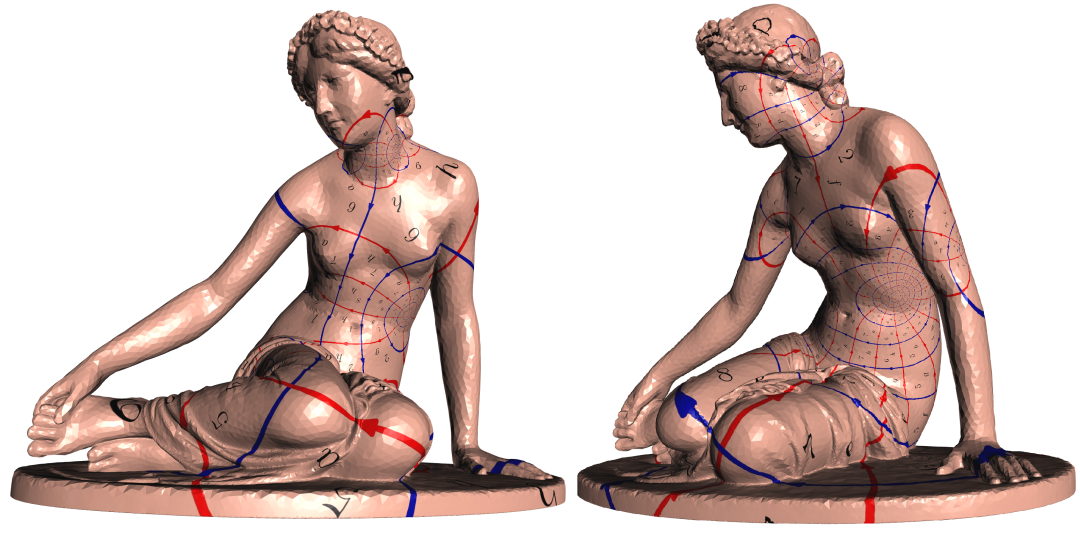
Figure 9. Logarithm of two meromorphic functions on a surface.
On the Riemannian surface, various geometric realities on the surface with Riemannian metric, meromorphic functions, holomorphic differentials, Abelian differentials, and meromorphic intercepts of holopure line bundles all rely on the analytical method of solving specific partial differential equations, and can also be solved by the algebraic method of the Riemannian Theta function. This brings great convenience to geometric calculations, and also reveals the deeper inner connection between differential equations, conformal geometry, and complex geometry.
Machine-translated from the Chinese original 浅谈黎曼因式分解理论 (published 2025-02-25). WeChat original ↗