Since middle school, teachers have emphasized the importance of combining numbers and shapes. The idea of combining numbers and shapes has been throughout the history of mathematics development, and has once again shined in the low-dimensional topological theory of modern mathematics!
In the past few decades, the topology of dimensional manifolds has been a mainstream direction in mathematical research. Thurston proposed a series of conjectures about manifolds, which guided the development of this field. The most basic one is the geometrization conjecture: we cut the manifold with a sphere and a topological torus to obtain a prime manifold that cannot be further decomposed. Similar to the surface singularization theorem, all prime manifolds can be equipped with a standard geometry. The ideas and tools that the final proof of the geometric conjecture relies on come from the school of geometric analysis founded by Mr. Qiu Chengtong, which uses differential equations to solve geometric problems. Hamilton invented the Ricci flow method, and Perelman used Ricci flow to prove the geometrization conjecture. The last two of all Thurston's conjectures that were proved are the virtual Haken conjecture and the virtual fiberation conjecture, where virtual means finite re-covering. The final proofs of these two conjectures are based on the method of geometric group theory, and geometric group theory perfectly embodies the idea of combining numbers and shapes.
Virtual Haken Conjecture
The virtual Haken conjecture proposed by Thurston is as follows: If it is a closed hyperbolic 3-manifold, then there exists a finite multiple cover containing an embedded incompressible surface, where is the genus of the surface. Several topological concepts are involved here, which are intuitively explained as follows. If the space covers, its projection mapping is, and the coverage multiplicity is, then for any point, its original image set is, and there is a neighborhood, and its original image is, and the restriction of the projection mapping is topological homeomorphism. The map is immersion. If there is a neighborhood for everything, the restricted map is topologically homeomorphic, but the overall image set may self-intersect. If the whole is injective, then immersion becomes embedding. The immersed image is imcompressible, which means that if there is a loop on the surface, if it cannot be reduced to a point by the through transformation, then it cannot be reduced to a point by the through transformation. (If we use the language of algebraic topology, the homomorphism between basic groups is injective). Kahn and Markovic of our school proved very early on that there are many immersed incompressible surfaces inside a hyperbolic manifold, which can be arbitrarily close to a full geodesic submanifold. So the problem boils down to how to find - a finite re-cover of a manifold such that immersed surfaces are promoted to embedded surfaces.
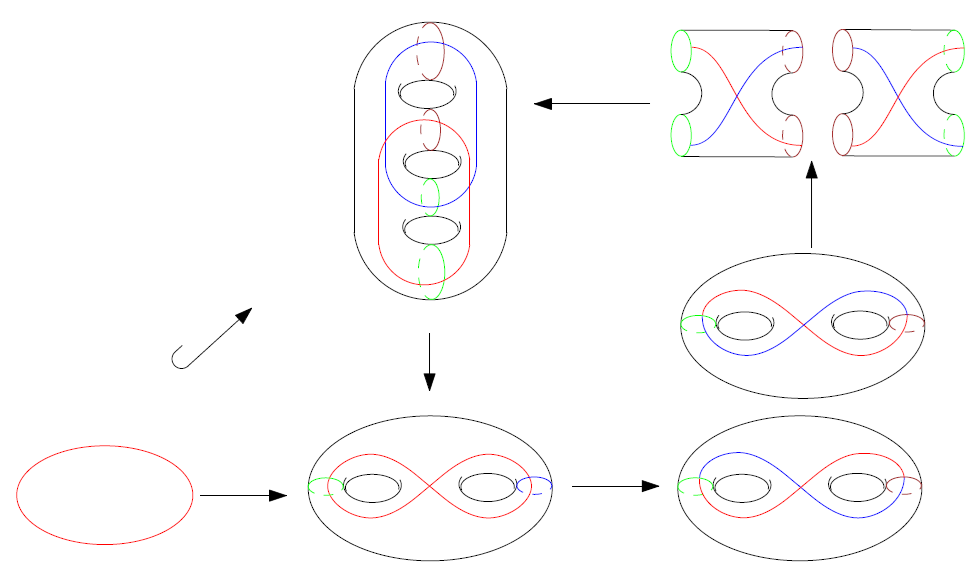
Figure 1. Intuitive explanation of the improvement of immersion into embedding in the virtual Haken conjecture.
Figure 1 visually depicts the lift from immersion to embedding. The red circle is immersed in the hyperbolic surface and has self-intersection points, forming a red figure 8. We cut the surface along the green and brown loops, make two copies, and then cross-glue the green and brown boundaries to get a double covering surface of the surface, projection mapped as. Immersion is promoted to embedding,. Here, the medium red and blue loops are both lifts of the medium red figure 8, both embedded. If the red loop is replaced by a high genus surface and the hyperbolic surface is replaced by a hyperbolic manifold, then Figure 1 describes the virtual Haken conjecture.
Lifting by immersion into embeddings can be described by algebraic language, so the virtual Haken conjecture can be explained algebraically.
From shapes to numbers, algebraic topology
Classic algebraic topology converts "shape" into "number" and uses algebra to understand topology. Given a topological space, we define various algebraic groups or rings for it, such as homology groups and Tonglun groups. By analyzing the algebraic structure and algebraic properties of these groups, we can detect topological information.
The most common is the fundamental group, which is a fixed base point. Continuous mappings are called paths. If the start and end points coincide, it is called a loop. If it can be transformed into through homotopy deformation, then it is equivalent to homotopy. The product of two loops is defined end-to-end. In this way, the homotopy classes of all cycles form the basic group of . For a hyperbolic 3-manifold, its topological information is reflected in the fundamental group. Mostow's rigidity theorem asserts that if two hyperbolic 3-manifolds are homotopically equivalent (basic group isomorphism), then they are equidistant.
General finite generation groups can be described by so-called "word groups". The generators of the group are some letters. A finite sequence of letters and the inverse of letters forms a word. The connection between the beginning and the end of the word forms multiplication. The empty word is the identity element. There are some words at the same time, which are called relationships. Two words are said to be equivalent if they are transformed into by inserting or deleting related words in finite steps. The group consisting of the equivalence classes of all words is called a word group, denoted as
If there are no relative words, it is called a free group.
Many topological concepts can be translated into corresponding algebraic concepts. If it is a subgroup of the basic group, then the covering space satisfies (until isomorphism); otherwise, given the connected covering space , , then it is a subgroup of . If it is a normal subgroup, , that is, for all elements, then the corresponding cover is a Galois cover. The automorphic transformation that covers the space is called a deck transformation (Deck Transformation), and all deck transformations constitute a deck transformation group. The deck transformation group covered by Galois is equal to the quotient group. The number of generated cosets (coset) is called the index (index), recorded as . If the index is limited, the corresponding coverage is limited coverage, otherwise it is unlimited coverage.
The promotion from immersion to embedding can be described by the concept of separability of subgroups. A subgroup is separable if, for everything, there is a subgroup with a finite index that contains but does not contain, that is, but. Peter Scott showed that if a subgroup of a surface is separable in , then it is virtual Haken.
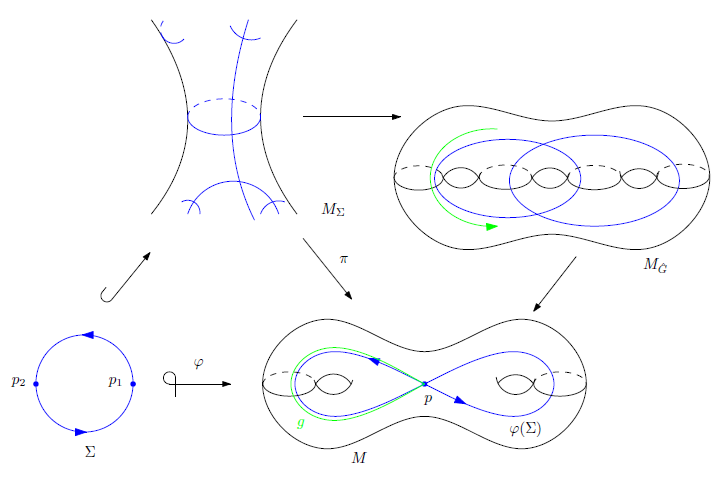
Figure 2. Intuitive explanation of subgroup separability and virtual Haken.
Figure 2 intuitively explains why subgroup separability is equivalent to virtual Hakenness. Immersion maps a low-dimensional manifold into a high-dimensional manifold, like a self-intersection point. There is a green loop passing through the self-intersection point, which is not a loop, so
Assume that the covering space of the corresponding subgroup is, then, the element is not inside, so the loop is promoted to become a non-closed path inside. But the index is infinite, so infinite coverage. If separable, then there are subgroups of finite indicators that contain, and do not contain. is the corresponding finite re-coverage space, and the green one is promoted to become a path. Due to the arbitrariness of , the image in is no longer self-intersecting and is embedded in .
It can be proved that the subgroup corresponding to the surface found by Kahn and Markovic is quasi-convex. Therefore, the proof of the virtual Haken conjecture boils down to how to prove that the quasi-convex subgroup of the hyperbolic-manifold fundamental group is separable. From this, we transform topological problems (shapes) into algebraic problems (numbers).
From numbers to shapes, geometric group theory
All topological information of hyperbolic manifolds is hidden in the fundamental group, but it is still extremely difficult to discover the intrinsic structure of the fundamental group through purely algebraic methods. The idea of geometric group theory is to find a topological space (complex) for an abstract group such that the basic group is equal to the algebraic properties obtained by analyzing it using a combinatorial method. Originally we hoped to understand the topological information of the hyperbolic manifold, we converted it into the algebraic information of the abstract group, and then constructed the complex, and understood the algebraic information through the topological (combination) information. So, are we back to the original starting point, and everything is in vain? This is exactly the crux of the problem: complexes are only equivalent to Thonglun (not homeomorphisms), the structure is much simpler, and it is also very easy to understand, thus greatly simplifying the problem. In this way, we turn into numbers (fundamental groups) through shapes (-manifolds) and return to shapes (complex shapes) through numbers (abstract groups), thus reaching the negation of negation and spiraling upward.
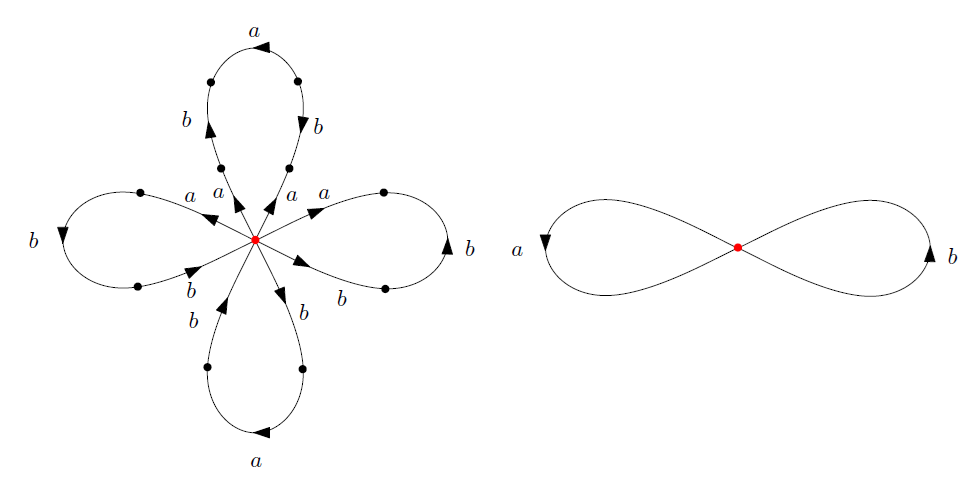
Figure 3. The complex corresponding to the finitely generated free group.
The original idea originated from Stalling's research on free groups in 1982. The Stalling fold he invented has become a classic algorithm in geometric group theory. We consider the simplest binary free group, that is, the group of all finite-length words generated from two letters. We construct a graph (Graph) to express the double-leaf rose, which has only one vertex as the base point, and each letter (generator) corresponds to a petal, that is, a directional loop starting and ending at the base point, and, as shown in the right frame of Figure 3. Each word represents a loop in the rose, and vice versa. For example, the word corresponds to the loop as follows: we start from the base point, walk twice in the forward direction, then walk once in the reverse direction, and return to the origin. Given the subgroup, we construct the Stalling diagram as follows: there is a red base point, each generated word corresponds to a petal, each petal is a loop, connected end to end by directional arcs, each directional arc has a character, corresponding to the generator or. For example, a petal loop consists of 3 oriented arcs, with the accompanying characters , and the orientation of the a arc is opposite to that of the loop. Between the directional arcs, add black vertices. We then construct a mapping so that the red base points map to the red base points, and the black vertices also map to the red base points. Each directional arc with a character is mapped to a petal with the same character. Then it is the inclusion homomorphism. However, it is injective rather than injective. For example, starting from the red base point, there are directional arcs with markers, and they are all mapped to the petals.
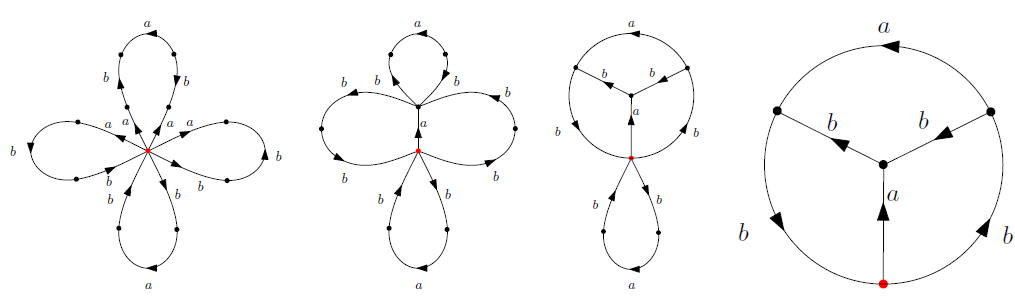
As shown in Figure 4, the graph can be simplified through the Stalling folding method, making the mapping from the simplified graph to an injective. We can get a lot of information about the group from the simplified Stalling diagram using graph theory methods. For example, let's calculate the rank, which is the minimum number of generators. The constructed spanning tree contains unique loops, then the basis formed by these loops is the generator of . We see that the generator is , and its rank is . We say it is a full topological degree, if for each generator of each vertex, there is an incoming directional arc and a leaving directional arc corresponding to it. If it is full topology, then the coverage space is, and the coverage multiplicity is equal to the number of vertices, that is. If it is not fully topological, it has an infinite index.
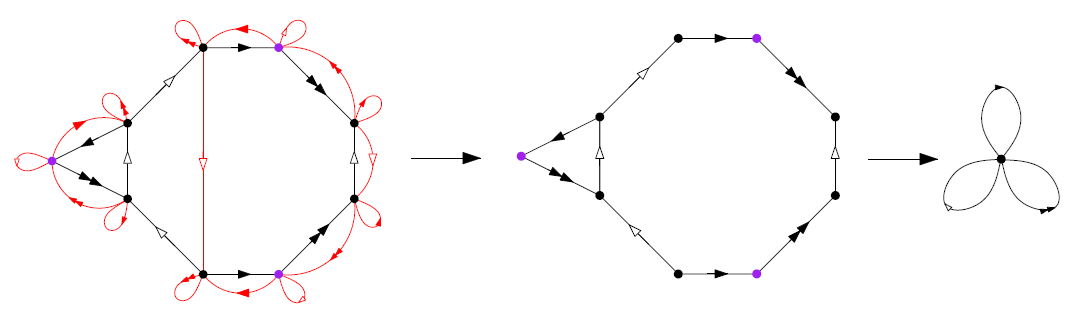
Figure 5 shows another example. The Stalling diagram of the free group is shown on the right, and the Stalling diagram of a certain subgroup is shown in the middle. The arrow on the right represents an injective, corresponding to the inclusion homomorphism. It is not fully topological, so it does not cover the space. Through the so-called canonical completeness operation, we can add some edges to make it a full topological degree and obtain a coverage space with a limited index. For each petal, we compute the preimage, examining each connected branch. If the connected branch is a loop, do nothing; if the connected branch is an arc, add a directional arc from the end point to the starting point, with a label; if the connected branch is a vertex, add a loop, with a label. The left frame of Figure 4 shows the result of canonical completion, and the red edges are the added edges. So yes finite heavy coverage.
From this, we get the famous Marshall Hall theorem: the finitely generated subgroup of a free group is separable. More specifically, let, be an element of the free group, be a subgroup of, and its generator is, hypothesis. Then there exists a finite index subgroup such that , , and the basis is constituted by a subset of the basis. The Stalling diagram we constructed is simplified using Stalling folding. We are adding a path to represent , , and then using regular completion to convert it into , then it is a finite-weight covering space that contains , , but does not contain . In addition, the spanning tree of is also a spanning tree, and the generating element of is also a generating element.
To sum up, the method of geometric group theory is to construct the topological space sum for the abstract group and its subgroup, then simplify it with the Stalling folding method, and then use canonical completion to obtain the finite repeat coverage space. Essentially, combinatorial methods are used to prove algebraic properties, such as the separability of subgroups.
The idea of proving the virtual Haken conjecture
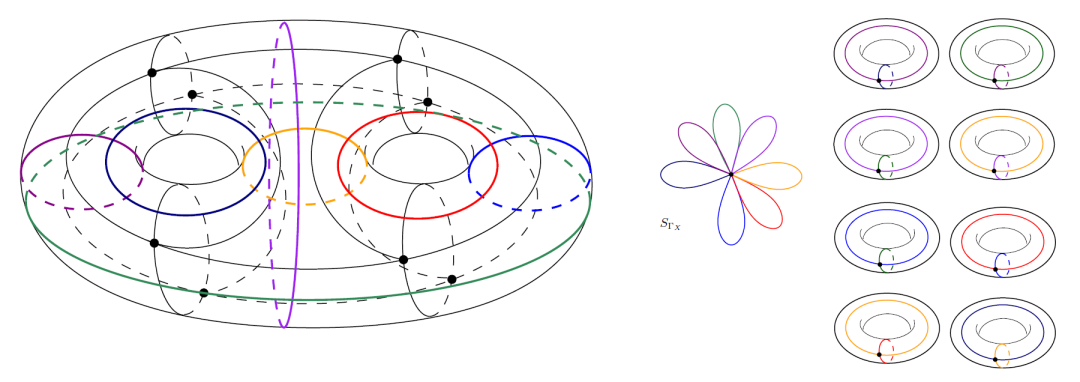
Figure 6. Cubic complex and hyperplane (left); Salveti complex (right).
The proof of the virtual Haken conjecture also follows this approach. Wise gave the outline of the proof, and after decades of hard work by many mathematicians, the proof was finally completed by Agol. Under this framework, Stalling diagrams are generalized into so-called cubic complexes. As shown in Figure 6, the so-called cubic complex is a complex formed by pasting a limited number of cubes () with different dimensions. It can be thought of as pasting some squares, cubes, etc. on the graph. In the framework of the virtual Haken conjecture proof, surfaces are represented by quadrilateral meshes, and hyperbolic-manifolds are represented by hexahedral meshes. At the same time, these divisions need to exclude pathological situations and are called special cubic complexes. Special cubic complexes can guarantee the mapping comparison rules between them, the so-called local isometry. For example, immersion is represented as the local isometry between cubic complexes.
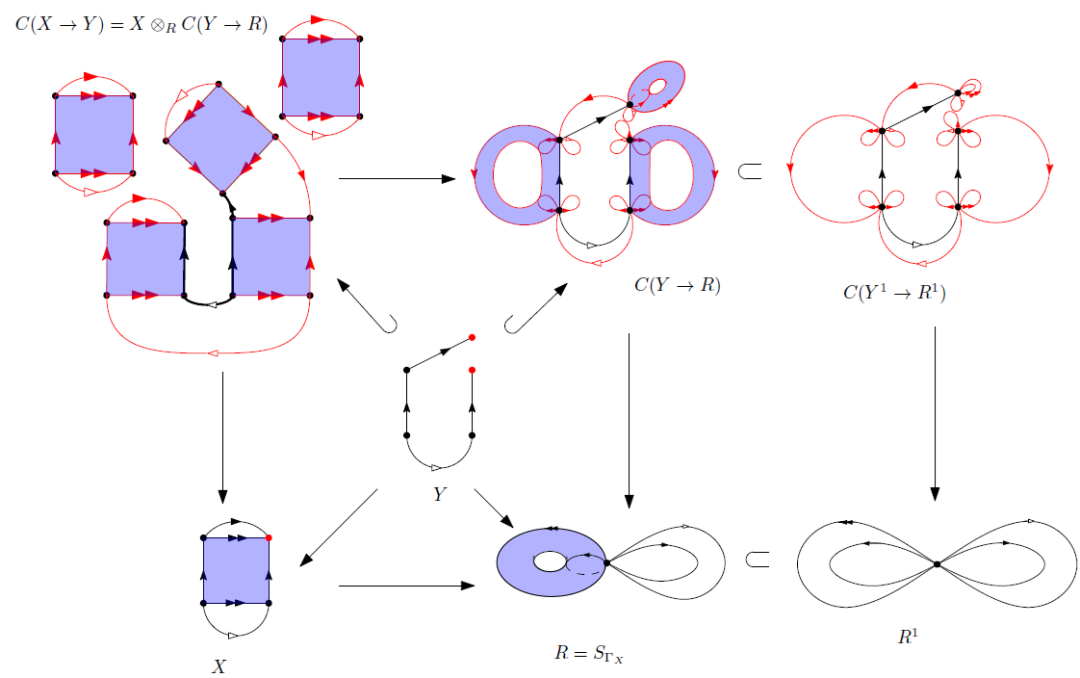
As shown in Figure 7, Wise uses a low-dimensional complex to explain the idea of the proof: the complex is immersed in the square complex, and each directed edge in has an arrow of a different style, indicating both the direction and the identification symbol; an edge in is reflected by an edge with the same style arrow, and the orientation remains consistent. We see that two vertices in mid-red are mapped to one vertex in mid-red, so not embedding, but dipping. We hope to construct a finite-weight cover so that it is embedded in it. The square complex in the upper left corner of the figure is the answer. The construction process is as follows: there are sub-cubes in the standard cube, and a certain coordinate is fixed into the resulting section. The subcube complex formed by these sections is called a hyperplane. First we calculate all hyperplanes. These hyperplanes form the so-called hyperplane complex, where each vertex represents a hyperplane and each edge represents the intersection of two hyperplanes. Represents a Right Angled Artin Group: each vertex in corresponds to a generator, and each edge in corresponds to a relationship. The constructed Salveti complex, the fundamental group of the Salveti complex is equal to, . As shown on the right side of Figure 6, there is only one vertex, and each cycle represents a vertex in , (a hyperplane in ); one of the -complete subgraphs (-clique, one of the -cube) corresponds to one of the -cubes. We construct a local isometric mapping from to, mapping all vertices of to the only vertex; an edge in intersects with the hyperplane transversally, corresponding to a petal in, will be mapped to; there is a hyperplane in -cube intersects at a point, let these hyperplanes be, there is a -cube pasted on the petal, will be mapped to. If the composition of the mapped sum is locally isometric, then we use Stalling folding and canonical completion to construct a finite-recovery such that it is embedded in .
Given the local isometric sum, we construct the cubic complex and the local isometric sum so that the above diagram is commutative, thus obtaining the pullback diagram in category theory. From pullback graph theory, we get the fiber product which is the sum
Its fundamental group is the intersection of two fundamental groups of factors
By the construction method, embedded in,; at the same time, it has limited coverage.
In the proof of the virtual Haken conjecture, it is the hyperbolic-manifold, the incompressible immersed surface discovered by Kahn-Markovic, and the finite-recovery of the hyperbolic 3-manifold, which expands the immersed surface into an embedded surface. Here, they are all expressed as cubic complexes, that is, the generalization of quadrilateral meshes and hexahedral meshes. These cubic complexes are special, i.e., pathological cases are excluded. In geometric group theory, hyperbolic manifolds and surfaces are not given in advance and need to be constructed from abstract groups. At this time, Sageev replaced it with Caley-diagram, which is equidistant from roughness; by replacing it with quasi-convex subgroup, it is still possible to construct Tongluan-equivalent cubic complex. The hyperplane intersection relationship in the cubic complex retains the intersection relationship of the immersed surface inside the manifold. The RAAG group is similar to the free group, in which the separability of subgroups ensures the existence of finite heavy coverage.
Summary
We see that algebraic topology changes from "shape" to "number", describing topological space with basic groups, and topological properties are translated into algebraic properties; geometric group theory changes from "number" to "shape", describing abstract groups with cubic complexes, and translating algebraic properties into combinatorial properties, which can be verified by algorithms. The idea of number-shape combination solves the last conjecture in Thurston-manifold topology theory. Mathematics has once again experienced the historical law of negation of negation and spiral upward. Geometric group theory will definitely bring a huge leap forward in engineering applications!
Machine-translated from the Chinese original 数形结合,浅谈几何群论 (published 2025-04-18). WeChat original ↗