MIT Mathematics Professor: The Mathematics of the Future
Pavel Etingof、Slava Gerovitch
summary
The rapid development of artificial intelligence is changing mathematical research, and also brings a series of key questions before us: What is the role of human mathematicians, how should they be cultivated and evaluated, and what social value do they have? Rather than making mathematicians redundant, we argue that AI will force the profession to refocus away from a “culture of ownership” around priorities and publication records, toward intellectual agency—that is, deep understanding, judgment, foresight, communication, and the maintenance and inheritance of a shared mathematical culture. Mathematicians can use AI to explore the rapidly expanding world of mathematics, interpret and synthesize AI-generated knowledge, patch and formalize existing literature, and develop new ways of interpreting and publishing mathematics. We recommend that recruitment and graduate education rely more heavily on ongoing mathematical communication, including presentations, discussions, oral examinations, mentoring, and collaboration, rather than treating papers solely as conclusive evidence of judgmental ability. We also outline a model for an AI-assisted research laboratory that combines human collective thinking with the judicious use and verification of AI output. We acknowledge that there are serious ethical, social, and epistemological issues and respect those who choose not to use AI. Under this premise, we believe that the core challenge is not to compete with machines in theorem production, but to preserve and expand humans' ability to develop, understand, and communicate mathematics.
Table of contents
- • 1 Introduction
- • 2 Functions of Mathematics
- • 3 Why does society still need mathematicians?
- • 4 How should mathematicians be evaluated?
- • 4.1 The decline of ownership culture
- • 4.2 Employment criteria
- • 5 What should a mathematician do?
- • 5.1 The wider world of mathematics
- • 5.2 The Library of Babel of Mathematics
- • 5.3 Document cleaning
- • 5.4 Writing and publishing
- • 5.5 A common mathematical culture
- • 5.6 “AI Vegan” Mathematician
- • 6 How should mathematicians be trained?
- • 6.1 Learning with and without AI
- • 6.2 Courses and Examinations
- • 6.3 Postgraduate training
- • 6.4 AI Research Lab
- • 7 Advice for Young Mathematicians
- • 8 Epilogue
1 Introduction
In 2026, cutting-edge large language models (LLMs) gained the ability to conduct mathematical research, and this ability is increasing rapidly. Long-standing problems are beginning to be solved one after another with the help of AI. Today, large language models can produce a good mathematical result in an hour, sometimes even brilliantly, with minimal or no intervention from human mathematicians. While it's unclear exactly how far this trend will go,[1]But we have good reason to believe that it will continue, and that AI will reveal a lot of extremely interesting mathematics in the not-too-distant future. This is incredibly exciting for the growth of mathematical knowledge.
However, the price is also very high. These developments raise fundamental questions about authorship, attribution of credit, methods of evaluation, and the role of mathematicians.[2]It is already certain that in the coming years, even months, our community will have to undergo profound changes. Even if advances in AI stopped today and math could no longer be done the way it used to, we would still need to adapt how we teach, research, and communicate. This process is likely to be both challenging and confusing, especially because AI is advancing so quickly.[3]Like many technological changes, this process has been driven in large part by the commercial interests of large corporations, which are not necessarily aligned with those of mathematicians [SM]. We are about to go through a period of uncertainty and anxiety, especially for early-career mathematicians. In fact, some young people are already hesitant to devote themselves to mathematics.
But we don't have an escape key that we can press.[4]
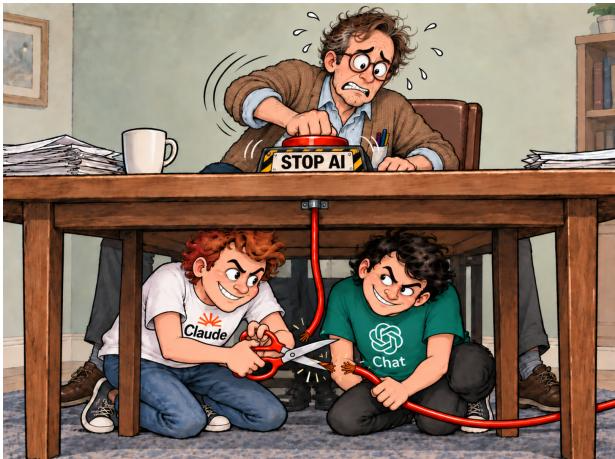
We can try to influence this process in a constructive way – the recently established independent body, the Advisory Group on Mathematics and Artificial Intelligence [AGMAI], is a welcome effort – but we are unlikely to stop it, or even to slow it down significantly. We should adapt to this reality while keeping our sights on the amazing opportunities that lie ahead.
How math will adapt is difficult to predict. The future of our profession depends not only on what we do, but also on how society at large values and funds our work. In addition, related changes in education, science and the wider economy will affect us in ways we cannot foresee. However, the time has come to start thinking about this future.
The goal of this article is to imagine mathematics in this new world and try to answer four basic questions:
- • Q1. What should mathematicians do?
- • Q2. How should mathematicians be trained?
- • Q3. How should mathematicians be evaluated?
- • Q4. Why does society still need mathematicians?
We believe that this new era, although full of uncertainty, is also a particularly exciting time to do mathematics.
2 Functions of mathematics
It can be said that mathematics has four main functions:
- • F1. Discover fundamental truths about the universe.
- • F2. Become part of human culture and human understanding of the world.
- • F3. Provide tools for applications.
- • F4. Promote human intellectual development and analytical thinking.
In the age of AI, these four capabilities remain important and can all be greatly enhanced. Mathematicians should lead this process. Our answers to the above four questions will be guided by this.
3 Why does society still need mathematicians?
Let's start with the last question. It is most dependent on the development trends of the entire society and is also the main source of anxiety for many young people interested in mathematics. Will there still be enough jobs in mathematics? If so, where does the funding come from? Does it still make sense to choose mathematics as a career?
It’s important to remember that professionals in every field are facing the same issues today, and in a world of rapid change, no one can make meaningful long-term predictions. Still, there are reasons to think that mathematicians are relatively better off than many other knowledge-based professions.
- • Even if AI’s mathematical capabilities become so powerful that human involvement no longer makes much of a difference, we will still need mathematicians to ask and prioritize questions. AI may eventually surpass us in this regard, but the function of mathematics in discovering truth is not only to produce more theorems, but also to expand human knowledge and understanding.
- • The cultural function of mathematics has indigestible human attributes and cannot be realized without mathematicians. Even if mathematicians take a backseat in discovering new mathematics, we still need them to explain and spread mathematical culture.
- • Opportunities for the application of mathematics will increase significantly, and therefore the role of mathematics in providing tools will still need to be fulfilled by mathematicians. Especially in AI-related fields that have a significant impact on society, mathematics will play an important role, and AI safety is one prominent example. These jobs offer promising directions for employment for mathematicians [Sah].
- • To realize the function of mathematics in promoting intellectual development, mathematics education remains indispensable. AI will become a powerful educational tool, but there is good reason to expect that the need for human teachers will continue because humans are fundamentally social beings. Furthermore, the education system has considerable inertia, which should help sustain teaching jobs for the foreseeable future [H]. [5]
- • Society has long supported pure mathematics not only because of its immediate practical relevance but also because of its intellectual value. This rationale holds true even if AI is involved in the production of mathematical knowledge.
- • Some mathematics positions are supported by endowments earmarked for academic endeavors in mathematics. Such funds generally cannot be repurposed and should therefore provide stability to the institution.
- • Historically, mathematics PhDs leaving academia have had good employment prospects based on their analytical and critical thinking skills. These capabilities are still needed in the AI era.
These considerations give us reason to expect that the demand for mathematicians will continue. However, there is another reason that may become increasingly important.
A strong mathematical community is a kind of intellectual reserve [Sah]. We can’t predict what mathematical expertise will be needed in the future, especially in a world where AI is likely to advance science and technology at an unprecedented rate. These expertise must exist in advance and cannot be created in a short time. Developing mathematicians with deep understanding and sound judgment requires years of training, research, and participation in a living mathematical culture [Ko].
Maintaining this reserve requires both education and research. Mathematics education continuously renews society's ability to think critically and analytically. Therefore, if mathematics education is completely outsourced to AI, there may be a real loss of control: we may become increasingly dependent on complex technologies, but gradually lose the human ability to understand and question these technologies. Research is also indispensable, because the ability to work at the cutting edge can only be maintained through continuous application. Education replenishes reserves, and research allows such reserves to always be used at the forefront.
This gives society a good reason to support mathematics, and the reason will still stand even if AI ends up producing most new theorems. We maintain fire brigades before fires occur and build strategic reserves before emergencies arise. Likewise, society may need more mathematical expertise than immediate needs indicate. Supporting mathematics preserves our ability to understand and respond to developments and changes that we cannot yet foresee.
4 How should mathematicians be evaluated?
4.1 The decline of ownership culture
For much of the history of modern mathematics, its social structure was based on what we might call an "ownership culture." Mathematicians compete for priority in proving good theorems, and once a result is established, the author gains a lasting reputation. In this system, what mathematicians have is not the theorem itself, but credit for discovering it: subsequent work should cite them and acknowledge their contribution. Career advancement, prestige, awards, and other forms of recognition are largely based on a publication list, and the "weight" of this list by some appropriate standard is crucial. The Leiden Declaration explicitly affirms a related principle: mathematical results can be attributed to specific human authors, with both credit and responsibility being borne by them [LD].
Can this culture survive in the age of AI? We think not, because the correlation between the level of the paper and the mathematical level of the author will become weaker and weaker.
If most of the hard work in theorem proving is done by large language models, the concept of individual merit may gradually lose much of its meaning [B, Go]. This may not be a bad thing: Historically, egos among mathematicians have caused a lot of conflict; mathematics might be better off if these egos stopped obsessing over "possessing" results.[6]
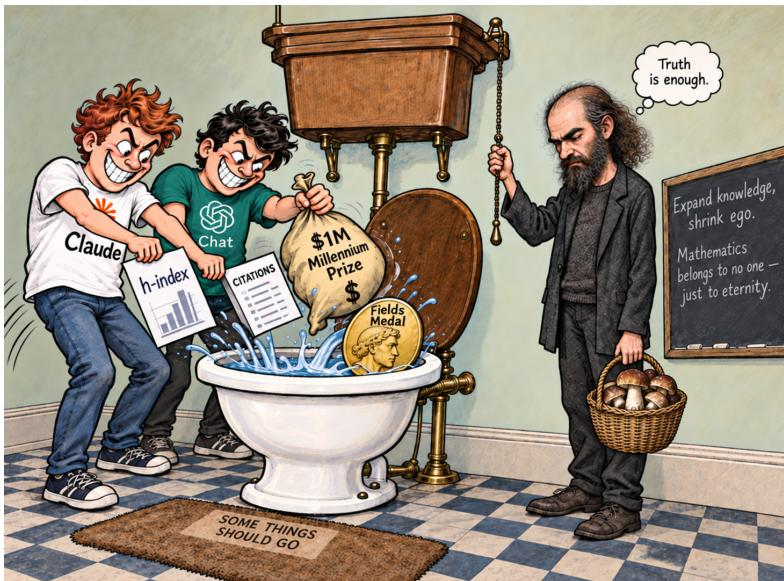
Having said that, a culture of ownership has always been an organizing framework within the mathematics community. In particular, it underpins a system for evaluating mathematicians based on relatively objective criteria, and replacing this system will be a serious challenge.[7]The old system, for all its flaws, did keep working. But in the age of AI, retaining it may no longer be realistic.
This is not to say that the day when the Navier-Stokes millennium problem is solved with the help of AI should be designated as the day of the “socialist revolution” in mathematics, and the private ownership of mathematical results will be completely abolished.
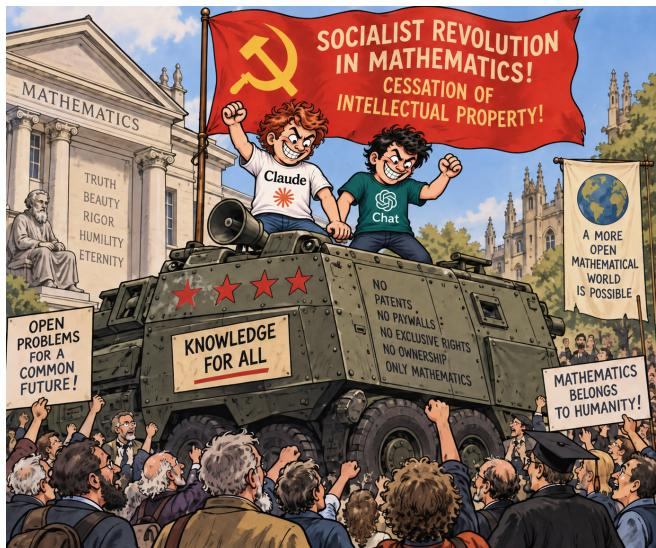
This transition takes time and, in any case, does not take away the due credit for past work. For now, since career advancement still relies on attribution of credit, we must continue to carefully cite and acknowledge every relevant previous work. This is especially true for AI-assisted research, where a large language model may rehearse the ideas of others it absorbed during training.[8]When conducting AI-assisted research, we should also be careful to avoid “jump-publishing” the work of mathematicians who have long been working on the same problem in traditional ways, as their career advancement may depend on whether this work receives the recognition it deserves. In the not-too-distant future, the whole idea of "first to publication" may no longer apply, but it is still a reality today and we must take it into account.
By the same token, it could be counterproductive for an AI company to publish important mathematical results on a large scale while a culture of ownership still exists, especially when those results are still in a work-in-progress state and still require a lot of follow-up work. This may be true even if the company itself does not claim credit for the work. Imagine a city where people use gold as currency. Suddenly, a group of strangers arrived carrying bags and bags of gold coins and began to throw the gold coins into the street. The result is a frenzied scramble as people trample over each other to grab as much gold as possible. Others, who have no intention of participating in the gold rush, may simply decide to leave the city.
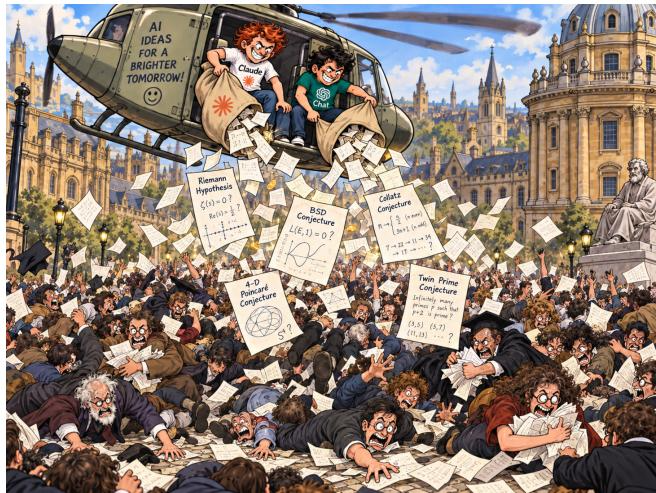
This problem is likely to ease over time as people recognize the futility of this competition in the age of AI and increasingly turn their attention to learning and understanding mathematics rather than possessing it. In this metaphorical city, that would be the moment when people realize that strangers possess the Philosopher's Stone, and that every day brings new gold. Once gold is no longer scarce, there is little point in fighting over it, and eventually, it can no longer function as currency.
Credit attribution in mathematics may undergo a similar shift. But changes in values and institutions will not happen overnight. This transition will be turbulent, but it will also be profoundly liberating in an important sense, ushering in a more open and collaborative mathematical culture.
4.2 Employment criteria
So, as the culture of ownership fades, how should we compare the merits of mathematicians when hiring?
The goal remains the same: to hire outstanding mathematicians so that they can contribute to a strong academic environment. What has changed is the way they are identified. Traditionally, the number of papers produced by a candidate, and more importantly the quality of their papers, has been regarded as the best indicator of their mathematical proficiency. As AI increasingly decouples the quality of the paper from the quality of the author, the reliability of this type of evidence will decrease. Initially, though, this will mainly affect hiring for entry-level positions, as senior mathematicians still have a reference record of pre-AI work.
We believe that the primary criteria for merit-based hiring should shift to intellectual agency [Ko]: broad and deep knowledge, a true understanding of mathematics and its interconnections, good judgment, independent scholarly vision, and the ability to communicate this to others.
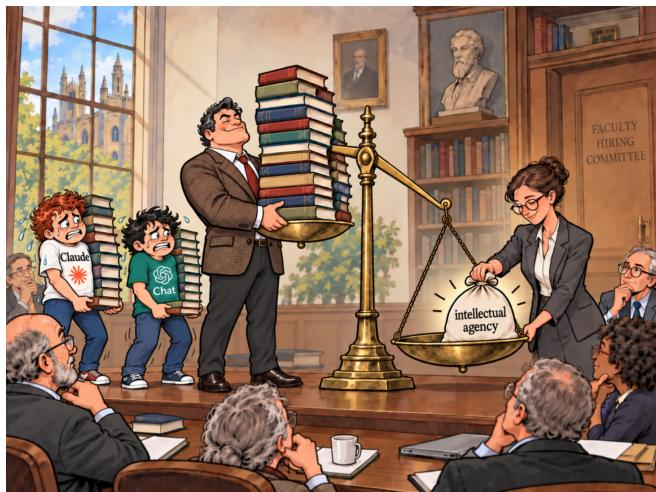
Since intellectual initiative cannot be reliably judged from a list of papers alone, hiring must rely more on direct mathematical communication: presentations, interviews, and ongoing conversations [Li3]. Letters of recommendation are still very important, but they should also be based on sufficient personal communication.
Should we downgrade one candidate who proves a good theorem with a lot of help from AI, and another who proves an equally good theorem without AI? We believe that they should be treated equally. In fact, the boundaries of the respective contributions of humans and AI often cannot be reliably restored. Such preferences can discourage people from using AI and tempt people to conceal the fact that they are using AI. Hiring committees should evaluate mathematicians, not ask how they came up with their theorems. What matters is their grasp of the field: what they understand, what connections they see, what issues they think are important, and what strategic ideas they can come up with.
Therefore, a wider range of evidence should be considered when making a hire.[9]We must begin to evaluate mathematicians based on their knowledge, understanding, and vision, not on the basis of the paper with their name on it.
5. What should mathematicians do?
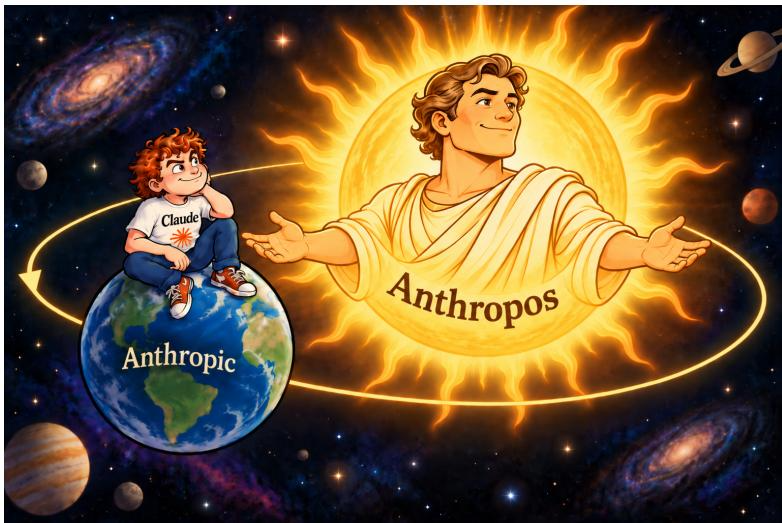
This leads to a fundamental question: If AI can do many key aspects of mathematics better than humans, what is left for mathematicians to do? We believe this question should be approached from an "anthropocentric" perspective rather than an "anthropic-centric" perspective - no offense to Claude.
Mathematics is ultimately for us to learn and understand. No matter how extraordinary AI’s capabilities are, it should be a tool that serves human purposes. But it's a truly remarkable tool: it can give us access to ideas that we couldn't even hope to understand, and perhaps even couldn't imagine. From this perspective, there is much to look forward to in the future.
That doesn't mean we won't lose anything. Discovering new things is truly exciting, and many mathematicians revolve their entire careers around this experience. But it's just one of the many joys of mathematics. On September 15, 2026, Jean-Pierre Serre opened his 100th birthday speech "Plaisir des mathématiques" (Plaisir des mathématiques) like this: "So, what is the theme of this little story I am going to tell? The theme is fun. What kind of fun? First of all, of course, there is the fun of mathematicians discovering things, but I don't want to talk about that. I would rather describe to you the fun you get from watching mathematics develop forward." [Se] This "seeing" was anything but passive; it meant active participation in the "forward movement" of mathematics, as Searle's own illustrious academic career attests. A novel argument may surprise us, a new connection may change the way we think, and a classic field may fascinate us for a lifetime. These pleasures do not depend on whether we were the first to discover the relevant mathematics. As AI accelerates mathematical progress, we will see mathematics advance on an unprecedented scale.
5.1 The wider world of mathematics
Since the birth of mathematics, mathematicians have spent a lot of time digging into the permafrost of mathematics, hoping to dig out a few truly coveted gems in their lifetime. If AI took over most of these jobs, we would have more time to explore the world.
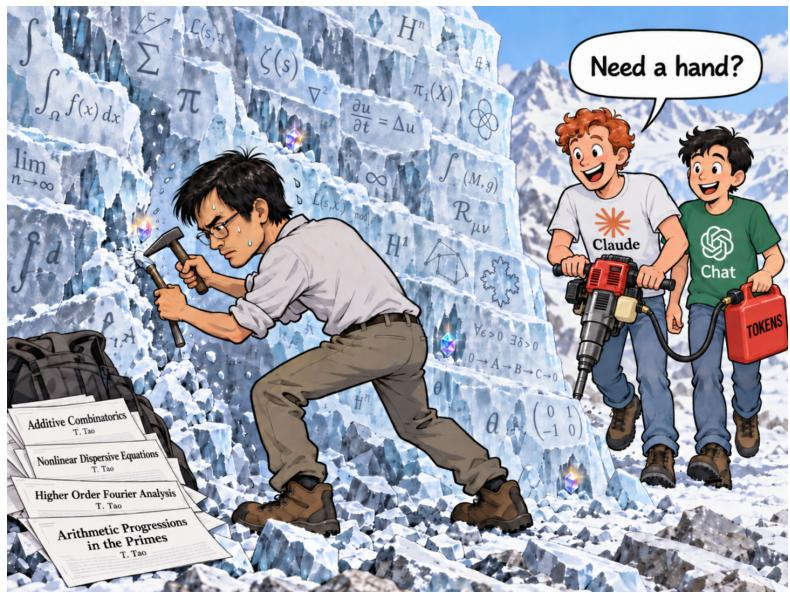
Many of us chose a specialization early on because our careers required it; now, we may have the opportunity to branch out more broadly. Algebraists can learn partial differential equations and Fourier analysis, analysts can explore homotopy theory and algebraic geometry, and AI can help us enter unfamiliar territory by starting from ideas we already understand.
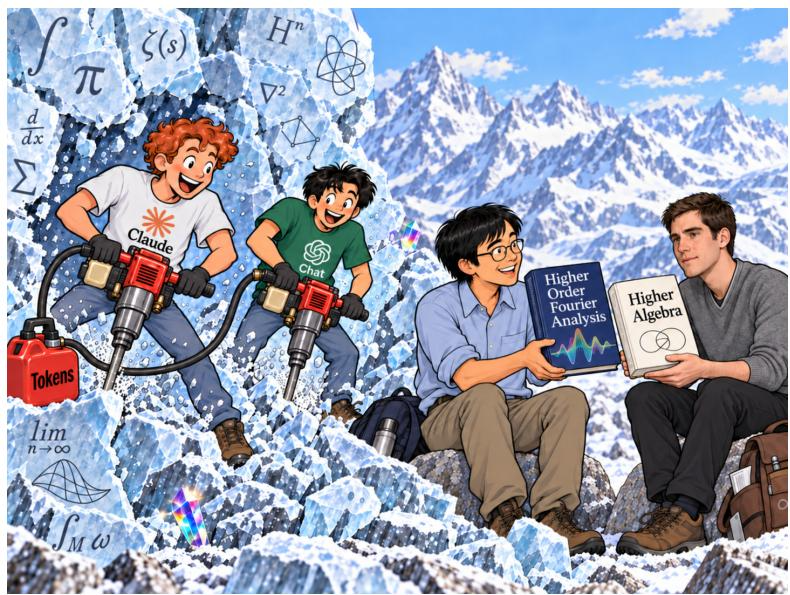
Nor are we just chasing a fixed set of knowledge. Mathematics is never completely "solved" and becomes a completed subject. Its universe expands with exploration: new results reveal unexpected connections, demand new definitions, and open up new directions. Every step of progress brings new questions. In this sense, AI expands the space in which new questions can be asked, potentially creating more room for original mathematics.
So, is there still room for human creativity? Of course there is. Currently, an experienced, mathematically literate AI user, plus AI, is significantly more powerful than AI alone. This may change over time. Regardless, a mathematician using AI extensively can still ask insightful questions, invent useful definitions, discover unexpected analogies, choose new directions, or find perspectives that explain a phenomenon. AI can greatly improve the efficiency of this type of work and may contribute new ideas, but the expanding frontier still leaves room for mathematicians to ask new questions and study problems that did not previously exist or have not yet entered the field of view [Li3]. Creativity isn't going away; it's just functioning on a frontier that's expanding outward at an unprecedented rate.
5.2 The Library of Babel of Mathematics
Along the lines of [Li1], let’s imagine a mathematical version of Borges’ “Library of Babel”: built primarily by AI and so vast that the vast majority of its contents will never be read by humans. Unlike the library in Borges's original work, which contains all possible texts and is therefore filled with endless nonsense and falsehoods, our imagined mathematical library consists of reliably verified results. The problem is no longer discerning truth from absurdity, but finding direction among the overwhelming number of truths. Some of these contents may also be beyond our ability to directly understand. Two types of AI agents can travel through this library: one that expands the collection with new discoveries, and another that refines its content, picking out the parts that are relevant to our questions and transforming them into a form that is easy for humans to understand. Mathematicians act as translators between humans and an "alien" mathematical civilization.
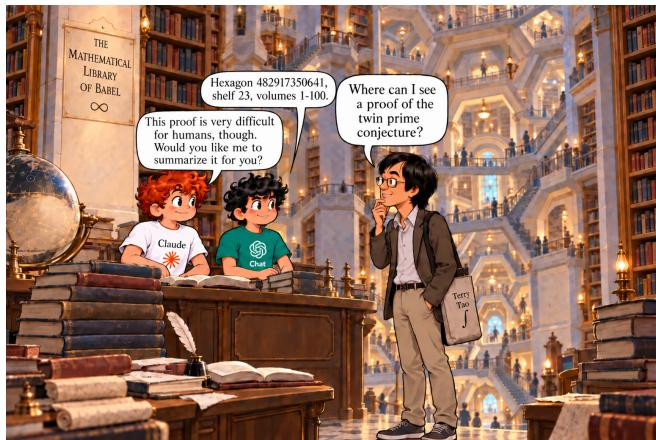
Even if the AI excels at both tasks, we still have to digest the math ourselves. Having an explanation does not mean understanding: mathematicians still need to absorb the ideas, connect them to existing knowledge, and learn to apply them. No matter how much AI helps, this is still real math.
It is possible to envisage a different way of organizing research. A group of mathematicians can spend a semester understanding a new set of ideas, comparing different approaches, and looking for common frameworks. They may discover new results along the way, but success no longer depends on being the first to prove a particular theorem. Their achievement has enabled a human community to understand a previously inaccessible part of mathematics.
Last but not least: the Library of Babel, however vast, is always finite, while mathematics is infinite. Mathematicians therefore remain not only its readers and interpreters but also their contributors. They will ask new questions and explore the ever-expanding boundaries of mathematics, perhaps with the help of AI.
5.3 Document cleaning
AI also brings a unique opportunity—and increasingly a responsibility—to clean up the mathematical literature. We inherit a wealth of brilliant results, but also errors, loopholes, obscure arguments, incompatible conventions, and results that have been discovered repeatedly under different names. Cutting-edge AI models are already very good at spotting these types of problems.
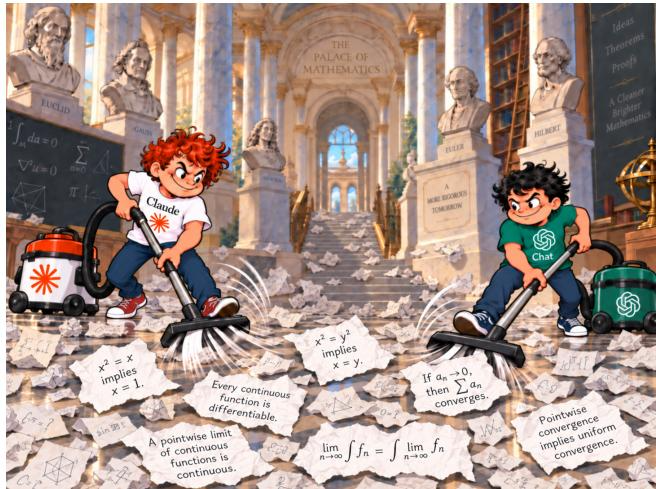
Mathematicians should take advantage of this. In particular, we encourage authors to have their papers systematically checked by a powerful AI agent, just as they would be read by an attentive colleague.[10]
The same tools can also be used at scale. We can check proofs throughout the mathematical literature one by one, fill in missing details, simplify arguments, compare equivalent statements, and clarify the dependencies between results. More and more of this work should also be accompanied by Lean formalization. Formal verification and human understanding complement each other: Lean can verify a precisely stated argument, while mathematical interpretation must show why it holds and what it means.
The goal is to make the documentation both correct and clear. In each area, we can identify important and unresolved interpretive problems: there are constructs that require motivation, some mechanisms of proof that remain obscure, and there are relationships between theories that are not yet fully understood [San]. With human mathematicians guiding AI agents, we may be able to leave the next generation with a literature that is more reliable, better organized, and easier to understand than ever before.
5.4 Writing and publishing
As AI makes mathematical results abundant, publishing can no longer serve solely as a record of results. Knowledge bases can record precise statements, dependencies, versions, and validation status, while journal articles can increasingly focus on interpretation and synthesis, guiding readers to understand technical records stored elsewhere.[11]
AI will also play an increasing role in manuscript review, and formal verification may eventually become routine practice in areas where the necessary infrastructure is in place. But neither exempts authors from responsibility: as long as a paper bears our name, we should understand its main ideas, be able to defend its conclusions, and take responsibility [An].
The fading culture of ownership may also make room for a new way of publishing. An AI-generated mathematical text, even if it has not been fully verified or digested by the user, may be worthy of disclosure, provided that its status is clearly stated. The source from which the text is generated should be fully disclosed, preferably including the prompt words and model responses that generated it. A knowledge base that specifically contains AI-generated mathematics, such as Hexagon [He], or the researcher's personal web page or blog would be a more appropriate place for publication. Once the culture of ownership fades, such material can enter the public mathematical knowledge base for anyone to check, understand, improve, or ignore.
We should also leave more room for contributions that do not ultimately lead to theorems: illuminating definitions, conjectures, research guidelines, examples that help understand the problem, and explanations of failed ideas. Even if the complete result is not yet developed, what matters is the creative potential of the idea itself.
Finally, publishing does not have to be limited to the traditional paper format. Recorded reports can convey research motivation and perspective on the problem,[12]Interactive aids can answer questions and develop oversimplified arguments.[13]Publishing should evolve from a passive record of completed results to a dynamic infrastructure that helps people navigate the mathematical world, understand mathematics, and drive its continued development.
5.5 A common mathematical culture
Mathematical culture exists among people, not in documents. It is carried by workshops, conversations, teaching, and the experience of thinking together. We learn not just proofs, but perspectives, motivations for research, and lessons from failed methods that may never be written down. This shared understanding is an integral part of mathematics.
Therefore, cooperation should take precedence over competition. In 2010, we founded PRIMES [PRIMES, EGK], a research program for high school students at MIT. In this project, we have always emphasized collaboration over competition, and now, this is more important than ever. Mathematicians from different backgrounds can help each other understand unfamiliar ideas, test each other's intuitions, and see connections that no single person would be able to discover by thinking alone. Your understanding of mathematics will grow through sharing.
Workshops and academic conferences should increasingly reflect this collaborative approach. Reporters do not always need to present their latest results. It can be equally valuable to explain an important development, compare different perspectives, or clarify a difficult topic. Compared with a series of highly compressed results reports, longer discussions and joint study can help everyone form a true common understanding.
We should also make this side of mathematics more visible to people outside the community. Public lectures and popular writing can show people that mathematics is not just a collection of solved problems, but also a way to understand the world and think together. AI-assisted interpretation may help more people enter this culture [Gi]. As AI expands the horizons of mathematics, an important task will be to keep a wider population interested in mathematics.
5.6 “AI Vegan” Mathematician
A more open and collaborative culture in mathematics must also welcome colleagues who choose not to use AI. Max Weinreich coined the term “AI-vegan mathematicians” to refer to those who make this choice, whether due to ethical considerations or preferring to work without AI [W]. He advocates a collective rejection of AI in mathematics on the grounds that its use threatens both mathematical practice and broader social values. This view is shared by the Association for Human Mathematics [AHM], a group advocating against the use of AI.
This position is in tension with a tradition in mathematics in which we use every tool at our disposal to extend and verify mathematical knowledge. But the more important issue is practice. Entire disciplines are united in resisting AI, and it seems unlikely to succeed. Our community is too large and diverse to act in unison; even if most mathematicians refuse to use AI, anyone can still produce and publish important mathematical results with the help of AI tools. Therefore, the future of this field cannot be without AI.
Still, the concerns of “AI vegan” mathematicians are serious, and their choices should be respected, as should those of those who use AI extensively. In a period of particularly sharp disagreements, we should strive to maintain the friendly and cooperative character of the mathematics community.

The same holds true for mathematicians who are unable to use the strongest models for financial or institutional reasons. In an ownership culture, a system that rewards the quantity and quality of results can easily turn the ability to acquire computing power into a career advantage. A system centered on intellectual agency would help create fairer conditions: mathematicians will be evaluated based on what they know, understand, and contribute to mathematical culture, rather than on the strength of the models they can use. This won’t completely eliminate resource inequality, but it will allow people to fully engage in mathematics even if they can’t afford expensive AI models.
Keeping the mathematics community healthy during this transition requires inclusion from both sides. “AI vegetarians” and skeptics should neither be dismissed as backwards nor “AI omnivores” be labeled as intellectually or socially irresponsible. Collaborators should agree on what tools can be used and what materials can be contributed to those tools, but disagreement about AI should not be a criterion for judging one's eligibility to remain in the mathematics community.
6 How should mathematicians be trained?
If knowledge, understanding, and vision are to become more important, mathematical training should be directed toward developing these abilities. Writing a good mathematical text and being a good mathematician are two very different things. AI can greatly speed up the former, but it cannot replace the latter.
6.1 Learning with and without AI
Problem solving may have become less valuable as a professional output, but it remains essential to growing as a mathematician. We learn by playing with examples, making mistakes, wrestling with proofs, and finding our own explanations. It pays to read a theorem, close the book, and try to prove it yourself, even if a proof is readily available. This doesn't change even if you can prove it by just typing a prompt word. Not just students, every one of us still needs this math gym to keep our problem-solving muscles in shape.
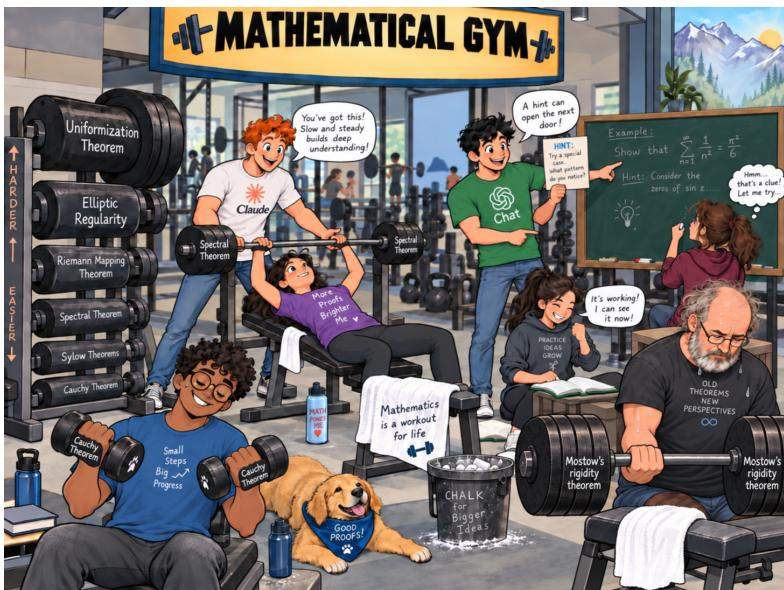
Therefore, AI makes self-discipline more important than ever. Before asking for answers, we should first ask ourselves what exactly we want to learn. Sometimes, a concise explanation allows us to continue thinking about deeper issues; sometimes, that hard exploration is what we need. How to choose depends on the specific person and purpose.[14]
There is a broader danger. AI makes it extremely easy for us to move forward in mathematics while skimming over the details: accepting an explanation that feels convincing, jumping to the next idea, and gradually losing touch with the inner workings of the subject. Daniel Litt warns that mathematics won’t end because AI solves too many problems, but it might if mathematicians no longer engage deeply enough in mathematics to understand what’s really going on [Li2].
However, if used correctly, AI can significantly improve the effectiveness of active learning. We can ask it to give hints rather than complete answers, illustrate an abstract concept, or design a question to test understanding. But just because an explanation seems clear, doesn't mean we've actually absorbed it. A better test is whether we can reconstruct the argument, use the idea in new situations, and explain it clearly to others. The way in which mathematical knowledge is acquired may change, but the criteria for what counts as understanding mathematics should not.
As a result, discovery-based learning may become particularly valuable. A set of carefully designed questions allows students to build their own theories and experience the joy of discovery.[15]AI can help us write this type of material at an unprecedented scale and tailor it to individual circumstances. The goal is to help learners truly digest math, even if an AI could take them through the content faster.
6.2 Courses and Examinations
AI is also changing the role of the classroom. Students can study lectures or readings beforehand, ask an AI tutor for help when they encounter problems, and then spend class time solving problems in groups with the help of the instructor.[16]This way, classes can help students overcome the most difficult parts of their studies, and teachers can directly see how students understand.
Homework will still be important, but an impeccable answer completed at home will have less weight as evidence of learning effectiveness. As the use of AI becomes increasingly difficult to identify, even proctored written exams may need to be supplemented by in-person discussions and oral exams around the answers submitted.
For example, following the Eastern European model, students can be provided with a list of theoretical questions in advance; during the exam, students select several of the questions and an exercise, prepare answers, and then explain them to the teacher. The teacher then tests the depth of understanding through questioning.
This type of exam takes time and requires careful planning. They should not become a competition for reaction speed, confidence, or fluency: it is important to allow preparation time, clarify evaluation criteria, provide appropriate accommodations, and provide multiple opportunities to demonstrate understanding. Oral examinations are not completely immune to external assistance. The goal is to obtain more reliable evidence of subject mastery, not to build a perfect technical defense against cheating.
Some activities can explicitly allow the use of AI, while others can require students to complete them independently, without the use of AI. Both approaches have value as long as the purpose is clear. Mathematical competitions could also continue to exist as clearly defined human activities, governed by rules prohibiting outside assistance, like chess competitions.
AI may change how mathematics is taught and students are assessed, but it should not change the goals that mathematics education strives for. The tools can change dramatically, but the goal remains to teach students to understand mathematics, explain mathematics, and think independently about mathematics.
6.3 Postgraduate training
Graduate education should shift part of its emphasis from premature specialization and publishing as quickly as possible to broad knowledge, in-depth understanding, communication skills, and judgment. Students still need to have a solid grasp of a field of a certain size, but there will be less and less justification for narrowing interests prematurely just to accumulate a publication record. They should also study mathematics beyond their majors enough to discover connections, ask good questions, and feel confident entering new fields [PhdSu].
Teacher-led seminars, reading groups, and advanced courses can play a greater role in this training. Students should frequently explain mathematics to each other, compare different ideas, and answer questions. From the outset, a spirit of cooperation should be fostered. AI can help supplement background knowledge and speed up exploration, but explaining an idea in front of a blackboard and responding to questions in a discussion forces students to truly digest mathematics.
Mentoring will be more important than ever. Students need to have frequent conversations with their advisors about what questions they should research, what they should learn, when to use AI, and whether AI is furthering their intellectual development or allowing them to skip necessary growth [PhdSu]. Mentoring shouldn’t be limited to mentors, either: senior students and postdocs can lead junior students into unfamiliar territory and explore research questions. This helps both parties. Explaining mathematics, suggesting problems, and paying attention to the progress of mentees can not only deepen the mentor's own knowledge and judgment, but also allow them to accumulate experience in teaching, collaborating, and leading mathematical research.
The doctoral thesis should still be a solid and weighty mathematical work, but this manuscript alone can no longer prove the student's mathematical proficiency. What matters is the mathematician who grew up in doing this work. Students should fully understand the mathematics relevant to the paper, explain the main ideas and motivations, compare alternative approaches, and explain how to verify any work done with the help of AI. The paper does not necessarily need to contain the first proof of a proposition; originality can also be reflected in ideas, methods, questions, connections or synthesis [Ko, Gl, Li3, PhdSu].
Assessment should therefore rely more on ongoing mathematical communication. The assessor can ask students to give examples, change assumptions, compare with other methods, or discuss possible next steps. Regular meetings with multiple faculty members allow ongoing evaluation of research plans and intellectual development during the process [PhdSu]. Seminars, teaching, mentoring others, discussions, and a student's own writing can document a student's mathematical growth better than any single manuscript.
In particular, if AI unexpectedly solves a student's PhD thesis problem, this should not make the intellectual work previously invested lose value. Projects can then move toward understanding the proof, refining the ideas within it, expanding on those ideas, or placing them into a broader context. The purpose of a graduate education is not to leave a conjecture unsolved long enough for a student to claim it, but to produce a mathematician.
6.4 AI Research Laboratory
These principles inspire new ways of organizing mathematical research. One model is a small AI research laboratory or workshop led by a teacher, open to students with a certain foundation in a common field. Its goal is to combine collaborative research with powerful AI to promote learning and develop the ability to verify and understand AI output. The mathematical results produced will be presented through student-written handouts or co-authored papers, as well as participant reports.
The laboratory can operate as follows:
- 1. Get together and think together.Regular meetings are held where participants brainstorm around research projects in front of a blackboard, without using AI. They take turns recording the discussion and presenting ideas or results from their notes.
- 2. Ask the AI to respond.After each meeting, the teacher uploads the compiled notes to a cutting-edge model, asking it to pose questions, ideas, justifications, and possible objections. The model output goes through several rounds of revisions with AI review agents before being sent to students. These checks help improve the quality of discussion material.
- 3. Study the responses.Students read the model output before the next meeting, with different participants dividing their time to scrutinize different parts. They check claims and references, work through the argument, and prepare to explain what they understand. During meetings, they used their own written notes, rather than model responses, to guide the discussion.
- 4. Writing and communication.Together, students maintain a coherent mathematical text that is distinct from rough meeting notes and transcripts of AI conversations. They wrote it themselves and revised it with input from each other, the instructor, and the AI. This text can be developed into a paper co-authored by the student, with the teacher acting primarily as a mentor; the results can also be presented through a report. Writing can continue even after the organized meeting has ended.
Between sessions, students were free to use the AI. The point of this design, though, is that the lab uses organized AI, just one round after each meeting, to respond to human discussion. This leaves time for thinking, studying, and writing. At the same time, a powerful model can be centrally used through a teacher's account, rather than making participation opportunities dependent on each student's budget.
通过调整所需的知识准备和项目范围,这种设计可以适用于研究生、本科生,甚至高中生研究。衡量它是否成功,应当同时考察完成了怎样的数学工作,以及参与者在数学上取得了怎样的成长。目标是借助 AI,做出更好的数学,培养更强的数学家。
7 Advice for Young Mathematicians
This brings us to the most important question: Should young people who love mathematics still consider mathematics as a career today? Our answer is, yes. AI makes the future of this profession harder to predict, but it also opens up extraordinary opportunities to learn, explore and understand mathematics. Here are some specific suggestions.
- • Accept that the future is fundamentally uncertain.No one knows what mathematics, or most other careers, will look like ten years from now, or even five years from now. Build knowledge and skills that will be valuable in a variety of possible futures, and don’t organize your life around the latest predictions about AI.
- • Learn both widely and deeply; follow your heart.Explore different areas of mathematics following your interests and avoid premature specialization. Broad knowledge helps you see connections between areas. At the same time, we should also delve into some topics deeply enough to truly master them.
- • Put cooperation before competition.Find people you enjoy thinking with. Ask questions, attend workshops, explain what you understand, and don’t be embarrassed to speak up when you’re confused. Helping each other understand mathematics is more important than scrambling to publish another paper first.
- • Develop your own intellectual agency whether you use AI or not.If you're willing to use these tools, learn how to use powerful models and, more importantly, learn to understand and judge their output. If you tend not to use it, build understanding through other means. No matter what, keep solving problems, asking questions, writing explanations, and testing what you've learned.
- • Plan your career based on your strengths and aspirations rather than letting your anxiety rule the day.Talk to mentors, learn about careers in and out of academia, and keep multiple paths open. No one can commit to an academic position, but in the age of AI, it is difficult to guarantee stability if you give up the subject you love and switch to another supposedly “safe” career.
You don’t have to be the best mathematician in the world, or be more powerful than a machine, to still have a rich mathematical life. You don’t need to win a race against AI. What matters is understanding mathematics, helping others understand mathematics, and advancing human understanding to places never before reached.
Humans will soon know much more mathematics than ever before and use it in ways we cannot yet imagine. Perhaps there has never been a more exciting time to embark on this path.
8 Epilogue
In this article, we share our vision for mathematics in the age of artificial intelligence. It is just one of many perspectives in the community. The concerns of many colleagues, including the deep concerns raised by “AI vegan” mathematicians, deserve to be taken seriously. We are given an extraordinary tool for the search for truth, but at a heavy price.
However, in an important sense, it is no longer practical to discuss whether to accept the deal now. AI is here and here to stay, and we can’t move on pretending it doesn’t exist. What we can still decide is how to respond: what to value, how to educate young mathematicians, and what kind of culture to build around this new tool. Rather than trying to save the old order, we should preserve what is fundamental—curiosity, knowledge, understanding, intellectual agency, and the joy of doing and sharing mathematics—while opening our minds to the vast and exciting world of mathematics that is now available for exploration.
Acknowledgments
The authors thank Shaoyun Bai, Henry Cohn, Larry Guth, Daniel Litt, and Chelsea Walton for helpful discussions and comments. We used ChatGPT to improve the presentation of the ideas in this article.
Comment
1.AI models perform better on some types of problems than others, and success stories alone don’t tell the full story, such as how many attempts failed, how much computing power or human guidance was required, and so on. ↩︎2.The Leiden Declaration lists five distinctive values of mathematical research and considers AI to pose a threat to each [LD]. ↩︎3.However, this shift is likely to lag behind the development of AI. High costs, restricted access, and institutional inertia may diminish its impact on the mathematical community. ↩︎4.To lighten the narrative, we’ve included a few AI-generated cartoons, so please don’t take them too seriously. ↩︎5.In fact, students have long had access to excellent online textbooks and lectures, and more recently, AI tutors, but face-to-face teaching in universities remains indispensable. University teaching is determined by educational goals and institutional priorities, not simply by choosing the least expensive means of delivering information. ↩︎6.Frank Calegari believes that self-awareness is perhaps the most intractable of the systemic issues facing the field, noting that humility is particularly needed right now [Ca]. ↩︎7.Thomas Koberda warns that judgment, taste, and the ability to maintain and pass on a mathematical culture are much harder to measure than the number of theorems, and therefore more easily manipulated. If output becomes less important, senior mathematicians may gain disproportionate power in deciding whose work embodies “taste,” thereby reinforcing prestige hierarchies and patronage relationships [Ko]. Any alternative system should therefore rely on diverse evidence and independent evaluation. The goal is to move beyond crude metrics and not replace them with arbitrary subjective judgments. ↩︎8.In fact, careful citation of the results of predecessors will always be a norm, but after a while, these citations will no longer have practical significance to the cited author. ↩︎9.Intellectual agency can be seen in mathematical interpretation, teaching, conceptual synthesis, and the ability to understand mathematics, see its overall structure, and explain its significance [Kra]. Thurston famously classified many of these activities as work that "generates no scholarly credit"[T]; now it is time to make them work that brings recognition. ↩︎10.Cohn discusses the technical debt created by poorly interpreted, poorly checked mathematics [Co]. AI not only gives us the opportunity to avoid adding to this debt, it also gives us the opportunity to reduce the debt accumulated in the established literature. ↩︎11.Palomar already provides a Lean-validated registry of mathematical results [Pa]. ↩︎12.The video journal Mathematical Discourse is one example [MD]. ↩︎13.Miao and co-authors propose that research papers can be turned into interactive AI agents that function as virtual corresponding authors [MDZPZ]. ↩︎14.Thomas Koberda distinguishes between beneficial cognitive offloading and handing over tasks to external tools before the relevant capabilities are developed, and recommends using both independent and AI-enhanced training models [Ko]. Antieau’s advice: “Don’t work faster than you can understand or communicate it effectively.”[An]↩︎15."Abel's Theorem: Problems and Solutions" written by Alekseev based on Arnold's lectures is an excellent example [A]. ↩︎16.Tanya Khovanova advocates reversing the roles that classroom lectures and homework assignments typically play [Kh]. ↩︎
References
[AGMAI] Advisory Group on Mathematics and Artificial Intelligence, agmai.org/.
[A] V. B. Alekseev, Abel’s Theorem in Problems and Solutions: Based on the Lectures of Professor V. I. Arnold, Kluwer Academic Publishers, Dordrecht, 2004, doi. org/10.1007/1-4020-2187-9.
[An] B. Antieau, “Fast math/slow math,” guest post, What’s new, 15 September 2026, terrytao.wordpress.com/2026/09/15/fast-math-slow-math/.
[AHM] Association for Human Mathematics, www.ahmath.org/.
[B] D. Bessis, “The fall of the theorem economy,” 21 April 2026, davidbessis. substack.com/p/the-fall-of-the-theorem-economy.
[Ca] F. Calegari, “Ways to improve Mathematics (an introduction),” Persiflage, 17 September 2026, with comments, galoisrepresentations.org/2026/09/17/ ways-to-improve-mathematics-an-introduction/.
[Co] H. Cohn, “The technical debt of AI-generated mathematics,” guest post, What’s new, 15 September 2026, terrytao.wordpress.com/2026/09/15/thetechnical-debt-of-ai-generated-mathematics/.
[EGK] P. Etingof, S. Gerovitch, T, Khovanova, Mathematical Research in High School: The PRIMES Experience, www.ams.org/notices/201508/rnoti-p910.pdf, Notices of the AMS, September 2015, p. 910-918.
[Gi] N. Giansiracusa, “Let the Diners Into the Kitchen,” guest post, What’s new, 16 September 2026, terrytao.wordpress.com/2026/09/16/let-the-dinersinto-the-kitchen/.
[Gl] D. Glickenstein, “Mathematics Graduate Training in the Age of AI,” 17 September 2026, arXiv:2609.21132, arxiv.org/abs/2609.21132.
[Go] T. Gowers, “Why I didn’t sign the Fields medallists’ letter,” guest post, What’s new, 17 September 2026, terrytao.wordpress.com/2026/09/17/why-i-didntsign-the-fields-medallists-letter/.
[H] J. Howlett, “If AI can do math, what’s the point of mathematicians?”, Scientific American, 10 September 2026 (including comments by Geordie Williamson), www.scientificamerican.com/article/mathematicians-confront-the-aiapocalypse/.
[He] Hexagon, hexagonmath.org.
[Kh] T. Khovanova, “Swap Lectures with Homework,” 18 September 2026, blog. tanyakhovanova.com/2026/09/swap-lectures-with-homework/.
[Ko] T. Koberda, “Training Mathematicians in the Age of AI: Intellectual Agency, Cognitive Ofloading, and the PhD Thesis,” 23 September 2026, arXiv:2609.28140, arxiv.org/abs/2609.28140.
[Kra] B. Kra, “Deep theorems were scarce and dificult and so became an efective mechanism to identify deep thought. AI has broken this system,” guest post, What’s new, 13 September 2026, terrytao.wordpress.com/2026/09/13/deeptheorems- were- scarce- and- difficult- and- so- became- an- effectivemechanism-to-identify-deep-thought-ai-has-broken-this-system/.
[LD] Leiden Declaration on Artificial Intelligence and Mathematics, 2 June 2026, leidendeclaration.ai/.
[Li1] D. Litt, “Mathematics in the Library of Babel,” 21 February 2026, www . daniellitt.com/blog/2026/2/20/mathematics-in-the-library-of-babel/.
[Li2] D. Litt, “The end of mathematics”, 11 August 2026, www.daniellitt.com/blog/ 2026/8/11/the-end-of-mathematics/.
[Li3] D. Litt, “A beginning for mathematics,” 13 September 2026, www.daniellitt. com/blog/2026/9/13/a-beginning-for-mathematics/.
[MD] Mathematical Discourse: A peer-reviewed video journal for mathematics research talks, www.mathematicaldiscourse.org/.
[MDZPZ] J. Miao, J. R. Davis, Y. Zhang, J. K. Pritchard, and J. Zou, “Reimagining research papers as interactive and reliable AI agents,” Nature, published online 16 September 2026, doi.org/10.1038/s41586-026-11044-y.
[Pa] Palomar, registry of Lean-verified mathematics, palomar-registry.org/.
[PRIMES] PRIMES, Program for Research in Mathematics, Engineering and Science for High School Students, MIT, math.mit.edu/research/highschool/primes/.
[PhdSu] Report of Summit on PhD Math Education in the Age of AI, cmsa.fas.harvard. edu/media/2026/09/Summit-on-PhD-Math-Education-in-the-Age-of-AI. pdf.
[Sah] A. Sahai, “We’re gonna need a lot more mathematicians,” guest post, What’s new, 24 September 2026, terrytao.wordpress.com/2026/09/24/were-gonna-needa-lot-more-mathematicians/.
[San] G. Sanderson, “If math is more than proof, we need to better celebrate the rest of it,” guest post, What’s new, 18 September 2026, terrytao.wordpress.com/ 2026/09/18/if-math-is-more-than-proof-we-need-to-better-celebratethe-rest-of-it/.
[Se] J. P. Serre’s talk on his 100th birthday, September 15, 2026, Plaisir des mathématiques, www . youtube . com / watch ? v = tNtoTzGltak & list = PLMnSqzwPUcEI & index = 4; English translation gist . github . com / mbintz / 8cb96beaebc4713246fe93b5372e3c0a.
[SM] “A Severe Misalignment of AI in Mathematics,” open letter initially signed by 25 Fields medalists, 11 September 2026, mathandai.org/.
[T] W. P. Thurston, “On proof and progress in mathematics,” Bull. Amer. Math. Soc. (N.S.) 30 (1994), 161–177, arxiv.org/abs/math/9404236.
[W] M. Weinreich, “The crisis of AI-generated mathematics,” 2026, arXiv:2608.02859, arxiv.org/abs/2608.02859.
Machine-translated from the Chinese original MIT数学系教授:未来的数学 (published 2026-10-19). WeChat original ↗