OpenAI announces three AI research advances: from Kakeya’s conjecture to quantum field theory
OpenAI recently announced that its internal model has produced three research results in harmonic analysis, computational complexity theory, and quantum field theory, and is working with academia to promote verification, explanation, and further research on these results.
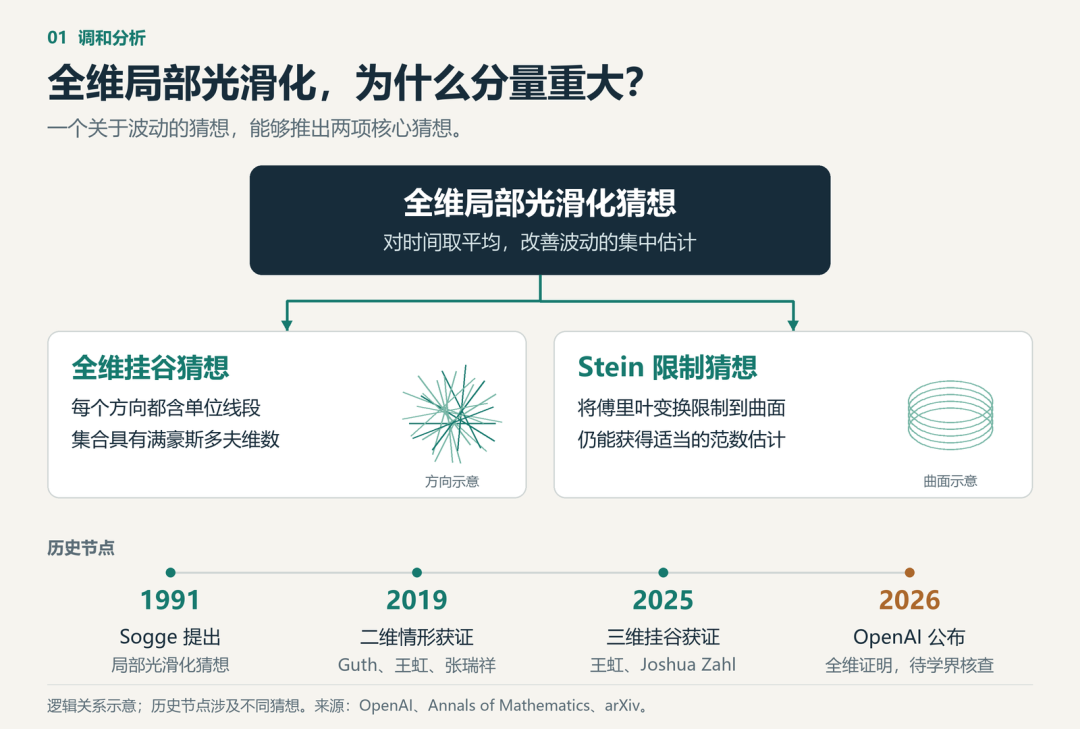
Full-dimensional local smoothing conjecture.This conjecture was proposed by Sogge in 1991 to study the concentration phenomenon of fluctuations in propagation: a strong focus can occur at a certain moment, but after averaging over time, a better estimate should be obtained. Its significance goes beyond the Kakeya conjecture: the full-dimensional local smoothing conjecture can deduce the Kakeya conjecture and Stein limit conjecture in all dimensions. The former studies the dimensions of a set containing a unit line segment in each direction, and the latter studies the estimation of the Fourier transform when restricted to surfaces. OpenAI said that the model was proved through a new auxiliary partial differential equation, and it has published natural language proof and Lean formal materials. If confirmed, this will simultaneously resolve several decades-old core conjectures in harmonic analysis, constituting a landmark breakthrough in the field.
Previously, Guth, Wang Hong, and Zhang Ruixiang proved the two-dimensional local smoothing conjecture in 2019, and the paper was published in the "Annals of Mathematics" in 2020; in 2025, Wang Hong and Joshua Zahl proved the three-dimensional Kaketani conjecture. This announcement advances the conclusion to all dimensions.
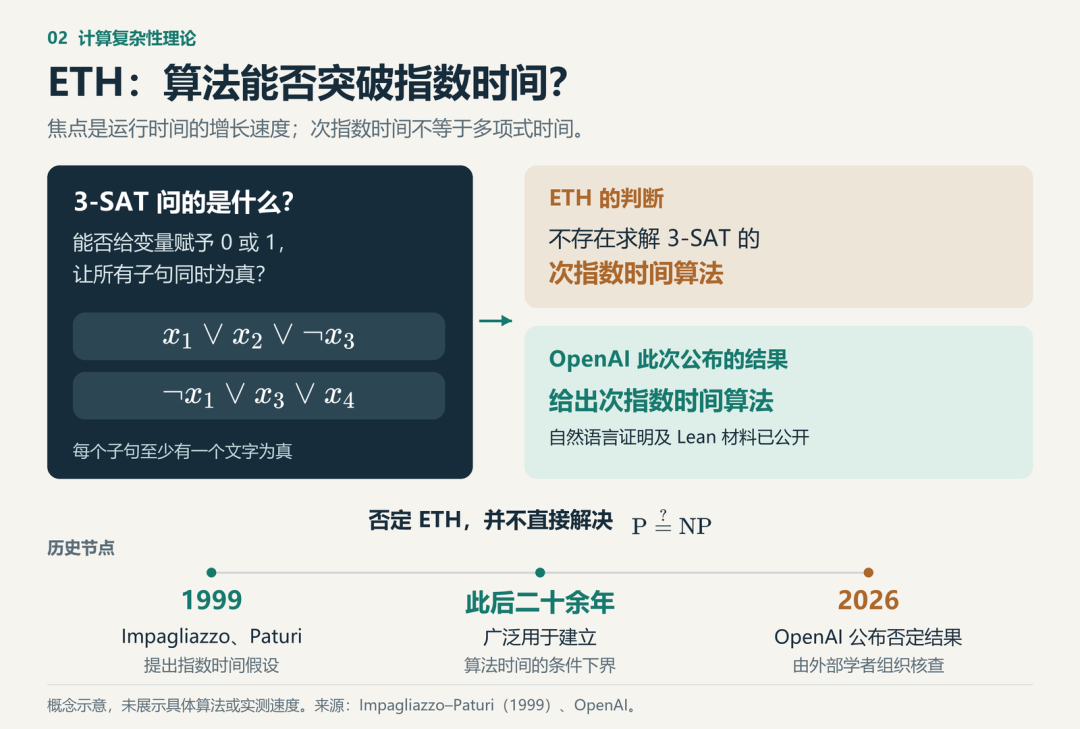
Negating the exponential time hypothesis (ETH).ETH believes that 3-SAT cannot be solved in sub-exponential time with respect to the number of variables; 3-SAT needs to determine whether a set of Boolean constraints each containing at most three literals (variables or their negations) can be satisfied simultaneously. The results published by OpenAI give a sub-exponential time algorithm and have been formalized in Lean. This means that a large number of algorithm time lower bounds based on ETH have lost their original conditional basis, and also opened up space for finding faster algorithms; however, sub-exponential time may still be much slower than polynomial time, so the result itself does not solve the P and NP problems. Russell Impagliazzo, Ramamohan Paturi and Ryan Williams will lead verification and interpretation.
ETH was proposed by Impagliazzo and Paturi in 1999. In the following more than two decades, it became an important hypothesis for studying algorithm time lower bounds, affecting fields such as graph theory, computational geometry, and databases. Among the scholars who organized the verification this time were the two authors of this hypothesis.
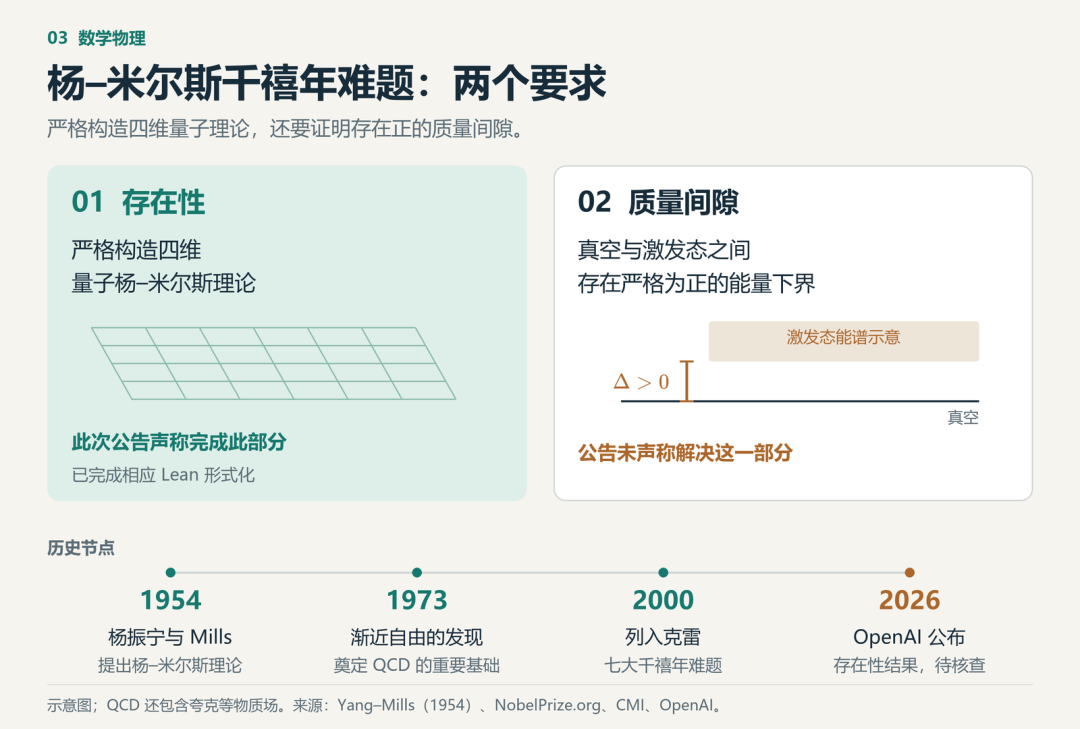
The existence of four-dimensional quantum field theory.OpenAI stated that the model is based on Balaban's constructive quantum field theory method and provides a rigorous existence proof of the theory including quantum chromodynamics (QCD) and a unified extension of the standard model. The mathematical difficulty is to strictly construct the four-dimensional interacting quantum field into a mathematical object to establish the basis for physical theory. Among them, the existence of pure Yang-Mills theory corresponds to the existence part of one of Clay's seven millennium problems "Yang-Mills existence and mass gap"; the other part requires the proof of a strictly positive mass gap, which the announcement does not claim to solve. QCD further includes material fields such as quarks. OpenAI stated that it has completed the Lean formalization of pure Yang-Mills existence; an expert group led by David Gross will be responsible for understanding and organizing, and the relevant AI materials have not yet been made public.
In 1954, Chen Ning Yang and Robert Mills proposed the Yang-Mills theory. In 1973, Gross, Wilczek and Politzer discovered asymptotic freedom, laying the key foundation for QCD and winning the 2004 Nobel Prize in Physics. In 2000, the problem of strict existence and mass gaps was listed as a millennium problem, highlighting the distance between the success of physical theory and the incomplete mathematical foundation.
OpenAI positions the manuscripts generated by these models as "raw research data." The focus of follow-up work is for the academic community to independently verify the demonstration, clarify the relationship with existing results, and transform the formal results into understandable and usable mathematical knowledge.
refer to
OpenAI:Working with academic communities to build scientific understanding:https://openai.com/index/building-scientific-understanding-with-academic-communities/
Machine-translated from the Chinese original OpenAI公布三项AI科研进展:从挂谷猜想到量子场论 (published 2026-10-27). WeChat original ↗