
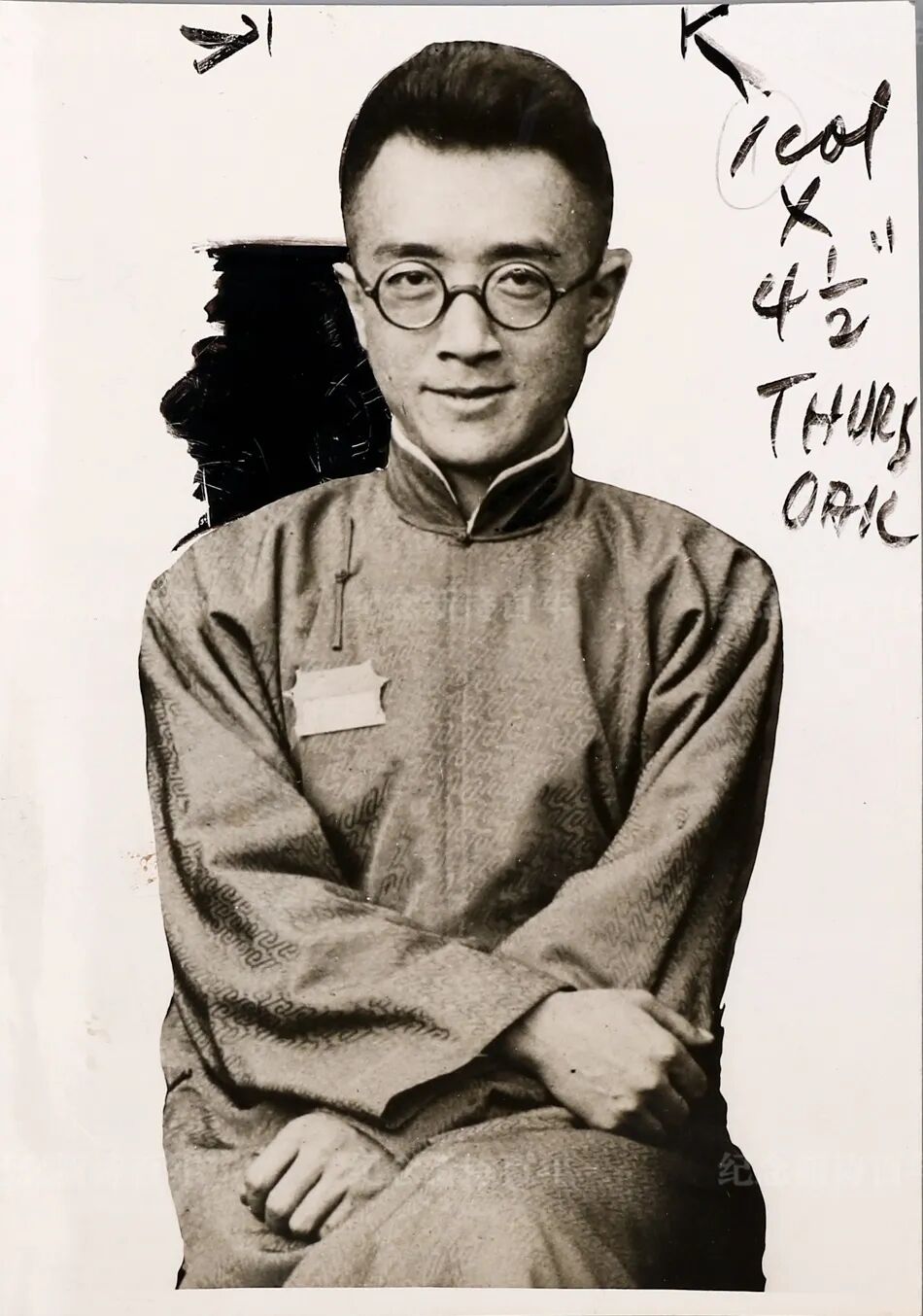
Hu Shi (December 17, 1891 - February 24, 1962)
In May 2020, I read an article by Mr. Hu Chengye, president of the Anhui Jixi Anhui Studies Research Association - "Hu Shi's Data Collection and Research by Me". Mr. Hu mentioned in the article that he wrote a few thousand words of "Three Pioneers of Hu Shih Research Worth Admiring—Professors Tang Degang, Li Youning, and Geng Yunzhi" and "knows that Hu Shih's research can break the forbidden zone and set off "Hu Shih fever" at home and abroad, which is hard-won." (Editors-in-chief Geng Yunzhi and Song Guangbo, "The Heart is Long and the Road is Distance: The Process of Hu Shi Research" (the third volume of Hu Shi Research Series), Heilongjiang Education Press, 2015)
Among the three professors, Geng Yunzhi is a researcher at the Institute of Modern History of the Chinese Academy of Social Sciences. Mr. Geng has long been committed to the study of modern Chinese political history, cultural history, and ideological history, and has devoted a lot of effort to the history of ideas. Regarding Mr. Geng’s research on Hu Shi, I have reviewed it and pointed out that “Mr. Geng has written a large number of papers on Hu Shi, compiled a lot of information about Hu Shi, especially the Hu Shi archives collected by the Institute of Modern History, initiated a Hu Shi research association, organized many relevant academic conferences, edited a variety of Hu Shi research books, and made important contributions to the development of Hu Shi research.” I also believe that “Mr. Geng Yunzhi is not only a pioneer in Hu Shi research, but also a pioneer in Hu Shi research.” (Yang Hailiang, "A Long Journey Ahead: A Random Discussion on Mr. Geng Yunzhi and the Study of Hu Shi", Scholar, May 31, 2020) It should be said that there is no controversy in classifying Mr. Geng Yunzhi as a "pioneer in the study of Hu Shi".
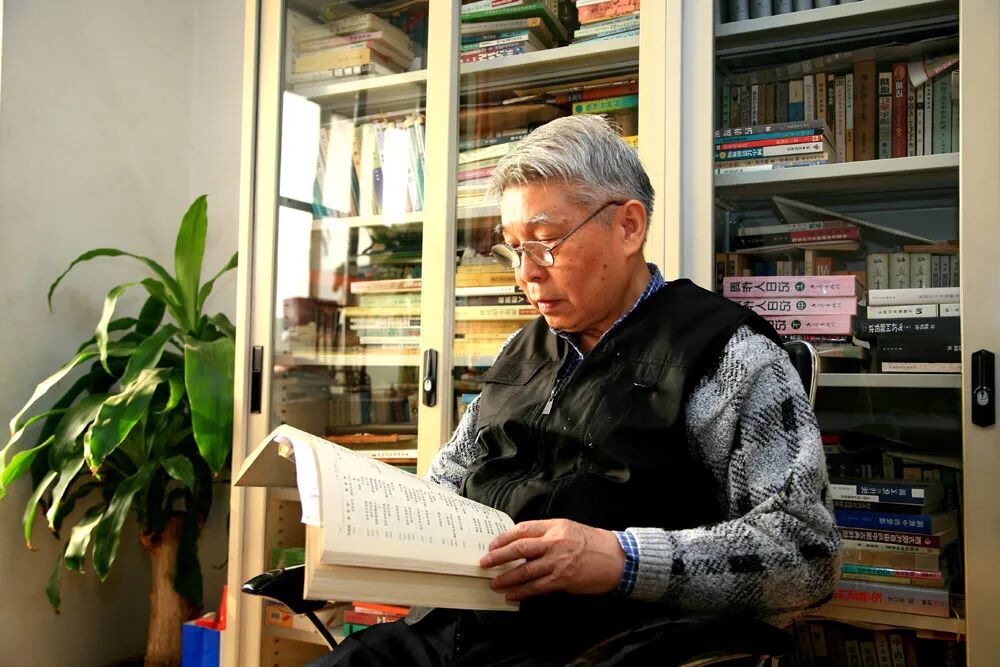
Mr. Geng Yunzhi
Among the three professors, Tang Degang is a Chinese-American scholar, a famous historian and biographer, and is well-known in domestic academic circles. Mr. Tang has long been engaged in the research, teaching and writing of Chinese history, Asian history, modern Western history, Western literary history and biography. He has taught at Columbia University and the City University of New York. Regarding the study of Hu Shi, Mr. Tang’s works are not many, but their influence is relatively large, mainly due to "The Oral Autobiography of Hu Shi" and "Miscellaneous Memories of Hu Shi". The former is a comprehensive translation by Mr. Tang based on the English manuscripts of sixteen formal recordings of Hu Shi's oral recollections published by the Department of Chinese Oral History at Columbia University in the United States and the residual manuscripts he has preserved and hand-edited by Hu Shi. The latter was caused by the former. Mr. Tang "before starting to translate Hu Shi's oral autobiography, he first wrote the introduction (preface). Unexpectedly, as soon as he wrote it, he made a mistake and wrote more than 100,000 words in a muddle. The result was a small book named "Miscellaneous Memories of Hu Shi"." (Hu Shi's Oral Autobiography, translated and annotated by Tang Degang, "Hu Shi's Oral Autobiography", East China Normal University Press, 1993) "Hu Shi's Oral Autobiography" and "Hu Shi's Miscellaneous Memories" have been popular in the literary and historical circles at home and abroad, and are considered to have high academic and historical value. In particular, one work "integrated description and explanation" and the other "formed a book based on the preface", which became a good talk for a while. Probably based on the value of the two works in literary history and the characteristics of the book, Mr. Hu Chengye also listed Mr. Tang Degang as a "pioneer in Hu Shi research".
As for Professor Li Youning among the three, he seems to be much less famous than Geng Yunzhi and Tang Degang. So, who is Professor Li Youning? Why does he study Hu Shi? What are his research results on Hu Shi? Can he be a "pioneer of Hu Shi research"?
According to public information, Li Youning was born in Nanjing. "I have a fate with Nanjing. She is the place where I first met the world. I am grateful to my parents for bringing me to this historic capital. The nickname comes from her old name, and I like the meaning of the word 'Ning': looking at each other day and night, and growing stronger over time." (Li Youning, editor-in-chief, "Hu Shi and His Students" Nanjing University Press, 2016) Li Youning's childhood was during the war-torn Anti-Japanese War era. After receiving primary school and junior high school education, 14-year-old Li Youning moved to Taiwan and studied at Taipei Municipal No. 1 Girls' High School. After graduating from high school, Li Youning was admitted to the Department of History at National Taiwan University. During his college years, he was influenced by famous scholars such as Tai Jinnong and Wu Xiangxiang. After that, Li Youning went to the United States for further study, received a doctorate in history from Columbia University, and taught at St. John's University in New York (English name: St. John's University), teaching courses such as "Chinese Women's History and Literature," "Modern Chinese Political and Cultural History," "Chinese Language Policy and Language Strategy," and "Ancient Chinese Literature."
Professor Li Youning has not much published information in the country, and his personal writings are also rare. I searched for information about her on the China National Knowledge Infrastructure (CNKI), and found that she has published only a handful of papers in China, mainly including "Introduction to Several Recently Discovered Letters of Sun Yat-sen and Soong Ching Ling", "Some English Materials About Song Jiashu I See", "The Revolution of 1911 and the Transformation of Women", "The Contribution of the Chinese Ethnic Group is an Important Driving Force in the Development of American History", "The Historical Mission and Contribution of Chinese Students Abroad", etc., which together only amount to more than 10 papers. It can be roughly seen from the content of the paper that Professor Li Youning focuses on modern Chinese history and the history of Chinese studying abroad. Professor Li Youning himself once said, "After I became an adult, I taught in the United States, but I regard Chinese culture and history as eternal treasures, which can always be compared with what I have seen, experienced, and heard in person." (Li Youning, editor-in-chief, "Hu Shi and His Students", Nanjing University Press, 2016)
Professor Li Youning likes to look at the big picture and start at the close, and calls himself “catching history in the making.” One of the goals of "searching" is "the national character and spirit of the encounter between ancient and modern times", that is, "how to survive in all directions with the tenacity of mountains and the good fortune of water, while never forgetting the opportunity to benefit the world at the same time." The achievements of Professor Li Youning's "capture" are very impressive. He has edited and published various series of books on the history of Chinese studying in the United States, including "Eighty Years of Studying in the United States", "Contemporary High School Students Studying in the United States", "History of Chinese Studying in the United States: 150 Years of Learning and Achievements", etc. She has edited a lot of books in both Chinese and English, including "Historical Materials on the Feminist Movement in Modern China", "Selected Poems of Modern Chinese Women's Self-narratives", "The Huamei Tribe and the 911 Catastrophe", "Collected Essays in Celebration of Professor Wu Xiangxiang's 90th Birthday", etc. She also has many English books, including "Chinese women through Chinese eyes", "The first emperor of China", "The Introduction of socialism into China", "Two self-portraits: Liang Chi-Chao and Hu Shih", etc. In addition, Professor Li Youning edits and publishes publications such as Chinese Americans in Science and Technology, New Flushing Journal, and Chinese Americans in Science and Technology, aiming to record the contributions of the Chinese Americans. When looking back on his academic career, Professor Li Youning said modestly: "I have not achieved much in the field of history. If I have made any contribution in my life, it is that I have discovered some problems and broadened my horizons. In the process of studying and questioning, consciously and unconsciously, I have confirmed that life and history can have some kind of interactivity and complementarity." (Luo Weinian, "Li Youning: Capturing History in Progress", "South Wind Window" Issue 9, 2016)
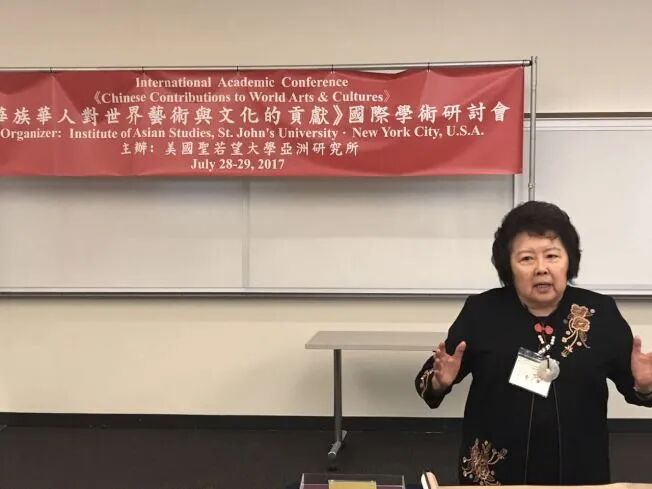
Professor Li Youning
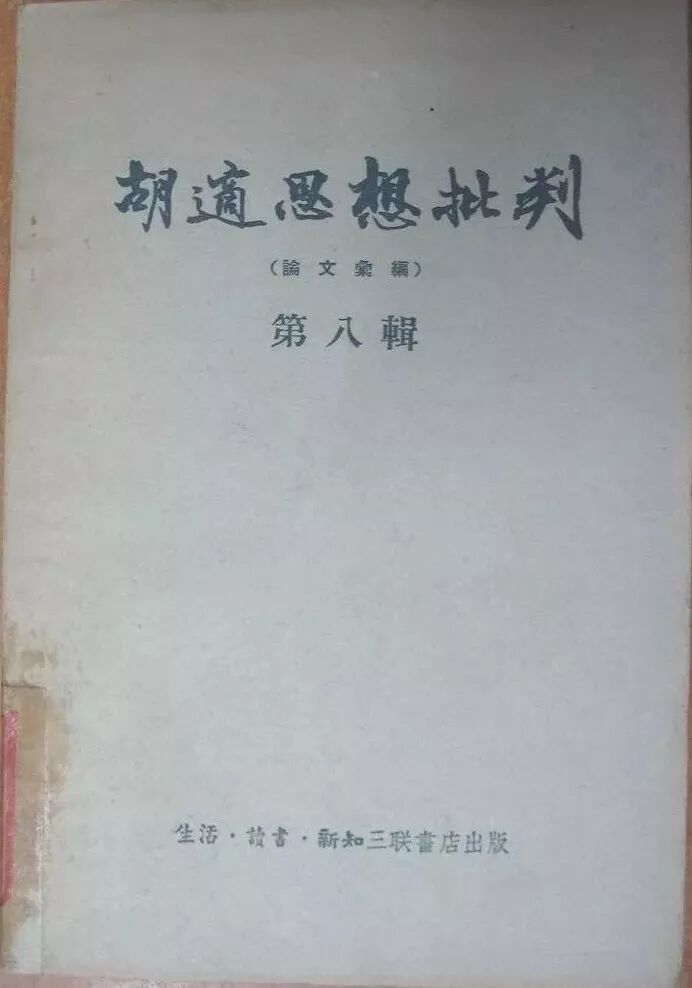
At this point in writing, we already know who Professor Li Youning is. But she seems to have no connection with Hu Shi's research. It's not that I'm avoiding the issue. In fact, compared to the research on the Huamei ethnic group, Professor Li Youning’s relationship with Hu Shi’s research is indeed not that close. Then why did she study Hu Shi? Professor Li Youning explained the reason: "I like to buy books and buy them everywhere. In the 1980s, I went to mainland China many times and visited bookstores everywhere, but I didn't buy much. In the spring and summer of 1989, I lived in Changchun Garden off-campus of Peking University for a few months to do some historical research. , I looked at several famous libraries. I found, but was not surprised, that the only monographs on Hu Shi were "criticism", and gradually the idea of a research project came up." (Li Youning, editor-in-chief, "Hu Shi and His Students", Nanjing University Press, 2016)
Obviously, what Professor Li Youning said is credible. In the 1950s, there was a comprehensive criticism movement across the country regarding Hu Shih. After Hu Shih was completely denied, for a long time, people talked about "Hu" in disgrace, or regarded him as a "villain" and "attacked" him. After the reform and opening up, a new wind blew in from the outside in the literary and historical circles, and Chinese intellectuals were relieved of their criticism. After removing ideological shackles and spiritual barriers, thinking became lively and energetic, Hu Shi's research gradually began. Due to various reasons, the process of Hu Shi's research was still difficult and slow. It was not until 1991, the centenary of Hu Shi's birth, that the first national Hu Shi academic symposium was held, and Hu Shi's research was "justified" at the national level. Professor Li Youning's "idea" in studying Hu Shi originated from this period. Considering that Hu Shih is inextricably linked to the United States, and there are many historical materials about him in the United States that can be collected in various ways, Professor Li Youning invited more than ten scholars and experts, such as Yu Yingshi, Zhang Pengyuan, Zhou Mingzhi, and Zhou Zhiping. On April 6, 1990, at the 42nd Annual Meeting of the Asia Society, the establishment of the "International Association for Hu Shih Research" (referred to as the "Hu Shih Research Association") was officially announced at the Hotel Palmer in Chicago. At that time, Mr. Yu Yingshi served as the president of this overseas Hu Shi Research Association, but Professor Li Youning was the chairman and chairman. Therefore, the first contribution to the establishment of the Overseas Hu Shi Research Society should be made by Professor Li Youning. As for the academic activities and academic impact that this overseas Hu Shi Research Society has had since its establishment, we will not discuss it due to limited information.
So, how did Professor Li Youning, who came up with the idea of studying Hu Shi's "ideas", study Hu Shi? Or, what is Professor Li Youning’s opinion regarding Hu Shi’s research? Professor Li Youning believes: "A person is a point in society and history, no matter how big or small, it is always a point. Influential people connect their own points with other people's points to form a line, and then the interweaving of the lines forms a surface, and the combination of surfaces can form a body. The relationship between points, lines, surfaces, and bodies can be invisible, such as feelings and thoughts; So it is tangible, such as societies and organizations. The intangible can become tangible, and the tangible can become intangible. The intangible and the tangible can coexist or disappear together." (Li Youning, editor-in-chief, "Hu Shi and His Students", Nanjing University Press, 2016) Professor Li Youning's words are not new today, and they are not very profound. Because Marx has long said that human nature is not an abstract object inherent in a single person. In its reality, it is the sum total of all social relations. The stipulation of "the totality of social relations" shows the objectivity, complexity and variability of people or social relations. When we talk about a person, it is impossible to isolate this person from reality. This person must exist in real, perceptible, developing and changing social relationships.
Therefore, studying Hu Shi, no matter what method or angle is used, is inseparable from the era and place where Hu Shi lived. After the two elements of time and space are determined, all relationships between individuals and others, individuals and groups, individuals and society, etc. are also included in a specific time and space. Probably based on this thinking, Professor Li Youning proposed a "new experiment in character research", that is, "Hu Shih and many of his contacts, including friends and enemies, are all influential figures, and the various relationships and various relationships between their points, lines, surfaces, and bodies are Evolution, intricacies, are all part of society, part of the times, and are interesting and meaningful historical topics, from which we can not only unearth a variety of personal historical materials, but also discover the diverse relationships between individuals and society, and between individuals and the times." (Li Youning, editor-in-chief, "Hu Shi and His Students", Nanjing University Press, 2016) It is still the same sentence. Today, Professor Li Youning's insights may not be novel or brilliant, but there is truth in it. After all, there are multiple "points", multiple "lines", multiple "faces" and multiple "bodies", which are more layered, more varied, more comprehensive and deeper. On the contrary, "If you study only one person and focus mostly on linear development, it will not be easy to see the various links around the person and the various cross-sections of the person's development process. It can also be said that it is not easy to see the small environment and the large environment around the person." (Li Youning, editor-in-chief, "Hu Shi and His Students", Nanjing University Press, 2016)
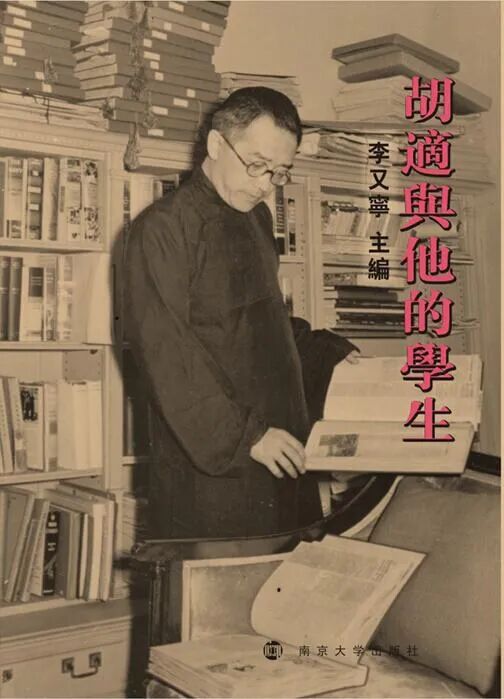
Li Youning, editor-in-chief, "Hu Shi and His Students", Nanjing University Press, 2016
History has proven that Professor Li Youning's "new experiment in character research" is successful. Since the end of 1990, Professor Li Youning has relied on the support of scholars and experts at home and abroad to launch a series of books on Hu Shih, including "Hu Shi and His Friends" (6 volumes), "Memories of Mr. Hu Shizhi's Collected Works" (2 volumes), "Hu Shi and His Family and Hometown" (1 volume), "Hu Shi and the Kuomintang" (1 volume), "Hu Shi and the Democrats" (1 volume), "Hu Shi and His Students" (2 volumes), etc. Most of these books are published by New York Tianwai Publishing House founded by Professor Li Youning himself, which is very rare in China. On the Confucius Used Books website, I once saw that a bookstore had a series of books on Hu Shi edited by Professor Li Youning. There were more than ten volumes. They were in good condition and sold for nearly 30,000 yuan. I could only sigh when I looked at the book. I thought that if one day it could be reprinted in China, I would definitely buy it and keep it.
It can be seen from the titles of the series of books that Professor Li Youning has indeed carried out her "new experiment", and the series of books basically reflects her editing ideas, academic attitude and stance. In the 1990s, if no one had done similar work, or if someone had done similar work, but it was far inferior, then Professor Li Youning was unique in the field of Hu Shi research. This is like Columbus discovering the New World. You cannot say, "When God created the world, he created that piece of land." Instead, you can say, "They thought of things we couldn't think of, and this is where they are better than us." Or, "They did what we didn't do, and this is where they are better than us." Combined with reality, Professor Li Youning's "new experiment" was indeed one step ahead at the time.
Let's take "Hu Shi and His Friends" as an example. The book contains many essays written by Zhang Pengyuan, Zhou Zhiping, Yang Tianshi, Wang Rongzu, Yi Zhuxian, etc. Most of them were selected at the moment. Scholar Lei Yi pointed out: "Perhaps because of the importance of 'friends' but previous historical research has ignored the 'friends' of the biography or genealogy author, Professor Li Youning of St. John's University in the United States edited "Hu Shi and His Friends" (published by New York Tianwai Press in 1900), which can be described as unique. It is quite appropriate to choose Hu Shi as the research object of this new approach." (Lei Yi, "A Useful New Attempt - Reading" "Hu Shi and His Friends" (Episode 1), "Modern History Research", Issue 1, 1992) The papers in this book respectively study the relationships between Hu Shi and Liang Qichao, Zhao Yuanren, Qian Xuantong, Chen Yinke, Chen Hengzhe, Wang Yunwu, Xu Zhimo, Ren Hongjun and others, and use these relationships as joint points to spread and discuss in depth their different political attitudes, academic views and complex emotional worlds deep in their hearts. The researcher compared Hu Shi with various of his friends one by one, which "not only overcomes the shortcomings of traditional historical research that places too much emphasis on the biography or the author of the biography and makes it difficult to look straight, look around, and look at the people and things around the biography or the author of the genealogy in detail, but also provides a broader social background and a richer 'image of all living beings.'" It can be seen that Lei Yi approved of Professor Li Youning's "new experiment".
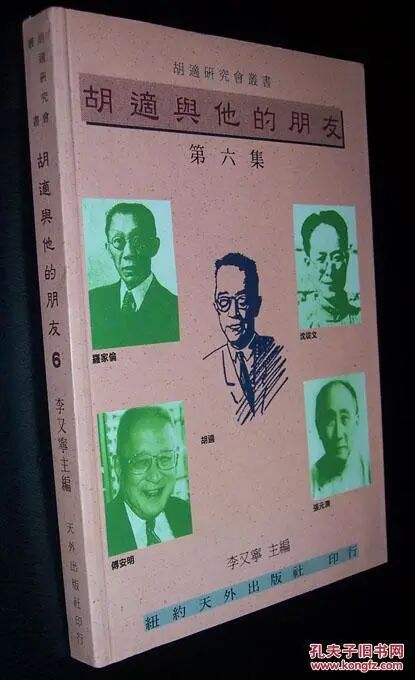
Similarly, some scholars pointed out that "the research method used in this book is to comparatively study the various relationships of historical figures. This is a change in the traditional historical research method"; "This book adopts a communication perspective. The author and friends interact on an equal basis. Comparing each other reveals the similarities and differences, and reproduces the original appearance of history. However, the book is dedicated to one person, lacks reference and comparison, cannot determine the true status of the author in history, and is prone to distortion and hallucinations." "This equal comparative research method has also brought about innovation in the style of historical treatises. This book is neither like a traditional biography, chronology, nor a special monograph. It is very novel, and more importantly, it has methodological significance. It opens up the horizons of comprehensive research and adjusts the researcher's perspective on the research object. This cannot but be said to be enlightening to historical research." etc. (Zhang Chonggui and Wan Zhichun, ""Historical research is a kind of commemoration" - Comment on "Hu Shi and His Friends", "Republic of China Archives", Issue 1, 1995) By analogy, in this series of books, Hu Shi and his students, hometown, family, and political groups, literary groups, educational groups, etc., all have relationships from one point to lines, surfaces and bodies, from one person to many people, multiple and multiple relationships.
As we all know, Hu Shih was the "social microcosm" of China in the 20th century. Although this "shadow" has been "shrunk", no matter how much it is "shrunk", it is still intricate and confusing, let alone comprehensive and detailed. However, it is undeniable that Professor Li Youning's "new experiment" has more or less made up for the shortcoming of "only seeing the trees but not the forest". In other words, it is precisely because of Professor Li Youning's "new experiment" that the "tree" of Hu Shi has a stronger three-dimensional sense, and the "forest" of society has become more visible. From this perspective, Professor Li Youning's contribution to Hu Shi's research is pioneering and extremely important.
As mentioned before, I have not had the opportunity to read the series of books on Hu Shi edited by Professor Li Youning. There is no sufficient "root" and "evidence" to discuss the research between Professor Li Youning and Hu Shi. Fortunately, I have learned about many authors in the series and their papers and writings about Hu Shi through various channels. For example, Mr. Zhang Pengyuan's "Hu Shi and Liang Qichao - The Affinity and Rejection of Two Generations of Intellectuals"; Mr. Yang Tianshi's "Qian Xuantong and Hu Shi"; Mr. Zhou Zhiping's "Hu Shi and Zhao Yuanren"; Mr. Yi Zhuxian's "Lifelong Friendship - Chen Hengzhe and Hu Shi", and "Hu Shi and His Students" edited by Professor Li Youning and published by Nanjing University Press, etc. Whether it is "Hu Shi and his friends", or "Hu Shi and his students", or "Hu Shi and his family and hometown", they are all perspectives from which we understand Hu Shi, and they are one of many possible perspectives.
Observing a problem from one perspective or multiple perspectives, the points, lines, surfaces, and bodies presented are ultimately partial and limited, and cannot be rich and complete, nor can they include everything. Mr. Ge Zhaoguang said that when people see things, the focus is highlighted and the background is blurred. However, there is no focus or background in the world. It is just that the viewer has a standpoint, a perspective, and a current interest. When I look back, I have focus and background, and the world in front of me becomes clear and blurry. (Ge Zhaoguang, "History of Chinese Thought", Fudan University Press, 2001) Focus and background are relative. The focus here and now may be the background then and there; and the background here and now may be the focus then and there. As the viewer's perspective changes, so does the focus and background. For example, in Mr. Geng Yunzhi's "Cai Yuanpei and Hu Shi", we can say that Hu Shi is the "focus" and Cai Yuanpei is the "background"; we can also say that Hu Shi is the "background" and Cai Yuanpei is the "focus", but we cannot say who sets off whom, or who obscures whom. It is precisely because of different perspectives that we can look up, look down, look flat, look around, look in detail, and look briefly. We have a more real, clear and accurate understanding of Hu Shi and the politics, academics, culture, education, publishing and other aspects of the era in which Hu Shi lived.
Some scholars have studied the ecosystem of Lu Xun research in the 1980s and 1990s, and pointed out that there are three major interpretive systems in the field of Lu Xun research, namely mainstream ideological, academic, and folk. The academic interpretive systems of Lu Xun that are more eye-catching include the intellectual history research system, spiritual psychology research system, cultural studies research system, comparative literature research system, textual research system, textual criticism research system, etc. (Wang Jiaping, "The Ecosystem of Lu Xun's Research in the 1980s and 1990s", "Journal of Capital Normal University·Social Science Edition", Issue 4, 2002) I think that if we follow the same pattern, there are many similarities and similarities between the research fields of Hu Shi and Lu Xun. However, the specific system in which Professor Li Youning's research on Hu Shi can be classified needs to be analyzed separately. However, what we can be sure of is that Professor Li Youning's research on Hu Shi focused on the "point" of Hu Shi, collected and sorted out the "lines", "faces" and "body" related to Hu Shi, and compiled them into more than ten volumes. It can be said that he devoted a lot of effort and great wisdom. This kind of research may not be conveniently classified under the name of a specific explanatory system, but the merits of collecting selected works will undoubtedly serve the present generation and benefit the future. The Hu Shi research series edited by Professor Li Youning collects the research results of many outstanding scholars from mainland China, Taiwan and overseas. The readability and historical value are beyond doubt, including "Hu Shi and his teacher Hu Xuanduo", "Hu Shi's patriarch Hu Jiefu", "Hu Shi and the first person of new punctuation - Wang Yuanfang" written by Mr. Hu Chengye, etc., which are also collected in the series of books "Hu Shi and his family and hometown".
Compared with Geng Yunzhi and Tang Degang, Professor Li Youning has almost no papers or books on Hu Shi's research. In fact, with her research accumulation in the fields of traditional Chinese culture, modern Chinese history, and the history of Chinese and American people studying abroad, it is easy to produce results and fruitful results in the study of Hu Shi. For example, Professor Li Youning once pointed out that the rise of new Chinese literature is closely related to overseas students. The reason why Hu Shi was able to put forward the concept of "literary revolution" while studying in the United States was "because he went through a process: from 'something' to 'nothing', and then created a new thing from 'nothing', that is, white Chinese vernacular literature and vernacular literature after the May Fourth Movement. If he had not studied in the United States for many years, he would not have an understanding of Western literature, and he would not be able to criticize traditional Chinese literature, and he would not be able to establish the theory of "literary revolution". If Hu Shi had not studied abroad for seven years, there would be no Hu Shi in history." Although this statement has some truth, it is a pity that Professor Li Youning did not explore it in depth. Similarly, why Hu Shih transferred from Cornell University to Columbia University, what kind of relationship Hu Shih had with Dewey and Schade, why Hu Shih could not seek a teaching position at Columbia University, etc., etc., Professor Li Youning has the advantages of time, location, people and so on. However, life is not complete and perfect. "Because of limited time, limited strength, and limited knowledge, what I can do is still limited." What Professor Li Youning said was both modest and true.
As for whether Professor Li Youning is the "pioneer of Hu Shi research", it is actually a matter of opinion. I didn’t have the opportunity to see Mr. Hu Chengye’s “Three Pioneers of Hu Shih Research Worth Admiring—Professors Tang Degang, Li Youning, and Geng Yunzhi”. But he must have his basis for listing Professor Li Youning as "the pioneer of Hu Shi research". Whether others are convinced or not is another matter. In short, regardless of whether Professor Li Youning is the "pioneer of Hu Shi's research" or not, I think that the labor she put in for Hu Shi's research and the results of her efforts will be recorded heavily in the "Hu Shi's research credit book".
October 30, 2020 in Luoxi, Huacheng
Related reading:
Can "Mr. Nice Guy" Hu Shi be considered a critical friend?
Hu Shi: I want you to be a dignified person, not my filial son (with related discussion)
A brief discussion on the style of research on historical figures—taking the research on Hu Shi and Feng Youlan as examples
A long journey ahead: A brief discussion on Mr. Geng Yunzhi and the study of Hu Shi
There will always be a day when you will love me: Selected articles related to Hu Shi
ScholarScholar
Machine-translated from the Chinese original 人物研究的新实验——关于李又宁教授可否为“胡适研究的开拓人”问题 (published 2020-11-16). WeChat original ↗