This morning I saw an old friend lamenting the difference between 2B and 2C sales:
At the same time, my old colleague and a 2B sales veteran wrote an article introducing his sales experience, "Tom's Things as a Salesman." It also talked about 2B sales methodology, from product sales to solution sales, to the transformation of challenger sales. I have also written in the past, see:
The difference between ordinary sales and awesome sales - Challenger sales model
Sales Management | History of Sales Method Development and 2B Sales Master Miller & Heiman
In the IT industry, major Internet companies that started from 2C have recently entered the 2B field, and 2B technology companies started by Internet technicians have entered this field with venture capital. Their user experience-centered marketing concepts have impacted traditional 2B sales management concepts.
So what is the difference between 2C sales and 2B sales? Most people think that the difference is that the contract value of 2B sales is high, the decision-making process is complex, demand satisfaction and delivery content are complex, etc.
I think these differences are superficial. For example, selling a yacht priced at 100 million yuan to a billionaire is considered 2B or 2C? For another example, if you sell a 2,000 yuan range hood to a street food stall owner, is it counted as 2B or 2C? Regardless of the contract value, the former is 2C and the latter is 2B.
We have to go back to the original meaning of the English words represented by the two English letters C and B. C is consumer, which means "consumption", which means consumption, "consume"The characteristic is the consumption of value input and no output of new value; B is Business, I think the more accurate words are "business" and "commerce", and the organization doing business is the enterprise (in the sales management language of foreign companies, large enterprise customers are called enterprise, and small and medium-sized enterprises are generally called generic business),"business"The characteristic is to output new value and create value-added through the consumption of value input.
When I implemented a sales management IT system for a leading Chinese construction machinery company, this company sold construction machinery such as excavators and loaders. The products had many models, complex configurations, and small batches. Channel dealers were under great inventory pressure and often had out-of-stock problems. I asked the sales general manager, can we implement a make-to-order sales model for our construction machinery? Provide sales options to customers, and based on their options, the factory produces to order, thus reducing channel inventory.
The sales general manager said that this method cannot be done. Customers bring cash to buy cars. If we can't pick up the car in the store, he goes to the store next door to buy it from other brands. This is because many of the customers who buy construction machinery are construction contractors, or leasing companies that provide equipment to contractors. They use money to buy machines because they have just received a construction project, and the progress of the project cannot be delayed for a day. If the machine is bought back one day earlier, it will make one day's more money earlier. They spend money to buy machines to make money, which is different from buying a car just for your own consumption. You can place an order according to your own personalized needs. It doesn't matter if you wait ten and a half days after placing the order. It doesn't matter if you drive a new car one day earlier or one day later.
This is the most essential difference between 2B and 2C sales:The value proposition of 2B purchases is the value creation brought about by using products or services, and the value proposition of 2C purchases is the experience of using products and services.。
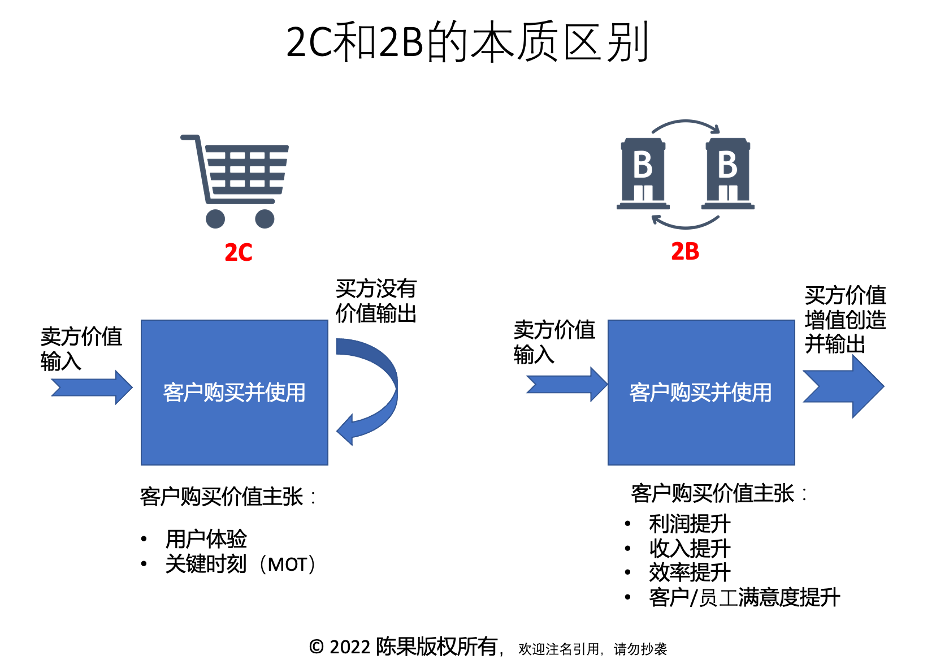
Therefore, 2B sales, and even the business design of the entire 2B company,Focus on how to present value to customers, deliver value and measure value, please note that the "value" mentioned here does not refer to the price paid by the customer to the seller, but the value created by the customer by using our products or services and providing products or services to its customers.new value;Such value measurement includes revenue improvement, profit improvement, efficiency improvement, satisfaction improvement, etc.
2C business has no value output. What measures the effectiveness of 2C business is user experience.”Moment of truth) is a key methodology for 2C sales and business design.
Companies with excellent 2B sales are using the philosophy of customer value management to improve sales methodologies, such as:
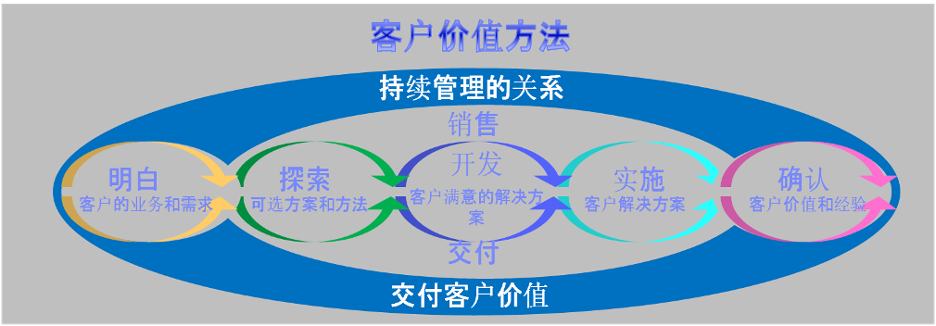
IBM's sales methodology is called the "Customer Value Method" (CVM), which is a 2B sales method that is more advanced than "solution selling", also known as "provocative selling". The former focuses on the details of solutions to customers' problems, while the latter focuses on the value creation of customers using the seller's products and services. This sales method can increase the contract amount, sales price, and shorten sales time:
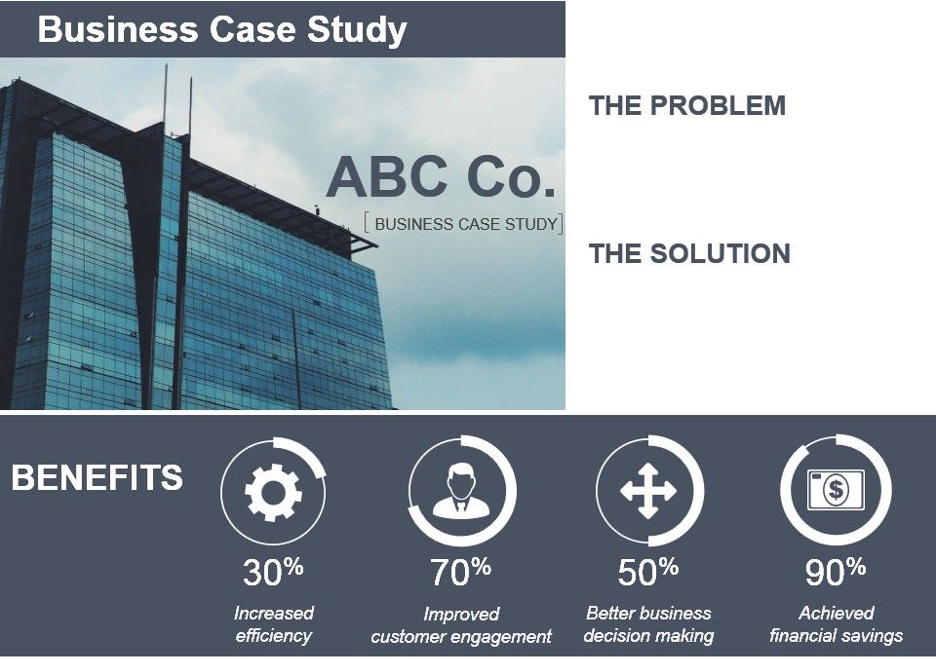
In the sales of high-value management consulting projects or high-value enterprise software, the key selling point is not the solution itself, but the focus on what problems are solved and what benefits it brings. For example, SAP's product pre-sales system is divided into two parts, one part is technical solution support, and the other part is called "value engineering", which focuses on the value measurement after customers use SAP products - business value must be emphasized in large bold fonts.
Machine-translated from the Chinese original 果总说管理哲学 | 2B销售和2C销售的差别究竟在哪里 (published 2022-07-02). WeChat original ↗