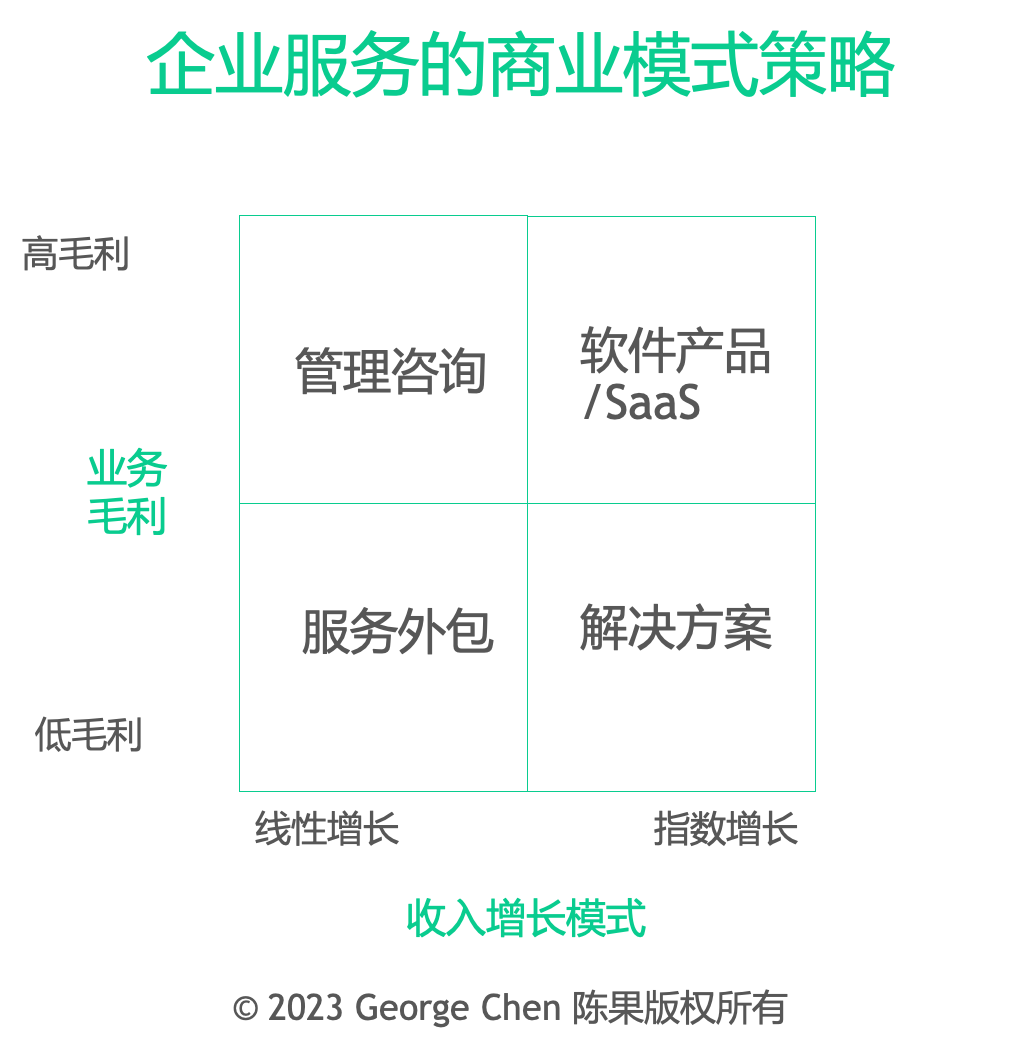
Yesterday I had tea with an entrepreneur in the enterprise service industry. I summarized a classification method for the business model of the enterprise service industry. From two dimensions, the business model of the enterprise service industry can be divided into four categories.

Dimension 1. Revenue growth model:
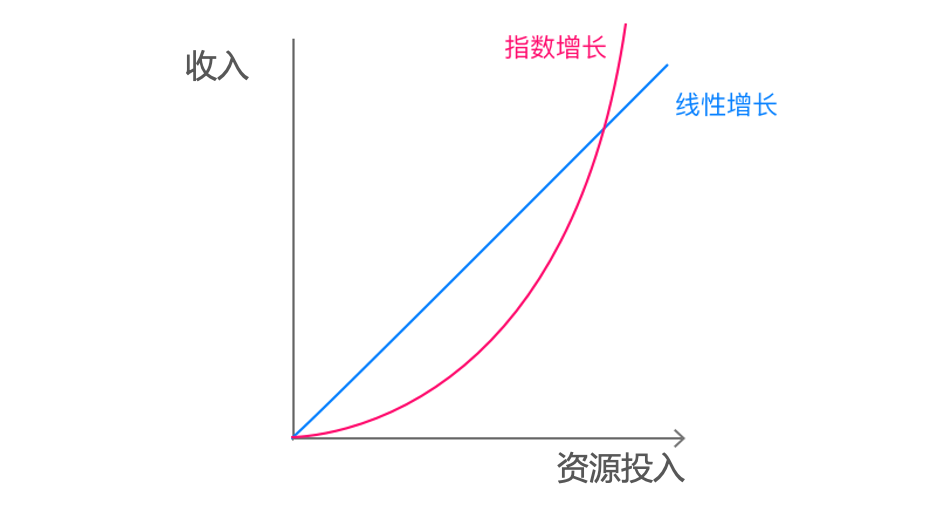
Is the relationship between resource investment (in addition to the direct cost of service delivery, including indirect resource investment such as R&D and marketing) and operating income growing linearly or exponentially: the former is "one point invested, one point harvested", while the latter is a large basic investment and low output, but when it reaches a certain input critical line or after a period of time, the revenue growth rate will exceed the growth rate of resource investment; or in other words, the marginal gross profit of linear growth is fixed, while the marginal gross profit of exponential growth is increasing:
Dimension 2. Business gross profit:
Gross profit is revenue minus direct costs. For the time being, businesses with a gross profit of 35 to 40% are considered high-margin businesses, and businesses below this level are low-margin businesses.
-
High gross profit/exponential growth:For software products/SaaS businesses, initial investment in R&D is large, and standardized products are used to solve customer business problems. As the number of customers and users increases, the share of customer groups for R&D and support services decreases, and marginal revenue increases rapidly. Manufacturers of such products or services have strong negotiation advantages and low substitutability, so they can continue to maintain high gross profits.
-
Low gross profit/exponential growth:Solution-based businesses, such as the development or implementation of industry solutions such as financial sharing and smart cars, use semi-standardized solutions combined with customized services to create customer value. This kind of business has certain product characteristics. As the maturity of the solution increases, the solution will be highly reusable and the marginal gross profit will increase; however, solution services are highly substitutable. For enterprises, the nature of their business is the outsourcing of complex services, so it is difficult to ensure a high gross profit level;
-
High gross profit/linear growth:Management consulting business is a service that is highly dependent on resources and highly customized. The correlation between operating income and the amount of resource input is linear. To this end, service providers use methods such as branding and resource scarcity to obtain high gross profits and establish competitive advantages based on value pricing rather than cost pricing.
-
Low gross profit/linear growth: Service outsourcing, including labor outsourcing based on headcount or business process outsourcing based on service matters, that is, based on standardized resources, providing standardized services, with low bargaining power and strong substitutability. Through scale expansion, it can reduce the sharing of marketing and management expenses and gain competitive advantages.
Some people think that the logic of capital is to make quick money, and investors are looking for a "high gross profit/exponential growth" business model. In fact, this kind of business is just financially easier for capital to understand. However, the above four models and the combination of multiple models can build core competitiveness in different ways in the market, and they are all good investment targets.
Related articles:
"China-Europe Business Review" article|The Chinese model of enterprise management software
SaaS drives the revolution in China’s enterprise software industry | Transformation to a user-value business model
Business Model | SaaS needs to evolve from enterprise software to digital open services
See through the business model of “Digital Transformation Consulting”
Business models for enterprise-level IT software and services
Machine-translated from the Chinese original 企业服务的商业模式选择 (published 2023-05-06). WeChat original ↗