Open Source Enterprise Knowledge (1) | The only way to save China’s enterprise service industry
Enterprise knowledge open source (2) | Good practices in knowledge generation
Open Source Enterprise Knowledge (3) | Knowledge Development for the Growth of Entrepreneurial Enterprises
Open Source Enterprise Knowledge (4) | China’s management consulting learns from the open source software industry
Practitioners in the enterprise service industry say that business is difficult to do, either because price competition is too fierce or because customers have low willingness to pay. However, companies receiving services complain that there are no solutions they want on the market, and the money spent does not meet their expectations.
What exactly is the problem? I wrote in "Management Philosophy | What is the Difference between 2B Sales and 2C Sales" that the essential difference between 2B business and 2C business is that 2C is pure consumption, while 2B is further value creation after the buyer purchases. Therefore, the value of the product/service is composed of the value obtained by both the seller and the buyer, rather than a unilateral game or a zero-sum game. The seller must create value that exceeds his own profit, and the buyer must have a clear perception of his own value.
The following figure shows the value acquisition and value creation model of 2B business:
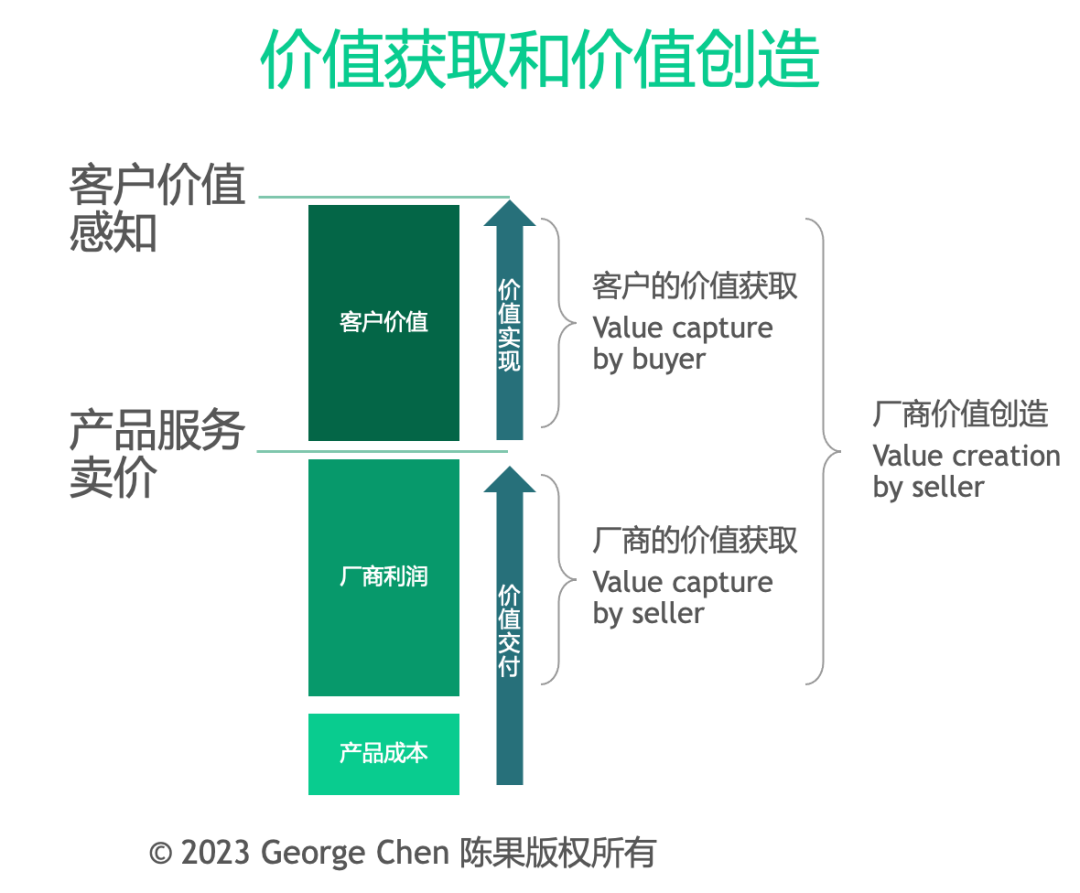
China's corporate services must avoid price involution. The biggest challenge currently is the value mechanism. Due to the lack of social standardized corporate operations and business knowledge, a large amount of value is dissipated in the process of value delivery and value realization of customer application products and services.
Enterprise knowledge (I hesitate to call business knowledge "enterprise knowledge" or "business knowledge") is divided into three levels from implicit to explicit:
- Concepts (cognition of basic knowledge objects)
- Framework (logical system formed by basic concepts)
- Practice (specific operations of the enterprise)
Why China's corporate service industry lags far behind Europe and the United States? Chinese companies do not lack opportunities to learn from the advanced practices of European and American companies, but managers and business owners lack basic conceptual understanding and do not understand the framework and apply it mechanically. A century of industrialization in European and American society has formed a consensus on basic concepts, so service manufacturers can focus value creation on practical applications.
How can this be changed to promote the formation of a healthy ecosystem in China's management consulting, enterprise software and outsourcing services, thereby achieving industrial upgrading? I think it must be:
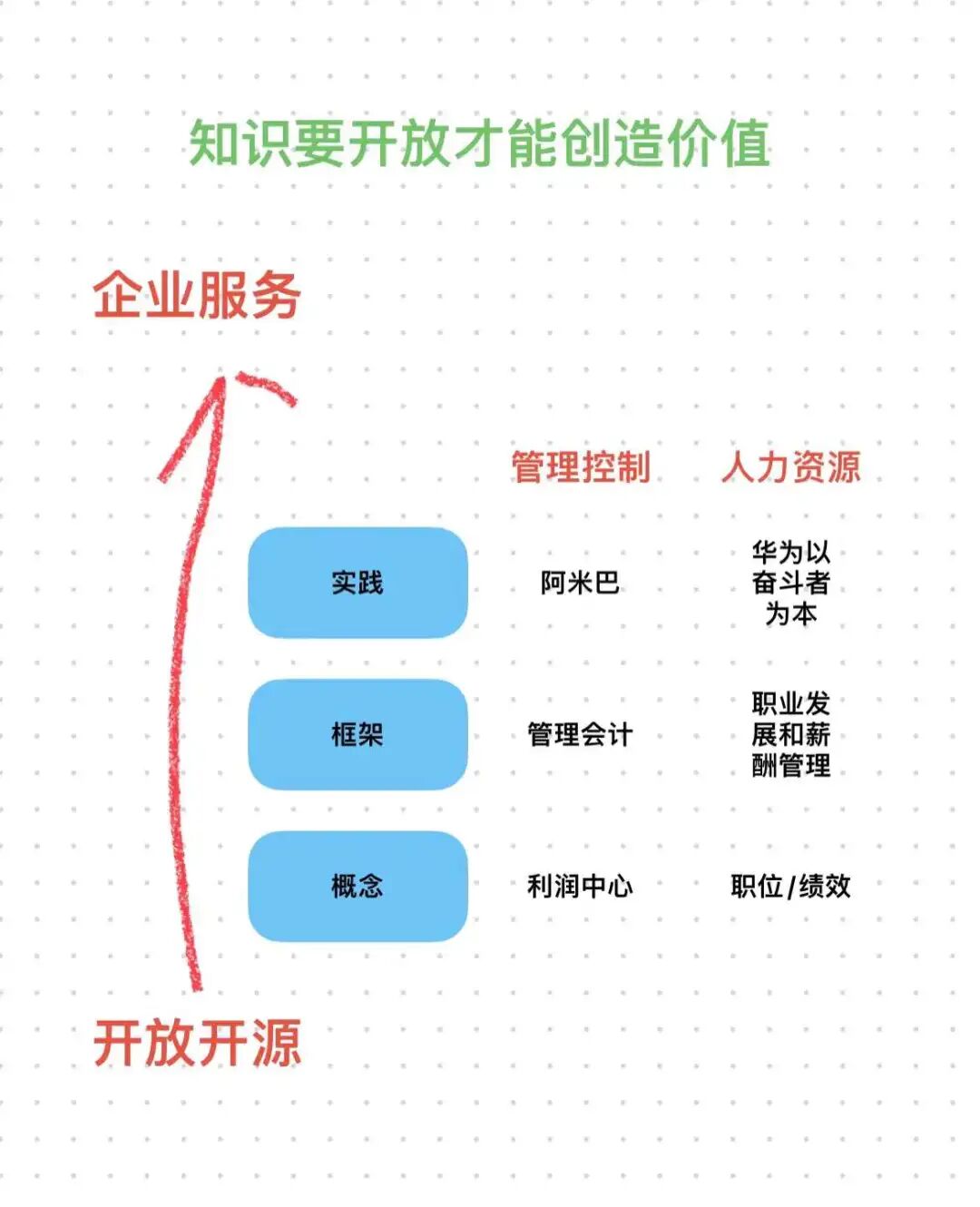
Achieve openness and open source at the lowest level of knowledge, that is, the conceptual level
At the framework level, various open source projects are used to promote social co-creation, dissemination and consensus.
At the practical level, through service companies with different value propositions, whether it is management consulting, education and training, enterprise software or SaaS, we provide low transaction costs and high customer value-added services based on an open source and consensus framework.
Only by promoting the social standardization of enterprise knowledge can we promote the joint reform of the demand side and supply side of the enterprise service industry.
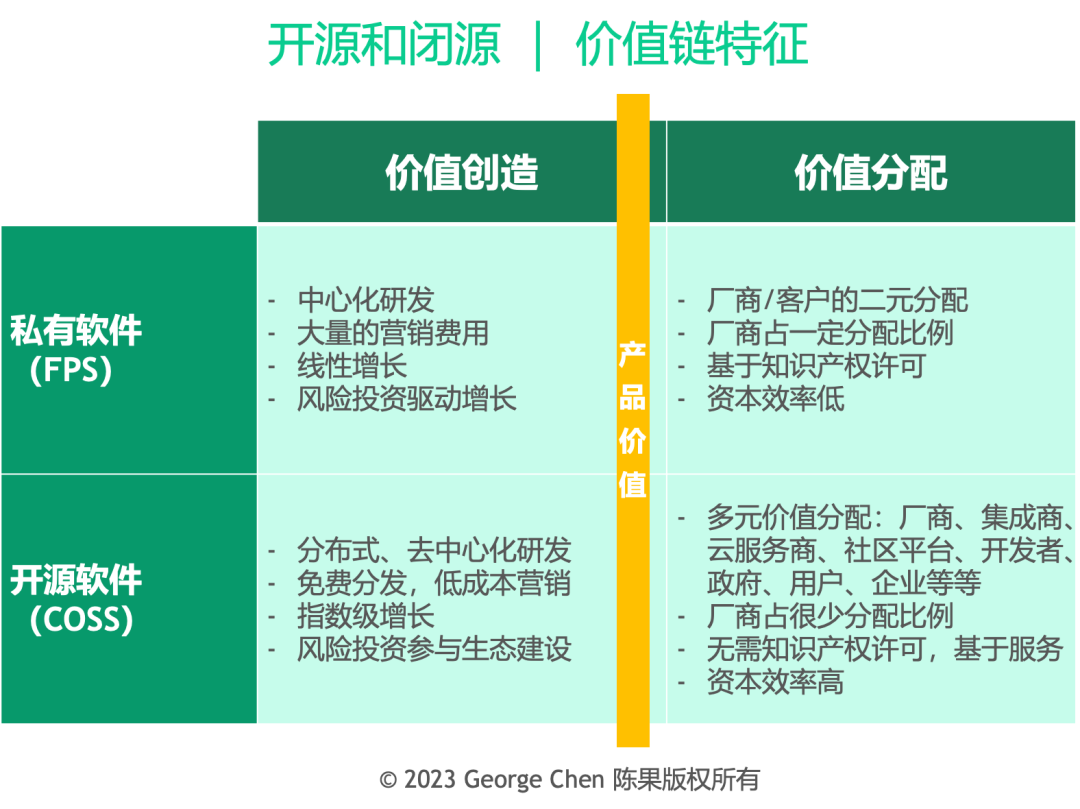
How did the Internet form? If the operating system was still Unix controlled by AT&T instead of open source Linux, if the browser was Microsoft's IE instead of open source Netscape, and if the application server was IBM's WebSphere instead of open source Apache, would there be an Internet industry? Will Internet technology evolve into contemporary enterprise IT technology? Will there be a rebirth of epoch-making companies like Amazon, Alibaba and Microsoft?
China's current corporate service industry has no mechanism to popularize the basic concepts of corporate knowledge. It can only use terms such as "amoeba" to create information gaps to earn money. In order for China's enterprise service industry to develop and grow, someone needs to do what the IT industry did thirty years ago, such as Richard Stallman and Linus Torvalds, who did not make money but used love to generate electricity.
How the information technology industry was formed in Europe and the United States in the 1970s and 1980s: Because of the industrialization foundation of the previous hundred years, informatization existed. The organizational model and decision-making methods of the industrialization era created requirements for information management. China's social development has an unavoidable obstacle: the weak cultural foundation of industrialization! The development of localized information technology must meet the needs of the whole society for information management. Only when Chinese society gets rid of the small-peasant consciousness and has modern organizations and modern management can it have modern information technology. China's information technology independence is not only a matter of chips and operating systems, but also a matter of social transformation.
For example, the digital product management solution I have been promoting in China’s clothing retail industry for many years has not been effective. The business model of Western clothing chain retail is "positional warfare", that is, centralized mechandising, so it has high requirements for product information analysis: category structure, price strategy, profit ratio, store grouping characteristics, etc.; while the Chinese clothing chain retail model is "guerrilla warfare", which embodies the thinking of small-scale farmers in the pre-industrial era: the profit and loss of each store is contracted to the store manager, and the store manager decides what to buy in each store based on feeling and experience. Of course, there is no need for complex information analysis. This is what I have always said: "Chinese companies value production relations, while Western companies value productivity."
Huawei seems to be becoming China's IBM hegemony in the information industry in the 1970s and 1980s. However, Huawei alone is not enough. China needs China's SAP, ORACLE, DEC, HP, EDS, Arthur Andersen and Microsoft in the 1970s and 1980s!
Promoting industry value creation is the problem that enterprise knowledge open source should solve.

Machine-translated from the Chinese original 企业知识开源(五)| 企业服务行业的价值创造 (published 2023-09-18). WeChat original ↗