As a university teacher, I am often asked or heard questions such as "Which university is the best university in China?"
Faced with such questions, I often don't know how to answer them. If I want to be honest, my ideal university is an open Internet university. As for universities with campuses, there seems to be no fundamental difference between one university and another. Although different schools have different campus sizes, number of teachers and students, funding, equipment, grades, and rankings, there are even T2, T4, H5, C9, 985, 211, and double first-class schools in society. Of course, in terms of admission scores, the universities with the highest admission scores in most provinces in recent decades are probably no more than Tsinghua University, Peking University, Fudan University, and Shanghai Jiao Tong University. Most of their graduates can objectively find more affordable places to go. You can often see statements such as "Qingbei University resumes diplomatic relations" online.
Perhaps for this reason, if most middle school graduates can get admission notices from any of these four schools, their whole families will be overjoyed and excited. It is understandable whether you are secretly happy, delighted, surprised, or ecstatic, even wearing red flowers, riding a big horse, thanking your neighbors, and paying homage to your ancestors. I myself am not exempt from vulgarity.
However, to put it calmly, even these four universities that claim to have entered or will enter the "world-class" category are not essentially different from other schools based on personal observation and understanding. The distance to a "world-class" school may be very close, but the distance to a real university may be far away. Don’t talk about anything else, let’s just talk about the four admission notices I saw recently.
1. Admission notice from Tsinghua University
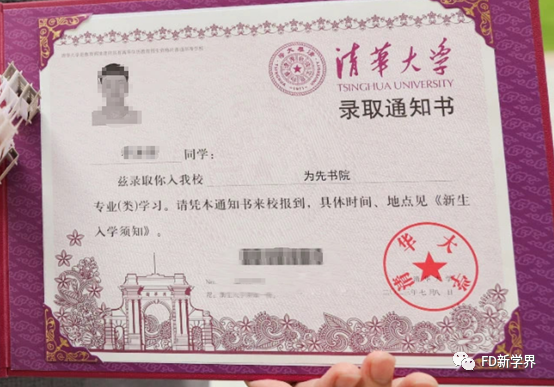
This admission notice is concise and concise, with complete elements. Matters regarding the start of school are independent of the "Admission Instructions for New Students" and is basically qualified. However, it is signed only with the school's name and without the principal's signature, which is somewhat inappropriate from today's perspective. Although the "admission notice" is a document, in the final analysis it is a written communication between people. The school is just an inanimate institution or organization and should not be the subject of signing the notice. The name of the legal representative, the principal, should be additionally signed. Although the principal cannot personally deliver the diplomas to the students one by one, he should respectfully place them on paper so that their names are present. It is also inappropriate for the principal's name to be on the other side of the notice. This is responsibility, testimony, and tenderness.
2. Admission notice from Peking University
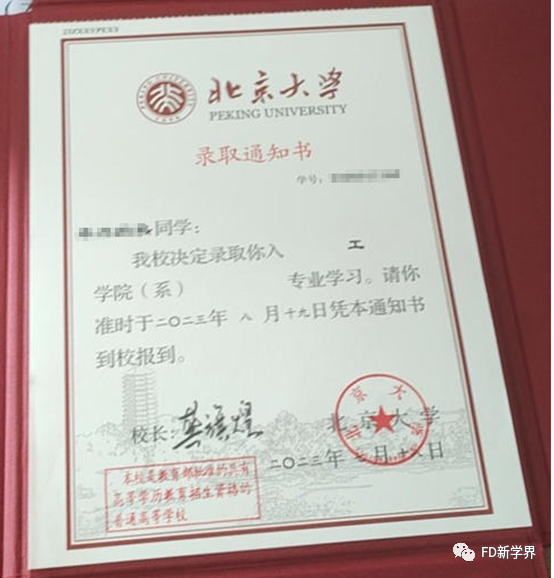
The name of the president can be seen on this admission notice. However, if we want to pay more attention to it, it seems that its position should be better to the right of the name of Peking University, which means "President of Peking University". The notice included the admitted college, major, registration time and other elements, but the core content of the notice, "Our school has decided to admit you..." was a bit skewed. The focus is on "I" rather than "you"; the emphasis is on "decision" rather than on the result of the "decision", that is, being "admitted." Rather than saying it is an "admission notice", it is better to say that this is an "admission decision notice", or "admission decision letter".
3. Admission notice from Fudan University
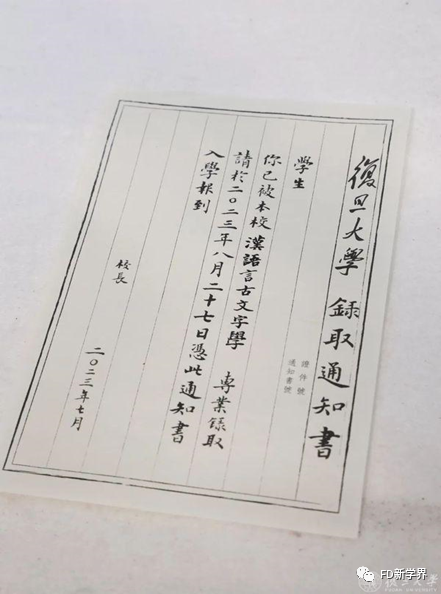
This is a vintage traditional traditional vertical notification that reads from right to left. The addition of "notification number" in addition to the "document number" is a labor of love, which enhances the solemnity and preciousness of the notification. I don’t know what the “certificate number” refers to. If it refers to the “student ID number” assigned to the student, there seems to be no reason to replace the “student ID number” with it. It is also inappropriate to call the “student ID number” by the “certificate number”.
The biggest problem with this notice is that the address is not "classmate so-and-so" but "student so-and-so". The intention is to make it more elegant and match the traditional vertical format. In graduation certificates from the Republic of China and even today, the usage of "student so-and-so" can also be seen. However, the difference between "student XXX" and "classmate XXX" is very different. Both words are nouns, and "student" refers to the identity of a teenager who is in the learning stage as opposed to "teacher"; some identity nouns can be used as titles, such as "teacher", "doctor", and "nurse". "Student" can also be used as a title, but it is generally limited to modest self-identification; using other names strengthens the mutual stance and hierarchy, appears cold and stiff, and loses the kindness and warmth that students should have. The graduation certificate is a certificate for the society. It can be described objectively as "student so-and-so". The notice is addressed to the student himself, and of course it should be commensurate with the more cordial and warm "student so-and-so".
4. Admission notice from Shanghai Jiao Tong University
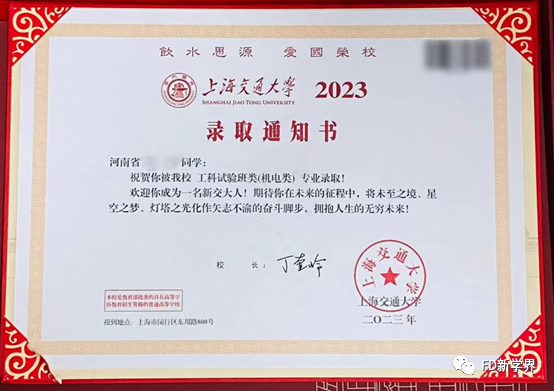
This notice also has the principal's name at the front and the school name at the back, which can be adjusted. In addition, there are three issues with this notice. First, the regional noun "province" was deliberately added before "classmate so-and-so", which may cause unnecessary associations and may be deleted; secondly, the main body of the notice has two paragraphs, the first paragraph is "Congratulations..." and the second paragraph is a message of "Welcome...Look forward to...". In this way, the notice becomes a "congratulatory letter." Of course, congratulations and expectations can be expressed in the notice, but it should be done so as not to overwhelm the guest. Congratulations, welcome, and expectations can be expressed after the formal content of the notice; thirdly, the time stamp on the notice is "2023". How careless is this to sign a huge time mark? Could it be that this notice took a year to write or notify?
Some time ago, an admission notice from a university in Anhui Province was published online. The registration date was written as "September 6" instead of "September 6", causing an uproar on the Internet. Everyone lamented, do you dare to accept such an admission notice? Do you dare to go to such a university? Now that you see the admission notices from these four so-called TOP4 universities in northern Qing Dynasty, do you dare to accept them? Do you dare to go up again?
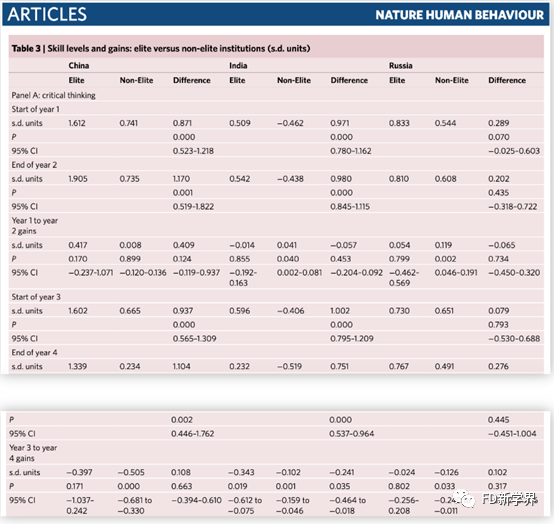
I often think that China has many good students, but there may not be many good schools and teachers to train them. A test called Supertest, co-sponsored by Stanford, Peking University, Tsinghua and Indian universities, shows that after four years of university study, Chinese students' critical thinking and learning abilities "have declined significantly", "whether they are elite universities or ordinary universities." I wonder if we can see some clues from these four admission notices? A takeaway report I saw recently shows that the number of customers saying "thank you" to takeaway guys is very small. I wonder if these customers include college students. If so, is this related to current university education and this notice?
About the author
Mo Luohan, whose real name is Luo Shuhua, whose family name is Mo Hongxuan, and whose signature is Modu Luohan, is a professor at Fudan University and the main writer of the "FD New Academic World" public account. Main teaching and research directions: Dream of Red Mansions, famous works and civilization, academic research theories and methods, Chinese traditional culture. His books include "Two Phoenixes Protecting the Pearl: The Structure and Narration of the Dream of Red Mansions", "A Close Reading of the Red Mansions", "Mainstreams of Chinese Fiction", "The Study of Chinese Narrative", "History of Chinese Prose", "Chinese Writing Tutorial", etc. In the field of "Dream of Red Mansions", the theories of "Two Phoenixes Protecting Pearls" and "Chai Dai competing for marriage" were proposed. In the field of culture, "Don't do to others what others don't want you to do to them; don't do to me what you don't want to do to me" is the golden rule of Chinese culture.
Message description
The FD New Academic Circle advocates and follows the dialogue guidelines of "discussing issues without sidestepping; presenting facts and being reasonable; following laws and regulations with good intentions; transcending positions and staying far away from motives; tolerating dissent and not focusing on the individual." This is called the "Nine Laws of Dialogue in the New Academic Circle". All messages and comments will be posted without distinction between positions and opinions, with the exception of rumors and lies that are clearly inconsistent with facts and laws, and remarks that call for violence, hatred and personal insults. If your messages and comments are not among the "exceptions" and are not released, it is not because of this account, but because they are controlled by the WeChat public account platform, or the comment limit for this article has been reached. We would like to inform everyone, thank you for your support and participation.
Machine-translated from the Chinese original 清北复交寄来录取通知书,你敢要么? (published 2023-09-18). WeChat original ↗