
The leading one-stop scientific resource sharing platform at home and abroad
Since its establishment, the platform has cooperated with many colleagues from higher scientific research institutes to create well-known academic platforms at home and abroad (includingKou Xiang conference affairs, Kou Xiang bookstore, live video broadcast, quality courses, special lectures, academic conferencesetc.), providing a new academic exchange platform for scientific researchers.
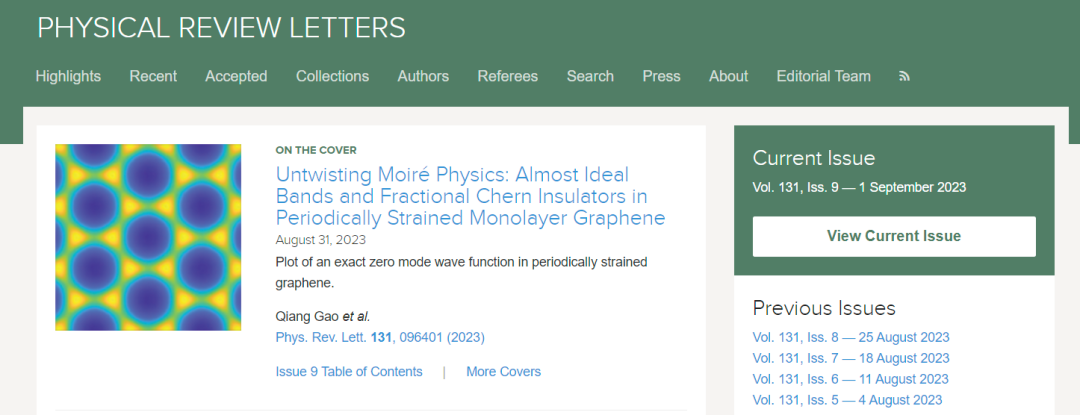
Recently, the condensed matter theory team of the University of Texas at Austin and the Harvard University team published a paper in "Physical Review Letters" (Physical Review Letters) published online the cover article entitled "Untwisting Moire Physics: Almost Ideal Bands and Fractional Chern Insulators in Periodically Strained Monolayer Graphene",It reveals the possibility of realizing strongly correlated electronic states in a single-layer graphene system without relying on rotational degrees of freedom and without applying an external magnetic field. The article conducts energy band analysis on single-layer graphene with periodic buckling and finds that the energy band near the Fermi surface has non-trivial topology and also exhibits an ideal quantum geometry similar to the Lowest Landau Level (LLL). Under the control of the external electric field, the system separates non-trivial flat bands to achieve strongly correlated electronic states such as the quantum anomalous Hall effect (integer filling) and fractional Chern insulator (fractional filling).
Since the realization of "magic angle" graphene, the condensed matter physics community has paid more and more attention to flat-band systems with non-trivial topologies: when the interaction is much larger than the bandwidth, various strong correlation phenomena will dominate low-energy physics. Long before corner graphene was theoretically proposed, the most classic flat band in condensed matter systems was the Landau level generated by an external magnetic field. Even magic-angle graphene, at the chiral limit, has a flat band that maps perfectly to the lowest Landau energy level produced by Dirac electrons under a non-uniform magnetic field. It can be seen that realizing Landau-like energy levels is still one of the keys to finding topological nontrivial flat bands. One possible way to achieve Landau-like energy levels is through strain engineering. For two-dimensional Dirac electrons, the deformation of the lattice usually enters the Hamiltonian in the form of a gauge field to produce a so-called pseudo-magnetic field. Appropriate lattice deformation can produce pseudo-Landau levels for electrons without destroying time reversal symmetry: for example, the two energy valleys of graphene will feel opposite pseudomagnetic fields. However, the lattice deformation required to achieve pseudolandau energy levels generally grows quadratically with space, limiting its real realization possibilities.


This time, the article proposes that under the influence of periodic deformation (wrinkling), single-layer graphene can still achieve physics similar to the lowest Landau energy level. For one of the energy valleys (K), the pseudomagnetic field generated by the deformation is shown on the left side of Figure 1. Due to the protection of chiral symmetry, the energy band structure of the system (right in Figure 1) still retains the Dirac point, and the total Chern number of the two energy bands near the Fermi surface is 1. Projecting the zero-energy state of the doubly degenerate Dirac point onto the sublattice basis, it can be found that the wave function on one of the sublattice has a non-trivial real space structure (left in Figure 2). From this, a series of single-electron trial wavefunctions can be constructed corresponding to the lowest Landau energy level under a non-uniform magnetic field. There is only an exponentially small deviation between these experimental wave functions and the real wave function. Therefore, within an exponentially small controllable error, the energy band of the system has an ideal quantum geometry similar to the lowest Landau energy level. It can be numerically verified that the quantum geometry of the energy band is indeed close to ideal (right side of Figure 2), that is, there is very little trace condition violation. The article further points out that by applying an external electric field, the chiral symmetry can be destroyed and the energy gap can be opened to separate a flat band with non-trivial topology (Figure 3): This energy band has an exponentially small bandwidth. The independent flat band (right in Figure 3) with non-zero Chern number and ideal quantum geometry is an ideal platform to realize fractional Chern insulating states. Numerical analysis shows (Figure 4), considering four flat bands including spin and valley degrees of freedom, the system exhibits the quantum anomalous Hall effect () or spin/valley polarization state () when integer filling (), and presents a fractional Chern insulator state when fractional filling ().

The article also discusses experimental systems that may realize the predicted strongly correlated electronic states. The periodic folds of single-layer graphene are usually substrate-dependent. To achieve the periodic pseudomagnetic field shown on the left side of Figure 1, the substrate needs to destroy the twofold rotational symmetry () such as hBN, WSe2, etc. to a great extent. At the same time, the substrate needs to be insulated to facilitate the control of the filling factor to achieve different strongly correlated electronic states.
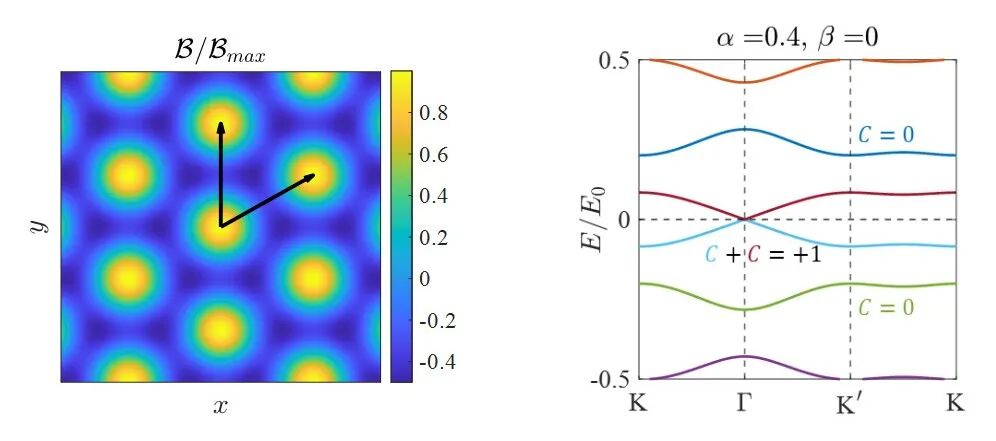
Figure 1: (left) Pseudo-magnetic field induced by periodic strain. (right) The band structure of the buckled graphene near the graphene K point
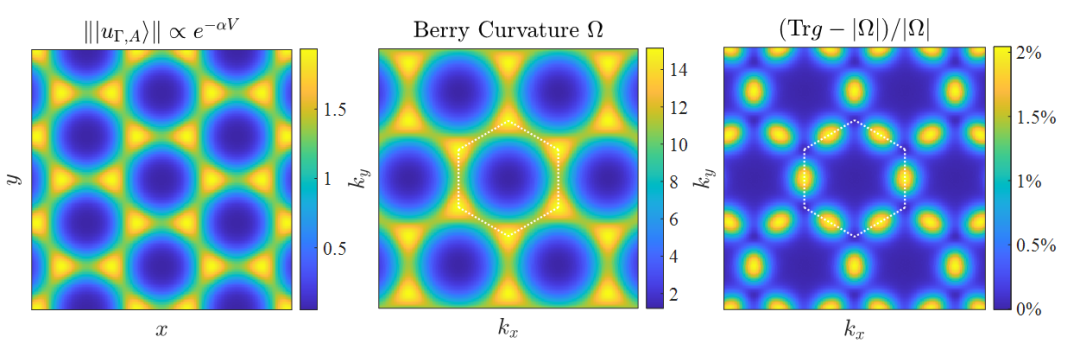
Figure 2: (left) Sublattice polarized wavefunction of the zero mode. (middle) Berry curvature distribution of the nontrivial band. (right) The trace condition violation.
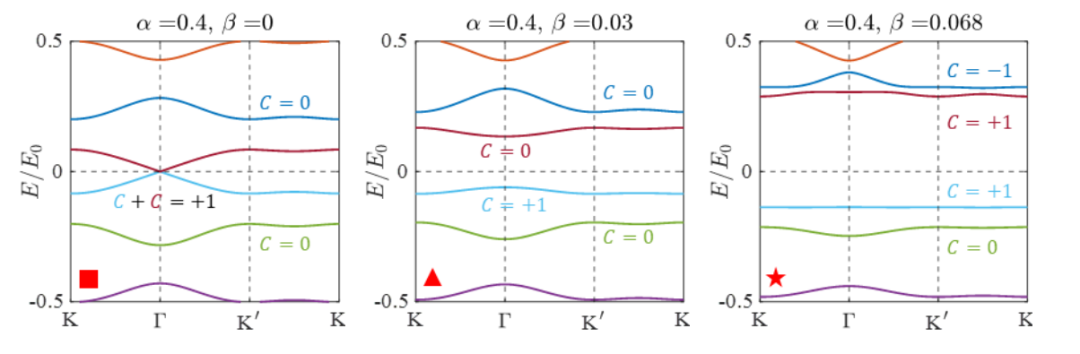
Figure 3: From left to right: band structures after gradually applying external displacement field. is a dimensionless parameter characterizing the displacement field strength.
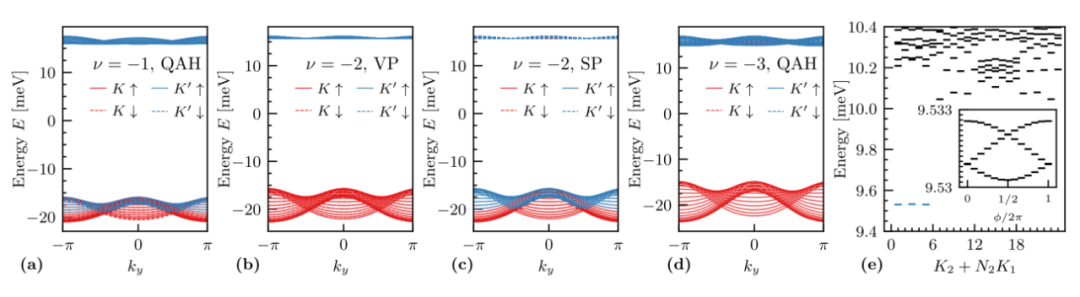
Figure 4: (a-d) Hartree-Fock spectra of the strongly correlated insulator at various integer fillings. (e) ED spectrum at .


Conference official website


To serve academics and spread science, the Kouxiang academic team launches scientists’ own professional bookstore - Kouxiang Bookstore

Shuyuan official website
Jump to related links for more details:
[alias alias alias] Kouxiang Bookstore is officially launched
[Kouxiang Bookstore] Nobel Prize-winning "Flowers Fall" Quantum Information, "How Much Do You Know" About Quantum? | Quantum Science Recommended Book List
[Kouxiang Bookstore] New Book Recommendations | A must-read list for entering the field of life sciences--Life Science Masterpiece Series
[Kouxiang Bookstore] New Book Recommendations | China’s 2035 Development Strategy Series for Academic Subjects and Frontier Fields
[Kouxiang Bookstore] Recommended new books on shelves
[Kouxiang Bookstore] Recommended books from the Ministry of Science and Technology’s National Excellent Popular Science Works and China’s Excellent Popular Science Books List
[Kouxiang Bookstore] Recommendations for first-class planning textbooks
Brilliant/Colorful/Review/Review
[PRL] NTU Li Shaochun’s research group observed a strong electron correlation effect in the VTe₂ monolayer
[PRL] Chongqing University has made important progress in the research of topological superconductivity of new cage lattice materials
[NC+PRL] USTC has made a series of progress in the research of new cage lattice materials
PRL: Professor Yao Yugui’s team from Beijing Institute of Technology discovered the in-plane anomalous Hall effect in antiferromagnetic materials
PRL: a universal mirror stacking scheme for constructing topologically bound states in the continuum
PRL: Molecular collapsed states in graphene/WSe₂ heterojunction quantum dots

Koxiang Academic Platform Introduction
Koxiang Academic Platform, the leading one-stop scientific resource sharing platform in China, relies on the scientific research strength of first-class scientific research institutes, universities and enterprises at home and abroad, focuses on cutting-edge science, and aims to optimize the scientific research and innovation environment, disseminate and serve science, and promote cross-disciplinary integration to create a shared data platform for high-quality academic resources.

Machine-translated from the Chinese original 【PRL】理论预言周期性形变使得单层石墨烯能带具有近乎理想的量子几何进而实现分数陈绝缘体 (published 2023-09-18). WeChat original ↗