
Today I signed an agreement with the publisher to deliver a bookbusiness process managementbook. Although I have written nearly a million words on public accounts over the years, this is the first time I have published a book, so I very much hope that readers of public accounts can give you some feedback on the following issues on the topic of "Business Process Management":
- What do you consider a "business process"?
- What problems does "Business Process Management" solve for enterprises?
- Do you have any unanswered questions about the topic of "Business Process Management"?
- What new and interesting content do you hope to see in Mr. Guo’s book?
Recently, I am launching the "Enterprise Knowledge Open Source" project, with the aim of establishing a standardized core of Chinese enterprise knowledge. In decades of management consulting practice, I deeply feel that in China, there is a lack of social consensus on common terms and basic concepts of enterprise management, resulting in low efficiency of management communication and confusion in enterprise services such as management consulting and enterprise solution software. Among them, "business process" and "business process management" are a typical example. After the enterprise knowledge open source platform is launched, I will create and host the knowledge topic "Business Process Management".
"Business process" frequently appears in the mouths of Chinese business managers. Companies in the market often say they want to "do business process consulting." If you ask him what problems this kind of consulting is to solve? He might say that the problem is to solve the problem of no business processes - to comprehensively sort out the processes and improve the level of corporate management. It is best to install an IT system to implement these business processes. I feel like someone asks a doctor to prescribe painkillers. When you ask him what disease he is treating, he says, "I just feel pain all over my body, so I take painkillers, and the pain goes away!".
The word business process is a management term passed over from Europe and the United States. I have written in "Guo Zong Management Review | The Rise and Fall History of Business Process Reengineering (BPR) (Part 1)" and "Guo Zong Management Review | The Rise and Fall History of Business Process Reengineering (BPR) (Part 2)". There are various concept schools. Although the noun is called "business process", in the context of different concept schools, there are certain conceptual differences, such as:
- The "Business Process Reengineering (BPR)" theory that flourished in the United States in the 1990s but quickly declined is a concept of organizational change;
-The American "Business Process Improvement (BPI)" originated from Toyota Management in Japan and developed in the United States in the 21st century, also known as Lean Management. In this context, the English word "process" is often translated as "process", which causes a lot of confusion in Chinese materials, but it is actually the same word;
- The "Business Process Engineering" (BPE) theory, that is, the ARIS model, originated in Germany in the early 1990s and has strong manufacturing characteristics. It has become the originator of "Business Process Management (BPM)" software and can be called the "German BPM" school;
- American enterprise software companies have produced a series of "Business Process Management (BPM)" software after the 21st century. However, its ideas, terminology and methods are somewhat different from those of "German BPM", so let's call it "American BPM". For example, American BPM does not emphasize process hierarchical modeling;
- Some large American companies launched several cross-enterprise process benchmarking organizations in the first decade of the 21st century. The more influential ones are APQC, SCOR, etc. The process classification they mentioned is quite different from the "German BPM" process classification in terms of ideas and methods;
The term "business process" was introduced into the Chinese management community at the beginning of the 21st century, influenced by the BPR and ERP craze at that time. However, this word has been spread in the Chinese management community for more than 20 years, and has greatly diverged from the original meaning of BPR - many people's understanding of "business process" can be said to be derived from the Chinese word "process". "Liu" represents circulation and "cheng" represents procedure. They believe that process is the approval of corporate matters. Some people believe that business process is the standardized operating system of the enterprise. These perceptions are fundamentally different from the concept of "business process" in Europe and the United States, and are tentatively called "Chinese business process".
In China's management consulting industry, "business process combing" and "business process management system" are very popular services (see "The Chaos of Business Process Management Consulting"). Interestingly, today in the European and American management consulting industry, it is rare to hear of a special consulting category or consulting product of "business process consulting". Generally, "process combing" is used in "operation management consulting (lean management)". The occasional "business process system" consulting projects are all carried out by super large companies carrying out ERP When it comes to planning for system implementation, it is rare to hear that medium-sized companies have five-level or six-level processes.
Chinese companies place great emphasis on using information systems to implement business processes. ERP entered China twenty years ago. To this day, many people think that the ERP system is a business process management system. They think that by using ERP they can see what their business processes look like and how they are running. This is a big misunderstanding.
Although ERP is indeed closely related to business processes, there is no business process in ERP itself (large ERPs have some workflow functions, but they are rarely used in domestic implementation projects), just like there is no wife in the wife cake. ERP is an online transaction processing (OLTP) system that saves business object (such as customers, orders, materials) information and transaction records related to business processes, but does not record process information.
Information systems related to business process management and operation are generally called BPM systems. They began to appear at the beginning of the 21st century and are information systems with different dimensions from ERP. Today, traditional BPM systems combine big data, artificial intelligence, RPA software robots, API integration and other functions, and are called enterprise automation (automation) or hyper-automation (hyper-automation):
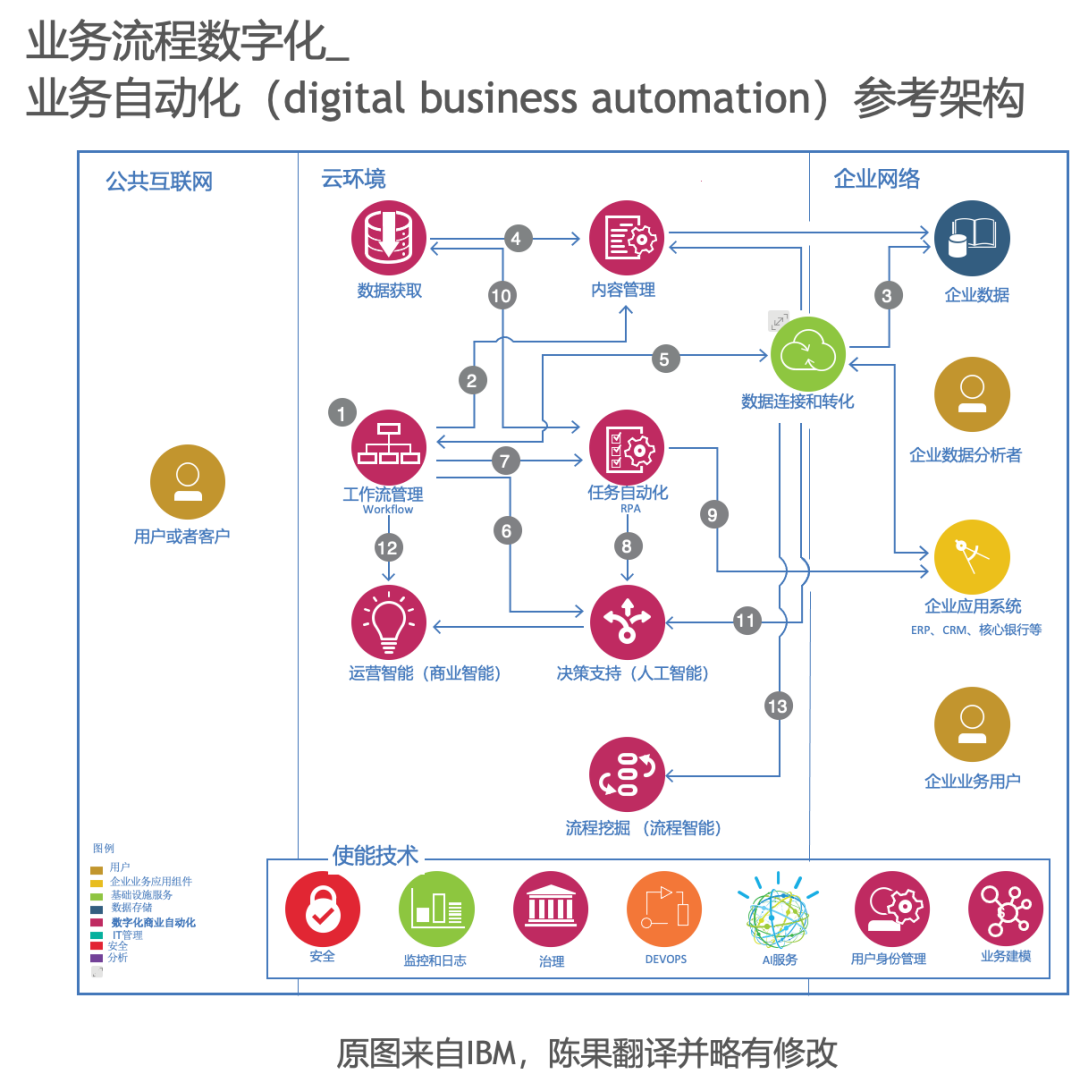
Around 2010, China's business process management craze reached its peak. At that time, many large state-owned enterprises used the ARIS process management platform. However, according to my observation today, such platforms are basically abandoned and cannot be used. There are also some companies on the market today that are building "process management platforms", which are actually just electronic document management of business processes. They are not very rigorous in terms of process meta-models, reference models, life cycle management, and process execution of core business system integration. Regarding the topic of "business process", there are many conceptual inconsistencies and misunderstandings in the Chinese management community. Therefore, I feel it is necessary to write a book to help everyone clarify the origin of the basic concepts and comment on the current situation and development direction of business process management in Chinese enterprises.
The editor of the publishing house who helped me publish the book researched the works related to process management in the domestic book market. There are not many influential works, and most of them were published relatively early. Some of the business process books with good sales are written by grassroots or marketing trainers who have no working experience in multinational companies with a real business process management environment. They interpret the process as a company system, and "management means running the process", which is very misleading to readers.
The content I plan to write in this book includes:
1. Analysis of the basic concepts of business processes
2. Look at business processes from the perspective of operational excellence
3. Look at business processes from the perspective of organizational management
4. Look at business processes from the perspective of information technology
5. Prospects for the future development of business process management
6. Business process management practices of large international enterprises
7. Suggestions on business process management for Chinese enterprises
I very much hope that all readers of the official account can give me some feedback on the topic of "Business Process Management" in the message box below (you can also send me a message on the official account) to help me improve the quality of my writing:
- What do you consider a "business process"?
- What problems does "Business Process Management" solve for enterprises?
- Do you have any unanswered questions about the topic of "Business Process Management"?
- What new and interesting content do you hope to see in Mr. Guo’s book?
Thank you!
Machine-translated from the Chinese original 【请帮忙】我要写本业务流程管理的书,希望得到你的输入 (published 2023-09-22). WeChat original ↗